
If a video collects a million views, is it a viral ad? Many advertisers treat that number as proof. It isn't. A large view count can come entirely from a media buy that never leaves the people you paid to reach. A smaller film can travel farther when each person who sees it hands it to someone else. The gap is between exposure you purchase and exposure people create. Virality is a distribution mechanism, not a format and not a scoreboard. You can raise the odds. You cannot book the result the way you book inventory.
Table of Contents
- What a Viral Ad Is and How It Differs from Paid Reach
- How Sharing Turns One Ad into Many Views
- Creative Traits That Make an Ad Spread
- How to Measure Whether an Ad Actually Went Viral
- Limits and Misconceptions of Viral Advertising
- Test a Viral Ad Idea Before You Spend
What a Viral Ad Is and How It Differs from Paid Reach
A viral ad is branded content that spreads mainly because people choose to pass it on, not because the advertiser keeps buying placements. The mechanism is earned amplification. Viewers find the message entertaining, useful, surprising, or emotionally sharp enough to send it onward. Paid reach puts the ad in front of a planned audience. Sharing builds a chain the media plan never bought.
What the definition actually requires
Every working definition needs three elements, and each one fails in a familiar way.
Branded or product-related communication. The piece is about an offer, a product, or a company, even when the logo stays quiet. A bakery film about a ruined wedding cake still counts if the shop is the subject. A funny clip with no brand in it is entertainment, not an ad.
Voluntary redistribution. The next viewer arrives because a person sent it, not because a second invoice bought that impression. A text that says "watch this" is distribution. A boosted post is not.
Reach past the original purchase. The audience grows beyond the people the first placement bought. If each viewer pulls in more viewers, a small buy can outrun a large one that nobody forwards.
Picture a stone dropped in a pond. The paid placement is the splash. Each share is a ripple moving into water you never paid to touch. When you buy that splash on Facebook or Instagram, a Meta Ads connection still only reaches the first ring. Sharing has to do the rest.
A friend's word weighs more than a placement the viewer can tell is paid. Nielsen's 2015 Global Trust in Advertising study found that 83% of respondents across 60 countries trusted recommendations from friends and family, while 66% trusted consumer opinions posted online. In that same study, 83% said they acted on recommendations from friends and family at least some of the time, compared with 58% for search ads and 56% for social-network ads. Sharing adds impressions and often adds credibility a media buy cannot attach.
The feelings that push someone to hit send look like this.
Three kinds of brand content compared
| Content type | How reach grows | Cost to add reach | Credibility signal |
|---|---|---|---|
| Paid ad with high impressions | Only as the media budget grows | Rises with every extra impression | Low to moderate; viewers know it is paid |
| Organic brand post | Followers and platform distribution | Low, but reach is capped by the existing audience | Moderate; depends on the brand's current audience |
| Viral ad | Voluntary sharing extends the distribution chain | Mostly absorbed by sharers once the content is out | High when shared by friends or trusted people |
Where the model came from
The pattern is older than short video. Hotmail launched commercially on July 4, 1996, and appended an invitation to every outgoing email, so each new user became a distributor to their own contacts. A history of campaigns that shaped the internet reports growth from about 20,000 users to 1 million in the first year, then 86 million active users and about 30% of the email market by 2001. Hotmail was a service, not a video ad. The asset was a loop that turned exposure into new audience. Shareable video, memes, referral incentives, and interactive experiences use that same loop.
Practical rule: If shares are not expanding the audience past the people you paid to reach, you have a well-funded ad, not a viral one.
Marketers check shares, reposts, earned impressions, referral traffic, and the ratio of secondary exposure to the original paid exposure. Views alone do not settle it. Nothing about the outcome is guaranteed.
How Sharing Turns One Ad into Many Views
A viral ad, in the technical sense, is sponsored content whose distribution expands through unpaid peer-to-peer sharing on interactive platforms. Each viewer is a possible next distributor, so reach can grow faster than the media spend instead of staying proportional to it.
Say a paid cut reaches 10,000 qualified viewers. Two percent forward it, and each of those people shows it to a few friends. Those friends can forward it again. The second ring did not come from a larger invoice. It came from social transmission. Stop the forwarding and the campaign shrinks back to whatever the budget bought that day. Keep the forwarding and the same budget keeps recruiting people the targeting never named.
What makes someone pass it on
Research on two large video datasets, one with 800 videos and daily sharing records, found that physiological arousal was the primary driver of video sharing, while emotional valence had a smaller effect. High-arousal feelings such as awe, excitement, amusement, anger, and anxiety can increase sharing. Low-arousal sadness tends to suppress it.
That split catches a common mix-up. A sad story and an angry story can both feel "emotional." Only the aroused one tends to move. A quiet, gloomy ending often dies in the feed even when viewers rate it as moving. Test variants for arousal, a turn the viewer did not expect, and a subject the audience already cares about. Total views will not tell you which cut people handed on.
When a bigger audience persuades less
Size is not the same as force. The same line of research found that average ad persuasiveness declined by about 10% for every additional million views, and that the decline disappeared when views came with comments. Passive exposure at huge scale can water down the argument. Active replies are a stronger quality signal than another million silent plays.
A million quiet views can weaken the pitch. A smaller audience that argues, laughs, and replies often holds it.
Track one rate across the whole run: shares divided by qualified views. Compare that rate as the audience widens. If it collapses once you leave the first tight group, the early spike was a paid splash, not a chain. If it holds, you have a distribution mechanism worth feeding, not just a popular file.
Creative Traits That Make an Ad Spread
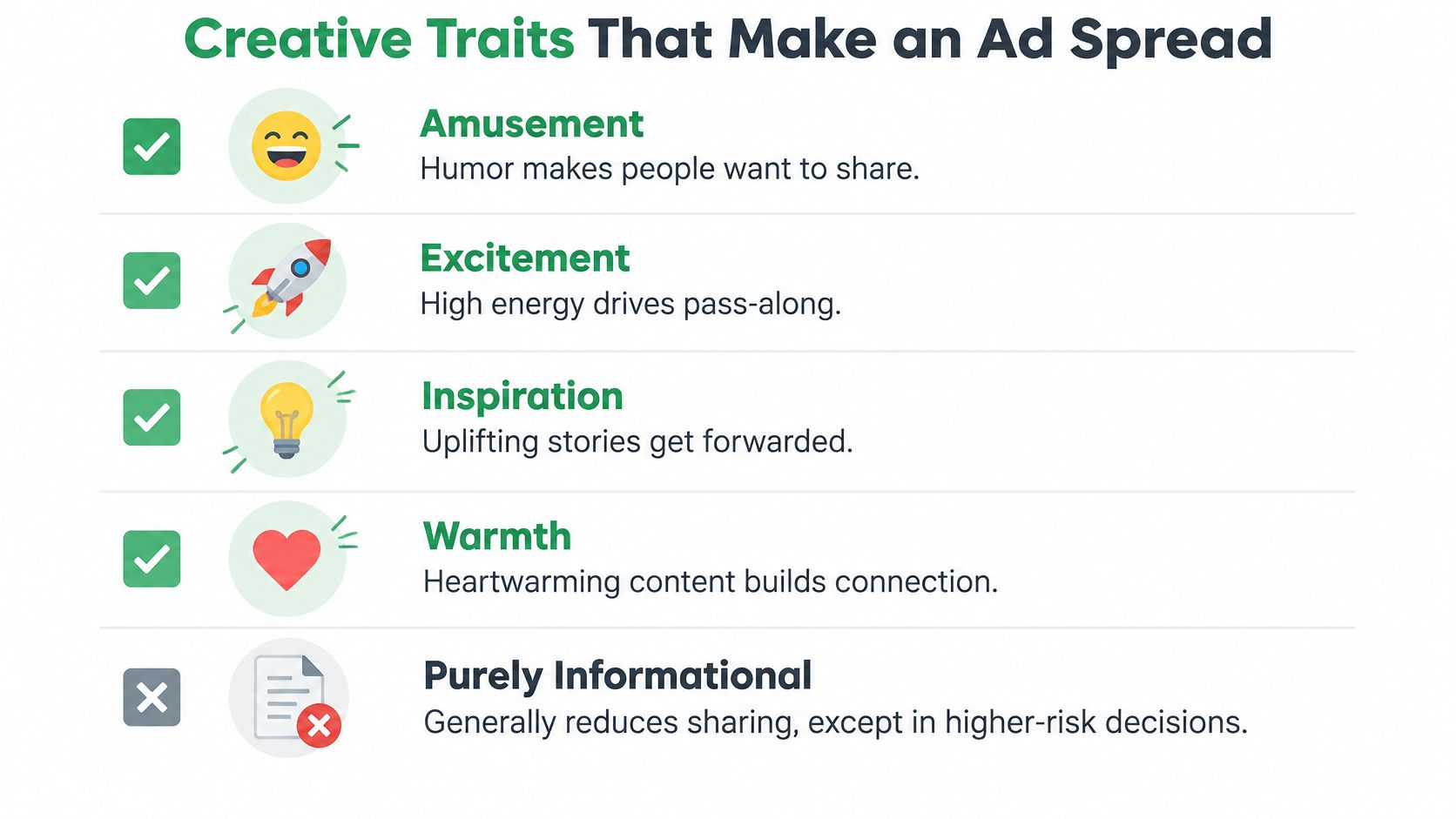
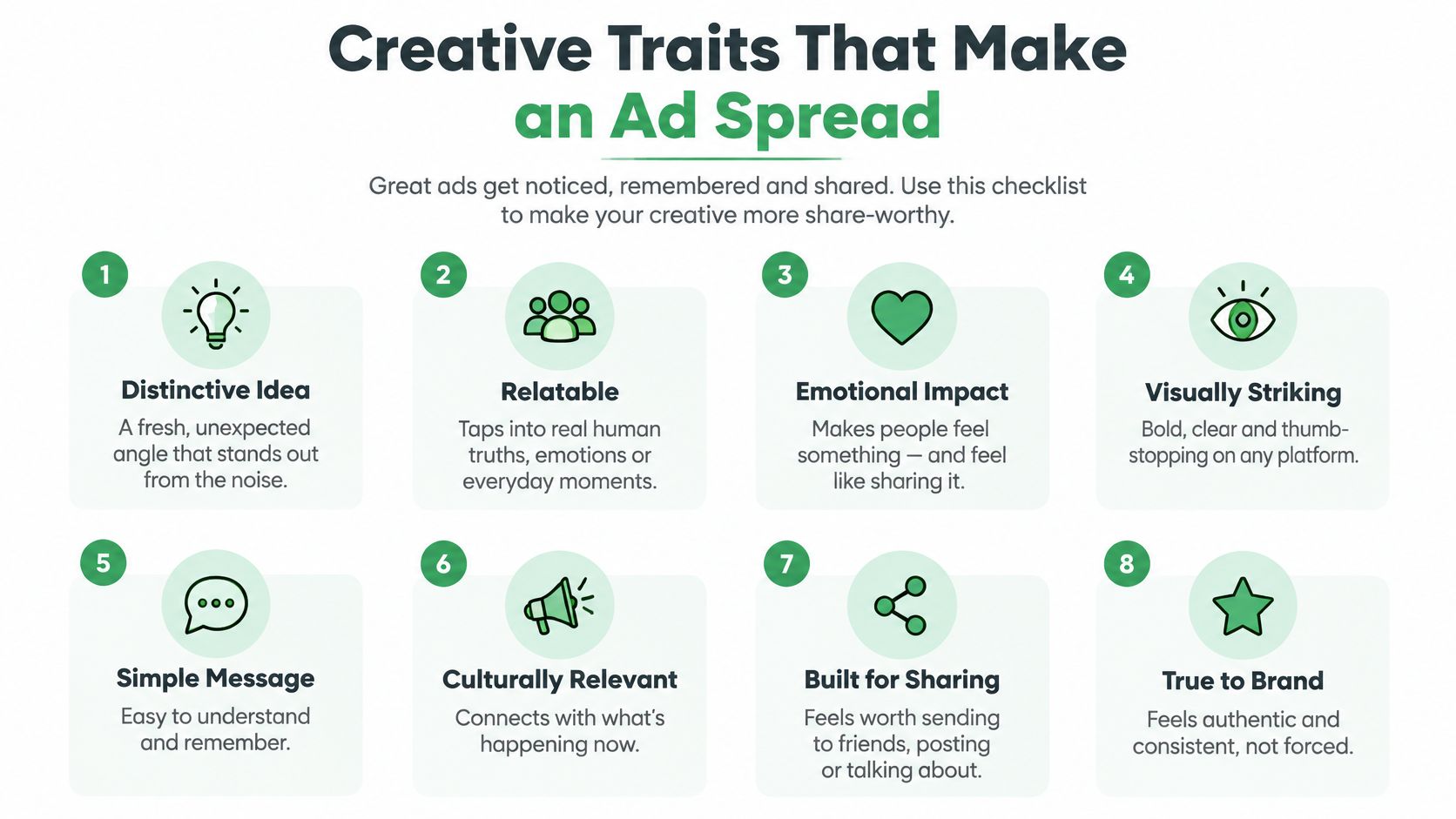
Creative structure changes the odds more than another round of targeting. A multi-platform study of 11 emotions and more than 60 ad characteristics found that amusement, excitement, inspiration, and warmth increased sharing. Purely information-focused content generally reduced it, except in higher-risk decision contexts. Lead with a feeling the viewer can finish in one sitting. Park the spec sheet for people who already leaned in.
Length and the brand name
Sharing was highest for moderate-length videos of about 1.2 to 1.7 minutes. A cut that never builds a payoff gives people nothing to forward. A cut that keeps going after the payoff asks them to sponsor your runtime with their friends' attention. Both lose.
The same research found that a conspicuous brand name, especially early, late, or pulsing on repeat, hurt sharing. Viewers will pass a story. They hesitate to pass a logo interrupt. Build the brand into the payoff. The product can be the punchline, the rescue, or the object everyone is reacting to. It should not be a title card that stops the feeling.
Platform changes the brief. Emotional creative performed better on broad social platforms. Informational appeals were relatively more suitable for LinkedIn, where the audience is often mid-decision and will forward a specific proof point to a colleague.
If you need a faster way to try those lengths and openings, you can make viral videos with templates and then judge them on shares, not on how polished the first frame looks.
Creative traits and their effect on sharing
| Creative trait | Effect on sharing | Practical guideline |
|---|---|---|
| Amusement, excitement, inspiration or warmth | Increases sharing | Lead with the emotional payoff in the first seconds |
| Purely informational content | Reduces sharing, except in higher-risk decisions | Move product facts to the retargeting step |
| Video length of about 1.2 to 1.7 minutes | Highest sharing in the study | Cut any scene that does not build toward the payoff |
| Brand name shown early, late or repeatedly | Reduces sharing | Weave the brand into the payoff instead of interrupting it |
| Broad social platforms | Emotional creative performs better | Use emotional creative for social feeds |
| Informational appeals perform relatively better | Use specific, credible proof points |
Split the viral asset from the conversion asset
The film people forward and the ad that asks for the sale are different jobs.
- Open on a self-contained payoff. A viewer who never sees a follow-up should still feel the joke, the jolt, or the warmth.
- Keep branding inside the story. Measure share rate and completion rate separately on each platform.
- Retarget people who watched or shared with clearer product facts and a direct call to action.
Before you export, run a short pass on the draft.
- Payoff: Does the feeling land before the viewer has a reason to leave?
- Length: Is the cut inside that 1.2 to 1.7 minute band, or is every extra scene earning its place?
- Brand: Could a stranger forward this without feeling like they sent an ad?
- Next step: Is the hard sell waiting in retargeting, not jammed into the shareable cut?
How to Measure Whether an Ad Actually Went Viral
Views do not prove virality. A view can be bought, autoplayed, or replayed by the same person. What you need is evidence that people created reach you did not purchase.
Metrics for judging whether an ad went viral
| Metric | Calculation or source | What it reveals | Main caveat |
|---|---|---|---|
| Sharing rate | Shares divided by qualified views | Whether viewers pass the ad on | Inflated by giveaways or bot activity |
| Earned impressions | Reposts and organic reach beyond paid spend | Size of the distribution chain | Platform counting methods differ |
| Secondary-to-primary exposure ratio | Earned exposure divided by paid exposure | Whether sharing outpaces paid reach | Requires clean paid impression data |
| Referral traffic | Visits from shared links and posts | Whether sharing leads to action | Undercounted by attribution gaps |
| Comments | Count and quality of replies | Active engagement, a stronger signal than passive views | Can be negative, so read them |
A five-step read of one campaign
- Record paid impressions as the baseline. Export the bought impressions for the exact flight, placement by placement, before you look at anything organic.
- Track shares and reposts daily. A single end-of-month total hides a spike that died in two days.
- Divide earned exposure by paid exposure. A ratio above 1 means the chain is larger than the buy. A ratio stuck near zero means the budget is still doing all the work.
- Check referral traffic in the same window. Visits from shared links and posts show whether forwarding produced an action, not only another play. Pull that trail in Google Analytics for the same dates as the flight.
- Compare platforms separately. A rate that looks strong on one network can be flat on another, because people forward differently in a group chat, a feed, and a professional network.
Referral counts understate sharing. Plenty of forwards happen inside apps that never pass a clean link, so a thin referral line does not prove the ad failed to travel.
Giveaways and coordinated comments can fake a sharing rate, so sample the accounts doing the forwarding. Read the replies. Praise, argument, and mockery are all engagement, and only some of them help the brand.
A campaign is viral when the ratio of earned exposure to paid exposure keeps rising as the flight continues. One post that peaks on launch day and then lives only on paid delivery is a hit in the media report, not a distribution chain.
Limits and Misconceptions of Viral Advertising
The most common mistake is equating a viral ad with a huge view count. If the sharing rate is flat, those views are a purchase.
Other beliefs fail just as quickly.
"Viral means sales." It means attention. Someone can forward a film and never buy. The share and the order are different events, and only one of them shows up in the sharing rate.
"You need a huge budget." Budget buys the first audience. It does not buy the willingness of that audience to recruit the next one. Teams with modest flights sometimes see a stronger chain than teams that flooded a network and trained people to scroll past.
"A hit keeps its momentum." Spread is hard to predict and often fades within days. The same cut can stall after the first circle of fans has already seen it.
"If people share it, they like us." Criticism, mockery, and backlash travel on the same mechanism. A spike in forwards can be a spike in damage. Read the thread before you put more money behind it.
What you still have to plan
Three limits survive even when the chain is real. Wide exposure can dull the sales argument, so the film people love is not automatically the film that converts. The shareable asset often has no offer in it, which is the point of keeping the sell out of the forward, and that means conversion has to be designed on purpose. A hit is also hard to repeat on demand. Last quarter's payoff does not entitle you to the next one.
Pair the film with a conversion path you planned separately. Retargeting, a landing page, and a follow-up ad with a clear ask belong in that path. When the same creative keeps running after people have stopped reacting, creative fatigue on Meta shows up as rising frequency and a falling click-through rate. Pause the tired cut. Do not ask a fading film to do a salesperson's job.
Test a Viral Ad Idea Before You Spend
A short paid test tells you faster than an organic page that takes months to build whether anyone will carry the idea. Use the same audience, the same budget, and a fixed window so the only difference is the cut.
- Write one payoff that lands in the first seconds. The viewer should get the joke, the jolt, or the warmth without a setup that depends on your brand history.
- Cut two variants that differ in one way. Change the emotional register or the length, for example a 1.2 minute cut and a 1.7 minute cut. Leave offer, audience, and bid alone. If you need drafts quickly, you can create videos with AI and then edit them down to those two lengths.
- Launch both to a small qualified audience with the same paid budget and the same targeting. Nothing goes live, and no ad budget changes, until you approve it. Once a paid flight is live and approved it can send leads, while SEO and AI search visibility still build over months, so the test is the faster read.
- After a fixed window, such as seven days, compare sharing rate and the secondary-to-primary exposure ratio. Ignore the variant that merely has more plays.
- Retarget people who watched or shared with product information and a clear call to action. Leave the hard sell out of the shareable asset.
- Scale only the variant whose sharing rate holds as the audience grows. A rate that only looked good inside a tiny, friendly segment is not a chain.
Scale a variant only when its sharing rate and its earned-to-paid ratio both hold as the audience grows, and stop it when either one falls.
NotFair connects AI agents such as Claude or ChatGPT to your ad accounts so you can read live campaign results, spot tired creatives, and preview a pause or a budget change before anything goes live. That approval step matters when you are testing which film people share rather than which one merely spent. Visit NotFair to connect an account and run the diagnosis from chat.