

The most capable model doesn't automatically make the best AI agent platform. A marketing agent can produce an impressive answer and still be unsafe if it can't access live account data, explain a proposed change, wait for approval, or reverse an action.
For buyers, the practical choice usually sits between two jobs: building governed agents for broader business workflows, and operating marketing accounts across advertising, analytics, search, and CRM systems. This comparison focuses on connectors, live reads, tool permissions, approval workflows, reversibility, observability, deployment model, pricing predictability, and engineering effort. Agencies may prioritize multi-client access and repeatable workflows, while in-house teams may care more about identity, compliance, data residency, and fit with an existing cloud stack.
That distinction matters as agent adoption moves from experiments toward production. Independent coverage of the AI agent market describes forecasts reaching roughly USD 10 to 11.5 billion in 2026, with projections of about USD 286 to 295 billion by 2034 to 2035. The platforms below are therefore judged by how safely they help teams do real work, not by model reputation alone. A compact comparison matrix follows the list.
Table of Contents
- 1. NotFair: Hosted MCP for Governed Marketing Operations
- 2. OpenAI Developer Platform
- 3. Anthropic Claude Platform and Managed Agents
- 4. Microsoft Copilot Studio
- 5. Google Cloud Vertex AI Agent Builder and Gemini Enterprise Agent Platform
- 6. LangChain LangGraph Cloud
- 7. Zapier Agents
- Top 7 AI Agent Platforms, Feature Comparison
- Choose the Control Model Before the Platform
1. NotFair: Hosted MCP for Governed Marketing Operations
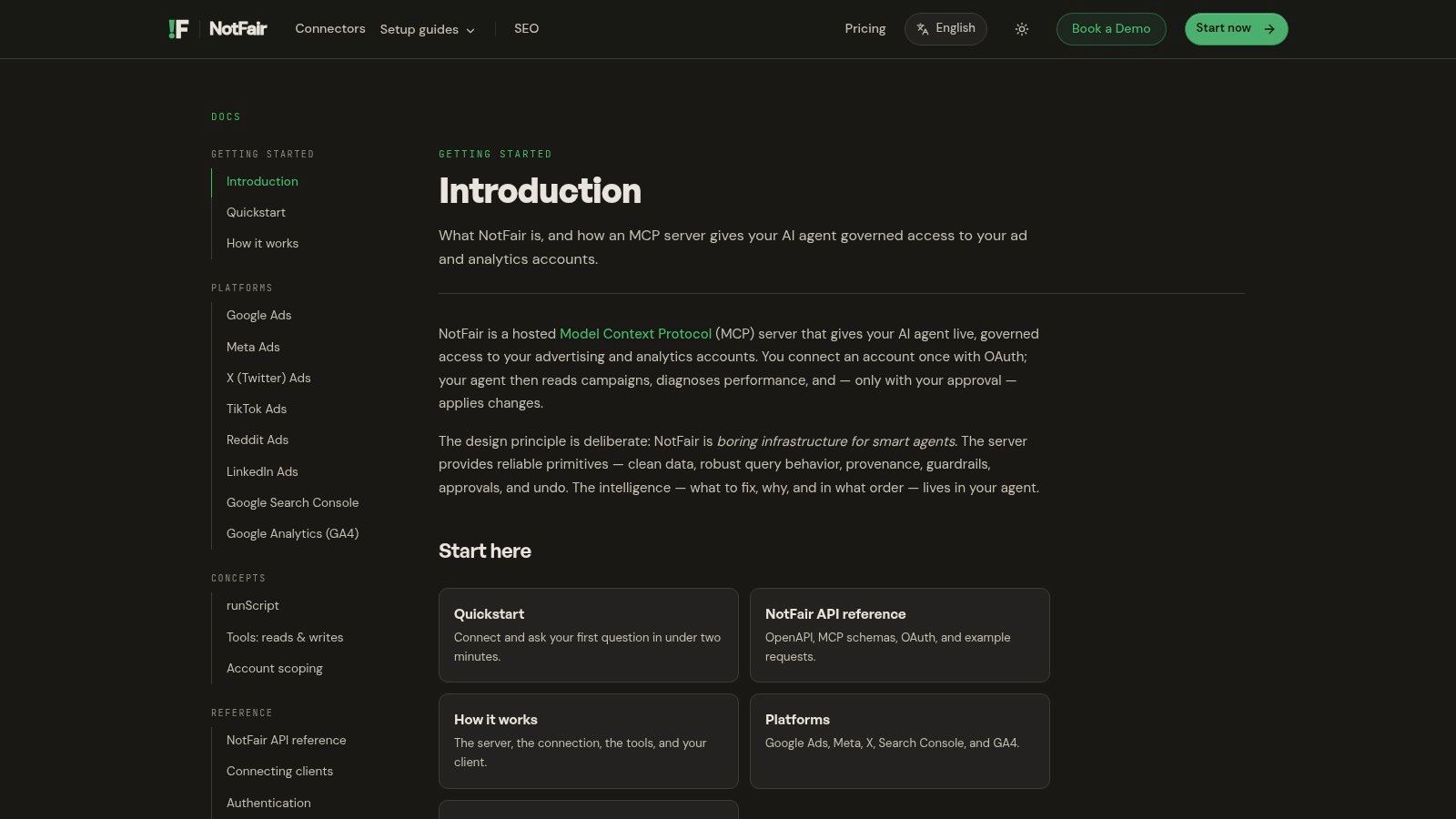
NotFair is designed for teams that need an AI agent to operate marketing accounts rather than only discuss them. Its hosted Model Context Protocol, or MCP, servers connect AI clients such as Claude, ChatGPT, Codex, Cursor, OpenClaw, and Hermes to live advertising, analytics, search, and CRM data through OAuth. This creates a focused operating layer for agencies, performance marketers, and marketing operations teams.
The key control question is whether an agent can read an account safely and change it deliberately. NotFair supports live, query-time reads across Google Ads, Meta Ads, X Ads, LinkedIn Ads, Google Search Console, GA4, and CRM data. For supported campaign operations, write actions require approval. The agent can propose a change, display an explicit diff, record the action in change history, and provide one-call undo. That design limits the risk of granting an autonomous system unrestricted API credentials.
Practical rule: Let the agent investigate freely, but make production changes deliberate, visible, and reversible.
NotFair's workflow starts with diagnosis. An agent can correlate paid performance with organic queries, analytics outcomes, and lead context in one session, then turn those findings into prioritized fixes ranked by spend at risk. An operator can examine loose-match search terms, quality-score drift, budget allocation, or conversion problems without manually switching between disconnected dashboards. Human judgment remains necessary. The platform places that judgment at the point where an action is proposed, rather than after an opaque change has already occurred.
Why it suits marketing operations
Hosted deployment reduces local setup and the need to manage separate credentials for each client account. OAuth sign-in also makes access easier to administer than unmanaged agent secrets. Organizations should still validate privacy, compliance, and data-residency requirements before connecting production accounts.
NotFair offers a free plan with a seven-day unlimited period followed by 300 operations per month, while the Growth plan is listed at $99/mo monthly, or $950/yr (~$79/mo) annually and includes unlimited Google and Meta operations with five shared ad-account spots, according to the NotFair documentation. Product coverage and pricing may change, so buyers should confirm the current terms.
- Best control: Approval-gated writes, explicit diffs, logged changes, and one-call undo.
- Best data fit: Cross-platform reads across paid media, organic search, analytics, and CRM context.
- Best deployment fit: Hosted access for teams that want to use existing connectors without building each one.
- Main limitation: Niche advertising platforms or bespoke account features may require additional integration work or managed support.
For agencies, the operational benefit is repeatability across client accounts. In-house teams gain a way to keep an operator in control while an agent handles cross-channel investigation. Teams evaluating related conversational workflows around customer or pipeline operations can also examine AI chat for B2B sales teams.
2. OpenAI Developer Platform
OpenAI's Developer Platform is a general-purpose runtime for teams that want to build custom agents quickly and use first-party tools. The Responses API supplies the main tool-calling interface, while function calling connects an agent to application-specific operations. Code Interpreter and File Search can reduce the infrastructure required to test reporting, analysis, or retrieval workflows.
GPTs with Actions provide a more accessible path to external connections. They can call defined APIs under specified policies, giving teams a starting point for permission boundaries. The control quality depends on the API design, however. System instructions cannot make an irreversible production endpoint safe without a confirmation step, approval gate, or other operational safeguard.
Speed with application ownership
The platform suits marketing teams that have developer support and need a custom reporting assistant, campaign-analysis tool, content workflow, or CRM process. SDKs, examples, and documentation can shorten prototyping. The team still owns the surrounding control system: read versus write permissions, approval rules, change logging, rollback, monitoring, and testing.
That ownership distinguishes OpenAI from a hosted connector product such as NotFair. A team can use the ChatGPT and Google Ads integration to access marketing-specific account connections through a hosted MCP service, rather than building every advertising connector itself. OpenAI supplies the model and runtime primitives. NotFair addresses a more specific marketing-operations deployment need.
The trade-off is platform dependence and continuing product change. APIs and runtime conventions can become part of the application architecture, so teams moving from legacy Assistants patterns to Responses and Agents should track deprecations and test production workflows during migrations. Pricing also requires workload modeling. Model calls, tool use, hosted execution, and retrieval can create different cost profiles, making predictability dependent on the workflow and its usage controls.
OpenAI is a practical choice when custom behavior and development speed matter more than ready-made cross-channel advertising operations. Before deployment, define which actions remain read-only, which require human approval, and where those rules are enforced. Implementation effort is moderate because the platform provides core primitives, while the team builds business logic, connectors, rollback, and operating policy.
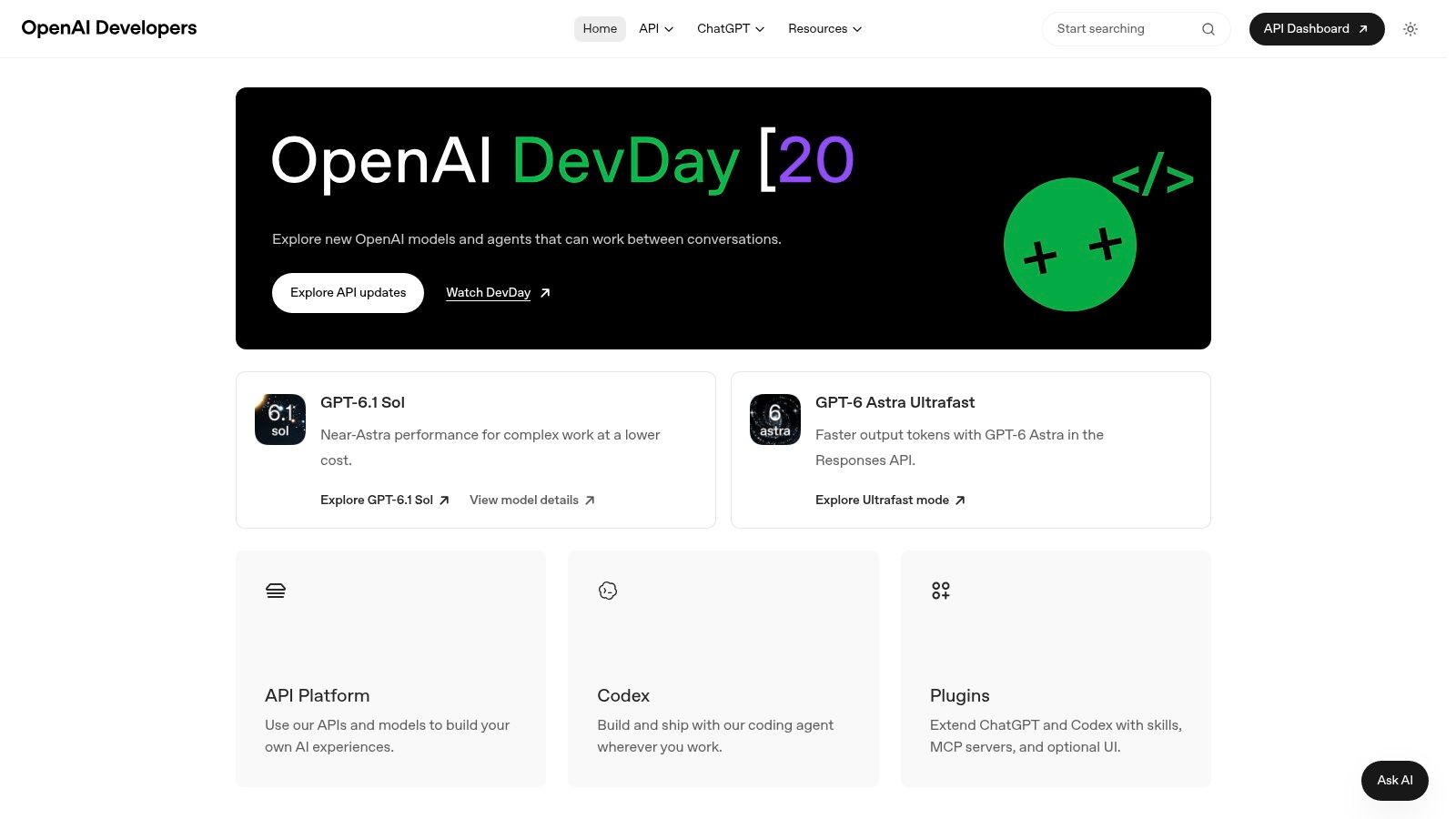
Teams assessing ChatGPT for Google Ads should evaluate the connector layer separately from the model layer. The OpenAI Developer Platform documents current API, tool, and migration details. Agencies and in-house teams should validate connector coverage, approval behavior, logging, rollback design, and expected costs against their own accounts before committing to production.
3. Anthropic Claude Platform and Managed Agents
Claude's model reputation is not enough to justify a production decision. Anthropic's platform is better assessed by how well it supports tool selection, instruction following, approval gates, tracing, and controlled execution across a marketing workflow. Its managed agent capabilities provide a hosted runtime for composable workflows, including parallel or specialized subtasks that can reduce dependence on one linear sequence.
A marketing agent may need to inspect campaign data, compare search queries with conversion information, retrieve CRM context, and prepare a recommendation. Claude can coordinate those steps when the required tools are available. Results still depend on connector scope, permission design, data freshness, evaluation coverage, and the team's ability to review or reverse actions.
Deployment choice affects governance. Teams can use the Anthropic API or work through Amazon Bedrock, Google Vertex, and Microsoft Foundry. These routes may fit existing procurement, identity, or data-governance requirements, but they should be compared individually. Logging, access controls, regional handling, support, and operational ownership can differ by hosting route.
Connector breadth is a separate buying question. Anthropic's MCP work describes an ecosystem that had grown to more than 10,000 active public MCP servers and 97 million monthly SDK downloads by late 2025, with support across major clients including ChatGPT, Cursor, Gemini, Microsoft Copilot, and VS Code. The Anthropic's engineering documentation on code execution with MCP supports the scale claim. Broad adoption can expand integration options, while leaving security review, data access, write permissions, and connector maintenance to the implementing team.
The model can select a tool correctly only when the platform exposes the right tool, with the right scope, at the right moment.
For agencies and in-house marketing teams, Claude fits governed, composable agents that need strong reasoning and instruction handling. Its strengths are managed workflows, tracing, safety guidance, and multiple enterprise hosting surfaces. Documentation and pricing may require sales engagement, and higher-tier model use needs workload sizing before costs become predictable.
NotFair adds a different operating model through its Claude connector for advertising workflows. A hosted marketing connector can reduce implementation work for advertising access, but buyers should verify account coverage, approval behavior, audit logs, rollback options, and multi-client separation rather than assuming those controls are included.
The Claude Platform is a sound foundation for broader agents. Campaign-change approval, rollback, and multi-client advertising administration still require validation in the selected implementation, including the deployment route and connector layer.
4. Microsoft Copilot Studio
Microsoft Copilot Studio makes the strongest case for organizations already operating across Microsoft 365, Teams, Power Platform, and Microsoft identity controls. Its low-code environment lets business and operations teams create conversational agents, connect actions, and ground responses in Microsoft Graph and related business data. For marketing processes built around Outlook, SharePoint, Excel, Teams, or Dynamics, that existing context can reduce integration effort.
Its operating advantage comes from ecosystem depth. A team can configure an agent to route requests, retrieve campaign documentation, start an approval flow, or update connected records. External advertising workflows require closer inspection. Connector availability and action coverage determine whether the agent can read live data or perform controlled writes in Google Ads, Meta Ads, and other marketing systems. A Microsoft connection alone does not guarantee either capability.
The control model is familiar to enterprises already using Microsoft governance. Agent identity, permissions, and data policies can align with existing IT and security processes. Low-code flows also let non-developers formalize approval gates. More involved branching, permissions, and exception handling may still require Power Platform expertise.
For marketing operations, NotFair represents a different option: a hosted connector approach focused on account workflows rather than a general-purpose enterprise suite. The relevant comparison is operational. Teams should check connector breadth, approval behavior, audit visibility, reversibility, client separation, and deployment effort before choosing between these models.
Copilot Studio billing uses Copilot Credits through pay-as-you-go or capacity-pack options. Consumption pricing can suit teams with predictable usage, while high-traffic agents and premium reasoning features require careful forecasting. Cost estimates should include triggers, conversations, connectors, actions, and premium metering, not only the visible license.
Microsoft-heavy enterprises with established identity and compliance processes are the clearest fit. Agencies managing independent client environments may face more tenant and permission administration than with a hosted marketing connector. The deciding question is whether the required external systems expose the live data and reversible actions the workflow needs.
The Microsoft Copilot Studio product page provides the current reference for capabilities and billing terms. Teams should validate those details before committing, since product scope and pricing may change.
5. Google Cloud Vertex AI Agent Builder and Gemini Enterprise Agent Platform
Google's platform is a strong choice for organizations that value cloud infrastructure and operational visibility more than a ready-made marketing workflow. Vertex AI Agent Builder and the evolving Gemini Enterprise Agent Platform connect grounded retrieval with managed deployment, while Agent Engine handles runtime operations. Agent Designer offers a more accessible way to build and manage agents.
Its clearest fit is a marketing or data team already using Google Cloud. Vertex AI Search and enterprise data grounding can connect responses to internal information. Cloud Logging, Monitoring, and Trace provide telemetry for investigating latency, failures, tool calls, and runtime behavior. That observability can support production review, provided the team defines what events to capture and who can inspect them.
Control depends on implementation. Google does not supply a complete marketing-operations workflow, so the team must configure advertising connectors, permissions, approval gates, and reversal procedures. An agent that can change budgets or targeting should expose those actions as controlled tools with review points, not rely on a broad instruction to optimize performance. Teams should also test whether changes can be paused, audited, and reversed through the selected deployment model.
Pricing requires workload modeling across compute, memory, storage, and management. Retrieval, long-running execution, and multiple tools can affect consumption, so a single headline rate will not describe the full cost. Naming changes across Gemini, Vertex AI, and Agent Builder may also complicate service comparisons. Confirm the exact product, region, deployment pattern, and billing categories before committing.
For agencies, the platform offers scalable infrastructure but demands more engineering ownership than a specialized hosted connector. In-house Google Cloud teams may value native grounding and telemetry. Marketing teams that mainly need advertising access could instead evaluate NotFair's connector approach, including its support for Google Ads workflows, against the effort of building and governing those integrations inside Google Cloud.
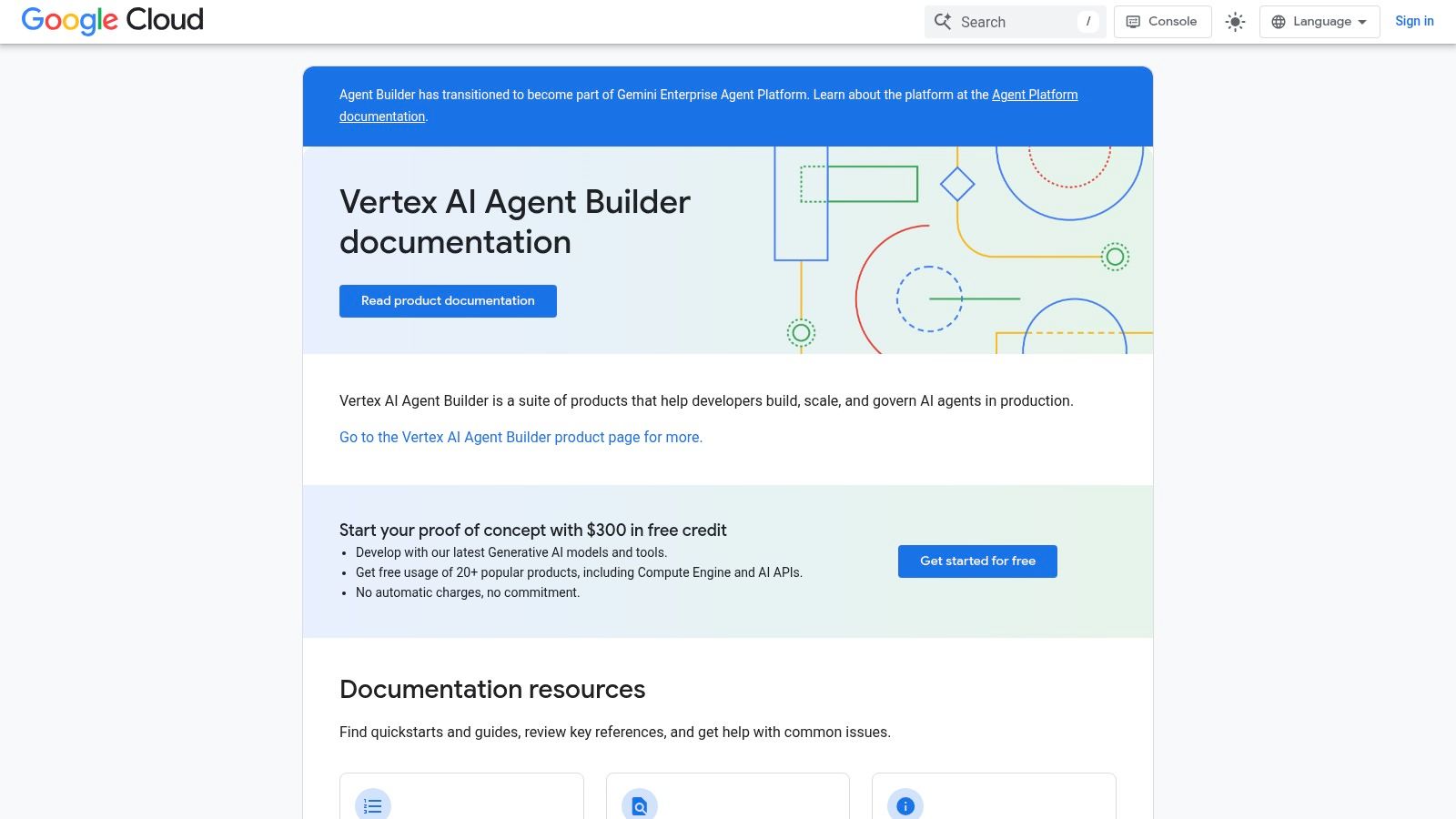
The Gemini CLI and Google Ads integration illustrates the difference between model infrastructure and a focused marketing connector. Review the current Google Cloud Agent Builder documentation to confirm available services, product names, and deployment requirements, since the service structure continues to evolve.
6. LangChain LangGraph Cloud
LangGraph is suited to teams that need agent behavior represented as an explicit graph rather than delegated to an opaque runtime. Developers can define states, branches, retries, tool calls, and handoffs directly. LangGraph Cloud adds managed APIs, authentication, queuing, deployment, and observability, while LangSmith supports evaluation and tracing. The LangGraph platform documents the current managed and self-hosted options.
That control matters when a marketing workflow can produce costly or irreversible outcomes. An agent might diagnose an account, produce a recommendation, pause for approval before writing a change, retry a failed read without repeating the campaign action, and preserve state for later review. Representing those rules in application logic makes them easier to inspect, test, and revise than instructions hidden inside a general-purpose prompt.
Engineering decision: Choose LangGraph when the workflow itself is a product and the team needs ownership of its behavior at the state-machine level.
The operational cost is engineering ownership. The team must build or connect marketing data sources, define identity and permission boundaries, create approval interfaces, export audit records, and implement rollback mechanisms. Connector breadth therefore depends on what the team builds and maintains, while reversibility and approval gates depend on the application design rather than a ready-made marketing control layer.
Choose it for: Deterministic multi-step orchestration and fine-grained state control.
Strength: Explicit branching, retries, memory, deployment, and tracing patterns.
Limitation: More technical ownership than a low-code builder or hosted marketing service.
Marketing fit: Strong for a custom internal platform, less efficient when a team mainly needs ready-made advertising connectors.
LangGraph suits engineering groups that already use LangChain and LangSmith, as well as organizations requiring self-hosting or air-gapped deployment options. Agencies should decide whether they want to maintain one custom system across client accounts or reserve LangGraph for differentiated workflows. A hosted connector option such as NotFair may be more practical for routine marketing operations, while LangGraph can govern the specialized logic around them.
The platform publishes pricing for runtime compute and storage, giving buyers a starting point for cost modeling. Those rates do not capture engineering time, monitoring, integration maintenance, test coverage, or incident response. For a complex agent, those operating commitments may outweigh the platform charge, so agencies and in-house teams should validate total cost against the control they actually need.
7. Zapier Agents
Zapier Agents reduces the implementation work between an idea and a multi-application action, particularly for teams already familiar with Zapier. Agents can reason across connected apps and use Zapier skills, actions, and SDK capabilities, so teams do not need a separate custom integration for every SaaS tool. Its management interface also supports agent building, team sharing, and permissions, giving operations staff a familiar way to begin.
Connector breadth is the main advantage. A non-technical operator can often prototype workflows for routing lead information, summarizing campaign notifications, updating records, or coordinating routine tasks across a marketing stack without waiting for engineering to create an API layer.
That convenience shifts the control question elsewhere. Zapier is a strong fit for quick multi-app automation, while code-first runtimes offer more direct control over state, branching, and execution behavior. Best fit: Operations teams that need minimal custom development. Strength: An accessible interface and broad app ecosystem.
Risk increases when an agent touches advertising budgets, targeting, or CRM records. Those workflows may need a hybrid design, with Zapier coordinating steps while a specialized service applies approval gates, records diffs, and supports rollback. For marketing teams, the relevant test is whether each connected action can be constrained, reviewed, logged, and reversed at the required risk level. A marketing-operations connector such as NotFair may be more suitable when live diagnostic data and governed advertising changes matter more than general app automation.
Zapier Agents is evolving, and some capabilities may be in preview or released gradually. Buyers should test the exact workspace behavior they need, including versioning, audit history, failure handling, permissions, and observability. Existing familiarity with Zapier governance and logging can reduce adoption friction, but it does not replace a formal review of actions that can run without approval. Teams should also validate deployment constraints and pricing predictability against task volume and operational support needs.
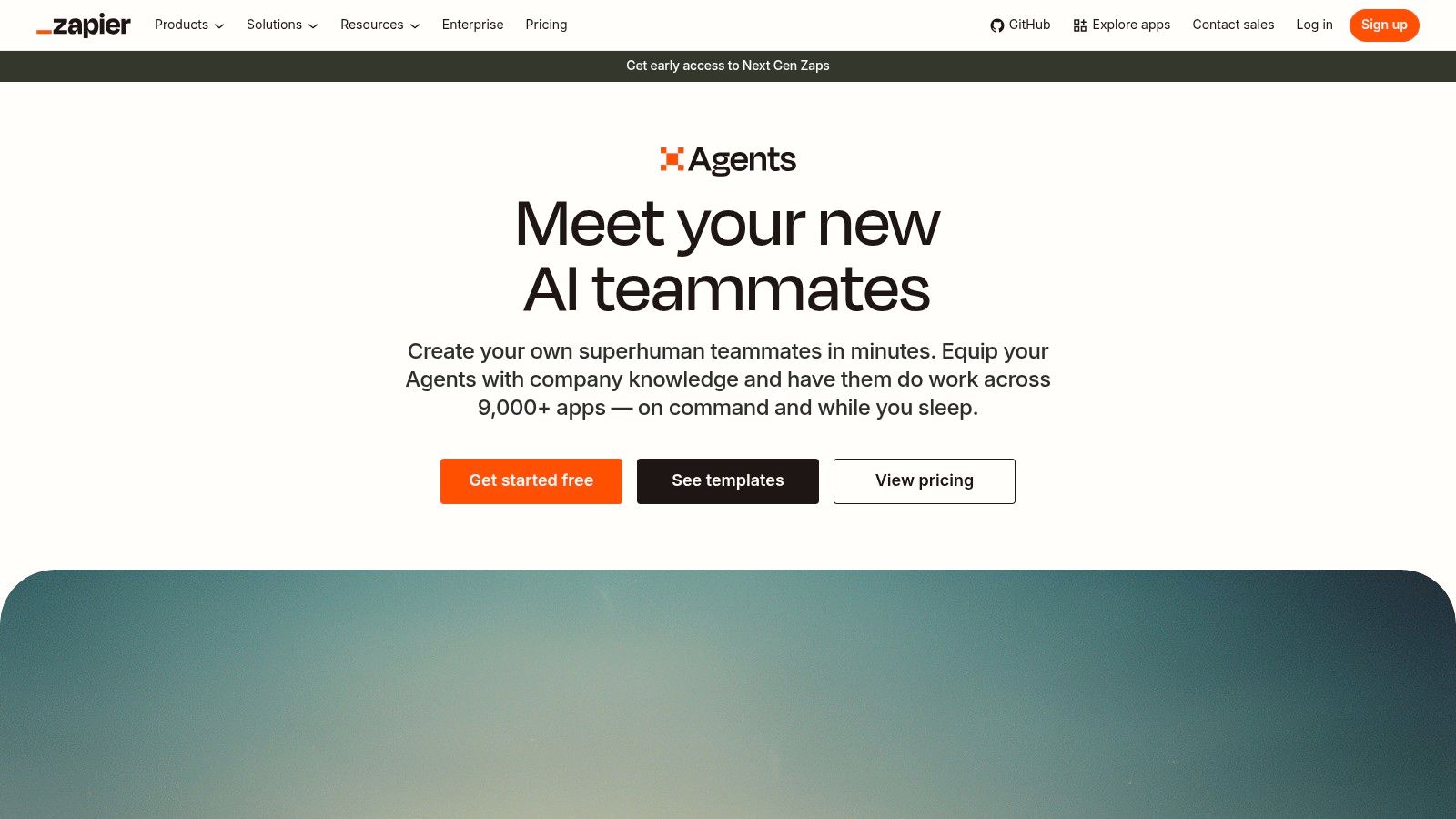
Review Zapier Agents to confirm which capabilities are generally available for your workspace. It may be sufficient for straightforward lead and reporting workflows. Live campaign diagnosis and controlled advertising changes require closer validation of safeguards, approval handling, and reversibility.
Top 7 AI Agent Platforms, Feature Comparison
| Platform | Implementation complexity 🔄 | Resource & cost ⚡ | Expected outcomes 📊 | Ideal use cases & tips 💡 | Effectiveness / Key advantages ⭐ |
|---|---|---|---|---|---|
| Introduction, NotFair Docs | Low–Medium, hosted MCP with OAuth and ready connectors | Low engineering overhead; paid tiers and managed support | Auditable, approval-gated edits; faster root‑cause ad diagnostics | Ad‑ops teams needing governed AI actions; audit OAuth scopes for compliance | ⭐⭐⭐⭐, live cross‑platform reads, explicit diffs, one‑call undo |
| OpenAI Developer Platform (Responses API, Agents, GPTs with Actions) | Medium, Responses API + tool/function calling; SDKs available | Medium, pay‑per‑use; built‑in tools reduce infra needs | Fast prototyping, extensible tool integrations, strong community support | Custom agents and rapid iteration; track deprecations and migrations | ⭐⭐⭐⭐, mature SDKs, Code Interpreter/File Search, GPTs with Actions |
| Anthropic Claude Platform and Managed Agents (Workflows) | Low–Medium, managed workflows with tracing and controls | Medium–High, enterprise pricing and sales engagement common | Trustworthy instruction following, governed workflows with tracing | Enterprise safety/governance use cases; expect sales/process for pricing | ⭐⭐⭐⭐, strong instruction following and enterprise guardrails |
| Microsoft Copilot Studio | Low (for M365 ecosystems), low‑code conversation & action flows | Medium, Copilot Credits/licensing can complicate forecasting | Deep M365‑grounded agents and governed action flows | Organizations standardized on Microsoft 365/Power Platform | ⭐⭐⭐⭐, low‑code design and deep Graph/Power Platform integration |
| Google Cloud – Vertex AI Agent Builder / Gemini Enterprise Agent Platform | Medium–High, managed Agent Engine + Google infra integration | High, multiple SKUs (compute, memory, storage, management) | Production‑grade, observable agents with enterprise policy controls | Google Cloud enterprises needing scalable, governed runtimes | ⭐⭐⭐⭐, strong infra, observability, and native RAG grounding |
| LangChain – LangGraph Cloud (managed agent runtime) | High, code‑first, graph‑based workflows require engineering ownership | Medium, managed cloud or self‑hosted; licensing for enterprise features | Deterministic multi‑step agents with fine‑grained orchestration and tracing | Teams needing control over state, retries, branching; pair with LangSmith | ⭐⭐⭐⭐, high control over workflow state and orchestration |
| Zapier Agents | Low, no‑code/low‑code agent creation in Zapier UI | Low–Medium, subscription; fast to deploy across apps | Rapid multi‑app automations with Zapier governance; limited low‑level control | Ops teams needing quick integrations across SaaS; use hybrid for complex logic | ⭐⭐⭐, fastest path to cross‑app actions; evolving feature set |
Choose the Control Model Before the Platform
Start with the workflow, not the model leaderboard. Map every required connector and live data source, including advertising accounts, analytics properties, search platforms, CRM records, internal documents, and approval systems. A platform that supports your preferred model but can't read the required data at query time will create a polished demonstration rather than a dependable operating process.
Separate read-only analysis from write actions before implementation. An agent can often investigate performance, summarize anomalies, and draft recommendations with broader access than it should have for changing budgets, keywords, audiences, records, or content. Require approval gates for production actions, show explicit diffs before execution, retain change logs, and provide rollback wherever the platform can affect a live system.
The benchmark evidence reinforces this point. Coverage of MLPerf's first agentic inference benchmark describes testing around multi-turn enterprise processes rather than isolated prompts. AgentArch findings also indicate that even advanced systems can struggle to maintain reliable performance across enterprise workflows. The practical conclusion is that orchestration, tool calling, memory management, and auditability deserve as much scrutiny as model quality.
A practical selection process
Use these questions to narrow the field:
- Connector coverage: Can the platform access the exact systems your workflow needs, or will your team build custom adapters?
- Live context: Does the agent read current account and business data, or does it depend on stale exports?
- Permission design: Can you scope tools by user, account, tenant, client, or action type?
- Change safety: Are approvals, diffs, logs, and one-call undo available before the agent touches production?
- Observability: Can operators inspect tool calls, failures, state transitions, and audit exports?
- Deployment model: Does the organization require a hosted service, managed cloud runtime, self-hosting, or an air-gapped option?
- Cost predictability: Can you estimate usage, storage, compute, model calls, connector operations, and support against realistic workloads?
For agencies and in-house marketing teams, NotFair is the focused option when the priority is hosted MCP connectivity, live cross-channel reads, approval-gated campaign changes, and one-call undo. OpenAI, Anthropic, Microsoft, Google, LangGraph, and Zapier are broader choices for teams building general-purpose agents, ecosystem applications, or cloud-native runtimes. The right answer depends on whether you need a marketing operations layer now or the building blocks for a wider agent platform.
Run a small pilot before expanding access. Choose one measurable workflow, such as diagnosing paid-search waste, routing CRM context into campaign analysis, or automating a governed multi-app task. Define the starting process, specify which actions remain human-approved, test identity and audit exports, model the actual usage cost, and review whether the agent produces decisions an operator can explain. A narrow pilot will reveal more about production readiness than a long feature checklist.
NotFair connects Claude, ChatGPT, Codex, Cursor, OpenClaw, and Hermes to live advertising, analytics, search, and CRM data with approval-gated writes, explicit diffs, logging, and one-call undo. If your marketing team needs safer agent-driven account operations, visit NotFair to review the hosted connectors and start with a governed workflow.