

You open Google Ads, click into a search campaign, and the ad editor doesn't hand you a single finished ad. It asks for headlines, descriptions, and choices you'll have to trust the system to test. That's the first moment many teams realize responsive search ads aren't just a new format, they're a different way of building search advertising.
The shift matters because Google moved Search text ads from fixed copy to asset-based combinations. Google introduced RSAs in 2018 as a beta format, then made them the only Search ad type advertisers could create or edit in standard Search campaigns beginning June 30, 2022. Existing Expanded Text Ads could still serve, but the daily workflow changed for good. Google also reported that advertisers switching from ETAs to RSAs with the same assets saw an average 7% increase in conversions at a similar cost per conversion, and campaigns using RSAs with broad match and Smart Bidding saw an average 20% increase in conversions at a similar cost per conversion Search Engine Land's summary of Google's RSA milestone.
Practical rule: Stop thinking of an RSA as one ad. Treat it as a constrained testing system made from headlines and descriptions.
That mental shift changes how you write, pin, test, and measure. You need enough distinct assets for Google to evaluate, not one perfect line of copy. You also need to know when Ad Strength is useful and when it's just a pre-launch diagnostic that can distract from qualified conversions. A good RSA workflow starts with mechanics, then creative variation, then disciplined testing, and ends with measurement tied to downstream outcomes.
Table of Contents
- Why Responsive Search Ads Changed Google Ads Forever
- How Responsive Search Ads Actually Work
- Writing Assets That Give Google Real Choices
- When to Pin Assets and When to Let Go
- Testing Strategies for RSA Performance
- Measuring What Matters Beyond Ad Strength
- Migrating from Expanded Text Ads and Your Action Plan
Why Responsive Search Ads Changed Google Ads Forever
A lot of advertisers first meet RSAs at the worst possible time, during a campaign rebuild or a rushed account cleanup. One day the team is used to one fixed ad with tightly controlled copy, and the next day the interface asks for a pool of headlines and descriptions instead. It feels less like writing an ad and more like stocking a shelf with ingredients.
That difference is exactly why RSAs changed Search advertising. Google's system no longer serves one frozen message. It combines advertiser-provided assets and tests which combinations fit the query, the auction, and the user context best. The format turned campaign construction from manual ad writing into asset management, and the 2022 transition made that shift unavoidable for standard Search campaigns.
What changed operationally
The biggest change wasn't visual. It was structural. Teams had to stop optimizing around one headline sequence and start thinking about the variety of messages inside an ad group.
That affects everyone who touches the account. Copywriters need to write more modular lines. Paid search managers need to think in themes instead of singular ads. Analysts need to inspect how assets and search terms interact instead of asking only which ad “won.”
A few practical consequences show up fast:
- Asset variety matters: Similar headlines create the appearance of volume without giving Google meaningful alternatives.
- Team workflows change: Writers, strategists, and analysts all touch the same RSA system.
- Testing becomes native: Google is testing combinations every day, so your job is to feed it useful options, not just approve a final version.
If you're managing accounts with automation already in place, the exact same logic also shows up in tooling. Platforms such as NotFair's Google Ads integration can read and edit RSAs through a hosted MCP workflow, which is useful when you need structured review and approval around ad changes.
The key takeaway is simple. RSAs didn't just replace ETAs. They changed what “writing an ad” means in Google Ads.
How Responsive Search Ads Actually Work
An RSA works like a pantry, not a plated meal. You provide the ingredients, and Google assembles the final combination at auction time based on the query and the available assets. If the pantry is thin or full of repeats, there is little real testing to do.
Google allows an advertiser to provide 3 to 15 headlines and 2 to 4 descriptions in an RSA. At serving time, the ad can show up to three headlines and two descriptions. Headlines are limited to 30 characters and descriptions to 90 characters, and double-width characters such as Chinese, Japanese, and Korean count as two characters Google's RSA guidance.
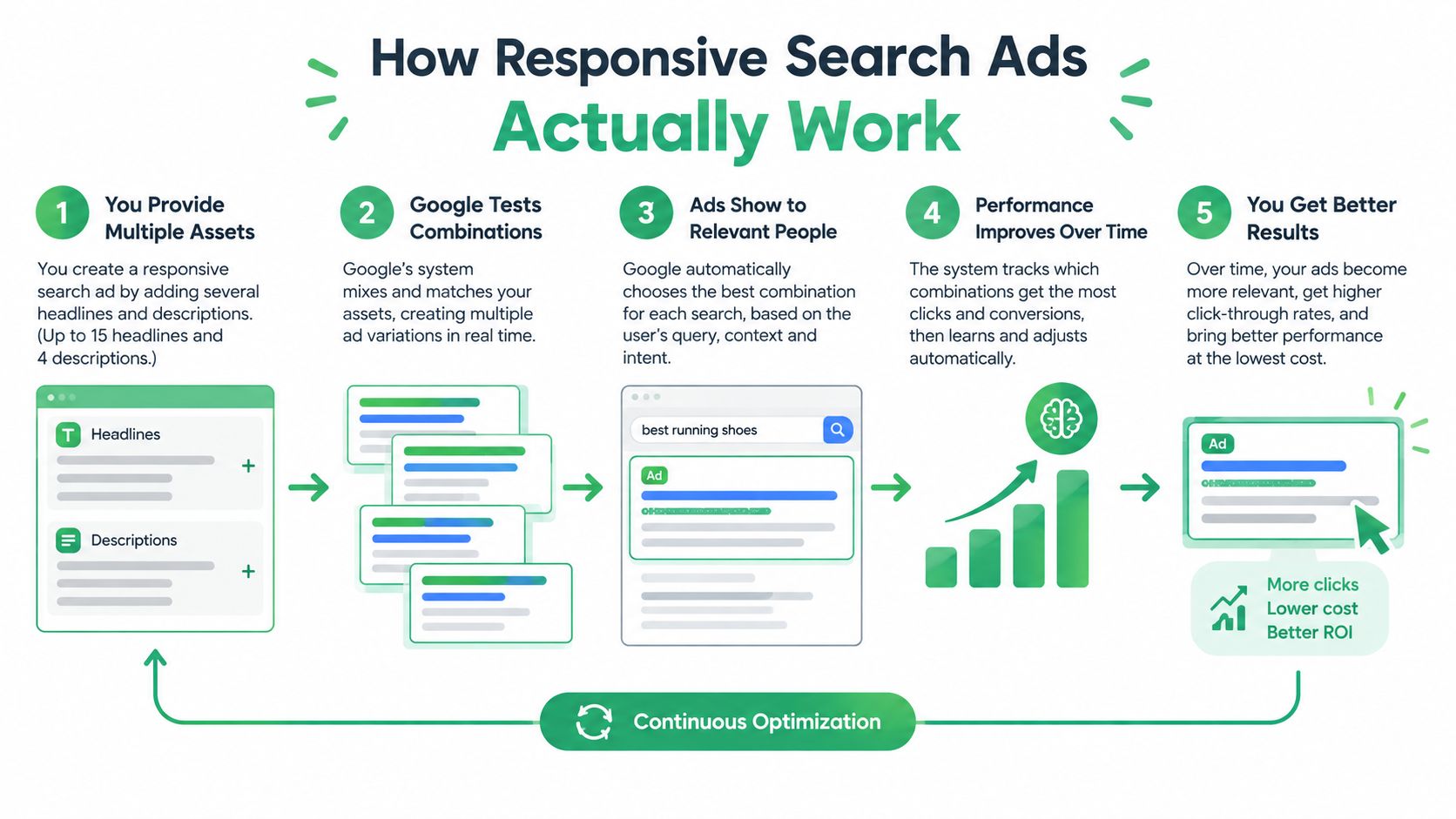
The practical point is easy to miss. The goal is not to write one perfect ad. It is to supply a broad, non-redundant set of assets so Google has real combinations to test. Google's API documentation says combinations are rotated to identify which perform best, and Google's guidance says the system selects combinations predicted to be most relevant and effective for the individual query.
What that means for writing
If you give Google fifteen ways to say the same thing, you have padded the form, not improved the test. Three headlines that repeat the same promise in slightly different words add very little experimental breadth.
A better asset set gives each headline a job:
- one line that matches keyword intent
- one line that states a value proposition
- one line that provides proof or trust
- one line that highlights an offer or price point
- one line that makes a clear call to action
Google can only test the combinations you make possible.
That is why pinning should stay limited, and why a good RSA often reads a little less polished than a static ad. It needs enough variation to create meaningful combinations, not just enough polish to look complete on paper.
For a visual walkthrough, the embedded video below shows the logic in motion.
Writing Assets That Give Google Real Choices
Strong RSA writing starts with function, not word count. If every headline says almost the same thing, Google gets plenty of text and very little testing room. The better approach is to write assets that serve different jobs inside the same ad group.
Build the set by function
Use this as a simple drafting checklist:
- Keyword relevance: “Project Management Software” or “CRM for Small Teams”
- Value proposition: “Faster Reporting for Busy Teams”
- Proof or trust: “Used by Growing SaaS Teams”
- Offer or pricing cue: “Free Demo Available”
- Call to action: “Book Your Demo Today”
Those examples are short on purpose. In an RSA, short lines make room for combination testing, and the character limits force discipline. The trick is to make each line distinct enough that Google can mix them into different messages without losing the thread.
Avoid fake variety
A lot of teams create fifteen headlines that are only grammatical rewrites of one promise. That looks like breadth, but it's really just repetition. If one headline says “Save Time on Reporting” and another says “Spend Less Time Reporting,” the system doesn't gain much.
A better asset set separates concept from concept. One line can emphasize the problem. Another can promise the outcome. Another can reduce risk. Another can answer the buyer's silent objection. That structure creates combinations worth testing.
A useful outside reference for modular message planning is Stamina's email copywriting framework, which is built around clear message functions rather than one long block of persuasion. The channel is different, but the logic of varied assets is the same.
If you're using an automation layer, it helps to keep asset themes organized before anything gets published. A workflow like NotFair's Google Ads optimization tool can support that kind of review because the point isn't just editing copy, it's seeing whether the ad group has enough distinct material to test.

When to Pin Assets and When to Let Go
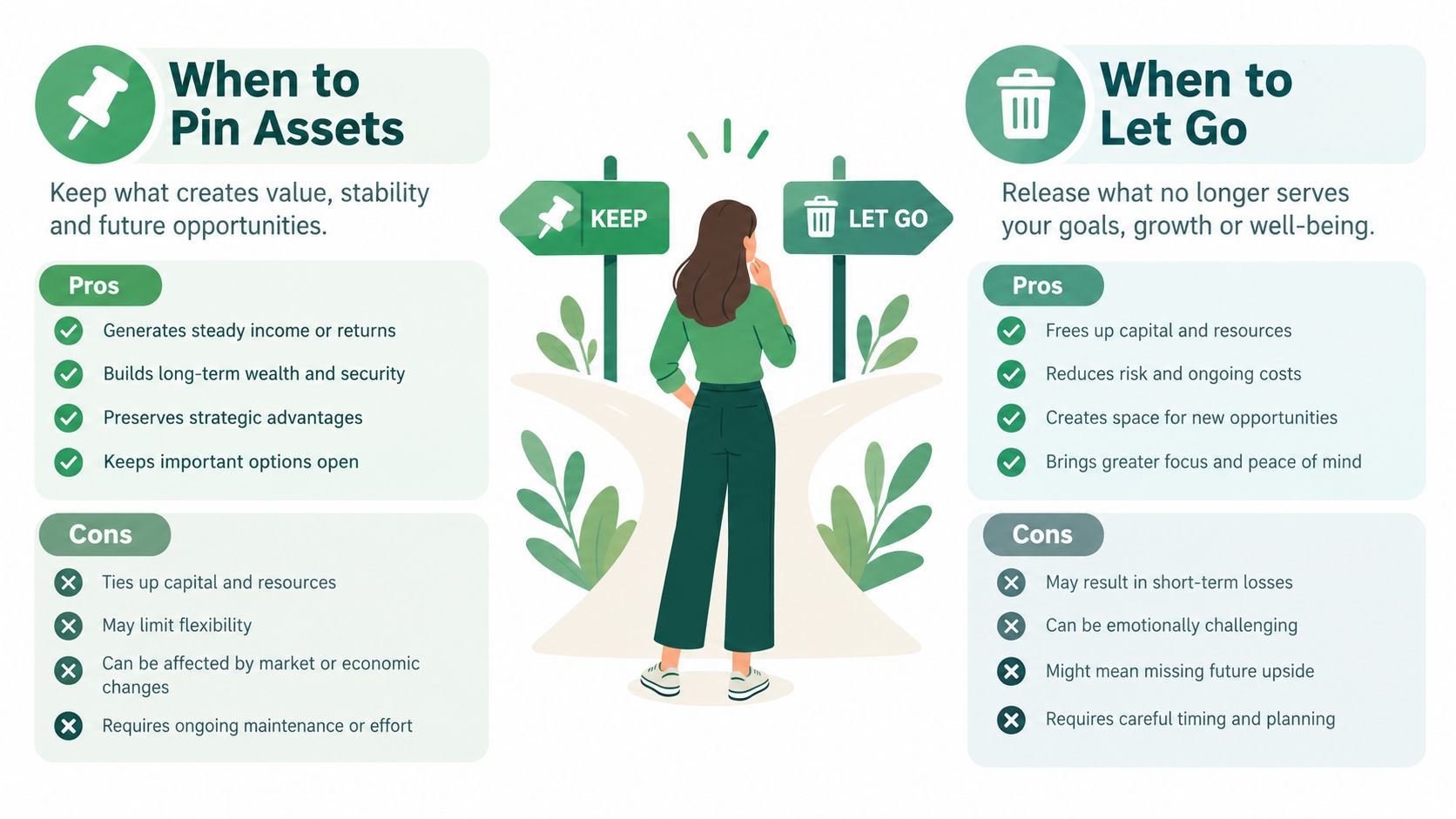
Pinning is useful when control matters more than flexibility. That usually means legal language, a mandatory brand proposition, or a regulated disclaimer that can't be left to chance. Outside those cases, pinning often becomes a habit born from discomfort with automation.
Here's the trade-off. Every pin removes options from the combinatorial system Google uses to assemble the ad. The more you pin, the fewer eligible combinations the system has to evaluate. That can be fine when the requirement is real, but it's costly when the pin only reflects preference.
Side-by-side scenarios
Pin it
- Legal disclaimer that must appear in a specific position
- Brand statement that compliance or leadership requires
- Regulated phrasing that can't move
Let it go
- First headline pinned “for control”
- Generic brand line pinned just because it was in the old ETA
- Secondary copy pinned even though it's not required
The first group protects the business. The second group usually protects a habit.
Decision rule: Pin only what you would be legally or brand-wise required to pin, and diversify everything else.
That rule is blunt, but it keeps the ad group healthy. It also forces the team to ask whether the copy problem is real or emotional. If the answer is emotional, unpin it and let the system learn.
A good pinning policy should feel boring. If every RSA in the account has heavy pinning, Google's testing space shrinks and the ad starts behaving like a fixed-format template again. If only the necessary elements are pinned, the rest of the ad can do its job as a test bed.
Testing Strategies for RSA Performance
Testing RSAs works best at the theme level. One headline rarely tells you much on its own, because Google is testing combinations across the ad group, not a single line in isolation. The useful question is which message angle gives the system better material to assemble around search intent.
A simple setup is to add a second RSA in the same ad group when you want to compare one theme against another. Google's RSA testing guidance says advertisers who add a second RSA in the same ad group see an average 6.6% increase in conversions at a similar cost per conversion Google Ads help on RSA testing. Treat that as a benchmark for planning, not a promise. The ad still has to meet the market you are bidding into.
Google's broader RSA milestones can also help set expectations. The figures for ETA-to-RSA migration and for RSAs paired with broad match and Smart Bidding are useful as reference points, but they do not prove that any one creative theme will work in your account. Use them as a baseline, then judge the result on qualified conversion rate and lead quality, not on the raw output of the platform.
Keep the comparison fair
Hold targeting and bidding as steady as possible while you test. If you change the audience, match type, and copy at the same time, you can't tell which change caused the shift. That is why asset-level reporting matters. It shows which headlines and descriptions are getting used, and which themes seem to carry the ad.
If your team needs a cleaner testing workflow, the core principle behind optimize checkout and payments applies here too, one meaningful variable at a time. Otherwise you are comparing moving targets, not ads.
For extra control, use a tool like NotFair's Google Ads optimization tool to track asset themes, compare search-term responses, and keep the test conditions easy to audit.
Read the signal correctly
Click volume alone can mislead you. A headline can pull attention and still bring the wrong leads. The better test is whether the theme improves the conversion quality that matters to the business.
That is why a test needs an ending. Keep the stronger theme, retire the weaker one, and leave the rest of the ad group stable long enough to learn something real.
Measuring What Matters Beyond Ad Strength
Ad Strength is easy to misread because it looks like a scorecard. It isn't a performance verdict. Google says it evaluates factors such as the number and uniqueness of headlines, keyword relevance, description diversity, and supporting assets, and it also says the rating itself is not an auction factor Google's Ad Strength guidance.
That matters because an ad can score well and still bring the wrong traffic. A neat asset set doesn't guarantee qualified leads. It just means Google has enough material to work with.
What Ad Strength tells you
| What Ad Strength Measures | What Actually Indicates Performance |
|---|---|
| Headline count and uniqueness | Qualified conversion rate |
| Keyword relevance | Cost per qualified lead |
| Description diversity | Search-term-level conversion efficiency |
| Supporting assets and coverage | Impression share |
| RSA asset availability | Downstream CRM quality |
Google reports that advertisers improving an RSA from “Poor” to “Excellent” receive 15% more clicks and conversions on average Google's Ad Strength guidance. That's useful context, but it still doesn't prove the score caused better profit or better lead quality.
Measure the business outcome, not the platform score.
The metrics that matter are the ones tied to revenue or pipeline quality. In a lead-gen account, that often means qualified conversion rate and cost per qualified lead. In ecommerce, it might mean search-term-level efficiency and how often the ad appears for the right queries, not just more clicks.
If your ad groups keep scoring well but the leads are weak, review the search terms, the asset themes, and the negatives together. A resource like NotFair's Google Ads negative keywords use case fits this kind of diagnosis because the issue is often not the RSA alone, it's the combination of message, query, and filtering.
Migrating from Expanded Text Ads and Your Action Plan
The ETA sunset changed how Search campaigns were built, but the bigger lesson is still practical. Google stopped new creation and editing of Expanded Text Ads in standard Search campaigns on June 30, 2022, while existing ETAs could keep serving and could still be paused, resumed, or removed. That history matters because it shows how quickly a format can become legacy, even while the account still depends on the thinking behind it.
The shift was not toward “the newest format.” It was toward giving the system enough distinct, policy-compliant assets to test against search intent. Once you see RSAs as a constrained combinatorial testing system, the work gets sharper.
A practical action plan
- Audit ad groups for asset diversity. Flag any group where three or more headlines repeat the same verb phrase, such as “Save Time on Reporting,” “Save Time on Insights,” and “Save Time on Analysis.”
- Unpin anything that is not required. Keep brand or legal lines pinned when they must stay fixed, but release routine selling points so Google can test different combinations.
- Add a second RSA where themes differ. If one ad speaks to price and another speaks to speed, separate them. Do not force two messages into one asset set.
- Check conversion-quality tracking. Verify that clicks are tied to qualified leads or sales, not just form fills. A polished headline can still attract low-intent traffic.
- Review search terms alongside assets. If queries skew toward research phrases while the ad promises a purchase-ready offer, the issue is message mismatch, not only headline wording.
If your team uses an AI-assisted workflow, approval and traceability matter more than speed. A hosted MCP layer can help by letting teams inspect changes before they go live and keeping the edit history reviewable.
Ad Strength fits best as a pre-launch diagnostic. Use it to spot thin asset coverage or repetitive themes, then judge the RSA by whether the headline and description mix matches search intent and produces better downstream conversion quality.
If you want to audit your RSAs with real account data, use NotFair to inspect ad group assets, compare search terms against conversion quality, and review approval-gated edits before they go live. It is a practical way to manage RSA variation, pinning, and negative keyword cleanup without losing control of the account.