

Your campaign dashboard looks healthy, but the sales team isn't celebrating. Forms keep arriving, reported cost per lead looks reasonable, and nobody can confidently say which campaigns produced customers worth acquiring. Before you increase the budget, you need to connect what happened after the click to the advertising decision that came before it.
CRM for advertising means using customer records to measure and improve campaigns against qualified outcomes, not just recorded responses. The important decision isn't how to connect the systems. It's which customer milestone you trust enough to influence bidding.
Table of Contents
- What CRM Data Shows That Ad Platforms Cannot
- Which CRM Lifecycle Stage Should Control Your Bids
- Consent and Governance Limits for CRM Data
- How to Send Qualified Outcomes Back to Ad Platforms
- Measuring Campaigns by Revenue, Not Clicks
- Audience Insights and Examples From Real CRM Data
- Confirm Your First CRM-to-Ad Step This Month
What CRM Data Shows That Ad Platforms Cannot
Say a paid campaign produces a busy lead report, but the CRM reveals that only a small group became paying customers. Some were already customers before the campaign began. The ad platform counts the shots; the CRM helps you count the goals.
That distinction matters when someone clicks an ad, speaks to sales later, and buys after a phone conversation. Without a retained identifier connecting those events, the advertising report and the customer record describe separate pieces of the journey. Neither automatically provides the complete answer.
Salesforce's marketing statistics report that 86% of marketers use CRM systems and 84% use first-party data, yet only 31% expressed satisfaction with their ability to unify data sources and only 48% tracked customer lifetime value. Adoption isn't the same as usable measurement.
Questions answered by ad platforms versus CRM records
| Question | Ad platform answers | CRM answers |
|---|---|---|
| Which ad was clicked? | Yes, with click and impression data | Only if the click ID was stored at lead creation |
| Which leads were qualified? | Only if a qualified conversion was uploaded | Yes, through lead stage and sales notes |
| Which campaign produced paying customers? | Rarely, without offline uploads | Yes, through closed-won, revenue, and retained campaign-source fields |
| Which audience has the highest lifetime value? | No, not from platform activity alone | Yes, if repeat purchases and retention are recorded |
| Which existing customers should be excluded from acquisition? | Partially, through uploaded lists | Yes, through customer status |
A CRM can distinguish an inquiry from an accepted sales lead, a profitable customer from a refunded order, and a prospect from an existing account. Those distinctions let analysts evaluate campaign quality rather than assume every conversion has equal value.
The qualification is important: a CRM isn't automatically a source of truth. Inconsistent stages, missing purchase records, and overwritten acquisition sources can make a customer database just as misleading as a conversion dashboard.
Before trusting a campaign ranking, check whether the CRM can connect its customers back to the advertising interaction.
For teams working with GoHighLevel, the CRM connection guide is a practical starting point for accessing lead and pipeline context. The unresolved reporting question is straightforward: which campaign produced new customers, and what were those customers worth?
Which CRM Lifecycle Stage Should Control Your Bids
| Stage | Example CRM event | Typical volume | Best use |
|---|---|---|---|
| Lead created | Form fill or call logged with its source | High | Volume baseline and fallback signal |
| Lead qualified | Sales accepts the lead as qualified, or SQL | Medium | Earliest bidding event once quality and volume are stable |
| Opportunity created | Deal or enrollment opportunity opened | Medium to low | Bidding when lead qualification is inconsistently recorded but opportunities are reliable |
| Deal or enrollment won | Closed-won or enrolled record with value | Low | Value measurement and bid value assignment |
| Repeat purchase or renewal | Subsequent order, renewal, or contract extension | Low | Lifetime value and channel quality review |
These volume labels describe an expected funnel pattern, not platform eligibility thresholds. Inspect your own event counts, delays, and qualification consistency before choosing an optimization event.
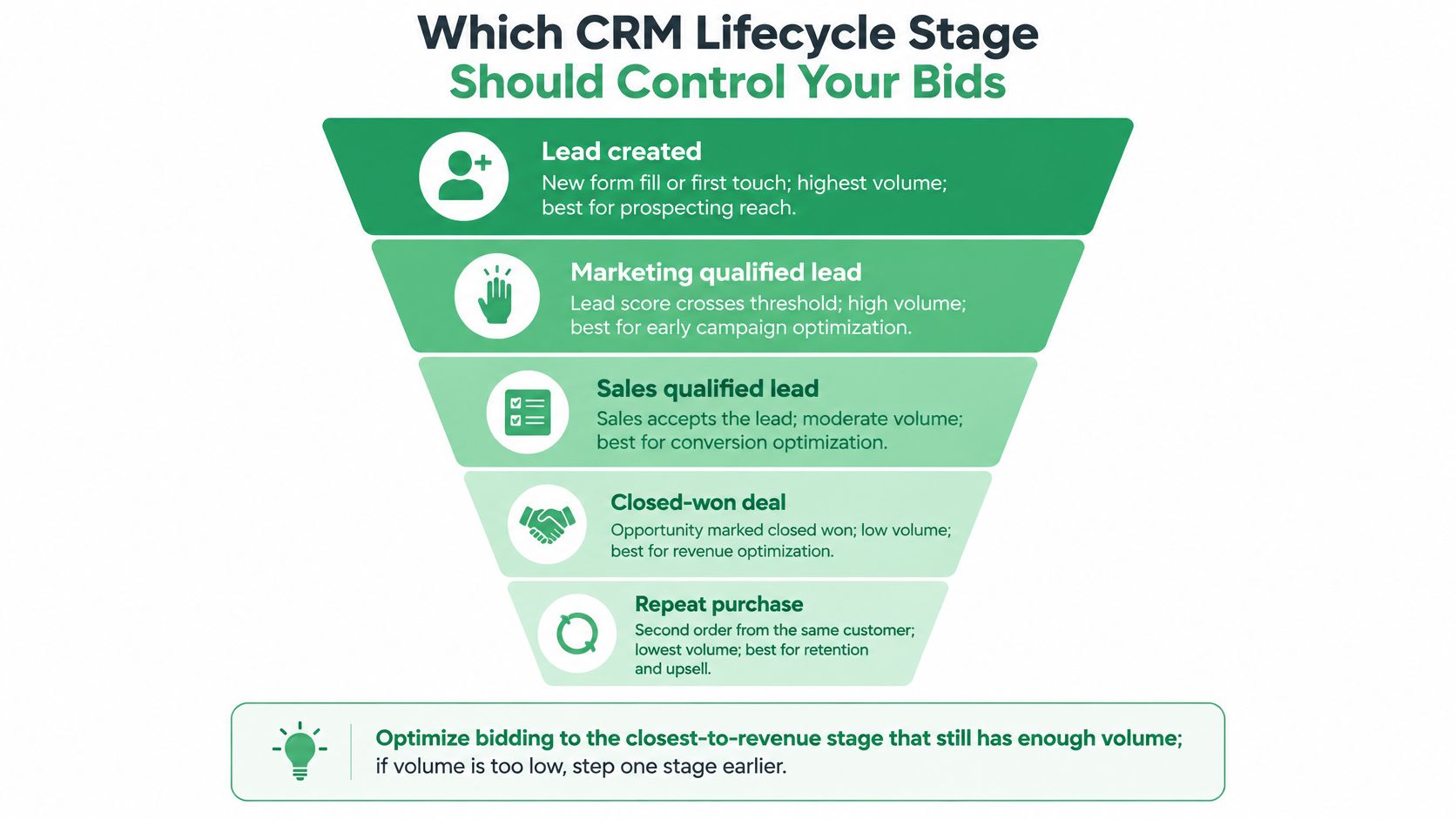
Optimize to the earliest lifecycle stage that has sufficient volume and reliably predicts commercial value. Use later stages to test whether that prediction holds. When a deeper stage becomes timely and stable enough, evaluate moving bidding closer to revenue.
The funnel illustrates the trade-off between proximity to revenue and available feedback.
Choose reliability before sophistication
Suppose sales accepts leads consistently, but closed-won deals arrive irregularly after lengthy negotiations. Sales-qualified leads may provide a more dependable bidding signal than revenue events. Conversely, an automated qualification score isn't useful just because it generates more events if sales routinely rejects those leads.
Don't move to opportunities merely because qualified leads are sparse. Opportunities generally occur less often. Use them when they provide a cleaner, consistently recorded business event, not as a mathematical solution to insufficient volume.
The commercial case for deeper signals is concrete. Google's Wpromote lead-quality case study reports a 72% increase in lead-to-enrollment conversion rate and a 24% reduction in cost per enrollment after offline CRM signals helped filter low-intent leads. That's a specific reported result, not a forecast for every advertiser.
Your headline cost per lead may initially rise when you stop rewarding cheap inquiries. That can be acceptable if qualified acquisition economics improve. Judge the change against the outcome you intended to buy, not the response metric you deliberately deprioritized.
Assign value before the sale closes
Use historical outcomes to estimate value:
- Expected value per qualified lead: Historical close rate multiplied by average closed-deal value.
- Expected cohort revenue: Qualified-lead volume multiplied by expected value per qualified lead.
- Margin-aware evaluation: Use contribution margin instead of revenue when delivery costs materially change customer economics.
Keep the assumptions visible and refresh them on a regular review schedule. Don't assign the entire expected cohort revenue to each individual lead, and don't count successive stage values as separate revenue.
Fallback rule: If your selected event becomes unreliable or excessively delayed, revert to the nearest dependable earlier stage and record when and why you switched.
That change log prevents analysts from mistaking a new optimization definition for a genuine performance improvement.
Consent and Governance Limits for CRM Data
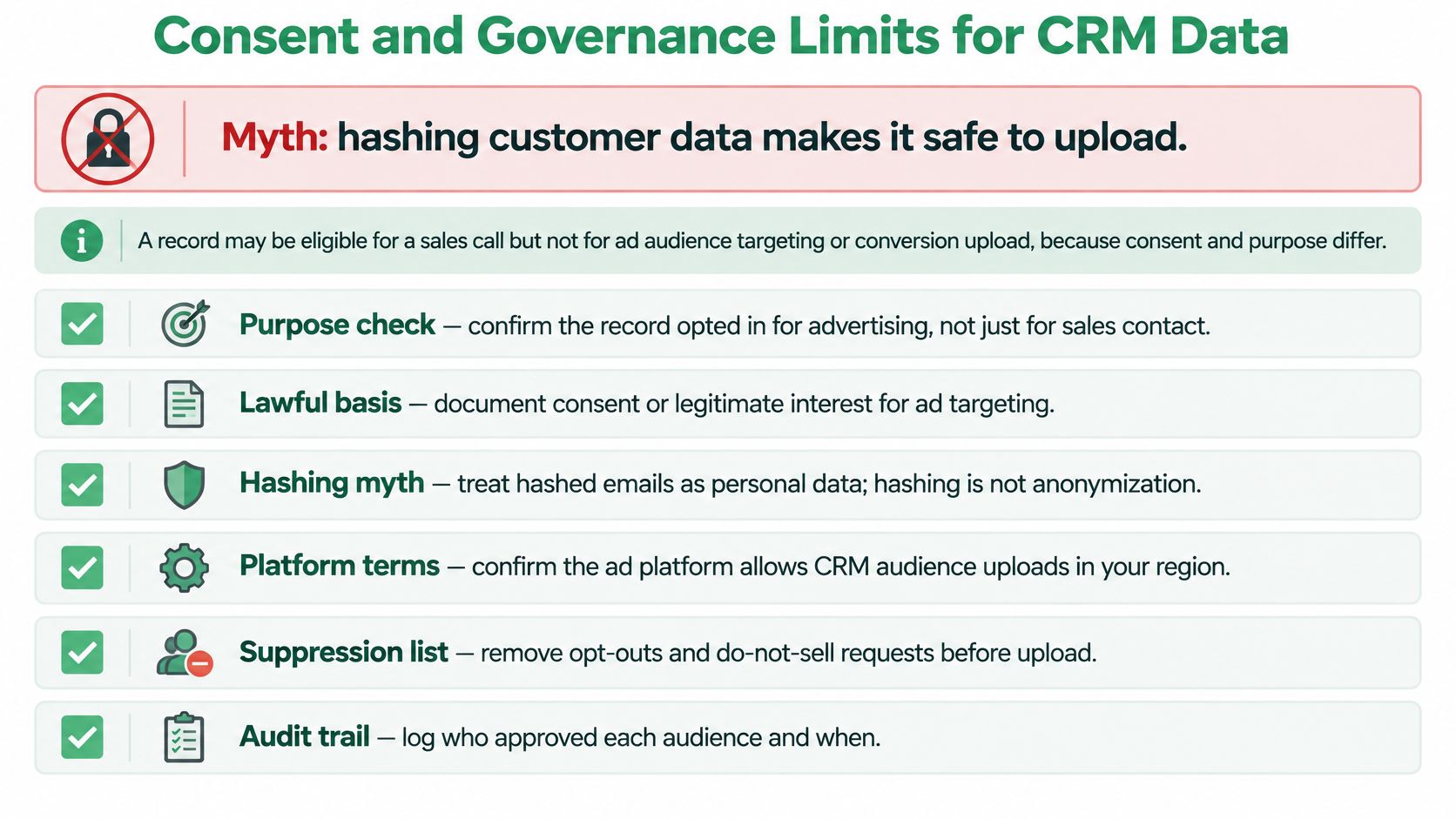
Hashing customer data doesn't make every upload permissible. It changes how identifiers are transmitted and matched. It doesn't establish that the advertiser was allowed to share them for that purpose.
The GrowLeads offline-conversion implementation guide explains the need to handle consent, advertising-partner disclosures, opt-outs, and deletion requests alongside technical matching. A contact may be eligible for a sales conversation without being eligible for audience targeting or conversion measurement. Treat those as separate permissions to assess, not interchangeable uses.
A smaller, permissioned dataset can therefore be strategically better than a larger collection with uncertain provenance. That's not a claim that fewer records automatically improve bidding. It means the team can maintain, explain, and consistently use the eligible records without relying on data it may later have to withdraw.
The checklist below separates technical readiness from permission to share.
Establish an upload control model
- Confirm purpose for each field: Document whether the intended use is sales follow-up, audience targeting, or measurement. Don't infer advertising eligibility from a populated email field.
- Apply regional restrictions: Route records according to applicable requirements and platform policies rather than treating every market identically.
- Set retention rules: Keep identifiers only for a documented business purpose and approved duration.
- Propagate deletions and opt-outs: Make downstream handling part of the workflow, not a separate task someone might remember later.
- Limit access and keep logs: Give operators only the permissions they need and retain a record of access and exports.
- Require human approval: Have a named reviewer approve each audience or conversion upload, including its destination and purpose.
- Separate reading from writing: Permission to diagnose CRM quality shouldn't automatically allow an agent or operator to export customer records.
- Record the payload: Log the fields, lifecycle events, and eligibility filters included in each approved transfer.
For the broader collection strategy behind these controls, Next Point Digital's first party data guide provides a useful resource to review alongside your implementation plan.
Keep rejected and withdrawn records out of retry queues as well as initial uploads. Otherwise, a technically successful retry can reverse a legitimate suppression decision.
A healthy match rate isn't proof that the data was allowed to leave the CRM. Evaluate eligibility and matching separately, with an accountable owner for each.
How to Send Qualified Outcomes Back to Ad Platforms
Choose the integration route before building the export. A native CRM connector is a sensible starting point when it supports your stages, consent controls, and required identifiers; a direct API integration offers more control over custom logic but needs development and maintenance.
Google's enhanced conversions for leads documentation describes supplementing imported offline outcomes with normalized, hashed first-party identifiers and retaining click identifiers such as GCLID. It also states that enhanced lead conversions uploaded more than 63 days after the associated last click won't be imported. Design the event selection around that limit rather than assuming every eventual sale can become an eligible bidding signal.
Use this process map to check the direction of the feedback loop before implementation.
Build and validate the export
Capture the click identifier at lead creation. Carry the GCLID from the landing-page parameter into a hidden form field and then the CRM record. Test redirects and form handoffs because losing the parameter before submission breaks the connection.
Store the stage, event timestamp, value, and currency alongside the lead's source identifiers. Preserve the original event time separately from the latest record-update time, or an administrative edit may look like a new commercial outcome.
Normalize and hash eligible email and phone fields before API submission. Follow the platform's formatting requirements and confirm whether your connector performs the transformation. A common implementation mistake is hashing an already hashed value or sending inconsistently formatted identifiers.
Upload only approved stages using stable event names, such as Qualified Lead and Closed Won. Map CRM labels explicitly to platform conversion actions, and exclude free-text sales notes and unrelated customer fields.
Create deduplication keys and process partial failures. Derive a stable event identity from the record and milestone rather than treating every edit as another conversion. Retry failed rows without resubmitting successful rows as new events.
Schedule exports around stage changes or a regular operating cadence. Reconcile eligible CRM events, attempted uploads, accepted records, and attributed outcomes separately, because acceptance doesn't establish that every record matched.
Check event age before export. Compare the last-click date, milestone timestamp, and upload time against the applicable import window. For long sales cycles, use an eligible earlier milestone for bidding while retaining later revenue for internal evaluation.
For a complementary tracking walkthrough, Silva Marketing explains how to measure offline sales from ads. Use it to review the relationship between the original interaction and the eventual offline outcome.
The accompanying video offers another implementation reference.
Monitor the connection as an operating system
Use the Google Ads connection documentation when planning account access and supported operations. Keep access configuration distinct from the conversion-export specification so a working account connection isn't mistaken for complete measurement.
The loop is ready for a controlled test when stage counts reconcile, duplicate handling works, and errors have named owners. Set an acceptable error tolerance before launch rather than declaring an arbitrary threshold afterward.
Then check whether bidding responds to qualified outcomes, not merely whether the upload job runs successfully.
Measuring Campaigns by Revenue, Not Clicks
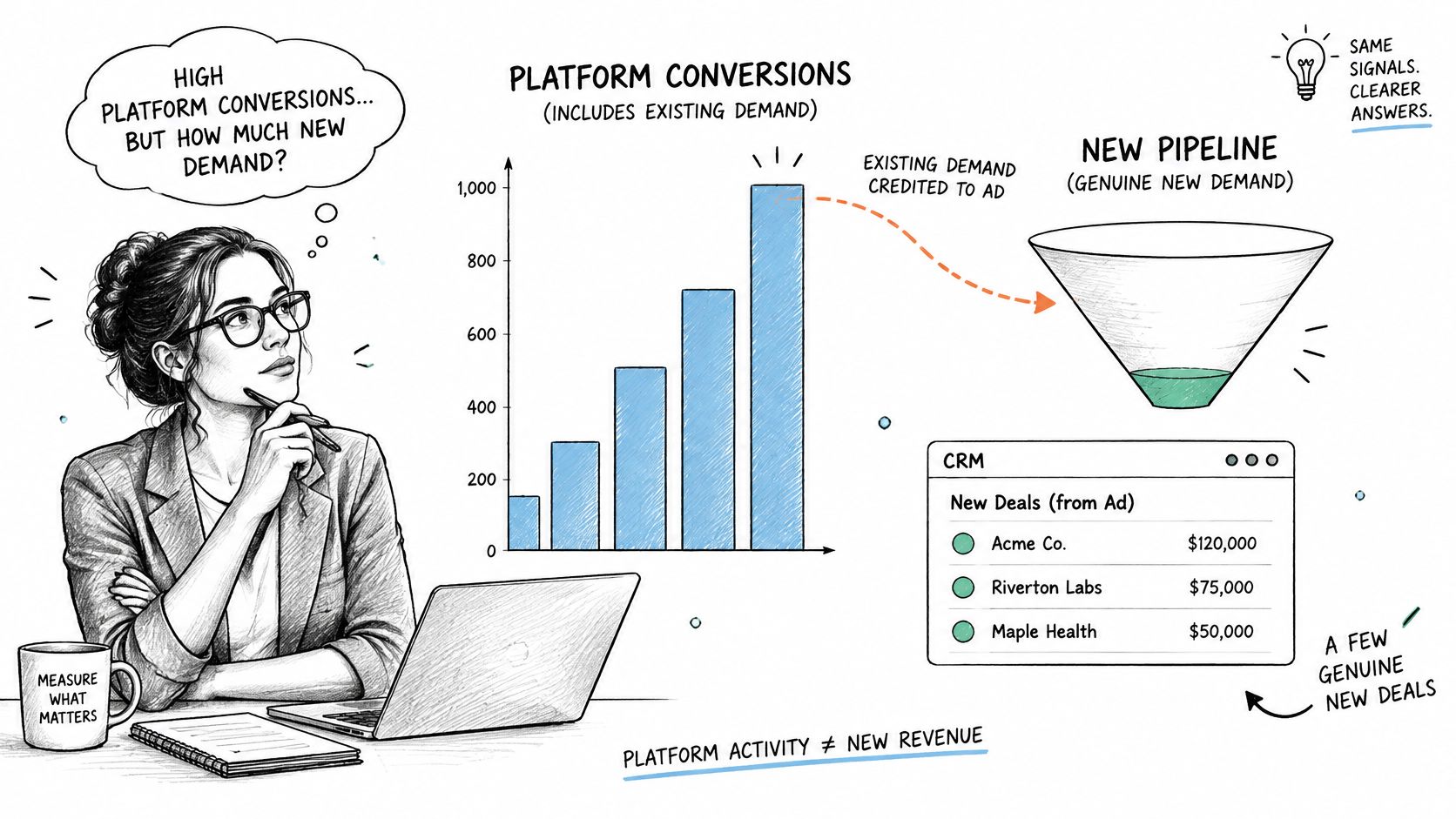
A campaign can receive credit for customers who were already likely to buy. CRM-linked revenue makes that campaign look more commercially relevant, but it doesn't by itself prove the advertising created additional demand.
This is the distinction between attribution, which allocates credit, and incrementality, which estimates what wouldn't have happened without the advertising. You need both perspectives before making consequential budget changes.
Measurement methods compared for CRM-linked advertising
| Method | Question it answers | Data it needs | Main limit |
|---|---|---|---|
| Platform last-click or default attribution | Which interaction received credit under the selected platform rule? | Click and conversion logs | Last-click overweights the final touchpoint; other defaults remain model-dependent |
| Data-driven attribution | How much credit should each observed touchpoint receive? | Historical journeys linked to CRM outcomes | Needs sufficient conversion history and observable journeys |
| Marketing mix modeling | What incremental sales are associated with channels over time? | Aggregated spend, revenue, and relevant business controls | Coarse for small-scale, short-term campaign decisions |
| Holdout or geo experiment | Did advertising create outcomes beyond an untreated baseline? | Treatment/control design and comparable CRM outcomes | Requires planning and limits exposure in the control |
| Incremental cost per qualified opportunity | What does each additional qualified opportunity cost? | Incremental opportunity estimates and corresponding spend | Requires clean stage definitions and a credible baseline |
Google's attribution white paper cites BCG and Google findings that companies with successful data-driven marketing strategies can reduce costs by as much as 30% while generating 20% more revenue. These are findings about broader data-driven strategies, not a guaranteed effect of connecting a CRM.
Google also describes marketing mix modeling as a cross-channel approach to estimating marketing-driven incremental sales against an expected baseline over a longer horizon. That makes it useful for strategic allocation, while a well-designed experiment can address a narrower campaign or market decision.
Define value before comparing models
Start with the economic outcome: accepted opportunities, closed revenue, contribution margin, or retained customer value. Choose the measure that reflects the business decision, then ensure sales and marketing use the same definition.
Maintain immutable event timestamps, campaign and ad identifiers, and normalized currencies. Compare acquisition cohorts with equivalent time to mature, or a recently launched campaign can look weaker because its customers haven't finished buying.
For operational comparisons, a cross-platform return-on-ad-spend workflow can help frame the account-level questions. But calculated ROAS still needs scrutiny when separate platforms claim the same customer.
Move substantial budget when commercially defined CRM outcomes and a credible incremental measurement method support the same decision.
Agreement isn't absolute proof, especially if both methods share biased inputs. Still, an attribution report supported by a properly designed holdout is a stronger basis for action than attributed conversions alone.
Audience Insights and Examples From Real CRM Data
Consider an illustrative dental-practice scenario, not a reported client result. The practice runs search campaigns for general checkups and implant consultations. Its advertising dashboard shows cheaper calls for checkups, so the paid media manager initially favors that campaign.
The CRM tells a more useful story: implant consultation leads are more likely to proceed to paid treatment and produce more revenue per patient in this scenario. Before shifting spend, the analyst checks whether the apparent advantage survives cancellations, treatment delivery costs, and differences in how long patients take to decide.
The useful insight isn't that implant campaigns always deserve more money. It's that the cheapest response and the best acquisition opportunity aren't necessarily the same thing.
Turn outcomes into audience decisions
- Suppression: Identify current patients and recent buyers who shouldn't receive new-customer acquisition offers. Keep service reminders and appropriate retention activity separate rather than excluding existing customers from all advertising.
- Seed lists: Where platform policy and permissions allow, define high-value customers using completed purchases, repeat business, and retained value. Don't export treatment details or other sensitive clinical information to construct a healthcare advertising audience.
- Segmentation: Group records by first product purchased, original lead source, and time to close. Compare subsequent outcomes within those groups instead of assuming every customer acquired through the same channel behaves alike.
The analyst should also check whether the groups are comparable. A campaign attracting existing patients shouldn't be evaluated as if it created entirely new customer relationships, and a high-revenue treatment isn't automatically the highest-margin acquisition.
Apply the same reasoning to B2B pipeline
Suppose a software team compares leads arriving through industry-specific landing pages. In this illustrative case, opportunity records show that prospects from a particular industry page progress to signed contracts faster than prospects from other pages.
That finding creates a testable hypothesis, not permission to scale immediately. The team should check whether those accounts also share company size, contract scope, sales ownership, or an existing relationship that explains the shorter cycle.
Preserve the original acquisition source while recording later touches separately. Otherwise, an account's final visit to a pricing page can overwrite the industry page that first attracted it, leaving the analyst to optimize the wrong entry point.
Both scenarios depend on complete outcome records, not just attractive segments. Include disqualified, lost, cancelled, and refunded records when evaluating quality, so successful customers don't become the only people represented in the analysis.
A customer record becomes useful for advertising when its outcome remains connected to its origin. Without that connection, an audience list may contain valuable customers but offer little evidence about how to acquire more of them.
Confirm Your First CRM-to-Ad Step This Month
Choose a qualified-lead stage and audit whether its records contain a click identifier, lead source, stage timestamp, and deal or expected value. Treat missing fields as implementation work, not reasons to fill gaps with assumptions.
Run a bounded measurement test
- Compare campaign rankings: Place cost per lead beside cost per qualified lead over an agreed observation period, allowing enough time for qualification.
- Set a measurable pass condition: Require reconciled eligible-event counts and complete source fields before testing bidding changes.
- Assign approval: Name the person who approves uploads and the person who authorizes budget changes.
NotFair is one option for teams that want an AI agent to examine advertising and CRM context in one session. Our GoHighLevel CRM records every form, call, and ad lead with its source, so clients can see which ad produced which customer.
Nothing goes live and no ad budget changes until the client approves it. Google Ads, Meta, and Search Console connect through the client's own logins, so the data and history stay with the client.
Start with a measurement test, not a scaling decision. Confirm that campaign rankings reflect qualified outcomes before asking automation to spend more.
NotFair connects advertising, analytics, and CRM context so your AI agent can investigate campaign performance and propose reviewable changes. Visit NotFair to explore a governed CRM-to-ad workflow, starting with a qualified-lead audit and client-approved next steps.