

At 8:47 a.m., a performance marketer opens Google Ads, Meta Ads Manager, Search Console, GA4, and the CRM. Cost per lead has climbed for three weeks, but every dashboard offers a different explanation. One points to creative fatigue, another to audience saturation, GA4 suggests a landing-page regression, and the CRM shows a follow-up gap. Four hours go into diagnosis, then another two go into making changes across disconnected systems.
That's the opportunity for AI for digital marketing. Not another copy generator, but a connective operating layer that brings signals together, recommends the next action, and executes it in the channel where the action belongs. The advantage comes from better decisions and shorter feedback loops, provided the system can show what it changed, who approved it, and how to reverse it.
Table of Contents
- The Five-Dashboard Problem AI Is Finally Built to Solve
- What AI for Digital Marketing Actually Means in 2026
- The Five Core Application Areas of AI in Digital Marketing
- How AI Changes Paid Ads and Organic Search
- Governance, Approval Gates, and the Audit Layer
- Measuring AI ROI Without Fooling Yourself
- A Phased Rollout Plan for AI Agents and MCP Layers
- The Question Marketers Should Be Asking Next
The Five-Dashboard Problem AI Is Finally Built to Solve
The marketer in that morning scenario doesn't have a lack-of-data problem. They have a coordination problem. Google Ads reports search-term drift, Meta shows declining engagement, Search Console reveals weaker click-through rates, GA4 exposes a conversion-path change, and the CRM tells a different story about lead quality. Each platform may be accurate within its own boundaries, yet none owns the complete diagnosis.

A useful AI system pulls those signals into one question: what changed, why did it change, and which action has the highest commercial priority? It might connect a rise in paid search costs to loose-match queries, then check whether those queries produced qualified CRM opportunities. It might compare the same landing page across paid and organic sessions before recommending a page rollback or a new message match test.
Diagnosis should end with an executable decision
The output shouldn't be a generic summary. It should be an ordered action list:
- Signal: Search terms are consuming spend without producing qualified leads.
- Hypothesis: Broad matching is attracting low-intent traffic after a campaign structure change.
- Recommended action: Draft negative keywords and move relevant queries into tighter ad groups.
- Control: Show the exact changes, require approval, and retain a rollback path.
- Measurement: Track qualified lead rate and downstream pipeline, not clicks alone.
Teams that need a shared reporting foundation should start with centralizing GA4 and CRM data, because an agent can't produce a reliable cross-channel diagnosis from isolated exports and inconsistent identifiers.
The important shift is that the marketer stops acting as the integration point. They set the objective, review the evidence, approve material changes, and investigate exceptions. The system handles the repetitive work of collecting data, comparing periods, drafting edits, and writing updates back to the relevant channel.
That is the operating model this guide recommends. Automate the analysis and chores first. Delegate decisions only when the data, permissions, safeguards, and measurement are ready.
What AI for Digital Marketing Actually Means in 2026
AI for digital marketing isn't one product. It's a stack, and most vendor confusion comes from treating a single layer as the whole system.
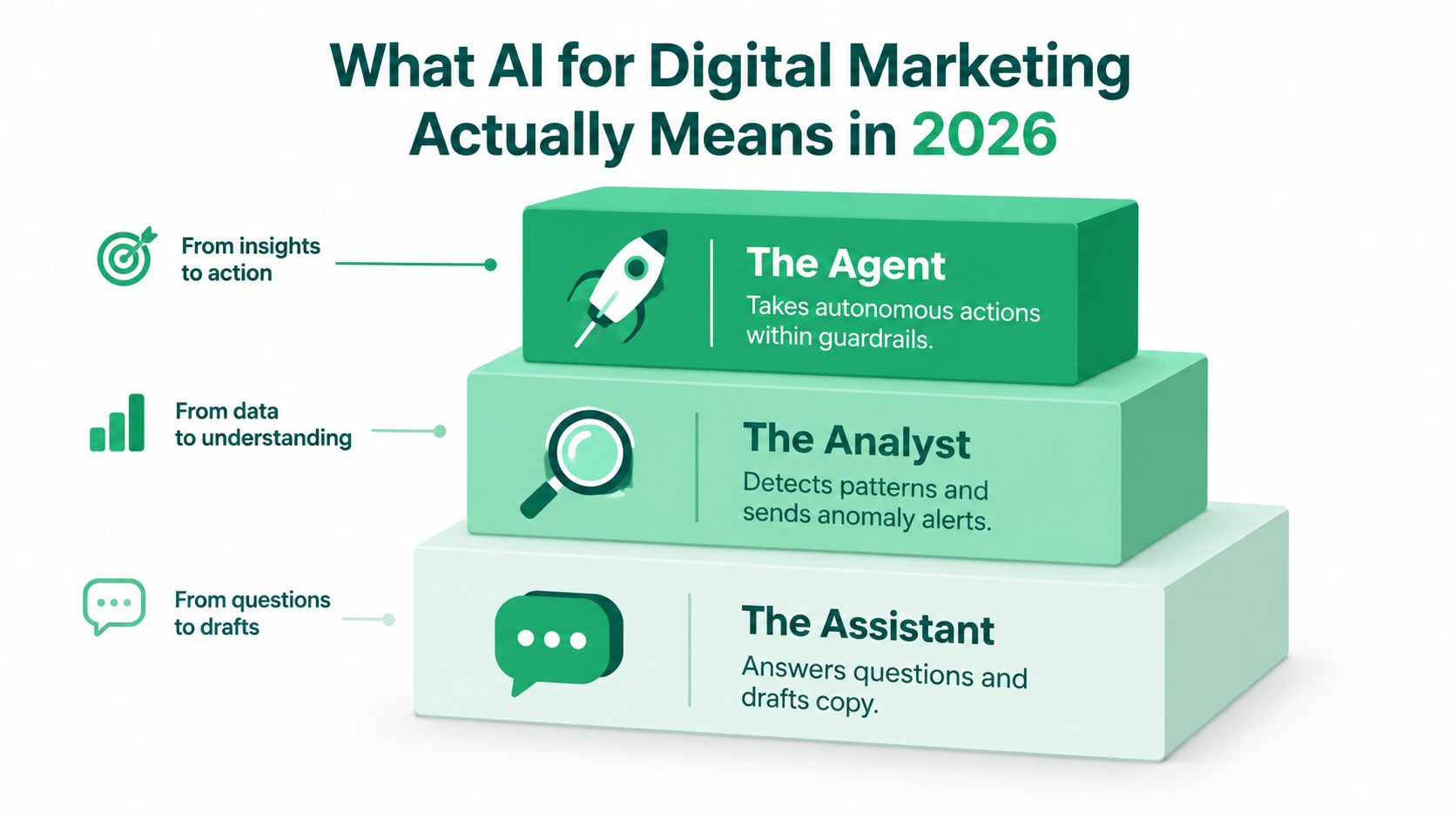
At the bottom sits the assistant. A generative model drafts ad copy, summarizes Search Console anomalies, turns a GA4 question into a plain-language answer, or creates a first-pass content brief. It responds to instructions, but it doesn't own a goal or act independently.
The next layer is the analyst. It compares performance, detects unusual movement, clusters queries, identifies relationships between events, and proposes explanations. This layer turns raw data into a decision context. It still shouldn't modify a live account without explicit permission.
Agents need tools, not just intelligence
The agent runs a goal-driven loop. It reads a signal, evaluates possible actions, selects a permitted action, and writes back to a channel. A paid-media agent might detect deteriorating search-term efficiency, draft negatives, display a diff, and wait for approval before publishing.
That agent needs a controlled connection layer. A Model Context Protocol, or MCP, layer provides scoped access to platforms such as Google Ads, HubSpot, BigQuery, GA4, and Search Console. Instead of scraping pages or handing a model unrestricted credentials, the connector exposes defined tools and permissions.
The final layer is governance. It includes risk tiers, approval gates, explicit diffs, audit logs, scoped tokens, and one-call undo. Without it, an agent is a fast operator with an unclear blast radius. With it, the team can increase autonomy based on evidence.
Place any AI product on this map before buying it. If it only writes text, it's an assistant. If it detects patterns but can't act, it's an analyst. If it can change campaigns but doesn't show diffs or preserve history, it has an execution capability without an adequate control layer.
Practical rule: Never evaluate an AI marketing tool by asking whether it can generate output. Ask which decision it can make, which system it can touch, and what happens when it's wrong.
The Five Core Application Areas of AI in Digital Marketing
The strongest use cases share one characteristic: the data and the action live close together. An insight that requires manual exporting, cleaning, interpretation, and re-entry loses much of its value.
Paid advertising
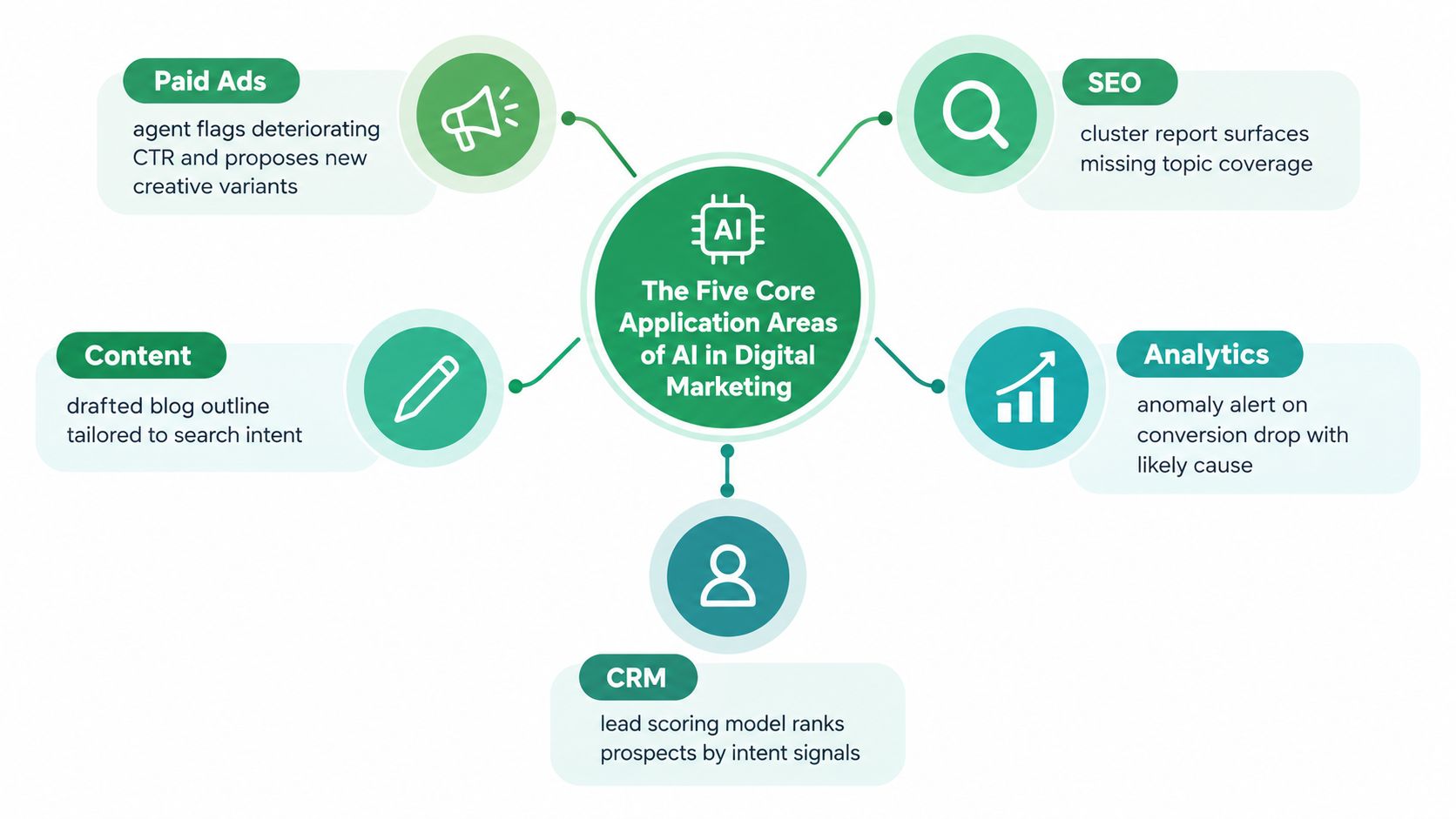
An agent monitors deteriorating click-through rate, checks spend and conversion quality, then proposes a new responsive search ad headline set. The expected output isn't “improve creative.” It's a draft with the affected campaigns, the proposed variants, the reason for each change, a budget ceiling, and an approval request.
AI can also harvest search terms, identify wasted spend, group related queries, and prepare negative-keyword changes. Keep budget movement and campaign launches behind a human gate.
Organic search
For SEO, the useful output is an actionable content and linking plan. A system clusters queries by intent, compares them with existing pages, surfaces missing topic coverage, scores internal-link opportunities, and drafts an outline that matches the site's current authority.
The editor still decides whether the recommendation reflects the brand's expertise. AI can accelerate research and prioritization, but it shouldn't invent expertise or publish unsupported claims.
Analytics
A natural-language analytics layer should answer a question such as “why did signups drop on Tuesday?” by producing the underlying query, a chart, the segments affected, and competing hypotheses. The marketer can then inspect whether the change came from channel mix, device behavior, a broken event, or a landing-page issue.
That transparency matters. A conclusion without the query and supporting breakdown is a prompt response, not an analytical workflow.
CRM
A lead-scoring model combines ad click paths, email engagement, firmographic context, and product usage. It then ranks prospects by intent and routes them to the correct HubSpot or CRM workflow.
The practical output might be a prioritized queue, a reason code for each score, and a proposed nurture change. Sales operations should approve threshold changes because an incorrect model can reroute valuable leads or overload a team with poor-fit opportunities.
Workflow automation
A workflow agent watches for a defined condition, such as an unusual cost-per-lead increase. It checks related campaign and conversion signals, pauses only pre-approved low-risk ad groups, posts an alert in Slack, and drafts a post-mortem for review.
Social and creator programs can also benefit from structured research, audience matching, and campaign coordination. For a focused view of this area, the discussion of AI in influencer marketing 2026 is useful context.
The shared principle is simple: AI creates commercial value when detection, decision, action, and measurement connect in one workflow.
How AI Changes Paid Ads and Organic Search
Paid media and SEO should not receive the same autonomy settings. Paid changes can spend money immediately. Organic changes can affect publication quality, internal architecture, and search visibility over a longer cycle.
| Workflow | Human owns today | Agent can handle | Approval required |
|---|---|---|---|
| Paid search terms | Inspect queries and decide exclusions | Classify terms and draft negatives | Publish changes |
| Paid budgets | Review pacing and reallocate spend | Model scenarios and flag risk | Any material budget move |
| Paid creative | Write and rotate variants | Generate drafts and compare performance | Final copy and launch |
| SEO refreshes | Choose pages and edit recommendations | Prioritize decay, draft updates, suggest links | Publication |
| Technical SEO chores | Check recurring issues | Detect anomalies and prepare tickets | High-impact changes |
The default should be supervise the spend, supervise the publish, automate the chores. Let an agent gather search terms, classify queries, identify stale pages, generate schema drafts, and prepare internal-link suggestions. Don't let it launch campaigns, change account-wide budgets, or publish sensitive copy without a reviewer.
Paid search benefits from short feedback loops. An agent can compare search terms, creative combinations, audience signals, and landing-page outcomes faster than a human working through separate interfaces. The handoff should occur at the point where a recommendation becomes a financial commitment.
Organic search needs a different boundary. Schedule crawls, content decay alerts, topical gap analysis, and link-opportunity scoring. Require editorial review for claims, factual accuracy, brand positioning, and pages that affect regulated or high-trust topics.
Teams can connect conversational AI to advertising workflows through integrations such as ChatGPT and Google Ads, but the connection itself isn't the strategy. The important question is whether the integration exposes context, limits permissions, records changes, and makes the human handoff obvious.
The safest automation is not the automation that does the most. It's the automation that makes the next decision easier to verify.
Governance, Approval Gates, and the Audit Layer
Governance is the condition that makes autonomy possible. Without it, teams either block agents entirely or allow uncontrolled changes because reviewing every action manually becomes impossible.
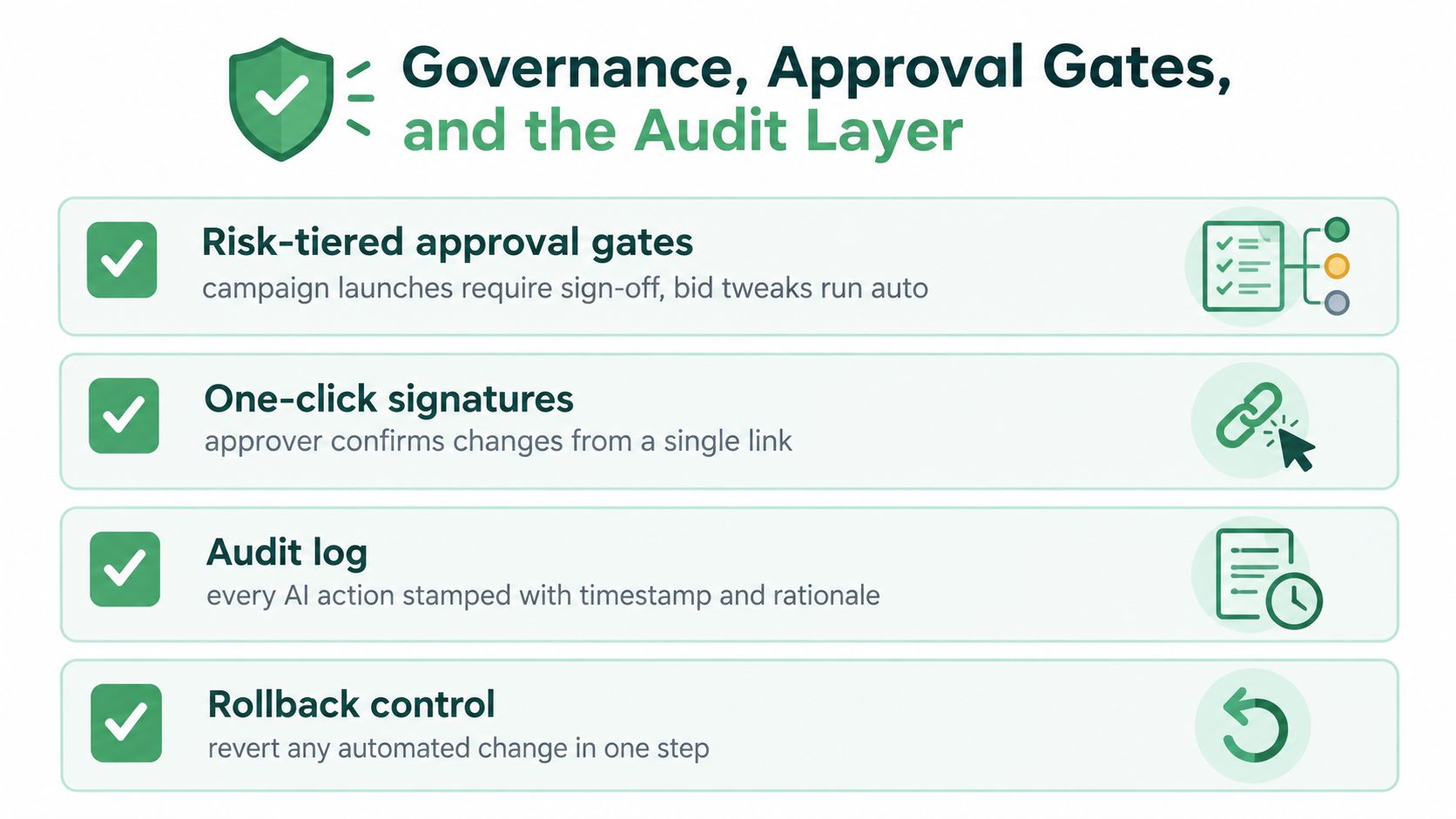
Start by assigning actions to risk tiers. A read-only diagnosis is low risk. A bid adjustment may be moderate risk. A campaign launch, audience expansion, budget move, or compliance-sensitive message is high risk. Each tier needs a different approval path.
Make every proposed change inspectable
An approval request should show a diff, not a vague recommendation. The reviewer should see the current value, proposed value, affected account or campaign, reason for the change, expected consequence, and any limits applied.
Use role-based ownership:
- Specialist: Approves creative, keyword, audience, and targeting changes.
- Marketing manager: Approves budget movements and campaign-level risk.
- Legal or compliance: Reviews regulated claims, sensitive audiences, and disclosure language.
- Automation: Handles read operations, routine alerts, formatting, and other explicitly low-risk chores.
A one-click signature should approve the exact diff, not an entire future sequence of actions. If the agent discovers a new issue after approval, it should create a new request.
Preserve history and reversal
An audit log needs the actor, timestamp, affected object, rationale, approval identity, and resulting platform response. Store enough context to reconstruct what happened without relying on memory or a chat transcript.
Undo must reverse the actual change and account for downstream effects. If an agent paused an ad group and moved budget elsewhere, rollback should identify both actions. A log that records activity but can't restore the prior state is a diary, not operational control.
Before connecting an agent to a live account, confirm that you have:
- Scoped permissions for each platform and action.
- Risk-tiered approval gates tied to named roles.
- Explicit diffs before every write.
- Immutable change history with rationale and timestamps.
- One-step rollback for automated changes.
- Data handling rules for customer and conversion information.
- Exception alerts when the agent encounters uncertainty or missing data.
A hosted connector such as Meta Ads MCP can fit this model when its write operations remain approval-gated and reviewable. The broader lesson applies regardless of vendor: governance turns an agent from an uncontrolled operator into a delegable teammate.
Measuring AI ROI Without Fooling Yourself
The ROI question has three layers, and teams often stop at the easiest one.
First, measure time recovered. Record how long marketers spend collecting data, preparing reports, classifying search terms, drafting variants, and implementing approved changes. Time saved only counts if the team redirects it toward higher-value work or reduces operating cost.
Second, measure performance movement. Depending on the workflow, that could include cost per lead, conversion rate, qualified lead rate, organic visibility, or revenue per customer. Pick the metric the automated decision can plausibly influence, not a broad dashboard number that moves for many unrelated reasons.
Third, measure revenue contribution. Connect AI-driven actions to incremental pipeline or margin where the data supports it. Don't call faster reporting revenue impact unless the reporting changed a decision that affected commercial results.
One 2025 survey found that 49% of companies said they could measure the ROI of their AI investments, which leaves a substantial measurement gap between adoption and proven financial impact. The figure appears in the 2025 State of AI Marketing report, and it should make every vendor promise more demanding, not less.
Use a practical evaluation formula
Stress-test a program with:
(hours saved × loaded labor cost) + (incremental revenue × margin) − (tooling cost + governance overhead)
Keep each input explicit. Governance includes review time, data work, testing, connector maintenance, and rollback preparation. If the result only works when you count every automated action as revenue, the business case isn't ready.
Avoid three common traps:
- Vanity metrics: More generated copy or dashboard summaries don't prove commercial value.
- Double counting: Don't count a report as both time saved and performance lift unless it caused a separate measurable action.
- Seasonality confusion: Compare an AI-enabled workflow with a comparable period or controlled holdout, rather than assigning every improvement to the tool.
A holdout cell provides the cleanest test. Keep AI disabled for a comparable segment or workflow, measure both groups over the same operating period, and define the success metric before the test begins. The point isn't perfect attribution. The point is to separate signal from enthusiasm.
For teams working in GA4, a conversational connection such as ChatGPT and Google Analytics can reduce analysis friction, but it doesn't replace experiment design or clean event definitions.
A Phased Rollout Plan for AI Agents and MCP Layers
Don't start by connecting an agent to every marketing platform. Start with the data and permissions that determine whether its recommendations can be trusted.
Phase one builds the operating base
Unify event names, campaign naming, conversion definitions, account identifiers, and CRM stages. Document which system owns each field and how a lead moves from click to pipeline.
Create a short data contract for every workflow:
- Inputs: Which fields the agent may read.
- Definitions: What each metric means.
- Freshness: How current the data must be.
- Owner: Who resolves data-quality failures.
- Exclusions: Which customer data and actions remain off limits.
During this phase, the agent should remain read-only. The success condition is not a performance lift. It's a diagnosis that a specialist can reproduce from the source systems.
Phase two proves one supervised workflow
Choose a narrow, recurring process with a clear action boundary. Weekly search-term pruning is a strong candidate because the inputs, proposed changes, reviewer, and rollback state are easy to define.
The agent reads live data, classifies terms, drafts a diff, and waits. A human reviews every proposed change, approves or rejects it, and records the reason. Measure recommendation quality, review time, implementation errors, and the downstream metric tied to the workflow.
Rollout principle: Earn autonomy with repeated evidence. Don't grant it because a vendor demo looked convincing.
Phase three expands across channels
Once the first workflow behaves consistently, add related routines. Connect paid search findings with landing-page conversion data, organic queries with content refreshes, and CRM outcomes with audience decisions. Keep cross-channel budget reallocation behind an explicit approval gate until the team understands the blast radius.
Before expansion, verify:
- Role assignment: Every action has a named owner.
- Rollback path: The prior state can be restored quickly.
- Approval scope: The agent can't exceed its permitted account or budget boundaries.
- Success threshold: The team knows what result justifies continued use.
- Failure response: Missing data, conflicting signals, and platform errors trigger escalation.
The pattern resembles the emerging agentic future for catalog managers, where systems coordinate repetitive decisions but still need structured inputs, boundaries, and human accountability. Marketing teams should apply the same discipline to campaigns, content, and customer journeys.
The Question Marketers Should Be Asking Next
Stop comparing AI tools by feature lists. Decide which workflow you're willing to delegate, under which controls, and with what evidence.
Model quality matters, but it is not the lasting advantage. Capable assistants and analysts are widely available. Performance improves when teams connect reliable data, permission design, feedback loops, and governance that increases autonomy without removing accountability.
Bring three questions to the next planning meeting:
- What decision should an agent make independently?
- What is the maximum blast radius if it makes the wrong decision?
- Who owns the audit trail and the rollback?
Start with a narrow workflow. An agent can classify search terms, draft negative keywords, and prepare a weekly approval queue. It might flag CRM routing anomalies without changing lifecycle stages. Choose work with clear inputs, a named reviewer, and a measurable commercial outcome.
Fast-moving marketing teams will not win through larger prompt libraries. They will instrument a revenue-influencing process, run it behind approval gates, inspect diffs and logs, then improve it after each cycle. Pick that process this week and ship its first supervised run.
NotFair provides hosted MCP servers that connect AI agents to advertising, analytics, and CRM platforms with live reads, approval-gated writes, explicit diffs, logging, and one-call undo. Visit NotFair to evaluate whether its connectors fit the first supervised workflow you are ready to operationalize.