
If you’re weighing adzooma alternatives, start by matching the tool to the work you need done: Optmyzr and Adalysis are candidates for structured Google Ads optimization; Skai is aimed at larger, multi-channel operations; Revealbot and Madgicx focus more on ad automation; and NotFair connects AI clients to ad platforms through MCP servers. This comparison is for paid search and paid social managers, agencies, and growth teams. It evaluates each option on workflow fit, platform scope, implementation burden, and commercial model—not on unverified performance claims.
These products are not interchangeable. Some organize recurring optimization work inside an advertising account, some automate rules across campaigns, and some suit complex enterprise operations or AI-assisted workflows. Treat the list as a shortlist to validate against your account structure, approval process, and channels—not a claim that each tool replaces every part of Adzooma.
How this comparison is evaluated
For a useful comparison, “better” depends on the job and on who must operate the tool. Use the same four checks for each candidate:
- Workflow: Does it support recurring optimization, rule-based automation, or another clearly defined job?
- Coverage: Does its stated focus align with the ad platforms your team actually manages?
- Operational fit: How much setup, account structure, and ongoing review might the workflow require?
- Commercial model: Can the team understand the current plan and what it includes before committing?
Specific features and plans can change. The links below point to official vendor pages; confirm current capabilities, supported accounts, terms, and pricing directly before buying. No hands-on testing or comparative performance data was supplied for this article, so recommendations are based on positioning and the work each product is designed to address.
1. Optmyzr

Best fit: recurring PPC optimization work
Optmyzr is a candidate for search marketers who want a dedicated optimization and management layer around paid campaigns. Consider it when the recurring job is larger than making occasional edits: for example, a team may need a repeatable process for reviewing accounts, spotting opportunities, and handling routine campaign work. The official Optmyzr site describes its PPC management offering; confirm the specific features and platform coverage relevant to your accounts before relying on them.
Implementation burden: Expect to map the tool’s workflow to your naming conventions, account permissions, review cadence, and existing scripts or reporting. An agency should also decide which tasks are standardized across clients and which require client-specific checks. A structured tool can make repeated work easier to organize, but it still needs an operator who understands campaign context.
Trade-offs
- Best for: Search teams with recurring optimization work and enough account volume to value a dedicated workflow.
- Does not suit: A team seeking only a simple campaign dashboard or a fully unattended decision-maker.
- Standout: A PPC-focused alternative to managing every routine action directly in platform interfaces.
Commercial model: Check Optmyzr’s current plan and sales information for the account scale and features you need; don’t assume a plan includes a particular channel or workflow. The trade-off is that a specialized optimization layer can add a separate subscription and another place to manage permissions and process.
2. Adalysis
Best fit: teams focused on Google Ads analysis
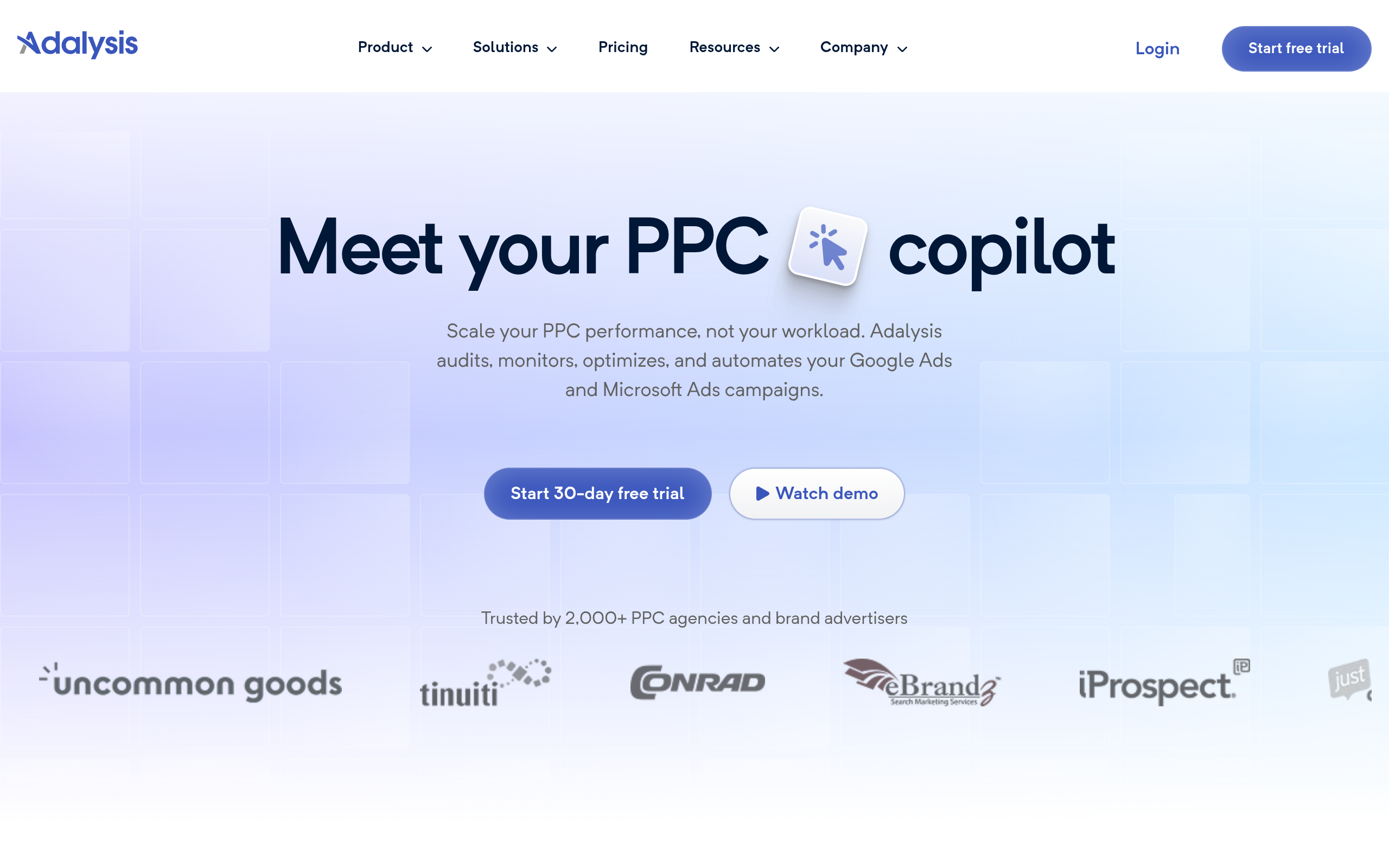
Adalysis is worth evaluating when the core need is Google Ads account analysis and ongoing optimization, rather than a broad enterprise media suite. A search manager can compare its stated account-review workflow with the team’s actual routine: Which checks are currently manual? Which findings need a human decision? Which changes can be applied only after a reviewer confirms the context? See the official Adalysis site for its current product scope, then verify that each desired check is available for your account type.
Implementation burden: The tool’s usefulness depends on connecting the right accounts and defining how recommendations enter the team’s change process. Agencies should test the workflow on a representative account before standardizing it across clients. A review flag is not automatically a business priority: branded search, seasonal promotions, and limited conversion data can all change what an account finding means.
Trade-offs
- Best for: Paid search specialists who want a Google Ads-centered analysis and optimization workflow.
- Does not suit: Teams whose primary requirement is one unified operating layer for a wide mix of paid media channels.
- Standout: A more focused candidate when Google Ads is the main source of optimization work.
Commercial model: Verify current pricing and plan boundaries with Adalysis before comparing it with a broader platform. If your team mainly wants a one-time audit, assess whether an ongoing subscription fits the frequency of work; if reviews are continuous, compare the tool’s recurring workflow with the time currently spent on checks.
3. Skai
Best fit: complex, multi-channel operations
Skai is a different scale of alternative: consider it when paid media operations span multiple channels, teams, or organizational workflows and a small-account optimization tool would not cover the operating model. Its official site describes a platform for marketers; check directly which modules and advertising channels apply to your use case. Do not assume that a platform’s broad positioning means every capability is included in one package.
Implementation burden: Enterprise-oriented software usually calls for more planning than a lightweight tool: assess account and user structure, data dependencies, approvals, onboarding, and who will own configuration. Before a procurement decision, write down the workflows that must be consolidated. If the only problem is a few repetitive edits in one Google Ads account, an enterprise buying process may be disproportionate.
Trade-offs
- Best for: Larger teams assessing a shared operating layer across complex paid media workflows.
- Does not suit: A small team seeking a quick, low-overhead replacement for basic campaign tasks.
- Standout: A candidate to assess when organizational and channel complexity—not just optimization suggestions—is the problem.
Commercial model: Confirm the current scope, contract, and pricing with Skai, including which capabilities require separate modules or services. The central trade-off is potential operational breadth against procurement and implementation effort; compare both with your actual requirements, not with a feature checklist alone.
4. Revealbot
Best fit: rule-based advertising automation
Revealbot is a candidate when the job is to automate defined campaign actions rather than to buy a broad PPC audit product. A useful example is an internal policy that calls for a manager to review a campaign when a chosen condition occurs. That rule needs an owner, a clear input, and a safe response; it should not be treated as proof that the underlying campaign is healthy. Consult Revealbot’s official site for current automation scope and platform support.
Implementation burden: Rule design is the real work. Teams need to agree on conditions, exclusions, notification or action behavior, and what happens when data is delayed or a campaign has an unusual schedule. Start by documenting one low-risk, reversible workflow and the person responsible for reviewing it. Verify platform permissions and the available actions before moving from alerts to changes.
Trade-offs
- Best for: Teams with clearly defined, repeatable campaign rules and a process to review their effects.
- Does not suit: Marketers who want broad strategic recommendations without specifying operating rules or review steps.
- Standout: A rule-automation option to compare when repetitive campaign responses are the main bottleneck.
Commercial model: Check Revealbot’s current pricing and plan details against the platforms and account volume you intend to use. Its automation approach may save repetitive operator effort, but it also creates a need to maintain rules as campaign objectives, tracking, and account structure change.
5. Madgicx
Best fit: teams exploring paid social automation
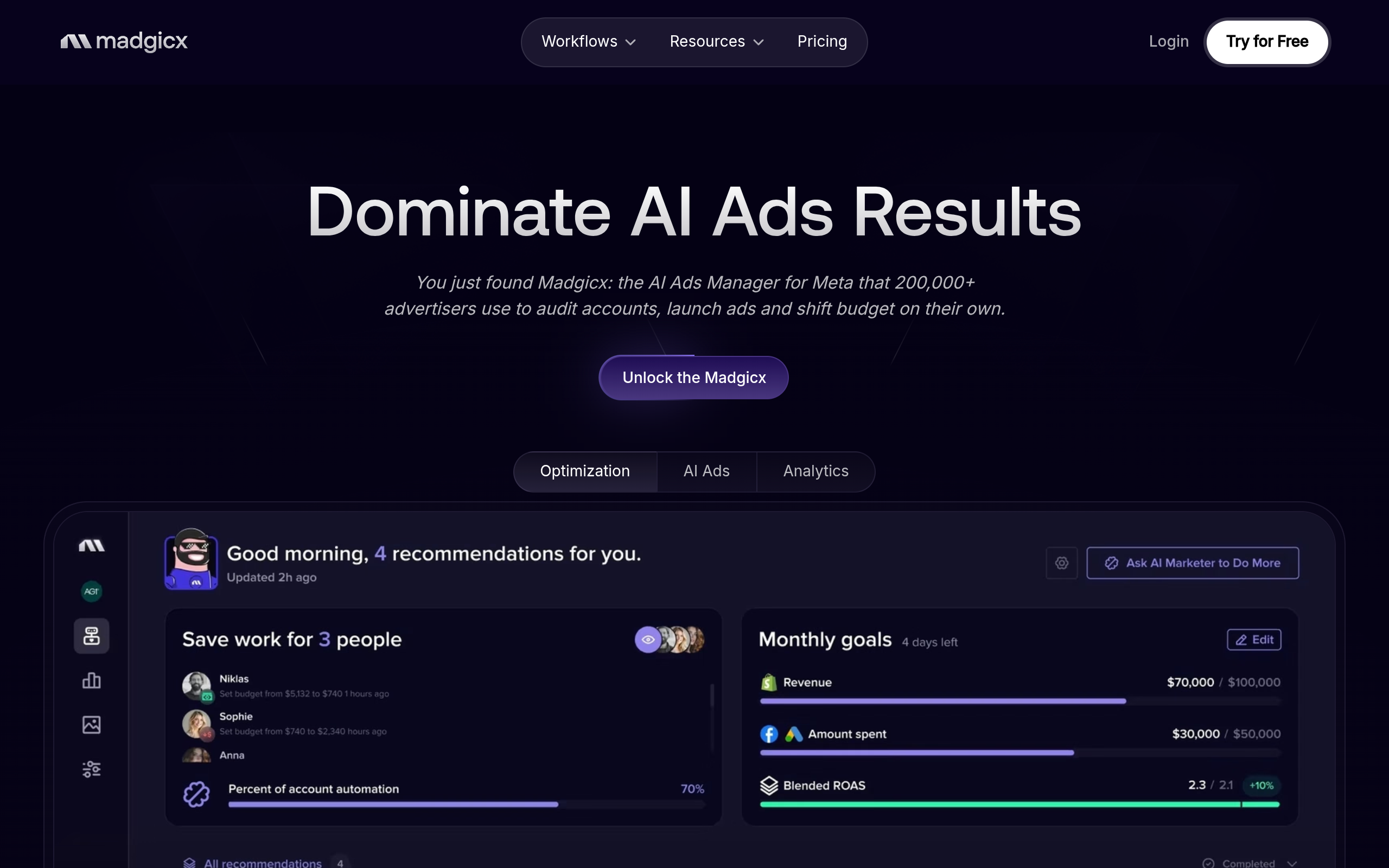
Madgicx is a candidate for teams whose paid social workflow is more central than broad search-account analysis. The practical question is not whether a tool markets itself as AI-powered; it is whether the supported workflow matches the decision your team needs help with, and whether a person can inspect the recommendation before it affects spend. Use the official Madgicx site to check its current product scope and supported platforms rather than assuming capabilities from a general product description.
Implementation burden: Paid social results depend on campaign structure, creative rotation, audience choices, and measurement quality. A team should test a proposed workflow against its own account setup and establish who reviews actions. Agencies also need to decide how a shared process will accommodate clients with different objectives and approval requirements.
Trade-offs
- Best for: Advertisers evaluating an automation-oriented tool for paid social workflows.
- Does not suit: A search-first team that needs Google Ads analysis to be its main reason for purchasing.
- Standout: A useful contrast to search-specialist options when paid social is the priority.
Commercial model: Confirm current plans, supported channels, and feature access with the vendor. If your team runs both search and social, compare the coverage and workflow depth against the cost of maintaining separate specialist tools; breadth alone does not ensure that either channel’s needs are met.
6. NotFair
Best fit: AI clients connected to ad workflows
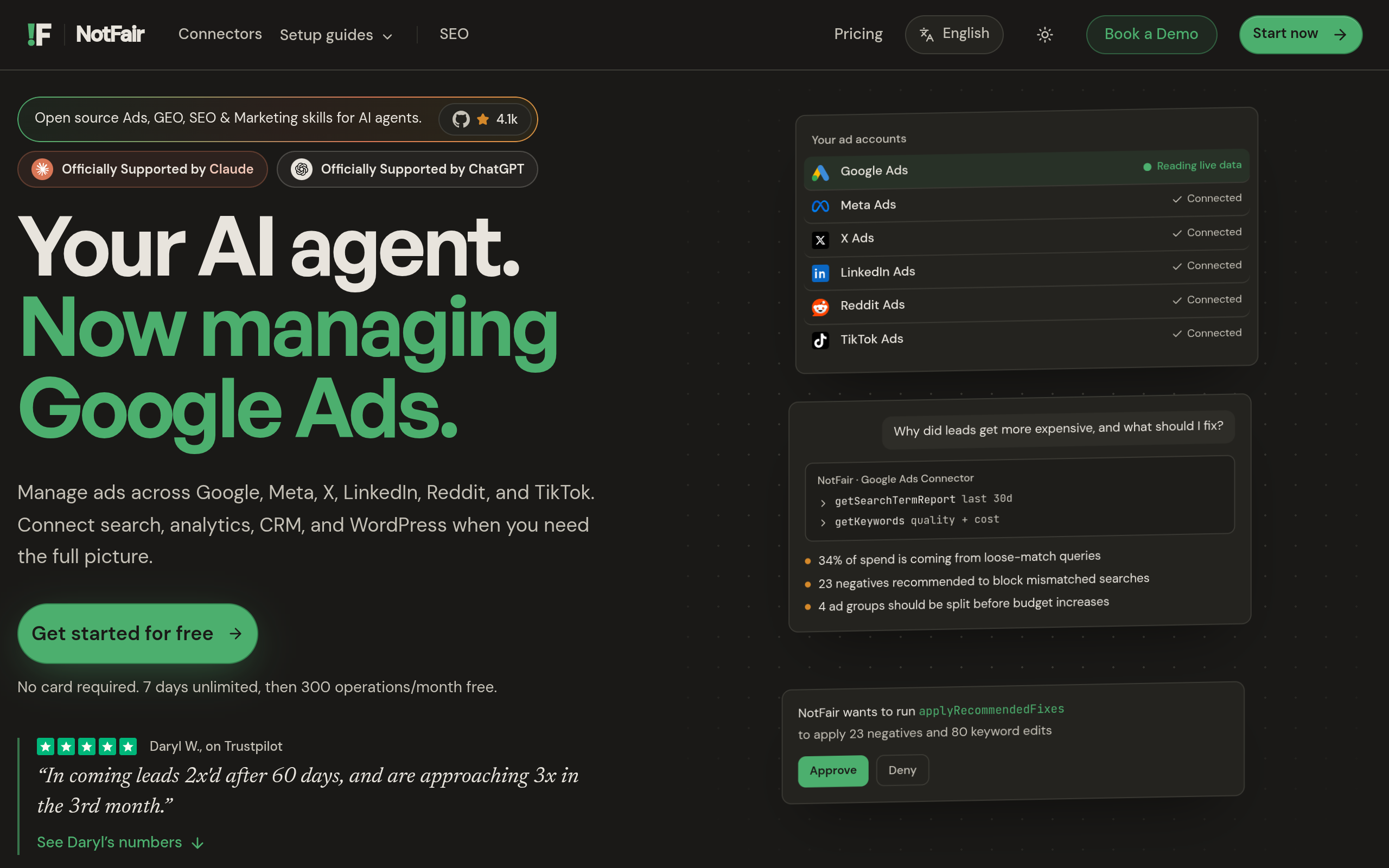
NotFair takes a distinct approach: its business description says it provides hosted MCP servers that connect AI clients—including Claude, Codex, Cursor, OpenClaw, and Hermes—with advertising and analytics platforms. The described approval-gated agents help marketers diagnose performance issues, recommend fixes, and execute reversible campaign changes. That makes NotFair relevant when the job is to bring AI clients into an ad workflow—not when the requirement is simply a conventional PPC dashboard. See Google Ads MCP and Meta Ads MCP for the owned pages’ stated topics.
Implementation burden: Teams must evaluate the AI client they use, the connected platform, permissions, and their approval process. Define which actions require approval and how operators review proposed changes. A team that cannot name an owner for that governance should not treat agent access as a substitute for campaign management.
Trade-offs
- Best for: Marketers or developers exploring AI-assisted workflows connected to ad platforms.
- Does not suit: Teams looking only for a standalone optimization dashboard, or those unwilling to govern AI-assisted changes.
- Standout: The MCP-server approach distinguishes it from the other optimization and automation products in this comparison.
Commercial model: Verify current product scope, access requirements, and pricing directly with NotFair; the available business evidence here does not establish plan details. This category shift matters: an MCP connection can support an AI workflow, but it is not automatically a replacement for a dedicated reporting, optimization, or enterprise media platform.
Comparison
Use this table to narrow the shortlist by the job you need covered. Platform scope and plan details can change; confirm them with the vendor before making a decision.
| Product | Primary workflow to assess | Best-fit team | Implementation consideration | Commercial check |
|---|---|---|---|---|
| Optmyzr | PPC optimization and management | Search teams with recurring account work | Map repeatable tasks to account structure and review cadence | Confirm current plans and feature scope |
| Adalysis | Google Ads analysis and optimization | Google Ads-focused specialists | Validate checks and recommendations on representative accounts | Check current pricing and plan boundaries |
| Skai | Broader paid media operations | Larger, more complex teams | Assess onboarding, data, permissions, and module needs | Confirm contract and included capabilities |
| Revealbot | Rule-based campaign automation | Teams with repeatable actions and review owners | Document conditions, exclusions, and safe responses | Check plan scope against platforms and account volume |
| Madgicx | Automation-oriented paid social workflows | Advertisers prioritizing paid social | Test fit against creative, campaign, and measurement setup | Verify current plans and supported channels |
| NotFair | AI-client access to ad workflows via MCP | Marketers and developers exploring AI-assisted operations | Set permissions, approvals, and change ownership | Ask the vendor to confirm current pricing and scope |
How to choose the right Adzooma alternative
Start by writing down the one job you want the replacement to own. “Improve performance” is too broad to evaluate. “Help the search manager review recurring Google Ads issues,” “apply a team-approved rule when a campaign meets defined conditions,” and “connect an AI client to an ad account with approval gates” are testable jobs. The first points toward a search optimization product; the second toward automation; the third toward an MCP workflow.
Then use a small, consistent shortlist process:
- Map your current work: List recurring tasks, the person responsible, and where each task happens now.
- Separate advice from action: Decide whether the tool should surface findings, propose changes, or perform approved actions.
- Test a representative account: Include an ordinary campaign and one with exceptions, such as a distinct budget rule or approval path.
- Check the operating cost: Account for onboarding, rule maintenance, staff review, integrations, and subscription—not just the quoted plan.
- Set a stop condition: Define what would make the workflow unsafe or not worth maintaining, then review against that before expanding access.
Before selecting a vendor, verify these details in the current official materials or with its sales team:
- Which ad platforms, account types, and actions are currently supported?
- What permissions are needed, and can your team review changes before they are applied?
- Which features are included in the relevant plan, and what is the current commercial commitment?
- How will your team handle exceptions, failed actions, or changes to campaign objectives?
For a Google Ads team that wants structured optimization, compare Optmyzr and Adalysis first. For defined rules, assess Revealbot; for a paid-social-centered workflow, assess Madgicx. Larger organizations should determine whether Skai’s scope is justified by their operational complexity. If the requirement is to connect an AI client to ad workflows rather than to buy a traditional optimization suite, explore NotFair’s MCP approach at NotFair—and verify that its current capabilities and governance model match the team’s needs.
Authored with NotFair SEO