

The most popular Google Ads campaign setup advice starts in the wrong place: choose a campaign type, collect keywords, write ads, and set a budget. Start instead with what you're willing to pay for, how you'll recognize it, and who can authorize changes. Otherwise, you can build a tidy account that measures the wrong outcome and gives automation permission to pursue it.
Table of Contents
- Why Most Google Ads Campaigns Stall Before They Start
- Building a Measurement-First Foundation
- Choosing the Right Campaign Type for the Job
- Structuring Keywords, Ads, and Landing Pages for Relevance
- Bidding Strategies That Fit Your Signal Quality
- Running Search Terms as an Ongoing Control Loop
- Approval-Gated Changes and a Pre-Launch Gate
Why Most Google Ads Campaigns Stall Before They Start
A campaign can look healthy while the sales team sees little worth pursuing. The problem isn't necessarily the keywords or creative. If every submitted form counts as success, you haven't distinguished a serious buyer from an unsuitable enquiry, a duplicate, or someone looking for support.
Google defines a conversion as a valuable action following an ad interaction, including purchases, calls, submissions, and downloads. Its reporting metrics depend on those actions being recorded correctly, which makes defining conversion tracking foundational to evaluating performance, not an administrative task after launch. See Google's conversion setup guidance.
Decide what success means commercially
The uncomfortable question is whether the event you can measure easily is the event you should buy. A submitted form is convenient. A sales-qualified opportunity is more useful when your business depends on fit, buying authority, and genuine demand.
Before building the account, agree on a measurement contract with whoever owns revenue:
- Outcome: Name the customer action that justifies advertising expenditure.
- Qualification: Describe what makes that action commercially useful.
- Ownership: Assign responsibility for tracking accuracy and sales feedback.
- Authority: Decide who can change goals, targeting, bidding, and budgets.
This isn't a request for a lengthy strategy document. A short, explicit agreement is enough, provided everyone understands what the campaign should optimize and what would invalidate its reported performance.
A cheap conversion isn't a useful conversion until someone can explain its connection to revenue.
Treat the account as an operating system
My recommended setup order is measurement, commercial targeting, campaign structure, bidding, then controlled launch. Each decision depends on the decisions before it. Selecting a bidding strategy before agreeing on the outcome reverses that dependency.
Governance belongs in that sequence because campaign changes alter how you spend money and interpret results. If someone changes conversion definitions while someone else changes bids, the team may lose a clean basis for comparison.
The practical standard is simple: every launch needs an accountable measurement owner and an accountable change approver. They can be the same person in a small business. What matters is that neither responsibility disappears between the media buyer, developer, and sales team.
Building a Measurement-First Foundation
A campaign can report conversions accurately and still optimize toward the wrong outcome. Define the business result first, then configure Google Ads to measure it. For lead generation, that could be an enquiry accepted by sales. For ecommerce, it could be a completed purchase with an accurate transaction value. Make the primary conversion the action that reflects commercial value, not every interaction the site can record.
Implement the event and test the journey
Create the conversion action and install the Google tag directly or through Google Tag Manager. With GTM, check the Conversion Linker configuration and validate the setup with Tag Assistant, following Google's conversion-tracking guidance.
Then test the full path from interaction to business record:
- Ad interaction: Confirm the journey retains the information needed to associate the outcome with advertising.
- Completion event: Make sure a successful submission or purchase triggers the conversion, not a button click.
- Deduplication: Reload the confirmation page and revisit the completion path. Confirm one business outcome is not counted repeatedly.
- Consent behavior: Test different consent choices, not only a browser that has accepted cookies.
- Business record: Match the conversion to the relevant order or lead in the system your team uses.
For service businesses, track quote-ready enquiries by distinguishing commercially relevant enquiries from general contact activity.
Connect measurement to qualification
A valid submission event may still be a poor bidding signal. If your CRM records lead qualification or completed sales, build a feedback path for those outcomes. Treating every form submission as equally valuable can steer spend toward leads that never become customers.
Document how CRM records connect to the original interaction, who updates lead status, and how the team handles duplicates or disqualified records. Apply the same ownership to phone enquiries and offline sales. An import process without a responsible owner is not a dependable measurement system.
Enhanced conversions aren't a substitute for this design. Google describes them as using consented first-party information, such as email or address data, in hashed form to improve measurement accuracy. Review Google's enhanced-conversions explanation alongside your consent and data-sharing requirements.
A Google Ads conversion audit can help organize implementation checks. Still, base launch approval on evidence from your own test journey, not on a checklist alone.
Finally, reconcile Google Ads outcomes against CRM or order records. Investigate discrepancies and annotate known measurement gaps. Don't raise budgets because platform-reported results look encouraging when commercial records disagree. Resolve the mismatch before scaling.
Choosing the Right Campaign Type for the Job
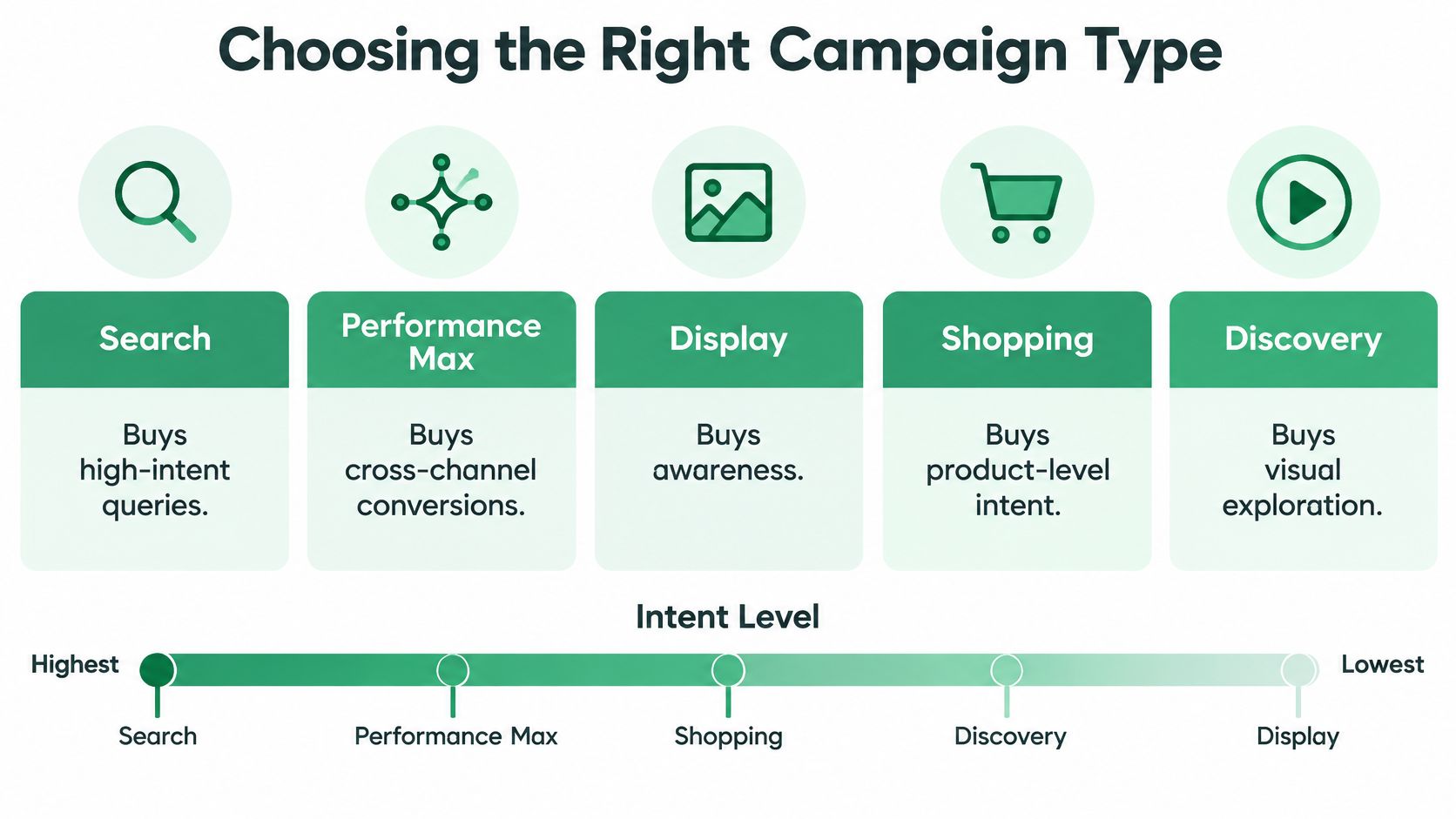
Campaign selection is a measurement and governance decision before it is a format choice. Pick the type that fits the buying situation, then define what evidence would justify keeping it. For a business capturing explicit service demand, Search is a practical starting point. Retailers should evaluate product-led advertising alongside Search rather than expect text ads to handle every acquisition task.
Use this comparison as a planning aid, not a universal ranking of profitability.
Match the format to the acquisition job
| Campaign option | When I'd consider it | What I'd require before launch |
|---|---|---|
| Search | Capturing explicitly expressed demand | Clear intent themes and suitable destination pages |
| Performance Max | Expanding an established acquisition approach | Trustworthy commercial outcomes and a clear evaluation plan |
| Display | Supporting awareness or a defined remarketing hypothesis | Audience rationale, appropriate creative, and separate success criteria |
| Shopping or retail Performance Max | Evaluating product-led ecommerce acquisition | Accurate product information and dependable purchase values |
| Discovery-style visual activity | Testing visual exploration rather than explicit search demand | A distinct creative hypothesis and confirmation of the currently available campaign format |
For lead generation, make Performance Max earn its place after qualification feedback is dependable. That is a risk-management choice, not a claim that Search always performs better. Broader distribution is harder to assess when the account cannot distinguish useful enquiries from unqualified ones.
Display can start as a supporting layer while its contribution is assessed, rather than carrying cold acquisition by default. Shopping merits consideration for ecommerce, but product fit, economics, and operational readiness determine whether it belongs in the mix. No campaign type is automatically mandatory.
Make targeting choices deliberately
Review location presence versus interest, language, networks, budget, bidding objective, and attribution settings as business decisions. Google's location and language targeting guidance can inform the setup, but the service area and commercial model should determine the configuration.
For a local provider, decide whether people researching the area are as valuable as people physically within it. For a specialist business, check whether each enabled network serves the same acquisition purpose. Defaults are not a reason to keep a setting.
Before approval, record the campaign's hypothesis: who it should reach, what action they should take, and what evidence would justify continuing. That decision record gives the team a basis for reviewing spend and changes, instead of defending a format after costs have accumulated.
Structuring Keywords, Ads, and Landing Pages for Relevance
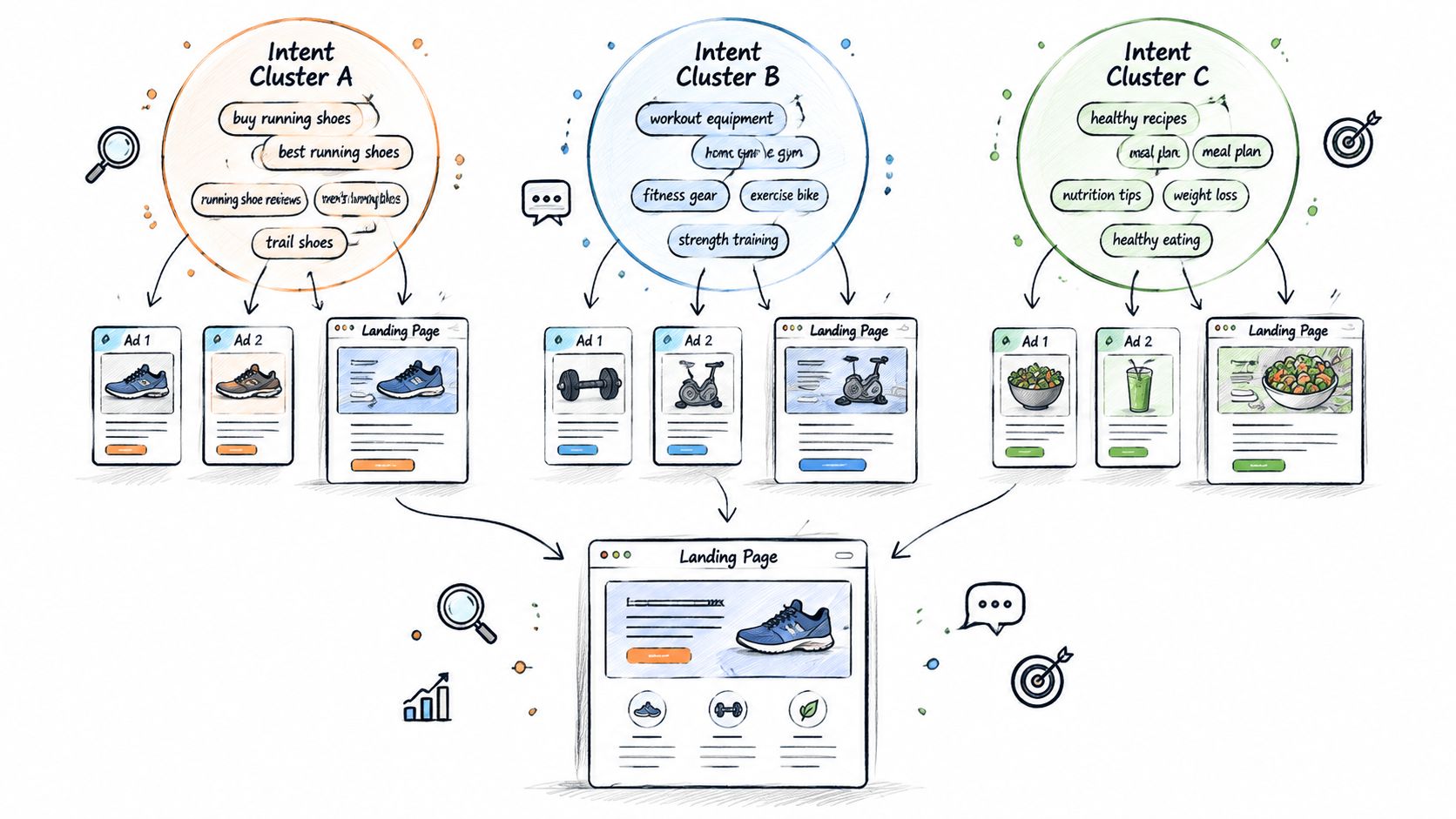
Consider a hypothetical commercial cleaning business. An ad group combining office cleaning, emergency cleanup, cleaning jobs, and equipment purchases doesn't represent a coherent buying task. A shared word isn't enough to justify shared advertising.
Separate those intentions before writing ads. Office-cleaning enquiries should reach an office-cleaning offer, while recruitment and equipment demand should be handled separately or excluded according to the business model.
Build around a buying task
Start with intent clusters, not an exhaustive inventory of product names. Keep brand, non-brand, and materially different customer needs distinct where their messaging, economics, or evaluation requirements differ.
| Loose structure | Intent-led alternative |
|---|---|
| General cleaning keywords | Commercial office-cleaning enquiries |
| An ad promising every service | Assets explaining the relevant service and qualification |
| A general homepage | A destination answering that buyer's practical questions |
Write responsive search ad assets so they remain truthful and coherent in different combinations. Headlines should identify the service, relevant differentiation, and next action. Descriptions should explain the offer rather than repeat the headline with extra adjectives.
Use sitelinks for meaningful destinations and callouts for genuine supporting details. Don't advertise immediate availability if the landing page asks visitors to join a waiting list. Likewise, don't promise a quote when the destination only offers a generic contact form without explaining what happens next.
The landing page should resolve the questions raised by the ad: who the service suits, what's included, where it's available, and how to proceed. Message continuity matters more than superficial keyword repetition.
Diagnose the weak connection
Google's keyword-level Quality Score runs from 1 to 10 and uses expected click-through rate, ad relevance, and landing-page experience. Component ratings compare performance with advertisers appearing for the same search during the previous 90 days, according to Google's Quality Score documentation.
Use those components to locate the likely problem:
- Expected response below average: Review whether the proposition is compelling for the intended query.
- Ad relevance below average: Check whether the keyword and ad address the same task.
- Landing-page experience below average: Inspect whether the destination delivers a useful continuation of the promise.
Treat Quality Score as a diagnostic, not a commercial target. A better score doesn't replace evidence of profitable customer acquisition.
Don't split ad groups endlessly to pursue tidiness. Separate them when buyers need materially different messages or destinations. Use a maintained negative-keyword workflow to support those boundaries rather than relying on naming conventions to keep unrelated intent apart.
Bidding Strategies That Fit Your Signal Quality
The bidding question isn't which strategy sounds most advanced. It's how much decision-making authority the available evidence can support. Review the volume of meaningful outcomes, confidence in their values, and the amount of direct bid control the operator needs.
There's no defensible universal conversion-volume threshold to prescribe here. Instead, assess whether recent outcomes are representative, whether the campaign has experienced a complete sales cycle, and whether qualification practices have remained consistent.
Choose the constraint before the strategy
Use the following as a practitioner's decision framework, not a promise of performance.
| Strategy | When I'd consider it | Main trade-off to review |
|---|---|---|
| Manual CPC | Deliberate bid-control work where available and appropriate | Operator attention versus automated adjustment |
| Maximize Clicks | A bounded traffic-acquisition or diagnostic exercise | Traffic volume isn't proof of business value |
| Maximize Conversions | A dependable conversion objective with room to test | More recorded outcomes may not mean acceptable acquisition economics |
| Target CPA | A commercially justified acquisition-cost objective | An aspirational target may be disconnected from actual conditions |
| Target ROAS | Trustworthy, meaningfully differentiated conversion values | Incorrect values undermine the relevance of the revenue objective |
Availability and configuration should be checked in the live account before approval. Don't build an operating plan around a strategy label without reviewing the controls offered for that campaign.
A lead-generation team shouldn't choose value-based bidding merely because it can assign arbitrary values to pipeline stages. First establish whether those values reflect meaningful differences in commercial outcomes. Otherwise, you've converted subjective assumptions into instructions for spending.
Set limits that reflect the business
Before increasing a Maximize Conversions budget, decide what acquisition cost the business can tolerate and whether a target CPA is appropriate. A budget limits expenditure, but it doesn't establish that the resulting customers are economically acceptable.
Budget rule: Approve the spending envelope and the commercial evaluation criteria together.
Portfolio strategies and shared budgets deserve consideration when campaigns share an objective. I wouldn't group campaigns because they belong to the same account. Different margins, service capacity, or qualification standards are reasons to preserve separate evaluation.
Finally, avoid changing the bid strategy, target, budget, and conversion objective together without a compelling operational reason. You'll make the result harder to interpret. Write the hypothesis, identify the variable being changed, and agree on the evidence needed before changing it again.
Running Search Terms as an Ongoing Control Loop
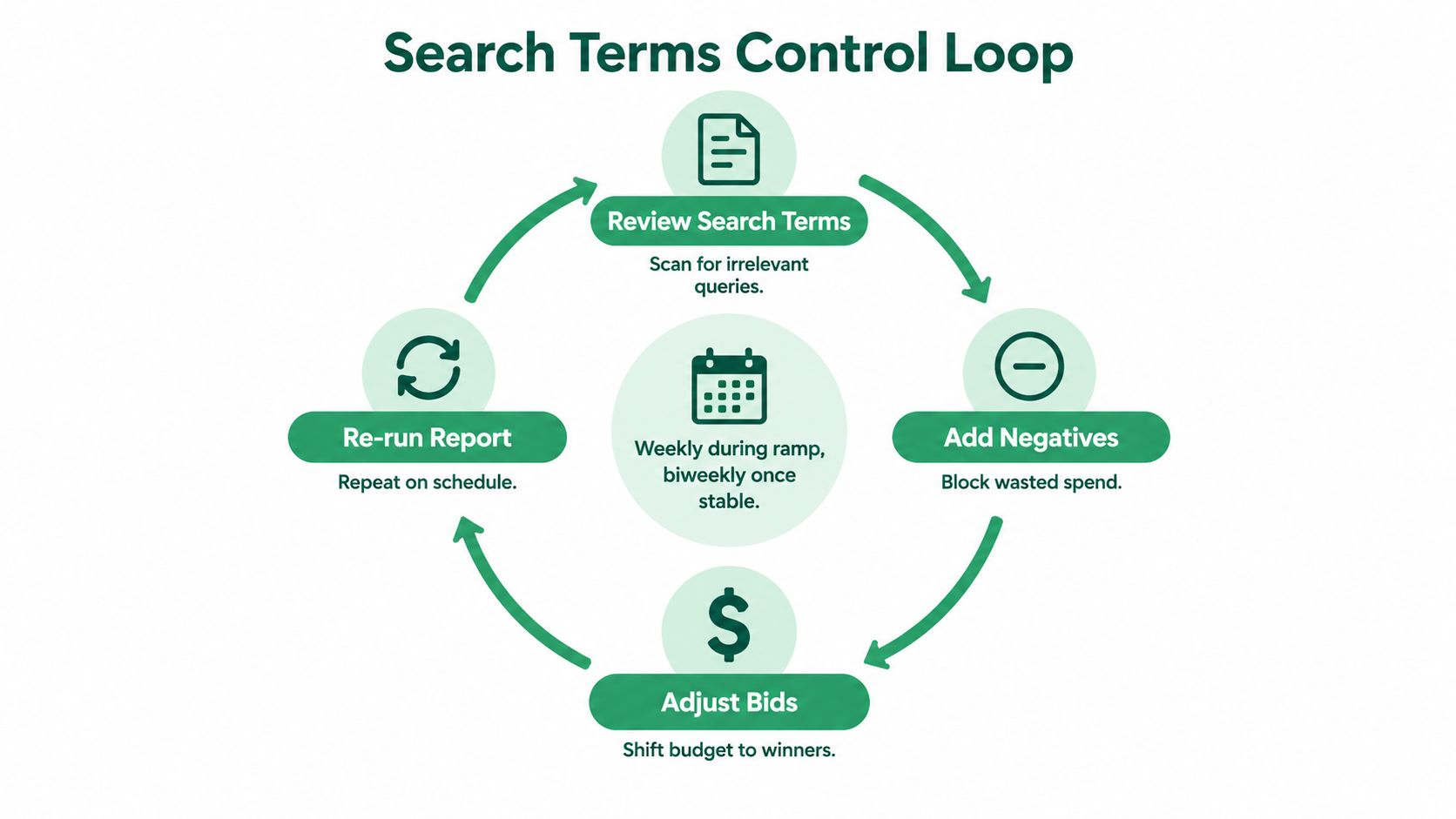
Suppose the commercial cleaning campaign begins attracting searches for cleaning vacancies. That's not a reason to rebuild the account immediately. It's a query-classification problem: identify the mismatch, select a safe exclusion, then check what happened.
Google's search-terms guidance supports using actual queries to revise keywords and exclusions. It also notes that negatives added from the report default to negative exact match, so excluding a displayed query doesn't necessarily exclude the broader concept.
Classify before excluding
Set a fixed review schedule, then add spend-triggered reviews when exposure warrants them. Don't wait for the reporting meeting if an ambiguous query pattern is consuming budget without credible commercial outcomes.
Classify the observed demand:
- Relevant: The query matches the offer and intended buyer.
- Irrelevant: The searcher needs something the business doesn't provide.
- Ambiguous: The wording alone doesn't establish intent.
- High-value pattern: Query context and qualified outcomes justify closer attention.
For the vacancies example, a recruitment exclusion might belong at campaign level if no ad group serves job seekers. An exclusion intended only to separate service themes belongs at a narrower scope.
Google explains that negative broad match blocks a search when all negative terms appear, regardless of order, and negatives don't automatically expand to close variants. Review Google's negative-keyword matching rules before treating an exclusion as complete.
Preserve discovery without surrendering control
Broad match isn't reckless. My view is that it becomes defensible when the commercial signal is dependable and someone actively reviews the resulting demand. Restrictive matching isn't proof of efficiency either; judge the actual queries and outcomes.
For ambiguous searches, inspect the destination and qualification evidence before excluding. A query that looks unusual may represent a valuable niche rather than waste.
Maintain a search-terms review workflow with an auditable change record:
| Log field | Required detail |
|---|---|
| Query and rationale | What appeared and why action is justified |
| Date and owner | When it changed and who approved it |
| Match type and scope | Exact, phrase, or broad; campaign or ad group |
| Expected effect | Which unwanted demand should stop |
| Rollback criterion | What evidence would justify reversal |
After each change, inspect qualified outcomes and lost relevant demand. An exclusion is a hypothesis, not an irreversible declaration.
Approval-Gated Changes and a Pre-Launch Gate
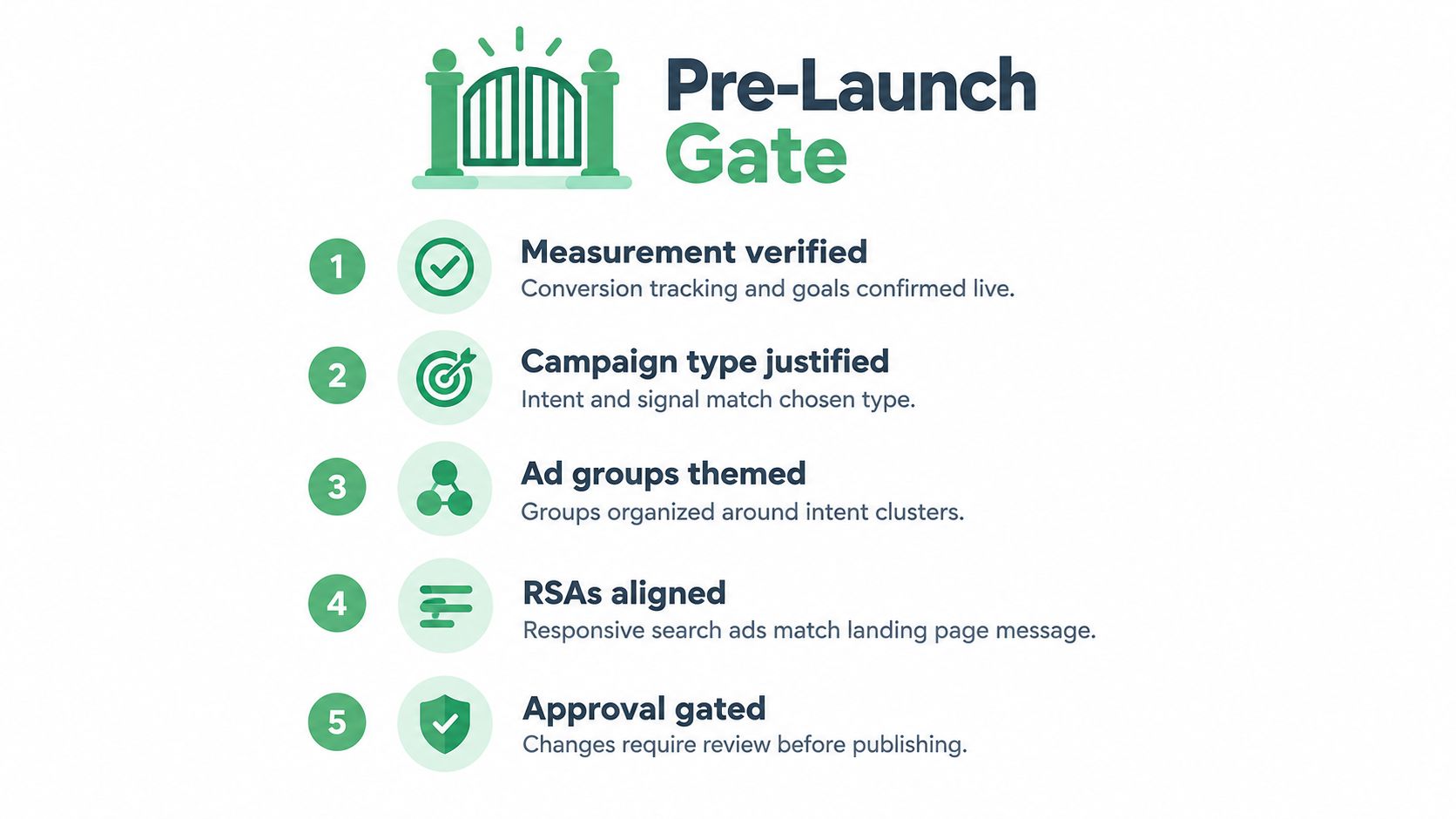
Launch approval should mean the campaign has passed a defined operating standard, not that someone glanced at the ads. Use a checklist in the same project tool where the team assigns implementation work and records decisions.
Make launch evidence reviewable
Paste this gate into the campaign task and attach evidence rather than marking items complete from memory:
- Measurement verified: Test evidence exists, the goal owner has signed off, and commercial reconciliation has an owner.
- Campaign choice justified: The acquisition hypothesis and targeting decisions are documented.
- Structure reviewed: Intent themes, exclusions, ads, and destinations have been checked together.
- Bidding approved: The strategy fits the available evidence and agreed spending limits.
- Operations assigned: Naming conventions, reporting responsibility, and query-review ownership are agreed.
- Changes controlled: An approver and rollback procedure are recorded before launch.
A failed gate doesn't always require delaying everything. You can approve a deliberately constrained diagnostic launch, provided its limits and unresolved questions are explicit. Don't describe an unverified campaign as ready to scale.
Give AI agents bounded authority
For AI-assisted operations, prefer a workflow that separates read, propose, approve, execute, and verify. A hosted MCP server is one way to connect an agent to account data and operational tools; direct platform review remains another.
Require a live account read before drafting changes. The proposal should show explicit diffs, including affected entities, previous settings, proposed settings, and the reason for each edit. Approval should apply to that specific proposal, not grant open-ended permission to “optimize.”
After execution, verify the resulting account state and retain the change history. Where one-call undo is available, confirm what it reverses and whether subsequent edits affect the rollback. Reversing a setting can't recover money already spent or recreate missed demand.
Governance isn't extra paperwork when it prevents blind edits. It's the mechanism that lets a small team move quickly while retaining a clear explanation of what changed and why.
NotFair offers hosted MCP connections for live advertising-account diagnosis, explicit change previews, approval-gated edits, logged history, and one-call undo. Visit NotFair to connect your Google Ads workflow and turn measurement checks, search-term reviews, and campaign changes into reviewable actions before you commit more budget.