

Co-founders
NotFair vs Semrush: Research and Connected Workflows
Compare NotFair vs Semrush for connected-account work, competitor research, MCP, and SEO execution. Learn which data each decision actually needs.
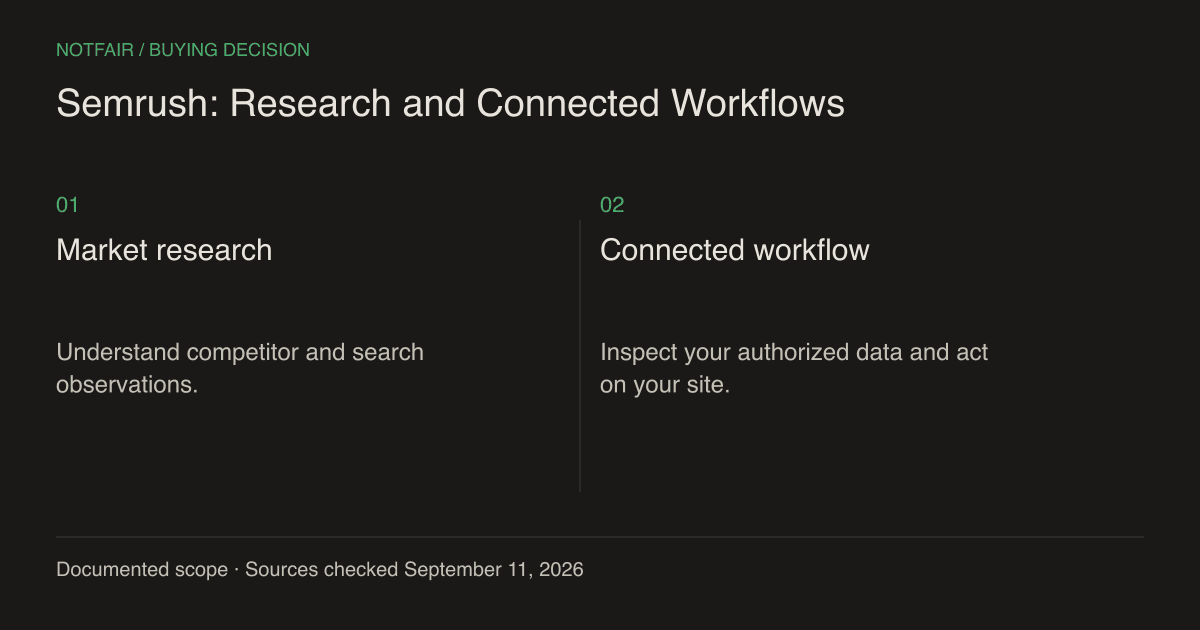
NotFair and Semrush answer different starting questions. NotFair helps your AI assistant work with your connected marketing accounts and websites. Semrush is a stronger candidate when you need a dedicated market-research and search-visibility dataset. They can be complementary: understanding competitors and making a verified change on your own site are distinct jobs.
Published by NotFair, one of the products compared. We checked public vendor documentation and NotFair’s implementation on September 11, 2026. This is a documented capability comparison, not a head-to-head performance test. Worked examples are illustrative; prices and plan terms can change.
Start with the source of the answer
If you ask which of your pages lost Google clicks, a connected Search Console property is a relevant source. If you ask which queries a competitor appears for, your own property cannot answer that question. Do not assume connecting an AI client to Search Console creates access to a competitor’s private performance reports.
Semrush’s current pricing describes keyword research, competitor insights, position tracking, and AI visibility features. Its Starter SEO + AI Search plan is listed at $199 monthly, with five monitored websites, 500 daily tracked keywords, 50 daily tracked prompts, and MCP access. Confirm the chosen billing term and plan rather than mixing annual equivalents with monthly prices.Semrush current SEO and AI Search plans (https://www.semrush.com/pricing/seo-ai-search/).
| Question | Evidence you need | Useful product role |
|---|---|---|
| Which of our pages lost clicks? | Our verified Search Console property | NotFair connected-account investigation |
| Where do competitors appear? | A market or search-observation dataset | Evaluate Semrush research coverage |
| Did our edit publish? | The CMS result and public page | NotFair supported WordPress workflow |
| Did the edit create customers? | Consistent analytics and business outcomes | Reconcile your first-party records |
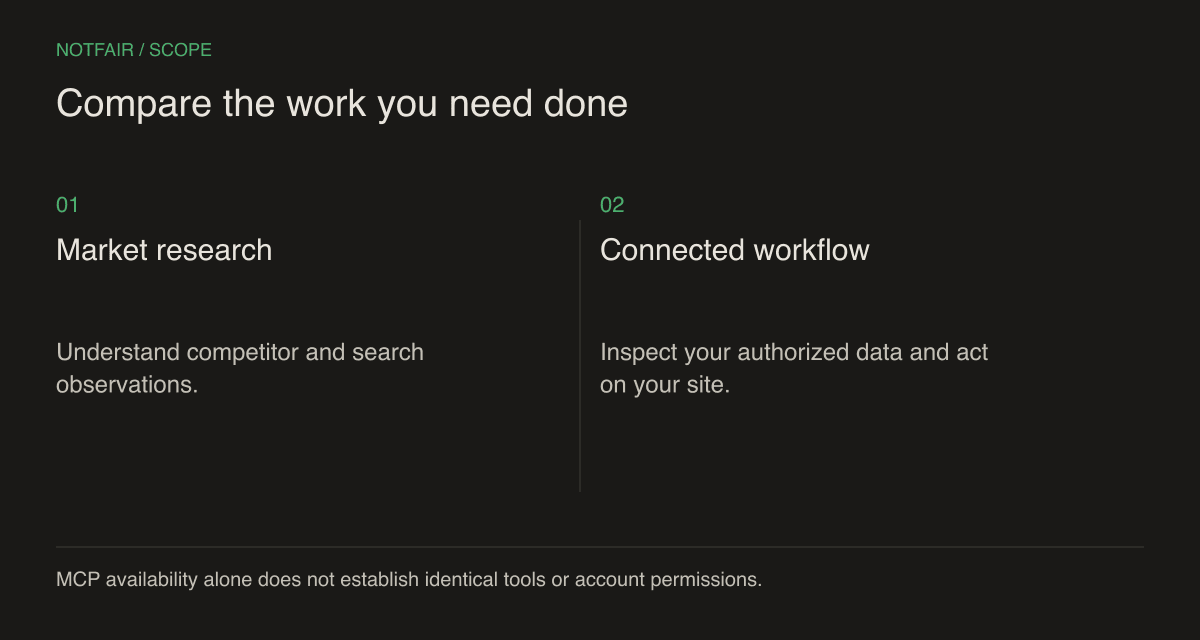
Semrush also lists Google Analytics and Search Console integrations in its reporting add-ons. It can work with first-party data as well as market research. Compare the particular reports, tools, and publication actions you need, rather than assigning each product an exclusive ownership of one data category.Semrush reporting add-ons and integrations (https://www.semrush.com/pricing/seo-ai-search/).
Where NotFair is useful after the research
NotFair exposes Search Console reporting, URL inspection, and sitemap operations, along with GA4 reporting and supported measurement configuration. A verified WordPress connection can support content creation and updates. An AI client can use those tools to inspect an underperforming page, prepare a specific edit, and verify publication.NotFair MCP setup and integrations.NotFair WordPress connection and publishing.
That reduces the gap between an analysis and the work it recommends. For example, you can ask the assistant to identify a page with relevant impressions, inspect its current content, and draft an answer to an underserved reader question. The editor still needs to check the evidence, product accuracy, and publication target. A keyword suggestion is not sufficient editorial justification.
NotFair’s MCP Growth price is $99 monthly or $950 annually. Search Console and GA4 properties do not consume its shared ad-account spots. Check separate SEO-product entitlements if you also want content-generation services; the MCP operation allowance should not be treated as unlimited editorial production. Include AI-client costs in the working setup.NotFair pricing and account limits.
A numerical example: improving an existing answer
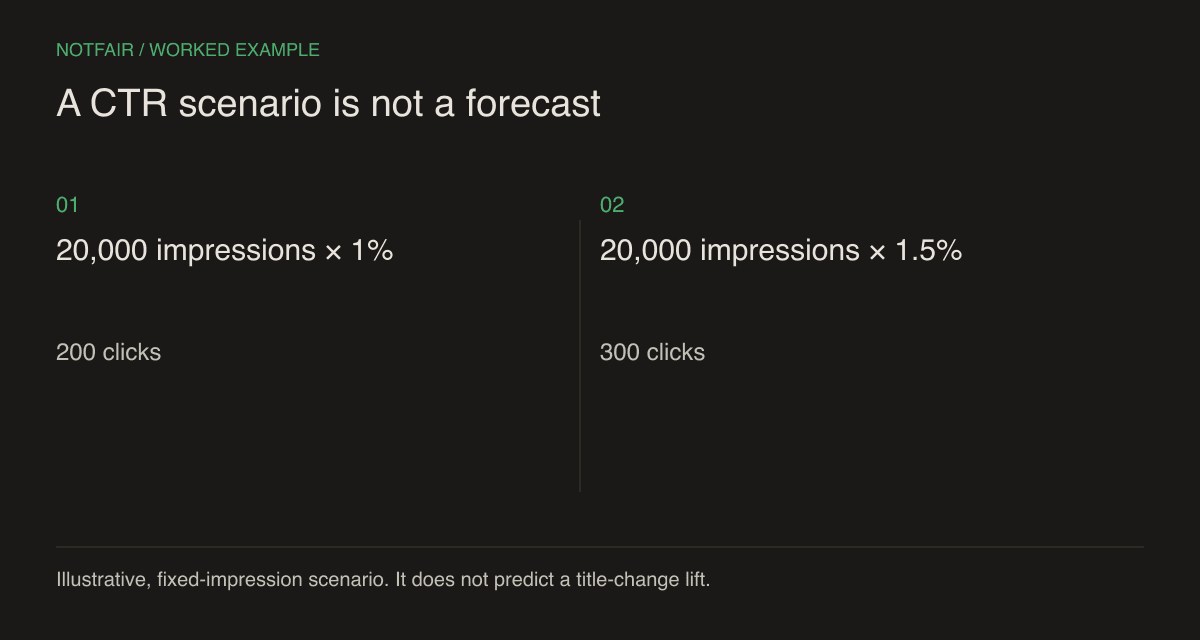
Illustrative Search Console slice: a page receives 20,000 impressions and 200 clicks over a completed period. Its click-through rate is 200 ÷ 20,000 = 1%. If the same number of impressions produced a 1.5% click-through rate, it would receive 300 clicks, an increase of 100. This is a scenario calculation, not a forecast that a title change will cause that result.
Before editing, split the page’s data by relevant query and device groups where available. A broad title that attracts unrelated impressions can depress aggregate CTR without indicating a problem for valuable queries. Likewise, a change in search-result layout can affect clicks even if your content is unchanged. Keep the conclusion tied to what the report actually establishes.
Then inspect the page as a reader. Does it answer the question in the opening? Does it explain costs and limits with a date and source? Does the comparison acknowledge a case where another tool fits better? A clear answer may be a better improvement than adding paragraphs simply to match a competitor’s word count.
Do not turn AI visibility into an invented certainty
Google says its existing SEO fundamentals apply to AI Overviews and AI Mode, with no special markup or AI text file required. Eligible supporting pages must be indexed and able to appear with a snippet. Meeting those conditions still does not guarantee inclusion.Google Search Central: AI features and eligibility.
A prompt-tracking product can show what happened for its observed prompts and runs. That is not the same as the percentage of every AI conversation that mentions your brand. When comparing visibility reports, record the prompt set, models, locations, sampling dates, and definition of a citation. Changing the sample can change the result without any change to the underlying website.
Preserve the source and collection date beside each measurement so later comparisons use a consistent baseline. Search Console clicks, model citations, and customer activation should therefore remain separate measures. A page can be cited without generating a visit, and a visit can fail to produce a customer. For a product like NotFair, the business question is whether the content brings people who connect a service and complete useful work, not merely whether the brand appears in a response.
Run a research-to-publication acceptance test
For competitor research, attach a confidence note to each important conclusion. An observed ranking supports a statement about that observation; it does not reveal the competitor’s conversion rate, paid spend, or private acquisition mix. A sitemap establishes discoverable URLs, not how many are indexed or cited. A pricing page establishes an advertised offer, not the final contract every customer receives. Keeping these evidence boundaries explicit prevents the assistant from turning a useful research source into an unsupported business claim.
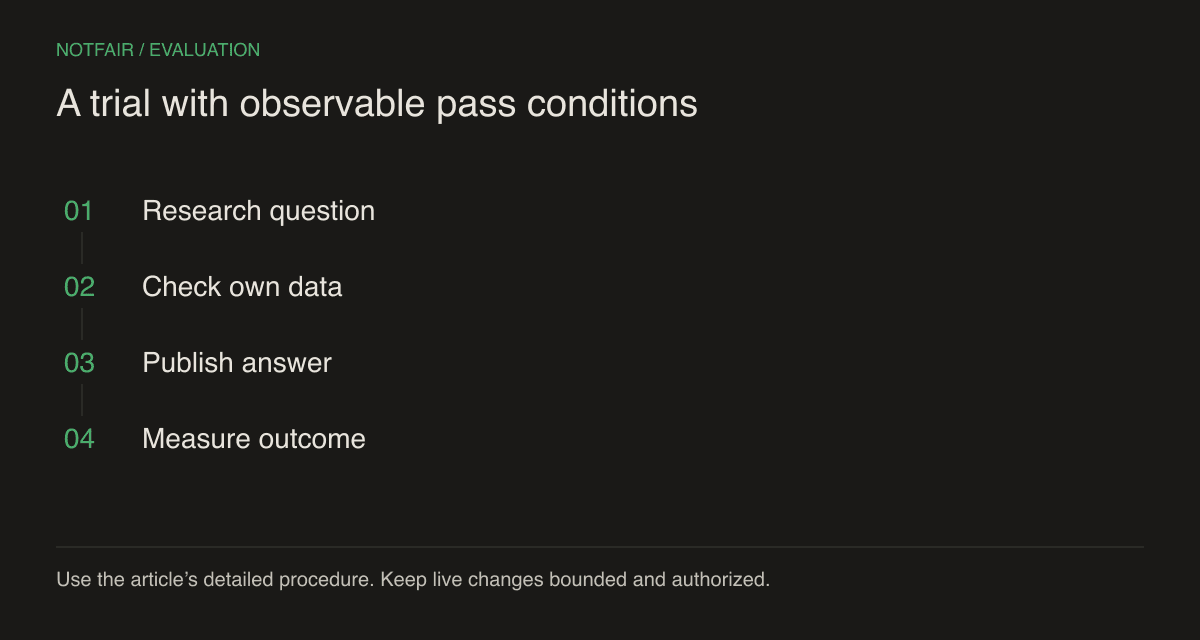
- Research — choose one competitor question and document the market evidence and its limits.
- First-party check — inspect the relevant page and query performance in your own verified property.
- Editorial decision — identify the original information the page will add, with sources for consequential claims.
- Publication — review the exact content and URL, authorize the CMS change, and inspect the public result.
- Measurement — record the date and evaluate subsequent discovery, engagement, and business outcomes separately.
If Semrush is supplying a research dataset your team relies on, do not cancel it because another product has an MCP label. Semrush also offers MCP on specified plans. Compare the data and actions behind each connection. Conversely, if most of your work is on your own connected properties, a broad market-intelligence subscription may be more than the immediate task requires.
Choose NotFair for an operator-led path from connected evidence to supported changes. Choose Semrush for the dedicated research and tracking coverage that your strategy requires. Use both when the trial shows that each performs a distinct, valuable job, and keep responsibility for editorial quality with the people publishing the answer.
Test the workflow on your own connected account
Start with a read-only question, inspect the evidence, then review one supported action. Check the current plan and connection requirements.