

Co-founders
NotFair vs Ryze: 6 Checks Before You Connect
Compare NotFair vs Ryze on price, MCP access, integrations, approvals, and a practical account trial. See which workflow fits your team.
Choose NotFair when you want your existing AI assistant to investigate connected marketing accounts and carry out specific, reviewed changes. Choose Ryze when you want to evaluate its packaged paid-ad or SEO autopilot service. Both advertise MCP connectivity and approval controls. The useful comparison is the exact work, subscription scope, and operating responsibility you want to buy.
Published by NotFair, one of the products compared. We checked public vendor documentation and NotFair’s implementation on September 11, 2026. This is a documented capability comparison, not a head-to-head performance test. Worked examples are illustrative; prices and plan terms can change.
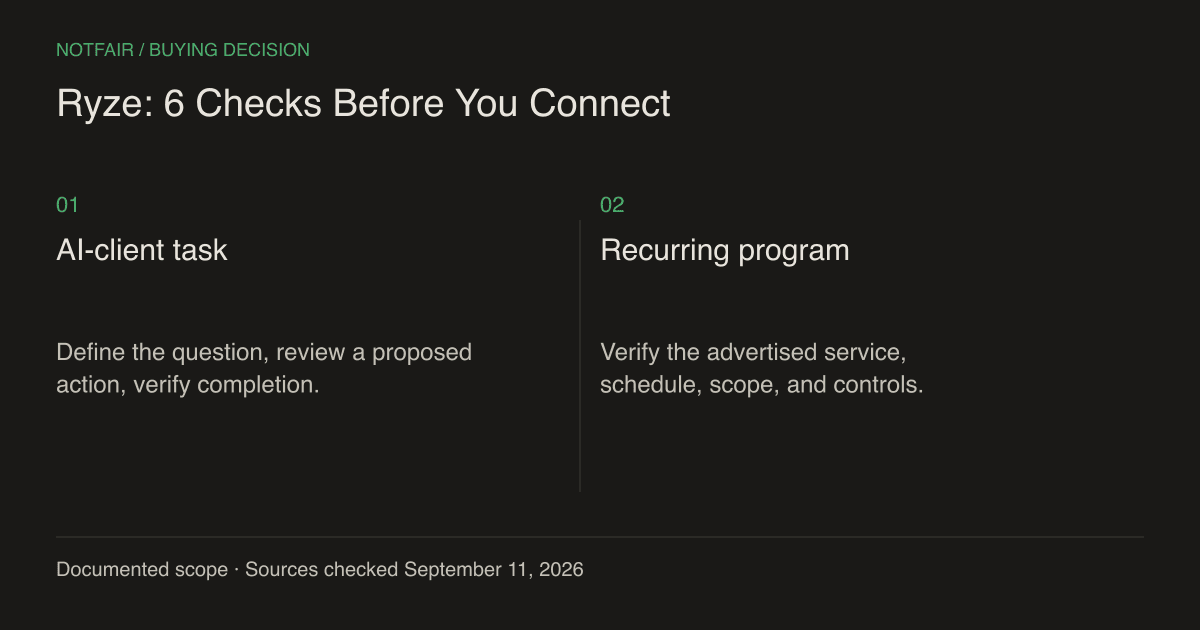
1. Compare the operating model before the feature list
Before a trial, list three jobs you want finished: for example, reproduce a campaign report, explain one discrepancy, and prepare one reviewed edit. Give each a pass condition and an owner. This prevents a vendor demonstration from redefining success around whatever feature is easiest to show.
An MCP connection gives an AI client tools that can read or change a connected service. It does not, by itself, run a recurring marketing program. With NotFair, you connect the relevant accounts, select a compatible client, and give it a concrete task. A recurring schedule requires an agent or scheduler that actually runs it. A successful interactive session is not evidence that tomorrow’s session has been scheduled.NotFair MCP setup and integrations.
Ryze’s current pricing page sells Paid Ads Autopilot at $89 per month and SEO Autopilot at $129 per month. It also advertises an MCP connector included with its plans. Treat its claims about continuous execution as vendor descriptions to test during onboarding, rather than assuming either company’s marketing proves superior campaign results.Ryze’s published plans and MCP inclusion (https://www.get-ryze.ai/pricing).
| Decision | NotFair | Ryze |
|---|---|---|
| Where you work | Connected tools in a compatible AI client | Packaged autopilot plus advertised MCP access |
| Paid-ad software price | $99/month Growth; Free plan available | $89/month advertised Paid Ads Autopilot |
| SEO scope | Check MCP tasks and SEO product entitlements separately | $129/month advertised SEO Autopilot |
| Proof to request | Account identity, proposed action, provider result | Same evidence, plus autonomous schedule and scope |
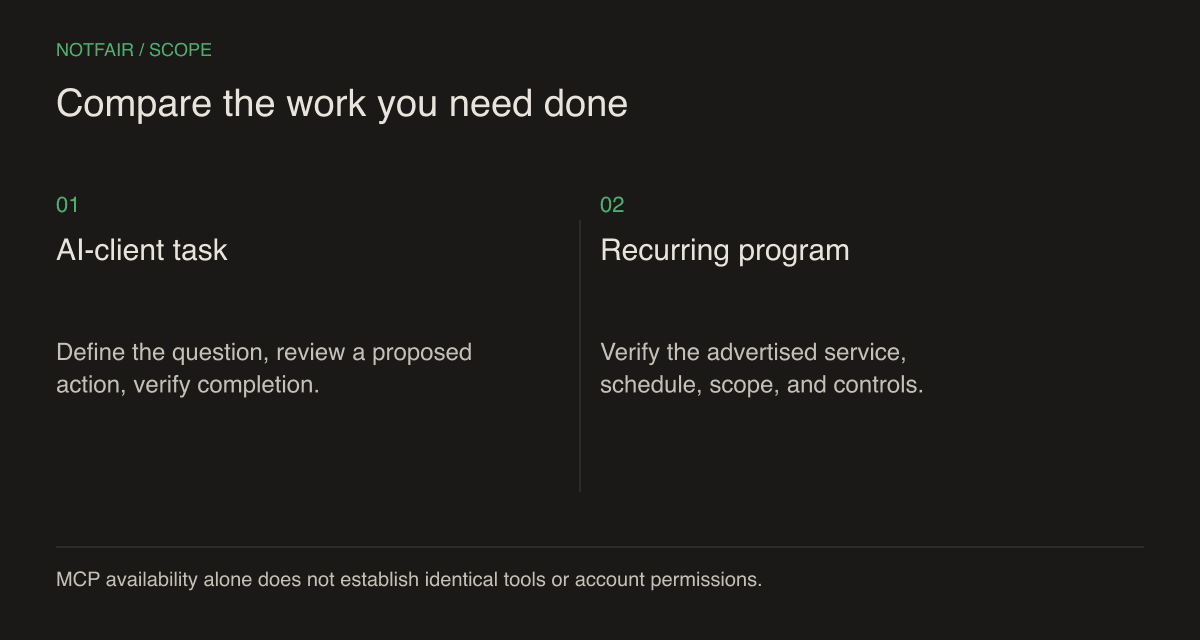
2. Inspect the integrations your task actually needs
NotFair’s implemented integrations include Google Ads, Meta Ads, X Ads, LinkedIn Ads, Reddit Ads, TikTok Ads, Google Search Console, GA4, GoHighLevel, and WordPress. They cover different jobs: campaign changes, search reports, analytics configuration, CRM records, and website content. That lets an operator investigate a problem across systems using the same client, subject to each connection’s permissions. It does not automatically join every visitor to a CRM record.NotFair MCP setup and integrations.NotFair WordPress connection and publishing.
Write a task that crosses the boundary you care about. A lead-generation business could ask for search campaigns with rising cost per qualified lead, then compare landing-page traffic and CRM outcomes where suitable identifiers exist. A publisher could inspect Search Console pages, prepare a WordPress edit, and verify the resulting public URL. These are stronger acceptance tests than counting integration logos.
Do not equate a supported integration with full administrative control. Ask whether the selected account exposes the exact action you need, whether a provider permission is missing, and whether a draft is being created or a live object changed. NotFair’s WordPress workflow requires a verified website connection and plugin access. A pending website should not be counted as ready to publish.NotFair WordPress connection and publishing.
3. Calculate the cost of your actual account portfolio
NotFair Growth is $99 monthly or $950 annually and includes five shared ad-account spots. Extra spots are $10 per month each. The Free plan includes two spots and 300 monthly MCP operations after a seven-day unlimited trial. Your AI-client subscription and ad spend are separate expenses. These limits concern MCP usage; do not assume they include unlimited SEO content production.NotFair pricing and account limits.
Illustrative calculation: a business with three Google Ads accounts and three Meta Ads accounts needs six shared spots. At the published monthly rates, NotFair is $99 + $10 = $109 per month, before tax, AI-client charges, or media spend. A business with one account is still $99 on Growth. Account count changes the comparison; a claim that NotFair is always cheaper would be false.
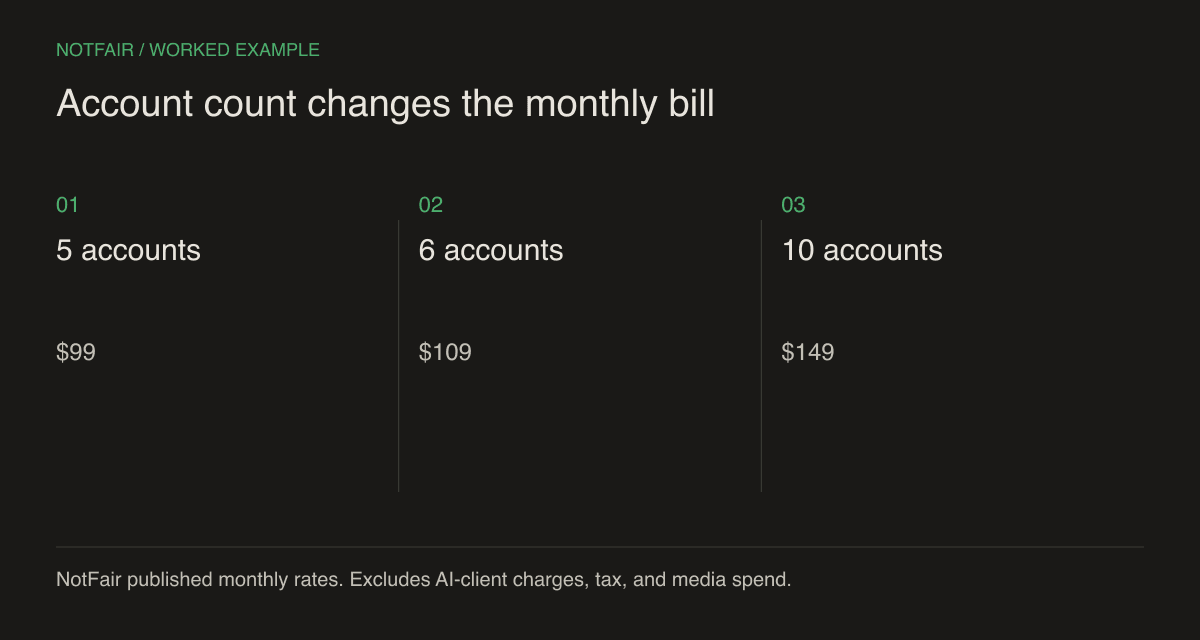
Compare matching billing periods. Twelve monthly Growth payments total $1,188; the $950 annual option saves $238 against that specific baseline. Annual payment also changes cash commitment. Obtain a Ryze quote for the same accounts and services before comparing totals; separate subscriptions for different jobs are not automatically equivalent bundles.
4. Test approval behavior in the client you will use
NotFair exposes separate read-only and write-capable execution paths. Write tools are marked as mutations, and the workflow instructs the agent to explain the change and obtain approval. Human confirmation behavior also depends on the AI host and its settings. Do not treat a generic ‘safe’ label as proof that a client configured to auto-approve cannot make changes.
Start with a read-only request naming the account, date range, currency, and desired metric. Then ask for one proposed change with the old value, new value, target ID, and reason. Inspect what the host actually displays. If the proposal omits its target or mixes several unrelated edits, stop the trial at that point and narrow the request.
- Before execution — identify the account and object, expected effect, and exact scope.
- At execution — authorize only the reviewed change through your chosen client controls.
- After execution — record the provider response and verify the actual state. An explanation or preview is not a completed write.
- For recovery — confirm the specific action supports reversal. No connector can recover spend already consumed.
5. Run a trial that can disprove your preference
Use the same account and question in both products, initially with no writes. Give each the same conversion definition and known business constraint, such as a location you do not serve. Score whether it retrieves the correct data, notices missing information, and recommends a change consistent with that constraint. A polished answer with the wrong account should fail.
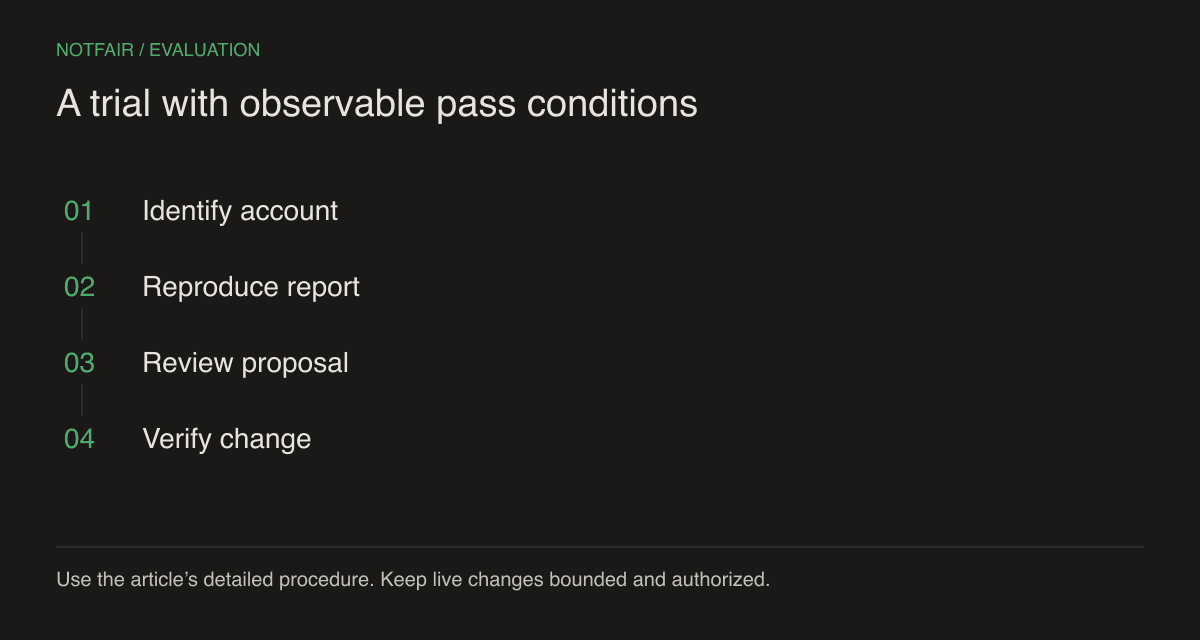
For the write test, use separate, non-overlapping targets and keep an operator present. Do not let two automation systems adjust the same campaign concurrently: each may react to the other’s edits, making the result hard to interpret. Keep the initial test small enough that you can inspect every changed object.
6. Choose based on work completed, not promised ROAS
A short trial can establish connection quality, reporting accuracy, and whether a requested operation completes. It usually cannot isolate long-term revenue lift from seasonality, conversion delay, other campaign changes, and normal variation. Record these as different conclusions. Avoid declaring a winner from one day’s return on ad spend.
NotFair’s strongest fit is an operator who already works with an AI assistant and wants a flexible route from a question to a verified change across connected systems. Ryze deserves evaluation when the recurring service it advertises is the main requirement. Choose the product whose actual onboarding, scope, and task results match that requirement, then keep measuring qualified business outcomes.
Test the workflow on your own connected account
Start with a read-only question, inspect the evidence, then review one supported action. Check the current plan and connection requirements.