

Co-founders
NotFair vs Birch: Rules, MCP, and Exceptions
Compare NotFair vs Birch, formerly Revealbot, for rule automation and MCP workflows. Test timing, overlapping rules, and exception handling.
Choose NotFair when your main job is investigating an exception and directing a specific action through an AI assistant. Choose Birch, formerly Revealbot, when you need to evaluate a dedicated rule-based advertising workflow. Birch now advertises MCP as well as AI features. The practical distinction is how you specify, schedule, and verify work, not whether one product has AI access.
Published by NotFair, one of the products compared. We checked public vendor documentation and NotFair’s implementation on September 11, 2026. This is a documented capability comparison, not a head-to-head performance test. Worked examples are illustrative; prices and plan terms can change.
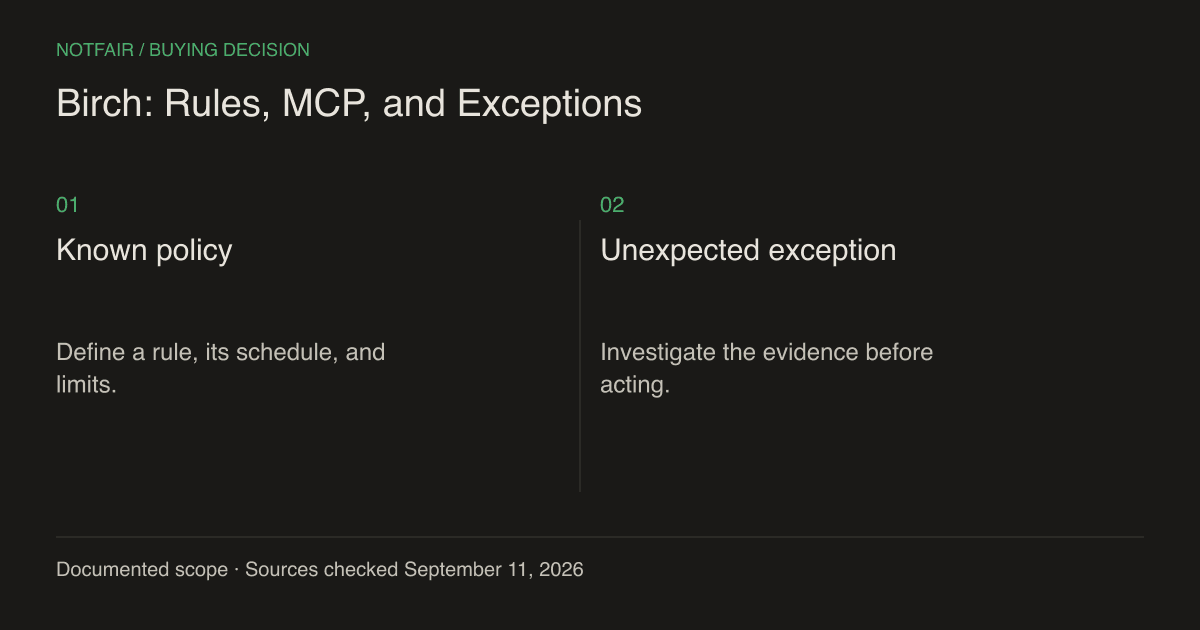
What current Birch documentation establishes
Birch’s pricing and product navigation describe condition-based rules, creative exploration, ad production workflows, and a Birch MCP connection. Its plan selector bases pricing on monthly spend across connected ad accounts, and automated rules are listed in the Pro feature set. Confirm the selected spend tier, billing period, and overage terms rather than relying on an unconfigured price shown in a page extract.Birch plans, Rules, and MCP navigation (https://bir.ch/pricing).
A rule engine is valuable when a team can express a recurring action precisely. It turns an agreed policy into repeated execution. An AI-client workflow is valuable when the question needs investigation, context, or a different sequence of tools each time. Both operating models still require reliable source metrics and someone accountable for the result.
| Requirement | Question to ask |
|---|---|
| Known recurring policy | Can the condition, time window, action, and limits be represented exactly? |
| Unexpected performance change | Can the operator investigate causes before choosing an action? |
| AI connection | What tools and accounts does this plan expose through MCP? |
| Recovery | Can we stop the schedule and inspect the changes already made? |
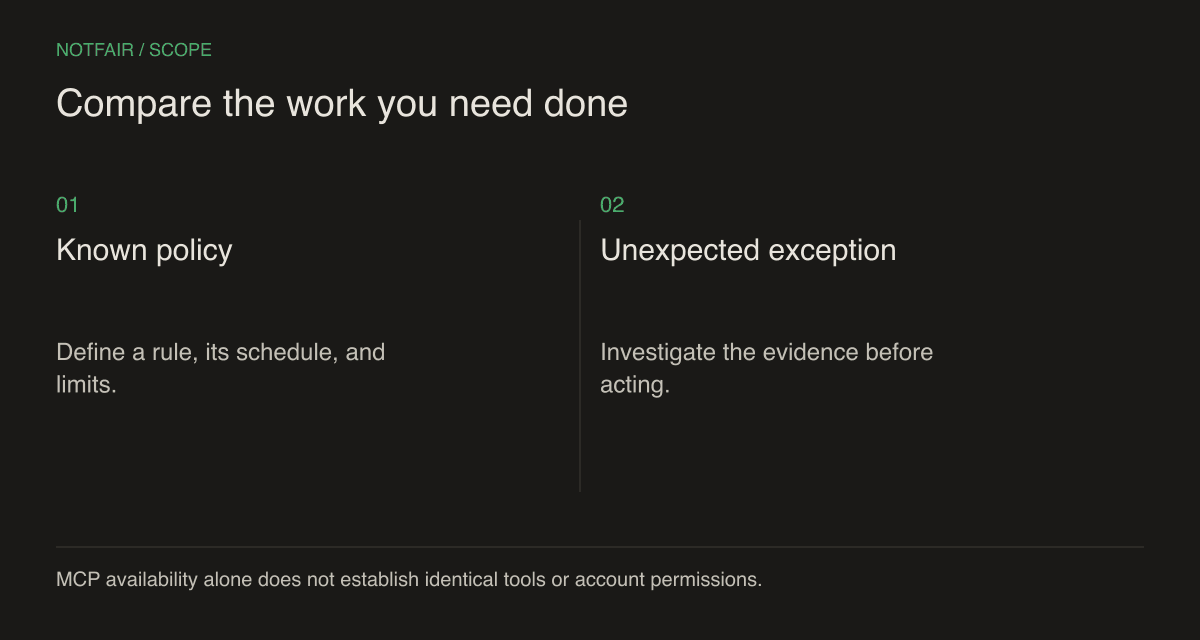
Write the rule completely before you automate it
Consider a rule that pauses an ad set after it spends $100 without a conversion. That sentence leaves important details undefined. Does spend refer to today, the last 24 hours, or the ad set’s lifetime? Which conversion action counts? Is the condition evaluated before delayed conversions arrive? Does the rule exclude a launch period or a protected campaign?
A complete policy names the account, object level, reporting window, conversion definition, evaluation cadence, action, and exception list. It also names who can change the policy. Otherwise an apparently consistent rule can behave differently from what the business intended, even when the software implements it correctly.
NotFair can help an operator retrieve the evidence and propose supported changes through its connected tools. A recurring NotFair-based workflow also needs an actual scheduler or running agent; an MCP endpoint alone is not a recurring service. Verify the host’s approval settings and the schedule’s state before describing the workflow as unattended.NotFair MCP setup and integrations.
Calculate what a repeated budget rule actually does
Illustrative rule: increase a daily budget by 20% whenever a condition is met. Starting at $100, one execution produces $120. A second execution produces $144, and a third produces $172.80. Three increases are a 72.8% increase over the original budget, not 60%, because each increase applies to a new base.
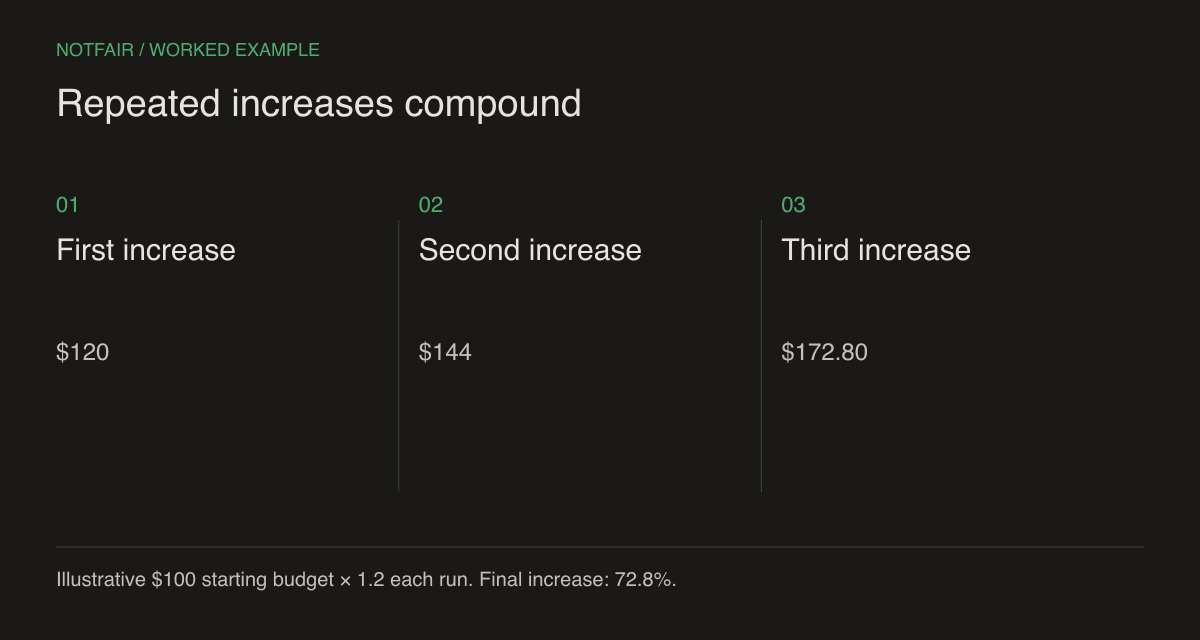
That arithmetic does not predict actual ad delivery or spend. It explains why you should ask about cooldowns, maximum budgets, repeated execution, and interactions between rules. A perfectly valid per-action percentage can still create an unintended final setting if the same condition fires repeatedly.
Test a dry-run or preview path where available, and inspect the action history. If two rules can modify the same target, document their priority and whether one sees the other’s new value. If the tool does not make that order clear, simplify the policy before enabling it. A small rule set with known behavior is easier to maintain than a large set of partly overlapping instructions.
Where NotFair’s broader workflow helps
An exception often needs context outside the ad platform. A promotion may have ended on the website, an offer may have changed, or a CRM qualification rule may have been updated. NotFair’s connected WordPress, GoHighLevel, GA4, and Search Console tools can help an AI client investigate those relevant systems alongside supported advertising accounts.NotFair MCP setup and integrations.NotFair WordPress connection and publishing.
For instance, ask the assistant to compare the current landing-page offer with the creative before proposing a campaign adjustment. If the problem is an expired offer, a budget rule is not the whole answer. Prepare the content or campaign correction that matches the business decision, then verify its result in the target service.
The benefit is a flexible investigation with a concrete endpoint. It is not a promise that the model always chooses the correct policy. Supply authoritative business constraints and require the client to distinguish facts, hypotheses, and proposed changes. If a source is inaccessible, the assistant should identify that gap instead of silently working around it.
A trial that tests exceptions and conflicts
Write a stop instruction before the first scheduled run. It should name the schedule owner, how to disable future execution, and where to inspect past actions. Test the distinction between stopping the schedule and undoing a prior change: these are different operations. A stopped rule can leave its last budget increase in place. A reversed budget can be increased again if the rule is still active. Your operating procedure needs to address both states explicitly.
- Normal case — provide a target where the proposed rule clearly should act, initially without authorizing execution.
- Exception case — include a protected launch or business constraint where the correct behavior is to leave it alone.
- Repeated case — inspect whether the same condition could trigger again and what final value it would produce.
- Conflict case — identify another schedule or person who can change the same object.
- Stop case — demonstrate how the operator disables future runs and retrieves the existing action history.
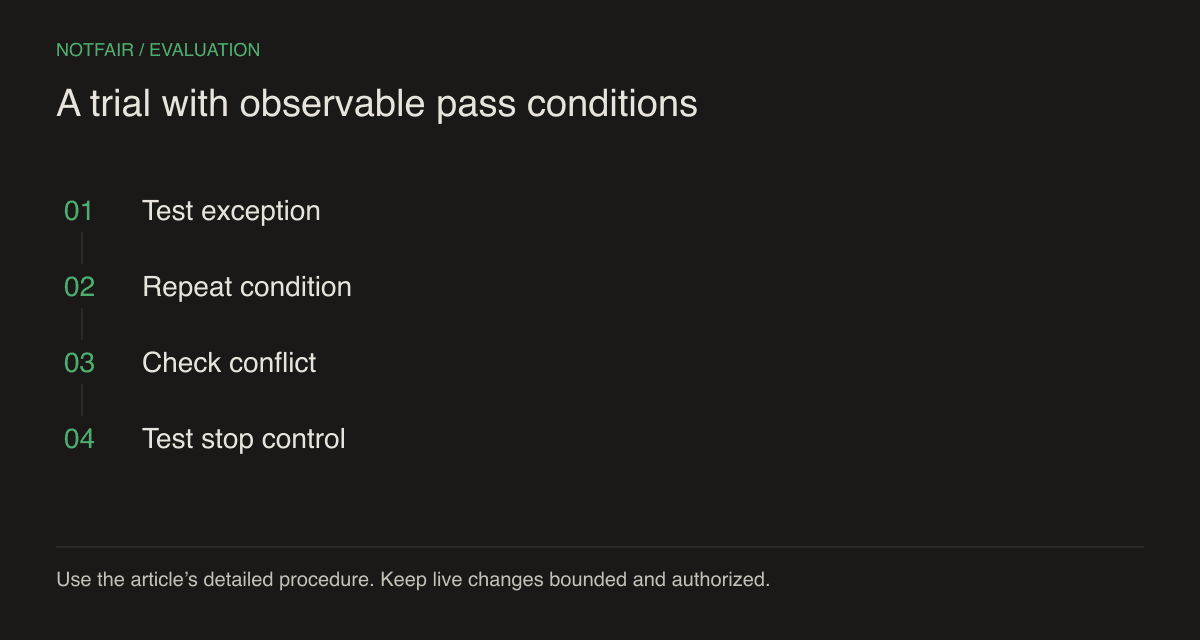
Use non-serving or otherwise appropriately bounded targets for configuration tests where possible. Keep live writes small and explicitly authorized. Verify the actual platform result after a test; a rule matching an object does not prove its action succeeded. Record denied permissions and partial completion as such.
Compare costs after the behavior passes
NotFair Growth’s published monthly fee is $99 with five shared ad-account spots and $10 per additional spot. Add your AI-client and any scheduling costs. For Birch, request a quote for the same connected portfolio and the plan that includes the required rules or MCP features. Do not compare NotFair’s base plan with a Birch tier that lacks the job you need.NotFair pricing and account limits.
Choose Birch if a dedicated recurring-rule environment is the right center of your operations and its controls pass the tests. Choose NotFair if you primarily need flexible investigations and supported actions in the assistant you already use. If both remain in the stack, designate one system as the writer for each target and schedule. Clear ownership prevents a useful tool combination from becoming an ambiguous control system.
Test the workflow on your own connected account
Start with a read-only question, inspect the evidence, then review one supported action. Check the current plan and connection requirements.