

Co-founders
NotFair vs Madgicx: A Meta Buyer’s Checklist
Compare NotFair vs Madgicx for Meta advertising, creative analysis, tracking, and CRM follow-through. Use a concrete qualified-lead evaluation.
Choose NotFair when you want Meta account work to sit inside your existing AI assistant and connect to broader analytics or CRM investigations. Choose Madgicx when you need to evaluate a dedicated Meta advertising and creative-management environment. The central question is whether your bottleneck is creative production, measurement, or the path from a performance question to an account change.
Published by NotFair, one of the products compared. We checked public vendor documentation and NotFair’s implementation on September 11, 2026. This is a documented capability comparison, not a head-to-head performance test. Worked examples are illustrative; prices and plan terms can change.
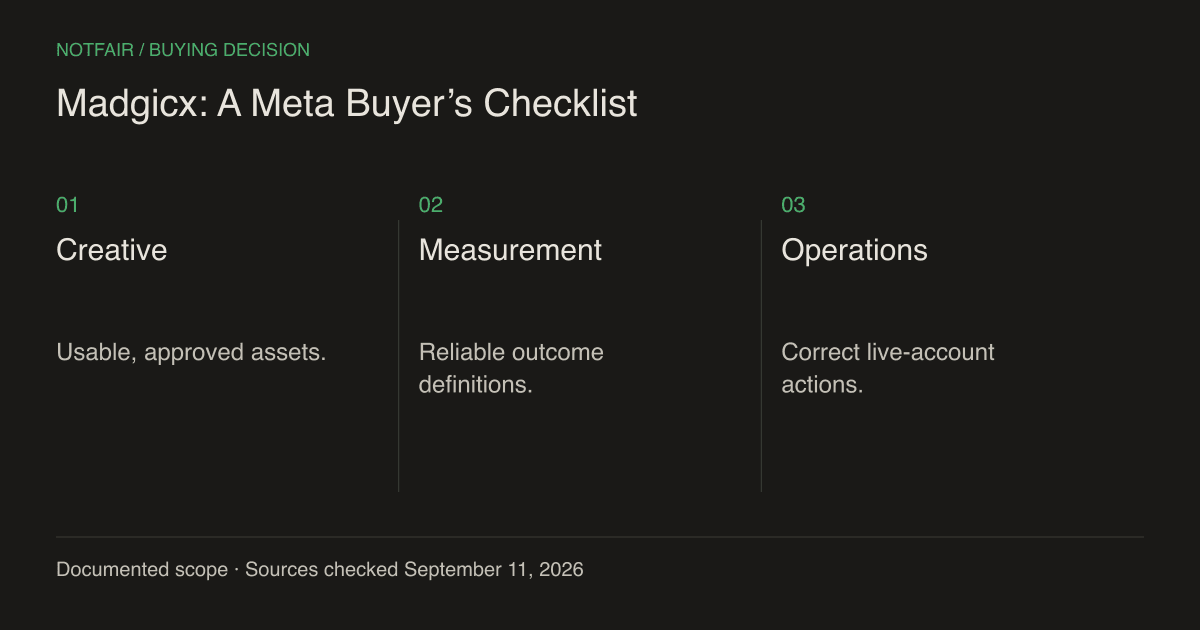
Separate three jobs that are often bundled together
Creative production makes assets. Measurement records and attributes outcomes. Campaign operations change delivery settings and live objects. A product may cover several of these jobs, but a useful comparison tests each independently. A strong creative dashboard does not prove reliable lead attribution, and a working campaign connector does not prove that the assets will convert.
Madgicx presents itself as an agentic Meta advertising platform. Its pricing page describes automation, targeting, analytics, and ad management, with plan selection based on monthly ad spend. It also lists Tracking Pro at $49 per month for each connected account and advertises a seven-day trial. Verify the selected base plan and billing period before adding that separate tracking cost.Madgicx product positioning (https://madgicx.com/).Madgicx plan selector and Tracking Pro (https://madgicx.com/pricing).
| Bottleneck | What to test | Why it changes the choice |
|---|---|---|
| Creative production | Usable assets, brand accuracy, delivery formats | More variations do not automatically mean better ads |
| Tracking | Event coverage, deduplication, attribution settings | Bad measurement can produce bad optimization |
| Operations | Exact account reads and supported mutations | The task must complete in the right account |
| Lead quality | CRM definitions and reliable record matching | Low platform CPA can hide weak prospects |
Madgicx also documents a hosted MCP connection for AI clients, and its pricing materials discuss cross-channel reporting. Neither AI-client access nor the existence of reports beyond Meta is exclusive to NotFair. The distinction to test is the exact connected tools and actions your chosen workflow requires.Madgicx hosted MCP setup (https://madgicx.com/blog/facebook-ads-mcp).Madgicx reporting and plans (https://madgicx.com/pricing).
What NotFair contributes to a Meta workflow
NotFair’s Meta tools include reporting and supported campaign, ad-set, ad, budget, and creative workflows. Its integration set also includes Google Ads, Search Console, GA4, GoHighLevel, and WordPress. This lets a compatible AI client investigate a Meta result alongside other connected business evidence instead of relying only on the Meta report.NotFair MCP setup and integrations.
For example, the operator can ask why one offer gets inexpensive leads but few bookings, inspect relevant CRM records, and prepare a narrowly scoped campaign or landing-page change. This workflow requires appropriate connections and record identifiers. NotFair does not automatically create a universal customer identity graph or replace the business’s definition of a qualified lead.
Meta permissions are another acceptance criterion. Account access alone may not establish permission to use a particular Page or create a particular creative. Have the client identify the account and required Page before proposing a publish operation. A permission error should remain an error to resolve, not be described as a successful campaign launch.
Use qualified outcomes to interpret a cheap lead
Illustrative example: Ad Set A spends $600 and produces 30 forms, of which six qualify. Ad Set B spends $600 and produces 20 forms, of which ten qualify. A costs $20 per form; B costs $30. However, A costs $100 per qualified lead and B costs $60. The ranking reverses when the metric matches the sales team’s outcome.
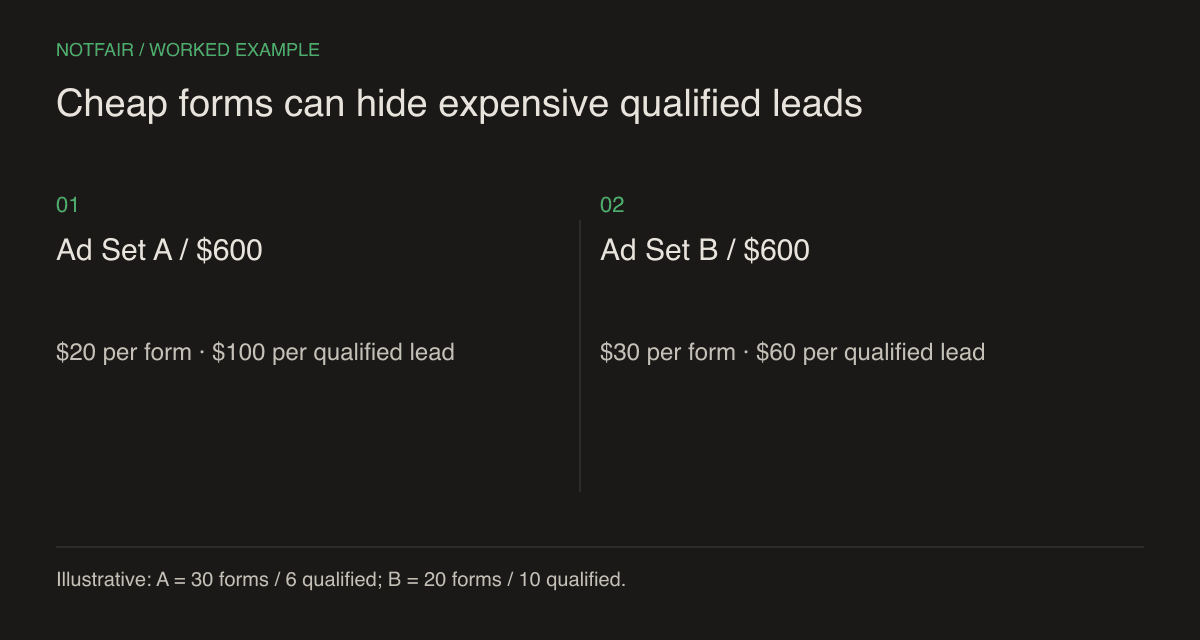
This is not permission to increase B’s budget immediately. The groups might differ in audience, placement, conversion window, or qualification timing. Match the reporting periods and determine whether the apparent difference is stable enough for the business decision. If qualification is incomplete, report it as incomplete rather than counting unreviewed leads as failures.
Also inspect whether the same person submitted more than one form. The cost per form calculation counts submissions; the sales process may count unique prospects. Do not describe one as the other. A useful AI workflow exposes these definitions before recommending a change, especially when a recent campaign has only a small number of downstream outcomes.
Evaluate creative with a controlled brief
Include a deliberately difficult creative requirement, such as a product name that must remain exact or a price that changes by region. The goal is to expose whether revisions preserve the rest of the approved asset. Check the destination on a phone before the ad is activated. An accurate creative can still send traffic to an unavailable offer or a form that loses the context promised in the ad. Record those handoff errors separately from image quality so the evaluation identifies the actual bottleneck.
If creative is the main reason to buy Madgicx, give it a real brief with an offer, audience, product facts, brand restrictions, and required formats. Count usable outputs after human review, not raw generations. An asset that invents a feature, changes a price, or misrepresents the product fails even if it receives an attractive internal score.
For the NotFair side, begin with approved assets and test the supported path into the correct account and creative object. Separate file upload, creative creation, ad creation, and activation in your notes. A file in an asset library is not yet a serving ad. The correct completion evidence depends on which of those operations you requested.
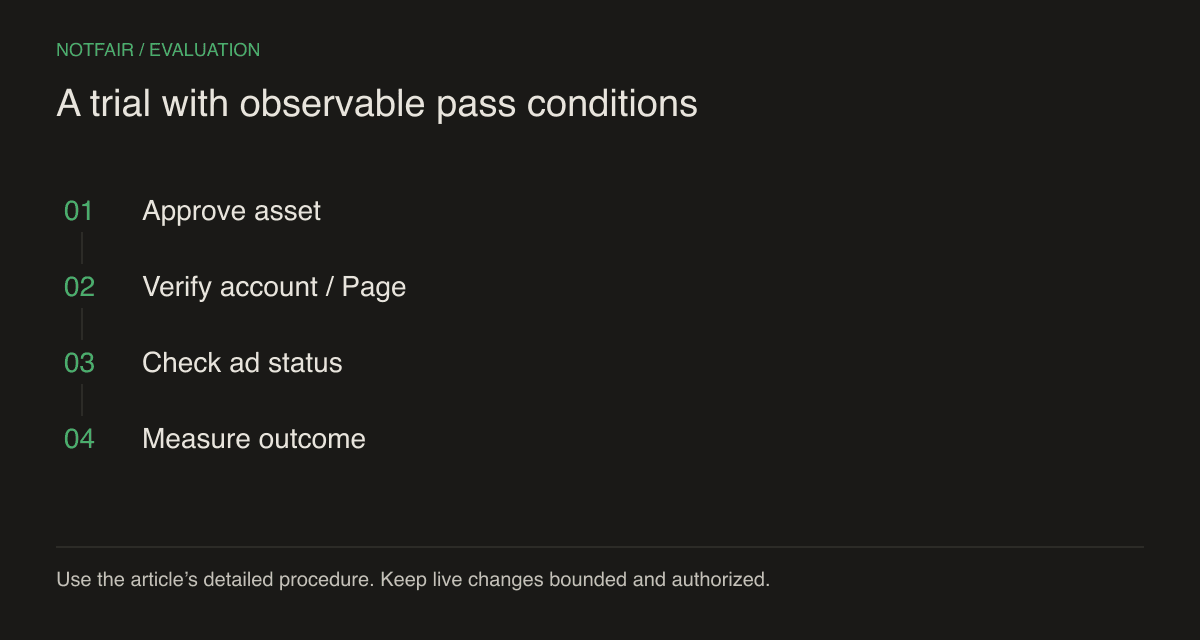
- Asset review — factual claims, offer, destination, branding, and usage rights are correct.
- Account review — the account, Page, campaign, and ad set match the intended destination.
- Delivery review — status and provider review outcome are visible; draft or paused status is labeled accurately.
- Outcome review — reporting uses the agreed conversion and qualified-lead definitions.
Price the complete working setup
NotFair Growth is $99 per month for five shared ad-account spots, with $10 per month for each extra spot. AI-client fees and media spend are separate. For Madgicx, obtain the base plan quote for the same connected spend and accounts, then include required tracking or other add-ons. This comparison does not treat either product’s subscription as a replacement for every creative or analytics expense.NotFair pricing and account limits.
Estimate review time from the trial. If one setup requires someone to reconcile a CRM export every week, include that work even if it is outside the product UI. If another setup offers a tracking feature, verify its actual data quality on your site before assigning it savings. A promised integration is not a measured reduction in work.
The choice for a working Meta team
Keep or choose Madgicx when its dedicated Meta environment materially improves the creative, measurement, or management job you are buying it for. Choose NotFair when you prefer an assistant-led workflow and the trial proves that it can retrieve evidence and complete precise actions across the connected services your business uses.
A combined setup can also be reasonable: one product for a specialist creative or tracking requirement and NotFair for broader investigations. Give each system a clearly owned role. Avoid two independent automations changing the same budget or ad state during evaluation, because that makes responsibility and performance interpretation unnecessarily difficult.
Test the workflow on your own connected account
Start with a read-only question, inspect the evidence, then review one supported action. Check the current plan and connection requirements.