

Co-founders
NotFair vs Perpetua: Where Does the Sale Happen?
Compare NotFair vs Perpetua by marketplace and owned-site workflows. Understand ACoS, ROAS, channel coverage, and the limits of a replacement.
If Amazon or Walmart advertising is the core job, Perpetua is the relevant specialist to evaluate. If you need AI-client workflows across your connected Google, Meta, analytics, CRM, or WordPress services, evaluate NotFair. NotFair is not an established replacement for Perpetua’s marketplace-advertising scope. The first decision is where the customer buys and which account the tool must operate.
Published by NotFair, one of the products compared. We checked public vendor documentation and NotFair’s implementation on September 11, 2026. This is a documented capability comparison, not a head-to-head performance test. Worked examples are illustrative; prices and plan terms can change.
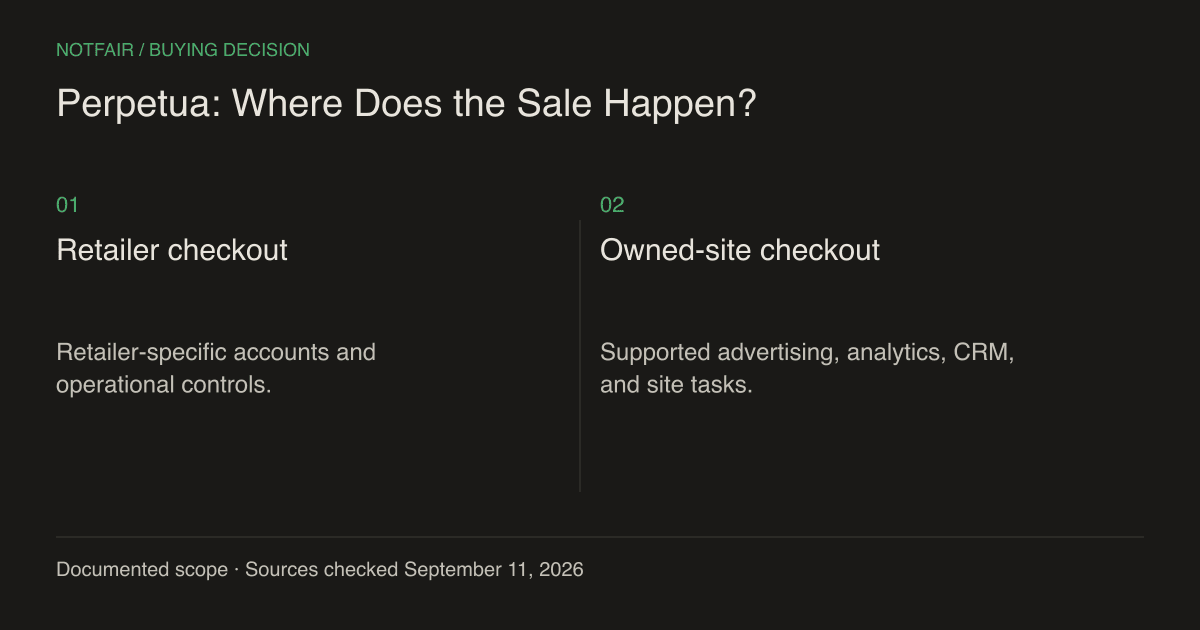
A marketplace account is a different operating surface
Perpetua’s official site describes retail-media optimization for Amazon, Walmart, and other marketplaces, including automated campaign creation and optimization around strategic goals. It also presents retail intelligence and reporting capabilities. Those functions are materially different from operating ads that lead to a website you control.Perpetua marketplace advertising and reporting scope (https://perpetua.io/).
Marketplace advertising can involve product listings, retailer-specific reporting, and operational constraints that do not appear in an owned-site campaign. A product being out of stock or losing eligibility can change the decision even if historical ad metrics look attractive. Ask the specialist to demonstrate the exact retailer, market, and campaign format you use.
| Your main job | Relevant starting point | Boundary to verify |
|---|---|---|
| Operate Amazon or Walmart ads | Perpetua | Retailer, country, campaign format, and account permissions |
| Operate supported Google or Meta campaigns | NotFair | Exact action and selected account |
| Investigate owned-site leads | NotFair with connected analytics or CRM | Reliable identifiers and qualification definitions |
| Compare retailer and website outcomes | A reconciled measurement plan | Different attribution and revenue definitions |
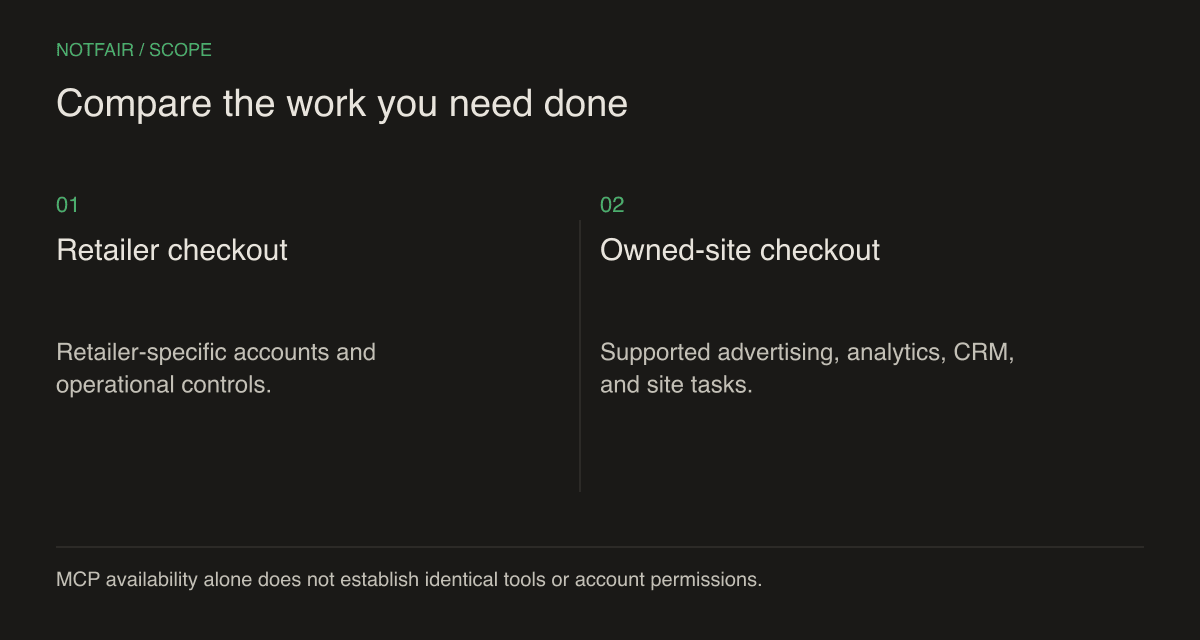
Where NotFair has a role in an ecommerce stack
NotFair connects a compatible AI client to supported advertising, search, analytics, CRM, and WordPress tools. For an owned-site business, an operator can investigate a Google Ads campaign, review GA4 reporting, inspect Search Console performance, or prepare a website-content update. Each step requires its corresponding connection and permissions.NotFair MCP setup and integrations.NotFair WordPress connection and publishing.
That is useful when the question crosses a campaign boundary. An offer may differ between the ad and landing page, a form may collect the wrong qualification information, or search traffic may be landing on an outdated article. A connected assistant can help assemble the evidence and prepare a precise correction in a supported service.
Do not stretch that benefit into a claim of native Amazon or Walmart campaign management. The verified integration scope for this comparison does not include those marketplace ad systems. If a requested retailer operation is missing, label it as a gap and retain the specialist workflow. An AI model’s ability to discuss a platform does not mean the connector can operate it.
Translate ACoS and ROAS before comparing reports
Advertising cost of sales, or ACoS, divides ad spend by attributed sales. Return on ad spend, or ROAS, divides attributed revenue by spend. With matching definitions and a nonzero denominator, they are reciprocals. Illustrative example: $2,000 spent against $8,000 in attributed sales produces 25% ACoS and 4× ROAS.
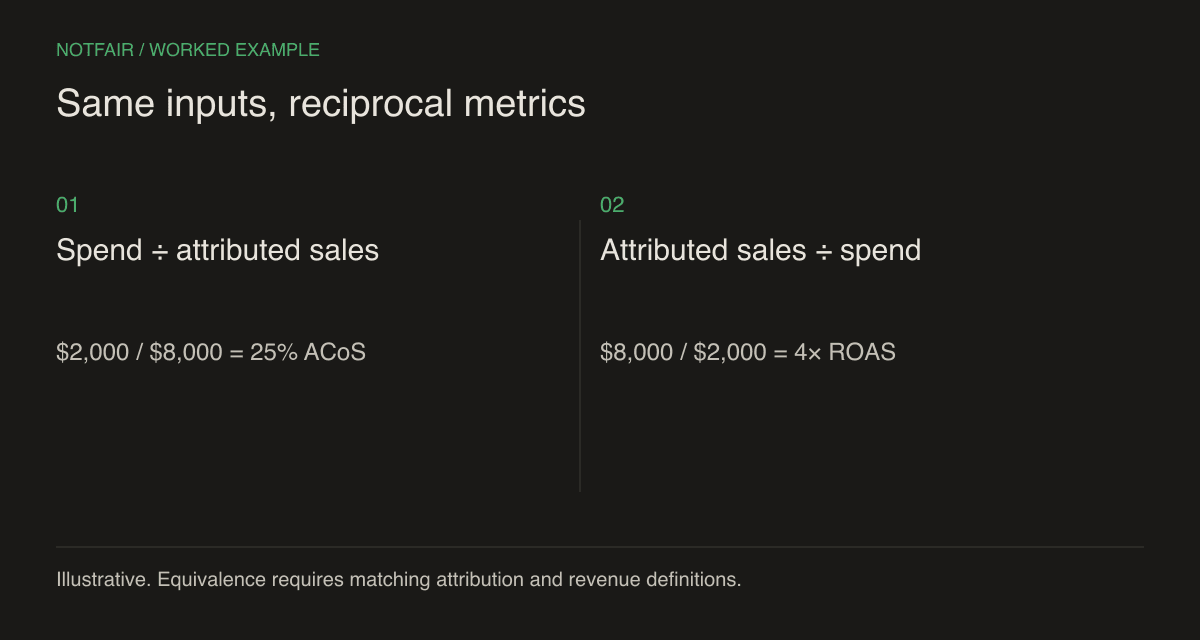
The reciprocal relationship breaks as a cross-report comparison when the inputs differ. One report may include a different attribution window, refunds, taxes, shipping, or view-through credit. A marketplace sales figure and a GA4 purchase-revenue figure should not be treated as interchangeable simply because both are displayed in dollars.
Neither ratio is profit. For the illustrative $8,000 in sales, product costs, fulfillment fees, returns, and other operating expenses still matter. Calculate contribution using the business’s actual cost data before deciding whether a campaign should scale. Do not present a higher ROAS as proof of higher incremental profit without that additional evidence.
Build a channel-level acceptance worksheet
Include a product-availability scenario in the evaluation. Ask what the operator should do when a promoted item is unavailable on one destination but still available on another. The answer should identify which campaigns and landing pages are affected, rather than pausing every campaign sharing the product name. Keep any retailer-specific eligibility decision with the source that actually controls it. This exercise reveals whether the team can maintain separate channel responsibilities without losing the overall business context. It also prevents a generic cross-channel summary from concealing a concrete operational constraint.
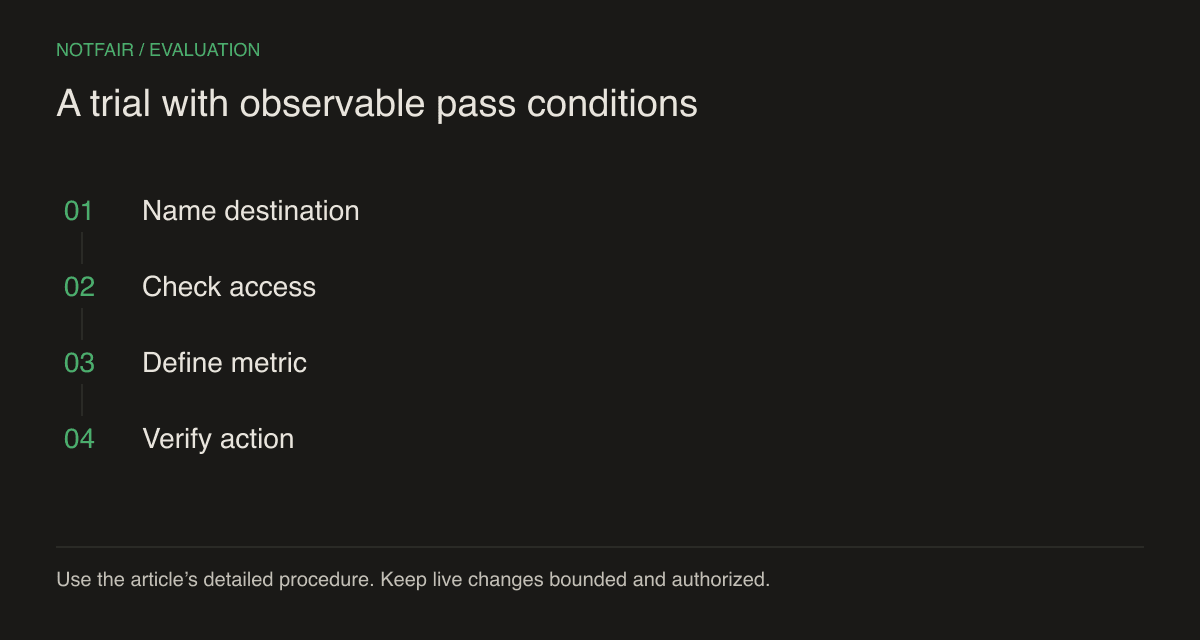
- Destination — name where checkout occurs and which party controls the product page.
- Access — identify the retailer or ad-platform account, market, and permissions.
- Action — specify one operation the software must complete, rather than ‘manage ecommerce.’
- Measurement — document the revenue definition, attribution window, refunds, and reporting lag.
- Operational constraint — supply inventory, margin, offer, or brand-defense rules relevant to the decision.
Apply the worksheet to a real product. For the Perpetua evaluation, request a demonstration of the retailer workflow the product actually uses. For the NotFair evaluation, choose a supported owned-site or advertising task and verify it in that connected service. Do not score a specialist down for a job outside its scope, or credit a general connector for a hypothetical integration.
If both tools are used, define a reporting handoff rather than assuming a common dashboard creates common attribution. Keep the source platform and reporting method attached to each metric, together with the retrieval date and the accountable report owner. When a number cannot be reconciled, present the two source values with an explanation of the difference instead of forcing them to match.
Price the missing capability, not a replacement fantasy
NotFair Growth is $99 monthly with five shared ad-account spots and $10 per additional spot. It also has a Free plan with 300 monthly operations after a seven-day unlimited trial. Those prices do not buy a marketplace-advertising integration that has not been established. Ask Perpetua for current terms covering the retailer accounts and services you need.NotFair pricing and account limits.Perpetua product and demo contact (https://perpetua.io/).
A valid cost comparison might be ‘What does it cost to operate our owned-site campaigns alongside our existing marketplace program?’ It is not ‘How much do we save replacing every retailer workflow with a connector?’ unless the replacement has first demonstrated all of those required operations. Make channel coverage a pass/fail condition before calculating savings.
The practical decision for a multichannel seller
Choose Perpetua when the required work centers on marketplace advertising and its demonstration establishes the relevant coverage. Choose NotFair when the work centers on supported connected marketing systems and an assistant-led investigation-to-action process. Use both when the business has both needs and the responsibilities are clear.
Before ending the trial, ask the actual operator to reproduce a report and complete one bounded, authorized action. Keep the object ID, source result, and measurement definition in the handoff. This prevents an attractive product presentation from becoming an unsupported claim that the entire ecommerce operating stack has been replaced.
Test the workflow on your own connected account
Start with a read-only question, inspect the evidence, then review one supported action. Check the current plan and connection requirements.