

Co-founders
NotFair vs Adzooma: What ‘Free’ Includes
Compare NotFair vs Adzooma on free limits, reporting frequency, account coverage, and live actions. Choose a plan around the work you actually do.
Both NotFair and Adzooma have free plans, but they meter different things. NotFair gives a compatible AI client access to connected tools with an operations allowance. Adzooma’s free plan centers on periodic reports, opportunities, and alerts. Choose by the task you need to complete and the limits that interrupt it, rather than treating ‘free’ as a complete product comparison.
Published by NotFair, one of the products compared. We checked public vendor documentation and NotFair’s implementation on September 11, 2026. This is a documented capability comparison, not a head-to-head performance test. Worked examples are illustrative; prices and plan terms can change.
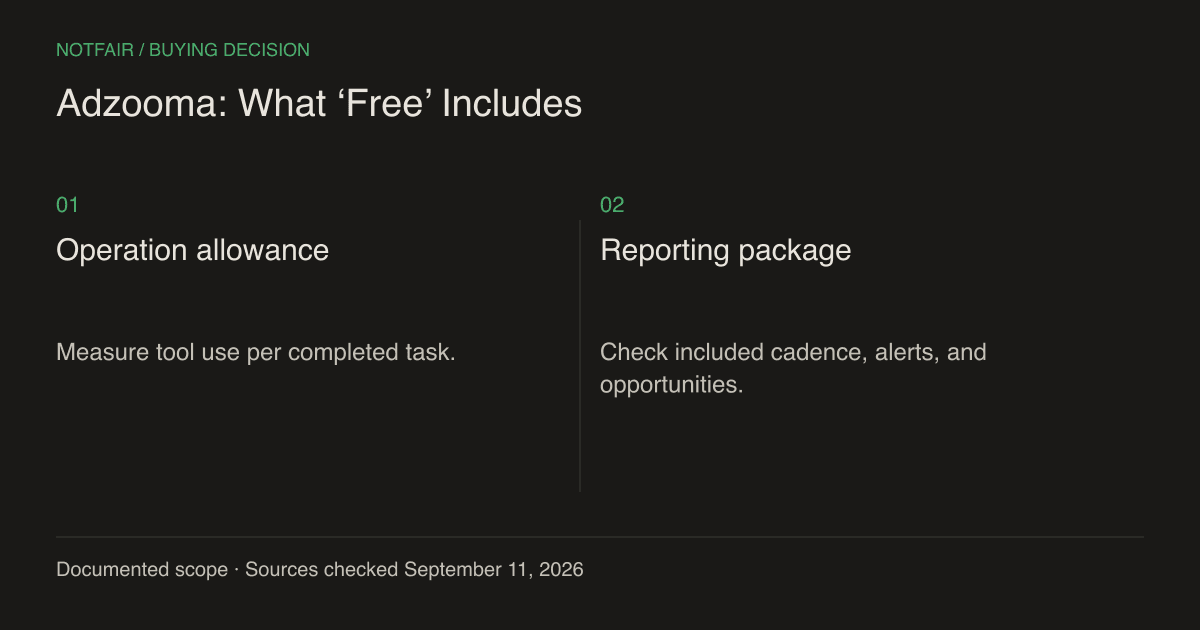
Read the free-plan limits side by side
Adzooma’s current pricing page lists a $0 plan with monthly PPC reports, monthly opportunity analysis, unlimited connected ad accounts, three PPC alerts, and one user seat. Its Silver plan is $69 monthly with weekly reports and opportunity analysis; Gold is $179 monthly with daily reporting. These are published plan descriptions, and applicable fair-use terms still matter.Adzooma Free, Silver, and Gold plan terms (https://adzooma.com/pricing/).
NotFair’s Free plan includes two shared ad-account spots and 300 MCP operations each month after a seven-day unlimited trial. Growth is $99 monthly with five spots and unlimited operations, subject to provider permissions and API limits. The AI client and media spend are separate. An operation allowance is not a count of finished audits or a guarantee about the number of questions you can ask.NotFair pricing and account limits.
| Free-plan question | NotFair | Adzooma |
|---|---|---|
| What is limited? | 300 monthly MCP operations; 2 shared ad-account spots | Monthly report/opportunity cadence; alert and seat limits |
| What starts the work? | A task in your compatible AI client | The product’s reporting and opportunity workflow |
| How many accounts? | 2 shared ad-account spots | Unlimited connected ad accounts, per published plan |
| What must be tested? | Actual operations per completed task | Whether the included cadence and opportunities are sufficient |
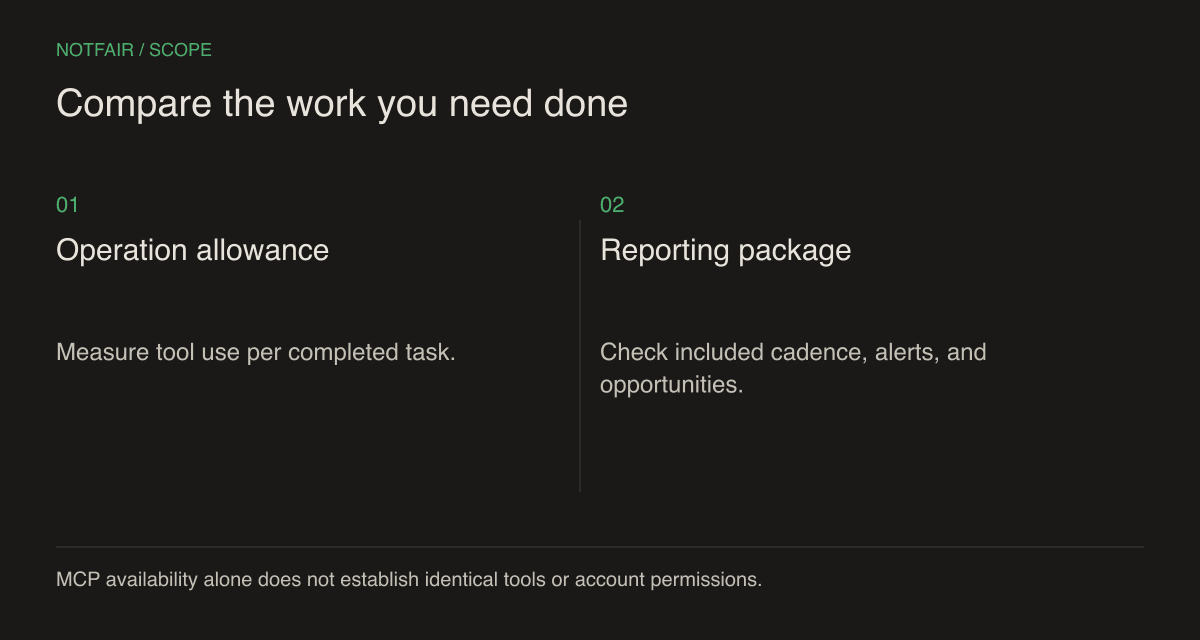
Calculate capacity from your own observed workflow
Illustrative planning exercise: suppose a repeatable account review uses 15 counted operations after you measure it in the client. A 300-operation allowance could cover 20 such reviews because 300 ÷ 15 = 20. If the task takes 30 operations, that falls to ten reviews. This is a hypothetical capacity calculation, not a benchmark of NotFair’s typical consumption.
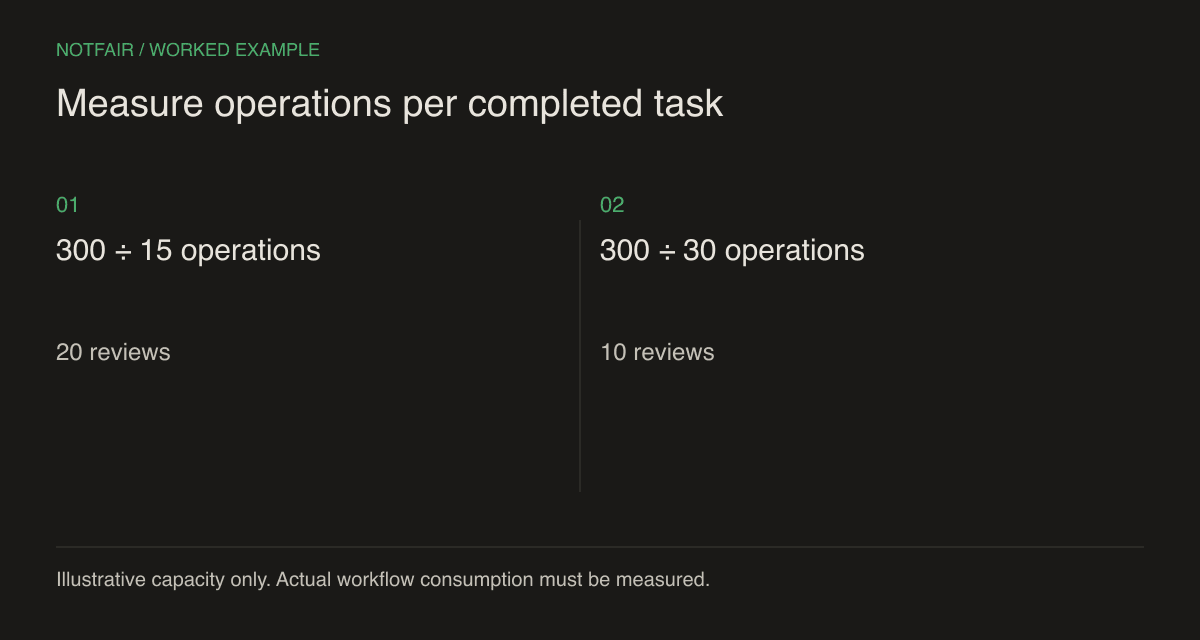
A single conversational request can require multiple tool calls. The agent may discover capabilities, retrieve several reports, inspect objects, and verify an action. Retries and a changed question can alter consumption. For that reason, do not advertise ‘300 free audits’ by substituting audits for operations. Check the actual usage record after a representative task.
Keep the usage record and the completed deliverable together so another operator can reproduce your estimate. Reporting frequency is a different constraint. A monthly overview may be sufficient for a quiet account review but insufficient for an operator who wants to investigate a sudden change today. Equally, paying for more frequent data retrieval adds little if nobody reviews or acts on it. Match the cadence to the decision and the person who owns it.
Both products can support account changes
Adzooma’s pricing-page FAQ says its management access lets users apply changes directly from the dashboard and automate workflows. Therefore, ‘Adzooma only recommends while NotFair acts’ is not a defensible distinction. Test the exact action each product supports, including the account type, object, and permissions required.Adzooma explanation of management access and applied changes (https://adzooma.com/pricing/).
NotFair’s useful difference is working through an AI assistant that can investigate connected services and carry out supported operations. The integration set includes Google Ads, Meta Ads, X Ads, LinkedIn Ads, Reddit Ads, TikTok Ads, GA4, Search Console, GoHighLevel, and WordPress. That breadth can help when an advertising issue is linked to a landing page or CRM outcome.NotFair MCP setup and integrations.NotFair WordPress connection and publishing.
Adzooma explicitly discusses Google, Microsoft, and Facebook advertising in its product materials. This comparison does not establish Microsoft Ads support in NotFair. If Microsoft is a required channel, decide how that work will be covered before comparing prices. Integration names should function as actual acceptance criteria, not decorative rows in a winner’s table.
A useful free trial ends with a verified task
Select one real question, such as whether a campaign’s apparent improvement came from better qualified leads or a change in the conversion mix. Specify the account, completed period, target conversion, and business constraint. Use the same inputs in both products, and compare the source evidence before comparing the recommendations.
- Report check — reconcile the main totals with the platform and record differences in date or conversion settings.
- Opportunity check — identify one recommendation that follows from the evidence and one that needs more context.
- Action check — review the exact object and intended edit, then authorize only that bounded change.
- Completion check — verify the resulting platform state and record any manual work needed to finish.
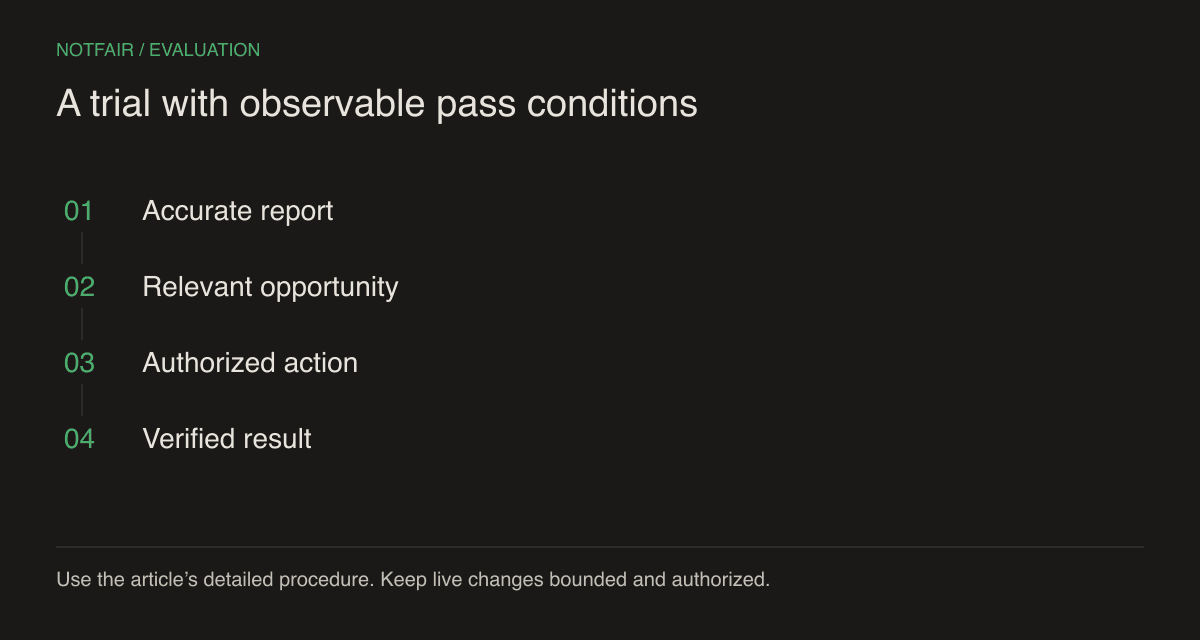
Do not upgrade merely because a report shows many opportunities. Count the issues that are relevant to your business and the actions you can verify. A tool that surfaces three useful corrections can be more valuable than one that produces a hundred generic suggestions. Record which recommendation was rejected and why so the next review does not start from scratch.
When paying for NotFair is justified
Consider a month when the usual operator is away. Have a colleague use the saved task specification to reproduce the review and explain the next step. If they cannot distinguish a recommendation from an applied change, improve the handoff before expanding usage. The benefit of a free trial is learning whether the process is maintainable. A monthly report that everyone understands can be more valuable than a sophisticated workflow only one person knows how to operate. Include that continuity requirement in the plan decision, and retain the task specification where the whole team can find it.
Growth makes sense when the Free plan’s account or operation limits obstruct a workflow you have already proved useful. For a team operating several connected systems from an AI client, paying for capacity can remove a concrete interruption. That is different from upgrading in the hope that a larger allowance will create a strategy.
Before upgrading, document the recurring task, who runs it, what evidence they inspect, and what successful completion looks like. A broader workflow may also require a paid AI-client plan or an agent scheduler. Include those charges in your estimate instead of presenting the NotFair subscription as the entire cost of the working system.
Choose Adzooma when its dashboard, report cadence, connected-account model, and opportunities meet the need with less work. Choose NotFair when flexible investigation and precise actions in your existing assistant are the decisive benefits. Keep the comparison grounded in one repeatable job and the real limits encountered while doing it.
Test the workflow on your own connected account
Start with a read-only question, inspect the evidence, then review one supported action. Check the current plan and connection requirements.