

Co-founders
NotFair vs Adalysis: Audits, Actions, and MCP
Compare NotFair vs Adalysis for PPC audits, automated actions, MCP, and cross-platform work. Use an issue-triage exercise before switching tools.
Choose NotFair for flexible AI-client investigations that extend beyond PPC into connected analytics, CRM, and website work. Choose Adalysis when its structured Google Ads and Microsoft Ads auditing, testing, and automation system matches your process. Adalysis now advertises both automated actions and MCP. A comparison that says only NotFair can execute or connect to AI is out of date.
Published by NotFair, one of the products compared. We checked public vendor documentation and NotFair’s implementation on September 11, 2026. This is a documented capability comparison, not a head-to-head performance test. Worked examples are illustrative; prices and plan terms can change.
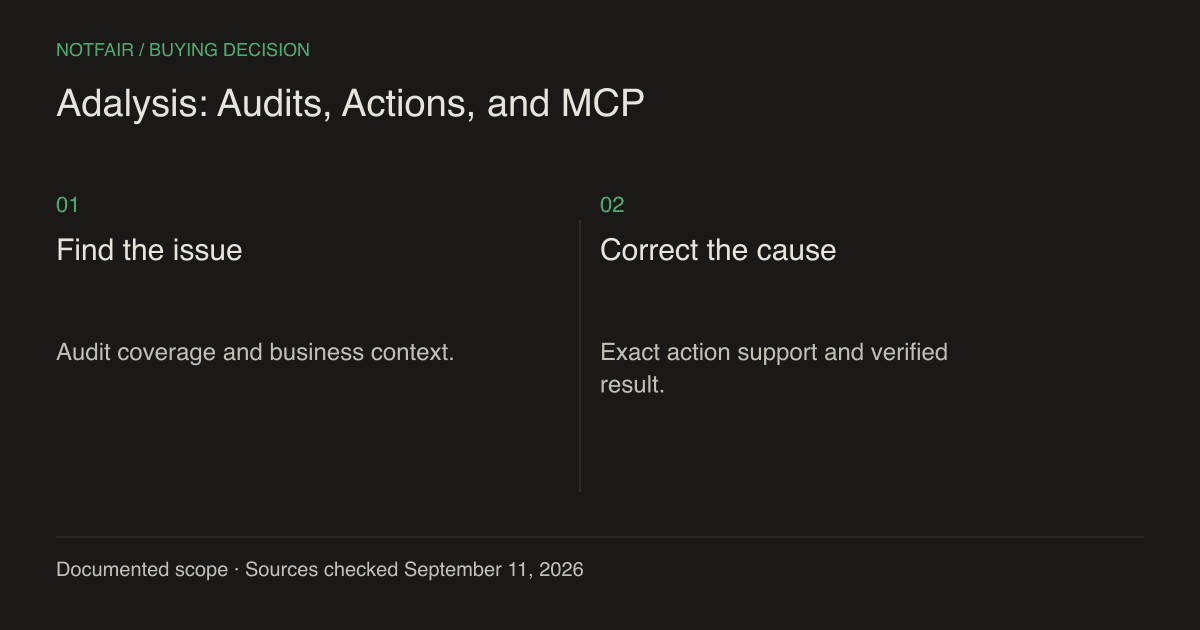
Compare the audit system, not the word ‘AI’
Adalysis’s current pricing page describes more than 100 customizable audit checks, automated actions, and unlimited Google Ads accounts, Microsoft Ads accounts, and users across its plans. Pricing is tied to managed spend, and the public page advertises a standard 30-day trial. Its navigation also links to an Adalysis MCP product.Adalysis audit, automation, account, and trial details (https://adalysis.com/pricing/).
Those features address a specific organizational problem: consistently finding and processing issues across a search-account portfolio. A catalogue of checks gives different team members a common review vocabulary. That can be more useful than asking each person to invent a prompt for the same weekly account audit.
| Job | NotFair evaluation | Adalysis evaluation |
|---|---|---|
| Repeatable search audits | Specify the checks and inspect source evidence | Evaluate built-in and customized checks |
| Microsoft Ads operations | Not in the verified scope of this comparison | Explicitly listed in current plans |
| Work outside PPC | Connected GA4, GSC, CRM and WordPress tasks | Verify the precise integration requirement |
| AI access | Hosted MCP with read/write separation | MCP advertised; inspect available actions |
Where NotFair can close a different gap
Some account problems cannot be diagnosed from the advertising settings alone. Suppose the sales team reports that leads from one offer are mostly ineligible. A search-term audit can help, but the answer may depend on a form change, a landing-page promise, or CRM qualification criteria. NotFair’s connected tools let an AI client inspect those relevant systems where access is configured.NotFair MCP setup and integrations.NotFair WordPress connection and publishing.
That creates a useful path from diagnosis to a specific action: identify the affected campaign, explain the mismatch between the ad and the offer, prepare a narrower negative keyword or landing-page correction, and verify the supported change. The assistant still needs the business’s eligibility rule. It cannot infer a private sales policy from click data.
The strongest reason to use NotFair here is the shape of the investigation. You can work across different kinds of evidence and direct the next question as the answer develops. This is especially valuable for an operator who is comfortable reviewing the model’s reasoning and checking the underlying records. It does not establish that an assistant will find every issue a mature audit library catches.
Work through a numerical triage example
Illustrative audit: one campaign has spent $1,800, produced 60 form submissions, and yielded 12 sales-qualified leads in the same reconciled period. Cost per form submission is $1,800 ÷ 60 = $30. Cost per qualified lead is $1,800 ÷ 12 = $150. The two numbers describe different outcomes; neither should silently replace the other in an optimization rule.
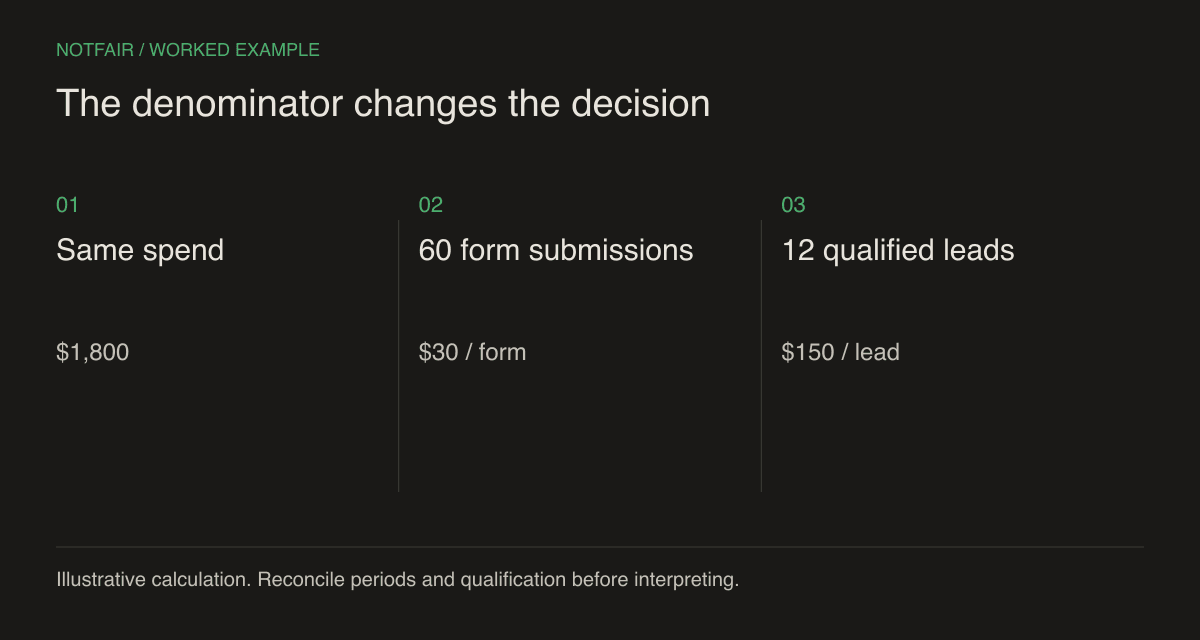
Now imagine an audit recommends increasing the budget because $30 is below the platform’s target CPA. Before applying that recommendation, confirm which conversion action the target refers to and whether qualified leads can be measured reliably. If the sales team’s target is $100 per qualified lead, the same campaign is above that target. The missing step is metric reconciliation, not another recommendation.
Do not assume the 12 qualified leads are a clean subset until you inspect the records. Check duplicates, qualification timing, time zones, and whether the CRM period uses lead-created dates or qualification dates. Recent leads may not yet have been assessed. This example is arithmetic, not a customer result or evidence that either product increases lead quality.
Evaluate findings by consequence and evidence
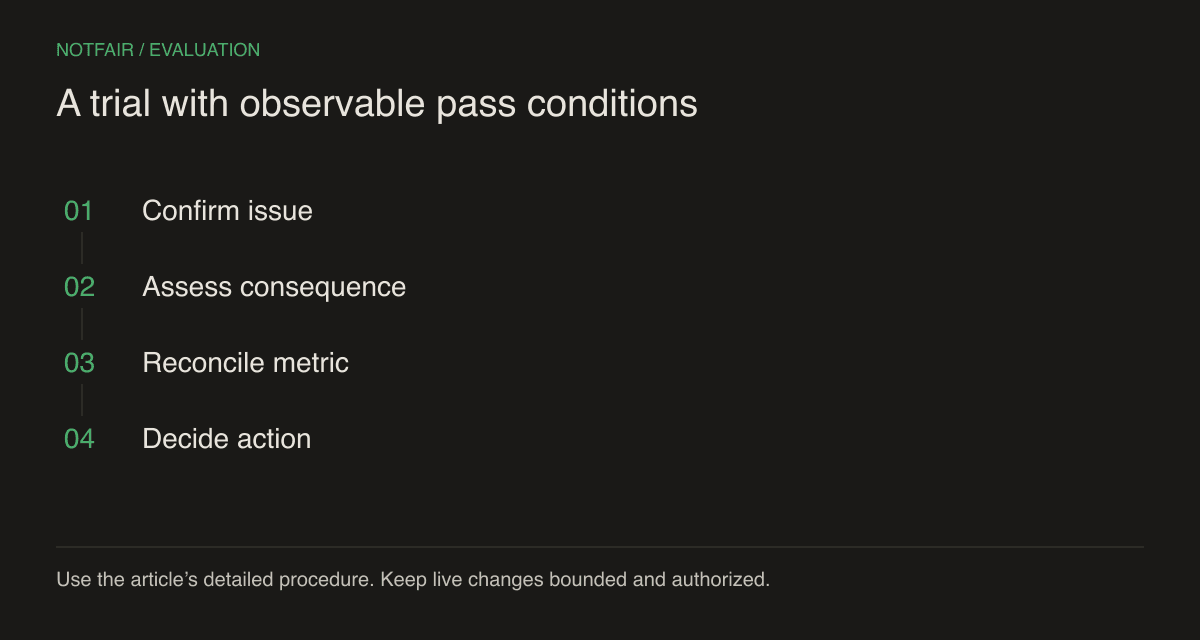
Use a small disposition log for the trial: issue, evidence, decision, owner, and revisit condition. A rejected recommendation should carry a reason such as an intentional brand-defense policy or insufficient conversion data. That reason is reusable context for the next audit. For an accepted recommendation, record what changed and which subsequent observation would justify reversing it. This gives the team a maintenance process, rather than a score that improves without explaining why.
- Immediate functional issue — a rejected ad, broken destination, or unintended campaign state can justify prompt investigation.
- Business mismatch — a search query can be technically valid but unsuitable for the product, region, or customer type.
- Measurement problem — missing or duplicated conversions can invalidate an otherwise sensible optimization.
- Preference — a naming convention or account score improvement may matter less than a verified revenue-impacting issue.
Have both products process the same small set of issues. Require an explanation of why each matters, the evidence supporting it, and the exact action proposed. Include at least one exception where the correct answer is to leave the account unchanged. For instance, a low-volume term with high-value qualified leads should not be paused merely because its click-level metrics look unusual.
Understand price and account coverage before migrating
NotFair Growth costs $99 per month with five shared ad-account spots, with additional spots at $10 per month each. Its Free plan includes 300 monthly operations after a seven-day unlimited trial. Compare this model with Adalysis’s current managed-spend quote and included account coverage. Do not assume an account-count advantage translates into a lower price for every portfolio.NotFair pricing and account limits.Adalysis current plan terms (https://adalysis.com/pricing/).
If Microsoft Ads is mandatory, treat that as a scope decision before evaluating price. This comparison does not establish a NotFair Microsoft Ads integration. Paying less for a tool that cannot operate a required channel does not replace the missing workflow. You may instead want NotFair for adjacent investigations while keeping the specialist PPC system.
Keep the history that explains past decisions
Before any switch, preserve the tests, rules, exceptions, and audit history the team actually uses. Record why a previous recommendation was rejected. Without that context, the next tool or operator may repeatedly propose the same change, consuming time and weakening confidence in the audit process.
Assign ownership for each active automation and separate read-only comparisons from live execution. Check client approval settings for NotFair and the configured automation controls for Adalysis. A supported inverse action can restore a setting, but it cannot reverse already-spent media or guarantee identical auction conditions after restoration.
Adalysis is worth retaining when its search-specific operating system is central to your team’s work. NotFair is worth choosing when the missing capability is an evidence-driven investigation across connected marketing services followed by a precise action in your existing AI client. Test that missing capability directly rather than replacing one broad marketing claim with another.
Test the workflow on your own connected account
Start with a read-only question, inspect the evidence, then review one supported action. Check the current plan and connection requirements.