

Your Meta campaign is still generating conversions, but you can't explain why yesterday's reliable ad looks expensive today. You added a vertical video, delivery shifted, and the carousel that looked strong in the creative report now seems ordinary. Before replacing the assets, check whether you're comparing creative formats or different places those assets appeared.
Table of Contents
- Why Meta Ad Formats Feel Harder Than They Should
- The Core Format Family and Where Each One Lives
- Creative Specs Every Format Actually Requires
- Matching Each Format to the Right Campaign Objective
- Format Versus Placement and Why the Difference Matters
- Measuring Format Performance Without Being Fooled
- An Optimization Workflow That Survives the Learning Phase
- A Practitioner Checklist for the Next Campaign Review
Why Meta Ad Formats Feel Harder Than They Should
Consider a familiar campaign review. A product image generates purchases, so the team turns the same proposition into a video and expects improvement. The video attracts attention, but acquisition costs move in the wrong direction. Someone concludes that video doesn't work for the account.
That conclusion skips an important question: what changed? Perhaps the message changed with the edit. Perhaps the video reached a different audience. Perhaps delivery moved from Feed into a full-screen placement where viewers behaved differently. This is a diagnostic example, not evidence that either asset is stronger.
The problem starts with how people discuss Meta ad formats. Image, carousel, Stories, and Reels often appear in the same recommendation list, even though they don't describe the same kind of decision.
Separate the decisions before comparing results
- Creative unit: The structure of the ad, such as an image, video, or carousel.
- Placement: The environment in which the ad appears, such as Feed, Stories, or Reels.
- Objective: The outcome you ask the campaign to pursue, which should match the business action you need.
A competitor's successful carousel tells you very little without its offer, destination, audience, and delivery context. Copying the card structure might reproduce the appearance while missing the reason someone bought.
Practical rule: Don't call something a format winner until you can describe what stayed constant and what changed.
For campaign reviews, use a naming convention that preserves those distinctions. Record the proposition, asset structure, intended placement, and destination separately rather than labeling everything “new video.” Keep the creative concept identifiable across executions so you can compare the same argument in different forms.
The useful question isn't whether video beats images. It's whether motion helps explain this offer, in this environment, to people who can take the intended action. That's a narrower question, but it produces decisions a designer and media buyer can execute.
The Core Format Family and Where Each One Lives
Meta's move toward native advertising helps explain why a fixed creative file isn't a complete advertising plan. Facebook introduced mobile News Feed ads in 2012, followed by carousel ads in 2015, Instagram Stories ads in 2017, and Facebook Stories ads in 2019, according to this history of Facebook advertising formats. The progression moved advertising from isolated desktop placements toward adaptable assets embedded in mobile experiences.
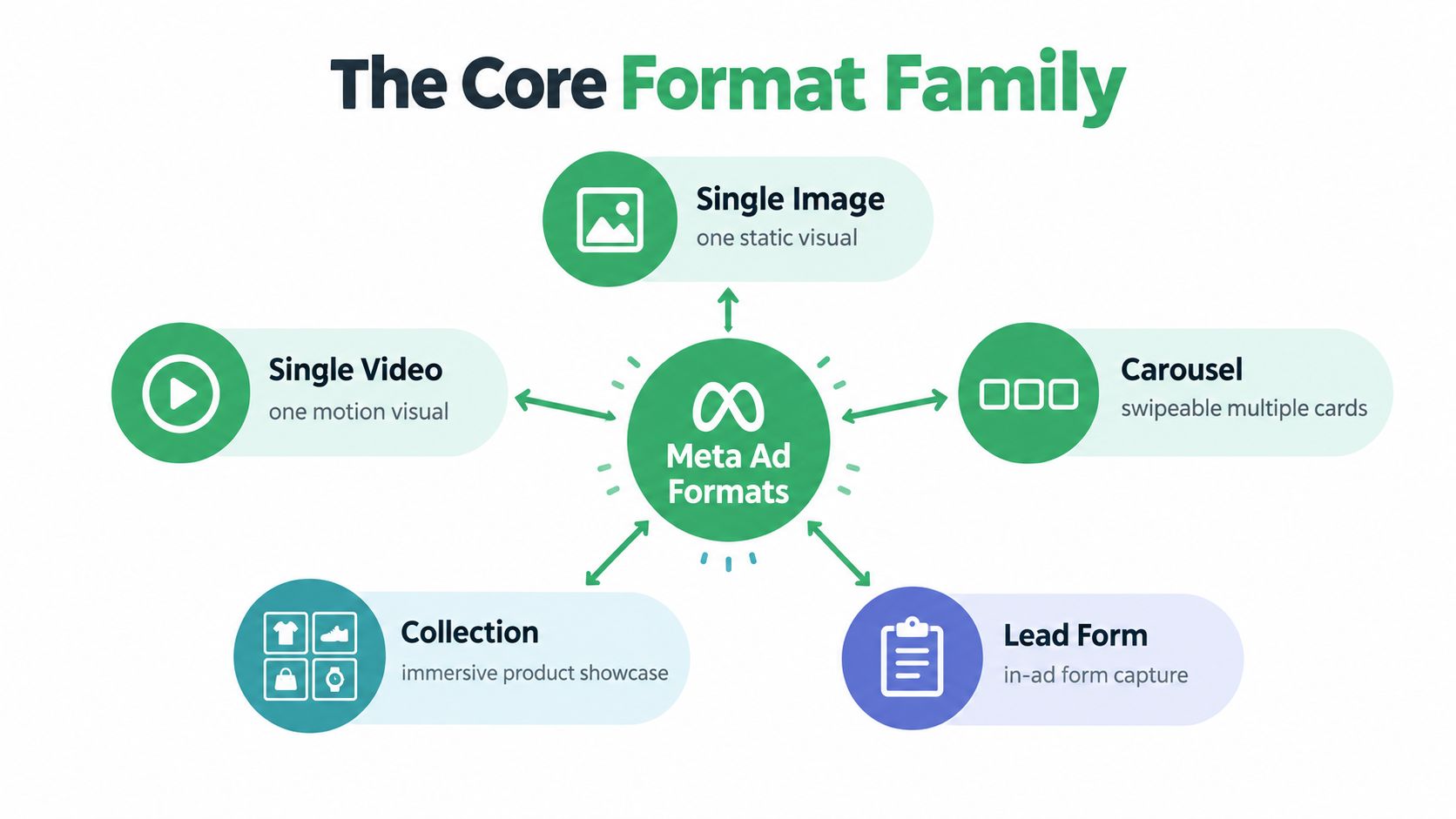
A working map for creative planning
| Format family | Core mechanic | Placement planning question |
|---|---|---|
| Single image | A static visual carries the proposition | Does the composition remain understandable in each selected surface? |
| Single video | Motion explains, demonstrates, or tells a story | Does the edit suit Feed viewing or a vertical full-screen experience? |
| Carousel | Multiple cards organize products or arguments | Does each eligible rendering preserve the intended browsing experience? |
| Collection | A product-focused showcase supports discovery | Are the catalog, opening visual, and shopping destination aligned? |
| Lead form | An ad connects interest with form completion | Does the available placement and form journey support useful qualification? |
Treat this as a planning map, not a universal eligibility chart. Confirm the available combinations in Ads Manager for the campaign you're building. Feed, Stories, Reels, right column, Marketplace, search, and Reels Overlay shouldn't become a blanket distribution list for every format.
Lead forms also deserve a distinction: they describe a conversion experience, not merely an image or video layout. Likewise, catalog-driven execution adds product data and selection logic to the creative decision. Mixing these layers makes account reports harder to interpret.
Production tools belong downstream of that planning. If you're exploring product-motion concepts, Veo3 AI's AI video ad generation is a resource to evaluate alongside conventional editing and original footage. Use generated material as a production option, not as evidence that a video format will outperform an existing image.
Build around the communication job first. A static product offer, a demonstration, a comparison, and a qualification journey need different inputs, even when the campaign ultimately shares a budget.
Creative Specs Every Format Actually Requires
A usable creative specification is placement-specific, not a folder labeled “Meta exports.” The designer needs to know which composition, copy fields, destination, and preview must pass review. A technically accepted upload can still be a poor execution if the interface obscures the product or the headline loses its meaning.
Avoid copying resolution minimums, duration caps, file limits, and character boundaries from an old template. Confirm those requirements in the current upload interface for the selected placement. A recommended copy length, a truncation point, and a hard acceptance limit aren't interchangeable.
What to put in the production handoff
| Asset | Required handoff details | Review before launch |
|---|---|---|
| Image | Placement-specific composition, readable product, separate copy fields | Cropping, legibility, and interface overlap |
| Video | Native edit, captions, audio treatment, opening proposition | Sound-on and sound-off comprehension |
| Carousel | Consistent visual system, card copy, destination mapping | Every card's meaning and landing-page match |
| Collection | Opening creative, product imagery, catalog checks | Product accuracy and browsing continuity |
| Lead form | Offer copy, qualification questions, completion message | Submission flow and follow-up expectations |
For Instagram production, revid.ai's 2026 Instagram video format specs can serve as a reference to check against the live placement requirements. The operational safeguard is the preview and upload validation, not the date printed on a guide.
Carousel has a verified structural constraint: it supports 2–10 images or videos, and individual cards can carry their own headline, description, destination URL, and call to action, as described in this carousel format breakdown. Make each card independently understandable while preserving a coherent sequence. A card that only makes sense after another card is a fragile sales argument.
Separate acceptance from effectiveness
Dense image text, weak sound design, and awkward cropping are reasons to inspect an asset, not interchangeable explanations for rejection. Don't diagnose an approval problem from a creative preference. Read the actual validation or policy message before changing the file.
For vertical executions, keep the product, demonstration, and essential wording clear of interface elements. For compact or overlay renderings, simplify further rather than shrinking a detailed composition. Audio can add meaning, but it shouldn't be the only way someone understands what you're selling.
The handoff is complete when the designer and buyer can identify the exact approved asset for each intended rendering, without guessing which export belongs where.
Matching Each Format to the Right Campaign Objective
Choose a format by the obstacle between the viewer and the next action. If the offer is immediately understandable, additional motion may add production work without adding persuasion. If the product needs a demonstration, a polished static image may leave the central buying question unanswered.
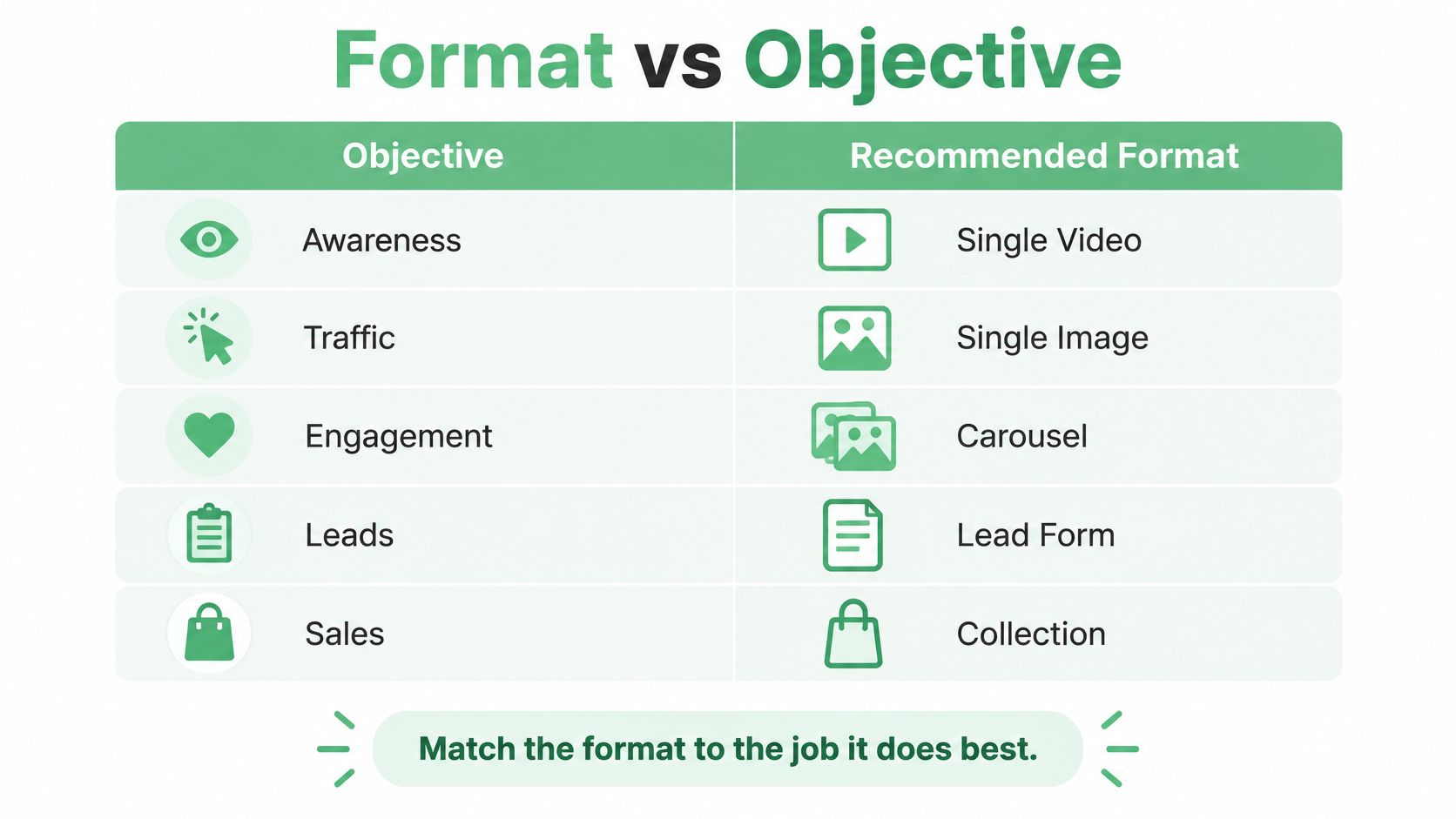
The following recommendations are starting hypotheses, not performance rankings.
Meta Ad Formats vs Campaign Objective
| Format | Best For | Funnel Stage |
|---|---|---|
| Single image | A clear offer, product benefit, or reminder | Consideration and conversion |
| Single video | Demonstrations, problem explanation, discovery | Awareness through consideration |
| Carousel | Product comparison, feature breadth, sequential explanation | Consideration and conversion |
| Collection | Browsing a related product assortment | Discovery through purchase consideration |
| Lead form | Capturing interest with deliberate qualification | Lead generation and conversion |
Choose the shortest convincing explanation
For ecommerce, compare a focused product proposition with a browsing proposition. A single image can keep attention on a specific item; a carousel can help someone compare alternatives. A collection is worth testing when discovering the assortment is part of the buying journey, rather than assuming catalog-based execution automatically beats a standalone asset.
For a service offer, compare the information needed before submission. A lead form is a reasonable test when the offer is clear and the team can qualify interest through questions and follow-up. A landing page may be more appropriate when prospects need detailed terms, examples, or reassurance before providing their information.
Reels and Stories executions can be useful discovery tests, especially when the creative demonstrates a problem or introduces an unfamiliar product. That doesn't exempt them from business outcomes. It changes the hypothesis you should write before spending.
Match the amount of explanation to the buyer's uncertainty, not to the amount of footage available.
For engagement campaigns, define why the interaction matters. A swipe through a carousel may reveal interest in a product category, but it isn't a purchase. Similarly, a video view can help assess whether an opening communicates clearly without proving that viewers intend to buy.
Format Versus Placement and Why the Difference Matters
Meta reported $160.633 billion in global advertising revenue in 2024, with Family of Apps ad impressions increasing 11% and average price per ad increasing 10%, in its annual filing. Those aggregate figures establish scale, not a winning placement. They also show why an advertiser needs to distinguish inventory volume and pricing from the effectiveness of an individual creative.
A more revealing placement comparison comes from a 2025 benchmark: Feed represented 36% of impressions but generated 72% of clicks, while Facebook Reels Overlay represented 46% of impressions and 11% of clicks, in this placement benchmark report. The contrast challenges any recommendation based solely on where delivery is expanding.
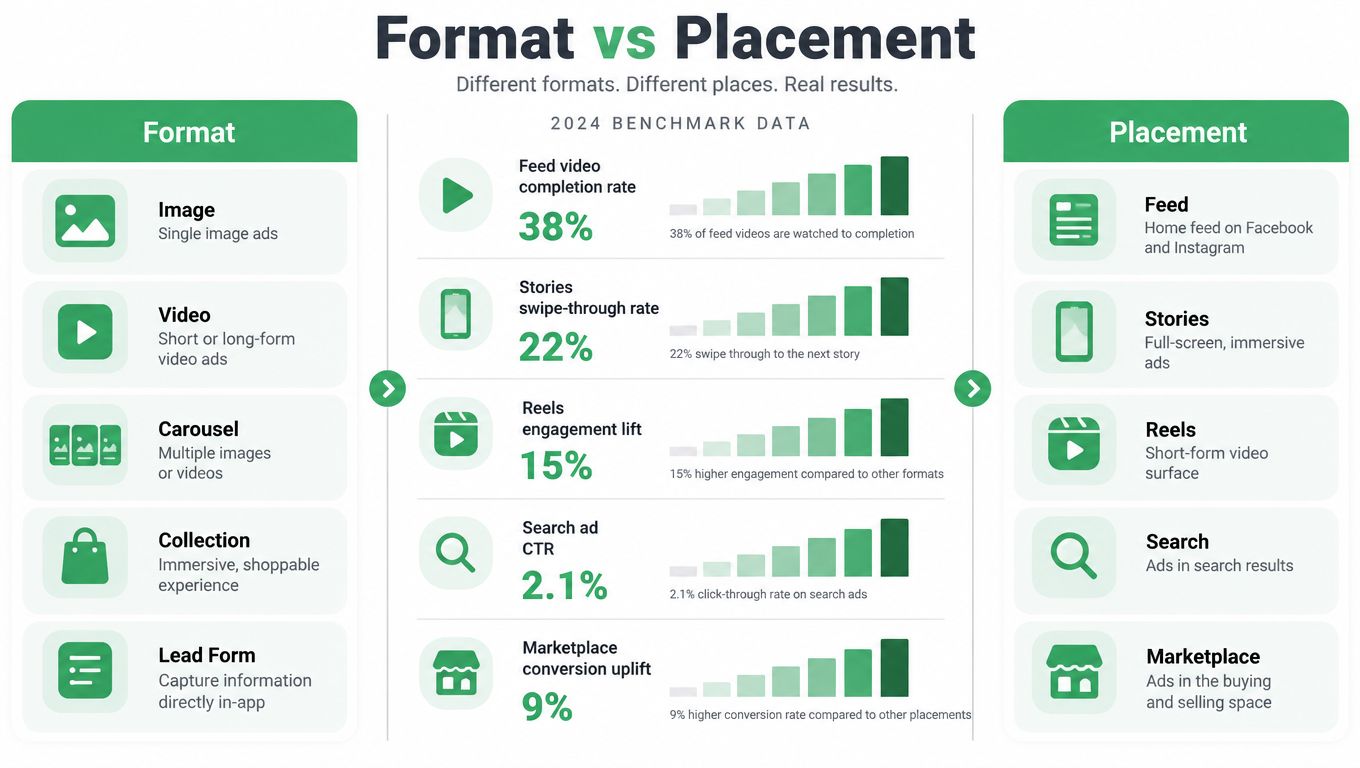
Use the graphic's format-versus-placement distinction, not its embedded performance figures as planning benchmarks. Those figures aren't substantiated by the cited evidence. Also, don't generalize findings about Reels Overlay to every Reels execution.
Read the distribution before judging the asset
Start with delivery share. If an asset receives a different placement mix after an edit, its blended result no longer describes creative quality alone. Inspect where spend and impressions went, then compare the relevant outcomes within those environments.
- For traffic acquisition: Evaluate landing-page arrival and cost per qualified session, not just the click.
- For sales or leads: Follow conversions through to purchase quality, qualification, or pipeline progression.
- For discovery: Examine relevant attention and subsequent behavior, then seek evidence of additional business impact before expanding spend.
A reach-heavy placement shouldn't receive more budget because it produces inexpensive exposure. It also shouldn't be removed because its direct click response is weaker. Both decisions require knowing what job that placement was assigned.
As a working hypothesis, inspect Feed closely for traffic and lower-funnel outcomes, and test Stories or Reels for discovery and assisted behavior where appropriate. Don't turn that hypothesis into a permanent rule. A successful direct-response vertical execution should be evaluated on its results, not forced into an awareness category because of its shape.
Measuring Format Performance Without Being Fooled
A format comparison is only as useful as its measurement design. Privacy constraints and modeled attribution complicate the interpretation of platform-reported conversions; more elaborate creative reporting doesn't remove that uncertainty. The measurement discussion in this Meta formats guide also distinguishes event collection from evidence that advertising caused additional demand.
Before launching a comparison, write the decision you intend to make. “Which ad gets more clicks?” is different from “Which execution acquires customers we can profitably serve?” If you don't specify the latter, the team can select an attractive dashboard result that never improves the business.
Build a measurement contract
| Measurement layer | Example | Decision it supports |
|---|---|---|
| Primary outcome | Cost per qualified lead or completed purchase | Whether the execution earns continued investment |
| Guardrail | Lead acceptance, purchase quality, landing-page arrival | Whether apparent efficiency hides a quality problem |
| Incremental check | Holdout comparison or suitable lift experiment | Whether advertising adds outcomes beyond those that would occur anyway |
| Diagnostic signal | Outbound clicks, viewing behavior, card interaction | What to investigate or change next |
Hold the offer and audience conditions steady where the test design allows. Produce native assets for the placements being compared rather than making a deliberately compromised resize and treating its failure as a fair verdict on the format.
Keep attribution settings consistent across the comparison. Inspect reporting delay and downstream records before declaring a winner, especially when the business has a longer sales process.
Measurement warning: Sending more events through the Conversions API doesn't, by itself, prove that a format created additional demand.
Use CRM outcomes to inspect whether submitted leads become accepted opportunities. For ecommerce, check whether the apparent acquisition result holds after relevant order-quality adjustments. Keep direct conversions, assisted behavior, and incremental findings separate instead of combining them into an undefined success score.
A structured Meta ads wasted-spend review can help frame the investigation around spend that lacks convincing business outcomes. The goal isn't to label every low-click placement wasteful. It's to identify where the evidence is insufficient for the money being committed.
An Optimization Workflow That Survives the Learning Phase
Start the week with a diagnosis queue, not a list of ads to pause. Early CPA volatility is a reason to inspect delivery and conversion timing before intervening. It isn't enough to establish that an asset needs replacing.
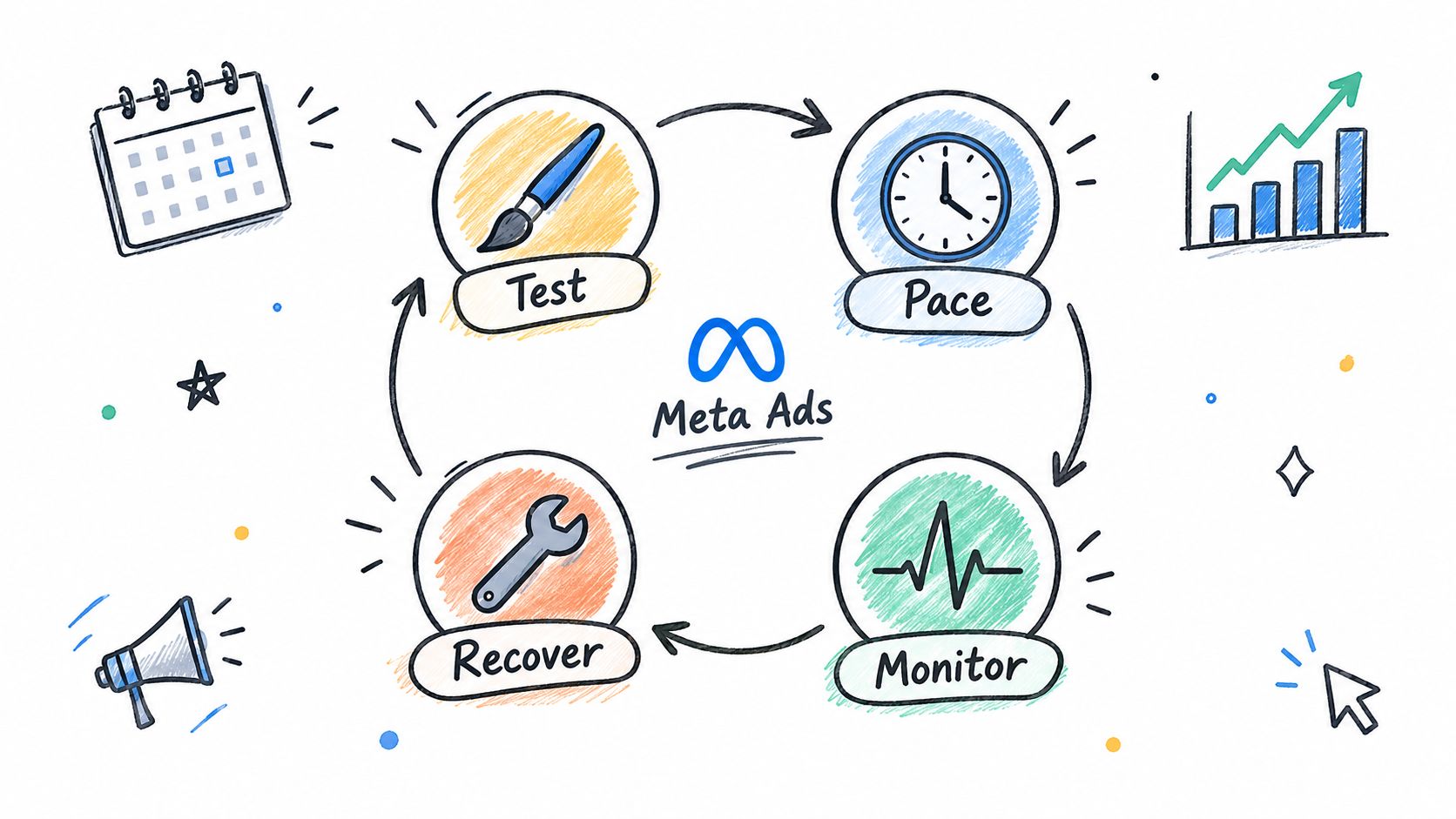
Test with a decision in mind
Launch a manageable set of distinct creative hypotheses. Keep the account structure simple enough that you can understand where spend goes, and avoid dividing the available budget across more experiments than you can meaningfully evaluate.
Write budget guardrails before launch using the account's economics and conversion timing. Don't adopt an arbitrary spending threshold from another advertiser. Record what evidence would justify continuing, limiting exposure, or stopping the test.
- Check execution first: Confirm delivery status, destination function, tracking continuity, and placement previews.
- Inspect the weak link: Separate an attention problem from a landing-page problem or a lead-quality problem.
- Choose the smallest useful intervention: Repair a broken destination immediately, but avoid replacing an entire concept because a particular crop is unreadable.
For carousels, inspect card-level outbound clicks and downstream contribution where the reporting supports it. A card that attracts curiosity without advancing the intended action may need a different promise or destination, not a more prominent position.
Recover without losing the diagnosis
If Reels delivery looks weak, inspect the opening, product visibility, audio independence, placement mix, and acquisition pricing before commissioning another edit. For rising costs on an established asset, use a creative-fatigue diagnosis to investigate the cause rather than treating every decline as exhaustion.
Pause when there's a clear failure or unacceptable business risk. Refresh when the evidence points to the execution. Duplicate only when it serves a defined test or operational need, not as a ritual intended to reset performance.
After an intervention, log the change and allow the relevant outcome to mature before judging it. When delivery is unsettled, repeated simultaneous edits make recovery harder to explain. Preserve a usable comparison so the next campaign review contains a finding, not another unexplained fluctuation.
A Practitioner Checklist for the Next Campaign Review
Bring the creative, placement, and business-outcome reports into the same review. Don't let the creative team celebrate engagement while the sales team rejects the resulting leads.
Use this checklist before approving the next production request or spend change:
- State the communication job: Identify what the buyer needs to understand and why the selected creative structure helps.
- Confirm the actual rendering: Review the asset as delivered, not just the clean export in the design file.
- Check comparison integrity: Flag offer, audience, destination, and attribution changes that could explain the result.
- Trace the business outcome: Connect the reported action to purchase quality or lead progression.
- Name the uncertainty: Distinguish a promising result from a demonstrated causal effect.
- Document the intervention: Record what will change, who approves it, and what would justify reversal.
Make budget decisions reviewable
A Meta ads budget-shift workflow should connect each proposed move to a finding. “This placement is popular” isn't a finding. Neither is “the video looks more native.”
Treat the current format map as an operating reference, not a permanent playbook. As placement options and creative automation change, preserve the discipline of checking eligibility, previewing execution, and validating outcomes. You don't need to predict the next dominant surface to make the next campaign decision responsibly.
The strongest review ends with a specific action, a named owner, and a reason the team can revisit.
NotFair provides hosted MCP connections that let AI agents read advertising, analytics, and CRM data, with approval-gated Meta Ads pauses and budget moves. Visit NotFair to connect campaign diagnosis with downstream outcomes and review explicit change previews before acting on a format or placement finding.