

87% of marketers now use generative AI in at least one recurring workflow, up from 51% in Q1 2024 and 76% in Q1 2025. The practical shift is from static dashboards and isolated chatbots to AI agents with live access to advertising, analytics, and CRM systems.
You can feel the problem in a normal campaign review. Google Ads shows rising costs, Meta reports a different attribution picture, Search Console reveals new query patterns, and the CRM contains the lead quality data that explains neither dashboard. By the time someone exports the reports, cleans the spreadsheet, compares date ranges, and proposes an edit, the opportunity may have moved on.
That's why a marketing AI platform should be judged as an operating layer, not as a content generator with a chat interface. The useful question isn't whether an AI assistant can write an ad headline. It's whether the system can inspect live account data, identify a problem, prepare a controlled change, show the difference before execution, record who approved it, and reverse the action when the result is wrong.
The adoption signal is already clear. Salesforce's State of Marketing 2026 is reported as surveying 4,450 respondents and finding that generative AI usage reached 87%, compared with 51% in Q1 2024 and 76% in Q1 2025 (reported adoption findings). AI is no longer waiting for permission to enter marketing operations. The harder work is making it safe and useful inside the existing stack.
Table of Contents
- What Is a Modern Marketing AI Platform
- Core Capabilities and Technical Control Planes
- Integration Patterns and Connected Ecosystems
- NotFair Case Study in Approval-Gated Workflows
- How to Choose the Right Marketing AI Platform
- Benefits, Tradeoffs, and Scaling AI Operations
- Future Trends and the Evolving Operator Role
What Is a Modern Marketing AI Platform
At 9:00 a.m., a paid media manager opens six tabs. Google Ads contains search-term data, Meta contains delivery and audience signals, GA4 contains conversion paths, Search Console contains organic demand, and the CRM contains pipeline context. A spreadsheet sits between all of them, usually with yesterday's data and no record of which changes someone made after exporting it.
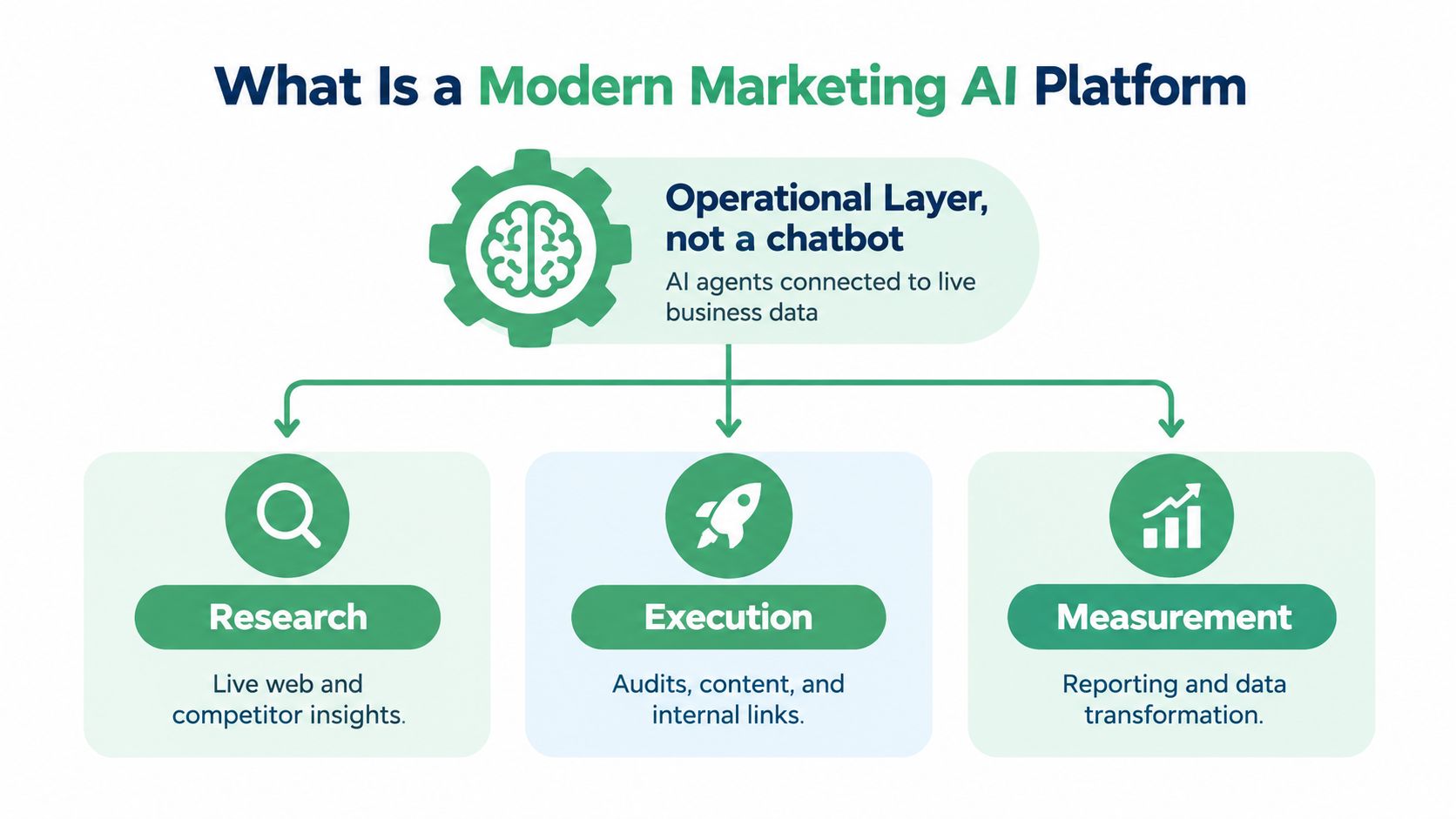
A chatbot can summarize that spreadsheet. A modern marketing AI platform can participate in the workflow itself. It connects AI agents to live business systems, gives them controlled read access for diagnosis, and exposes write actions behind explicit approval gates.
The distinction matters because generation is only one step in marketing execution. An agent might draft a new negative keyword, recommend a budget adjustment, group search queries by intent, or identify a conversion-tracking anomaly. None of those recommendations should automatically become a live account change without a defined scope, a visible diff, and a person who understands the business context.
The operating layer between insight and action
A practical platform has three connected functions:
- Research and diagnosis: It reads current advertising, analytics, search, CRM, and relevant web signals instead of treating a manually exported report as the source of truth.
- Execution with controls: It prepares supported actions such as campaign edits, keyword changes, pauses, or budget adjustments, then routes them through approval.
- Measurement and recovery: It logs the action, links it to the diagnosis, and makes reversal possible when the outcome or interpretation proves wrong.
That model also changes how teams evaluate adjacent tools. A resource on AI-powered video tools for startups may help a team produce creative assets, but asset generation alone doesn't explain whether the resulting campaign attracted qualified demand or whether the spend should be redirected. Creative production becomes more valuable when it sits inside a measured workflow.
Practical rule: If an AI platform can create an output but can't show the data behind it, the approval required to act, and the path to undo the action, it's an assistant, not an operating layer.
A connected system should fit the organization's existing permissions and processes rather than force marketers into another isolated dashboard. Teams evaluating the mechanics can inspect how the workflow works, especially the relationship between live reads, proposed changes, and controlled execution.
Core Capabilities and Technical Control Planes
Feature lists make platforms look similar. Control planes reveal whether they can operate safely. The most useful evaluation separates the system into seven technical control planes: data and signal readiness, approved knowledge, agent scope, human review, cross-channel execution, measurement, and leadership reporting (marketing AI governance framework).
Start with data and approved knowledge
An agent can only diagnose what it can access and interpret. Confirm whether the platform reads current campaign data, conversion events, search queries, account structures, and CRM context at query time. Then define which brand rules, account conventions, exclusions, and business definitions the agent is allowed to use.
This prevents a common failure mode: the AI makes a technically plausible recommendation using incomplete context. For example, it may identify an expensive query but miss the fact that the query belongs to a strategic account segment or a temporary promotion.
Limit the agent before you expand it
Scope should be explicit. A diagnostic agent may read spend, search terms, conversions, and learning status without having permission to alter anything. A second workflow may draft negative keywords. A later workflow may request a budget change, but only within a defined range and only after approval.
Use the following questions when testing scope:
- What can the agent read? List platforms, fields, historical windows, and customer information.
- What can it propose? Separate recommendations, drafts, and executable actions.
- What can it change? Identify the exact write operations and their limits.
- What requires review? Require confirmation for spend, targeting, messaging, tracking, and deletion-related actions.
- What can be reversed? Check whether the system stores the prior state and supports a reliable undo path.
Make review, measurement, and reporting part of the product
Human review shouldn't mean copying an AI recommendation into a ticket and hoping someone checks it. The reviewer needs the trigger, evidence, proposed diff, expected effect, and rollback method in one place.
Measurement should connect the action to business outcomes rather than merely report activity. Leadership reporting then becomes a record of governed decisions, unresolved risks, and measured effects. Research on AI-powered marketing automation also emphasizes customer data quality, clear human roles, technical and analytical competence, and trust in the model as adoption conditions, while weak data management can reduce personalization accuracy (research on AI marketing automation implementation).
The practical test is simple. Ask a vendor to demonstrate one complete path from live signal to recommendation, approval, execution, measurement, and reversal. If the demonstration stops at generated copy or a dashboard summary, the platform hasn't shown operational maturity.
Integration Patterns and Connected Ecosystems
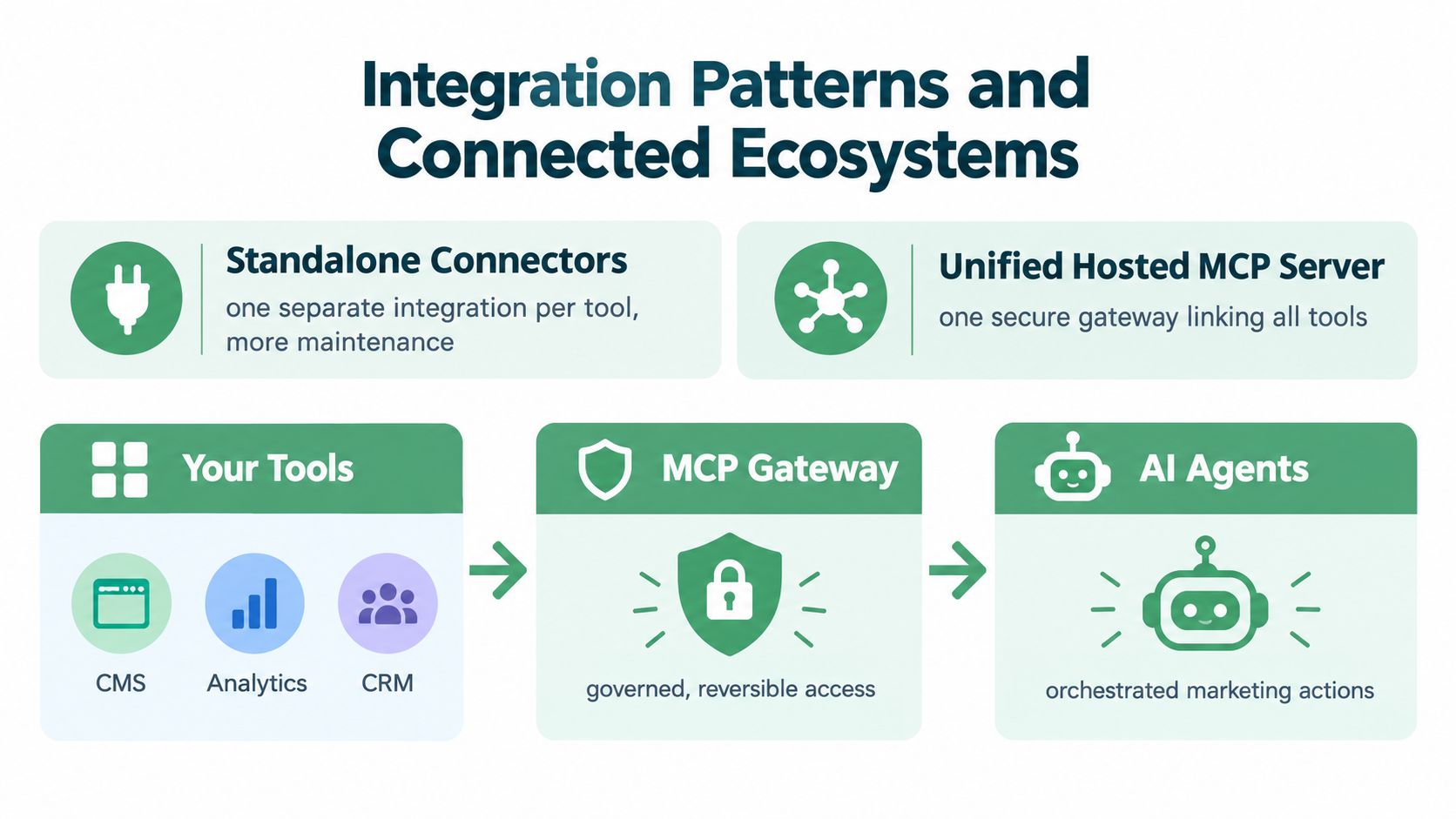
Integration design determines whether an AI system reduces dashboard work or just adds another interface. A standalone connector gives an agent access to one tool through a separate setup. That can work for a narrow use case, but every additional connector introduces another permission model, maintenance burden, data interpretation problem, and audit trail.
A unified hosted Model Context Protocol server takes a different approach. It acts as a governed gateway between AI clients and business tools, allowing one session to inspect advertising, organic search, analytics, and CRM context. The value isn't the acronym. It's the shared control layer.
Standalone connectors versus a unified gateway
| Integration model | Where it works | Main operational weakness |
|---|---|---|
| Standalone connectors | A single-channel diagnostic or narrowly defined automation | Permissions, logs, and data definitions may differ across tools |
| Unified hosted gateway | Cross-channel investigation and coordinated workflows | The gateway needs strong scope controls, authentication, and failure handling |
| Manual exports | One-off analysis or systems without integrations | Data becomes stale, context gets lost, and actions remain disconnected from findings |
OAuth sign-in is an important practical safeguard because it reduces the need to pass long-lived credentials through local scripts or scattered configuration files. It doesn't remove the need for access reviews. Teams still need to define which account, property, or data set the agent can reach and whether the permission is read-only or write-enabled.
Test the integration against a real diagnosis
Don't ask whether a platform “integrates with Google Ads.” Ask it to perform a useful sequence:
- Read current spend, search terms, and conversion data.
- Compare paid demand with organic queries in Search Console.
- Check GA4 conversion context.
- Surface relevant lead or pipeline information from the CRM.
- Rank issues by business risk.
- Prepare a proposed change with a visible diff.
- Require confirmation before writing to the ad account.
- Record the action and preserve the prior state.
That test evaluates the seven control planes more effectively than a connector count. It also exposes whether the platform normalizes data across systems or merely opens separate windows for each one.
Teams can review the available integration options by asking which systems support live reads, which actions are writable, how OAuth is handled, and whether the same approval policy applies across channels. Paid and organic data should not be joined only in a monthly report. The useful moment is often while the marketer is deciding what to do next.
NotFair Case Study in Approval-Gated Workflows
Consider a search campaign with rising acquisition costs. The account contains broad or loose-match coverage, and several queries are consuming spend without producing useful lead or sales signals. A generic AI assistant can identify suspicious terms if someone provides a recent export. A governed platform can inspect the live account, explain the pattern, and prepare a structured response.
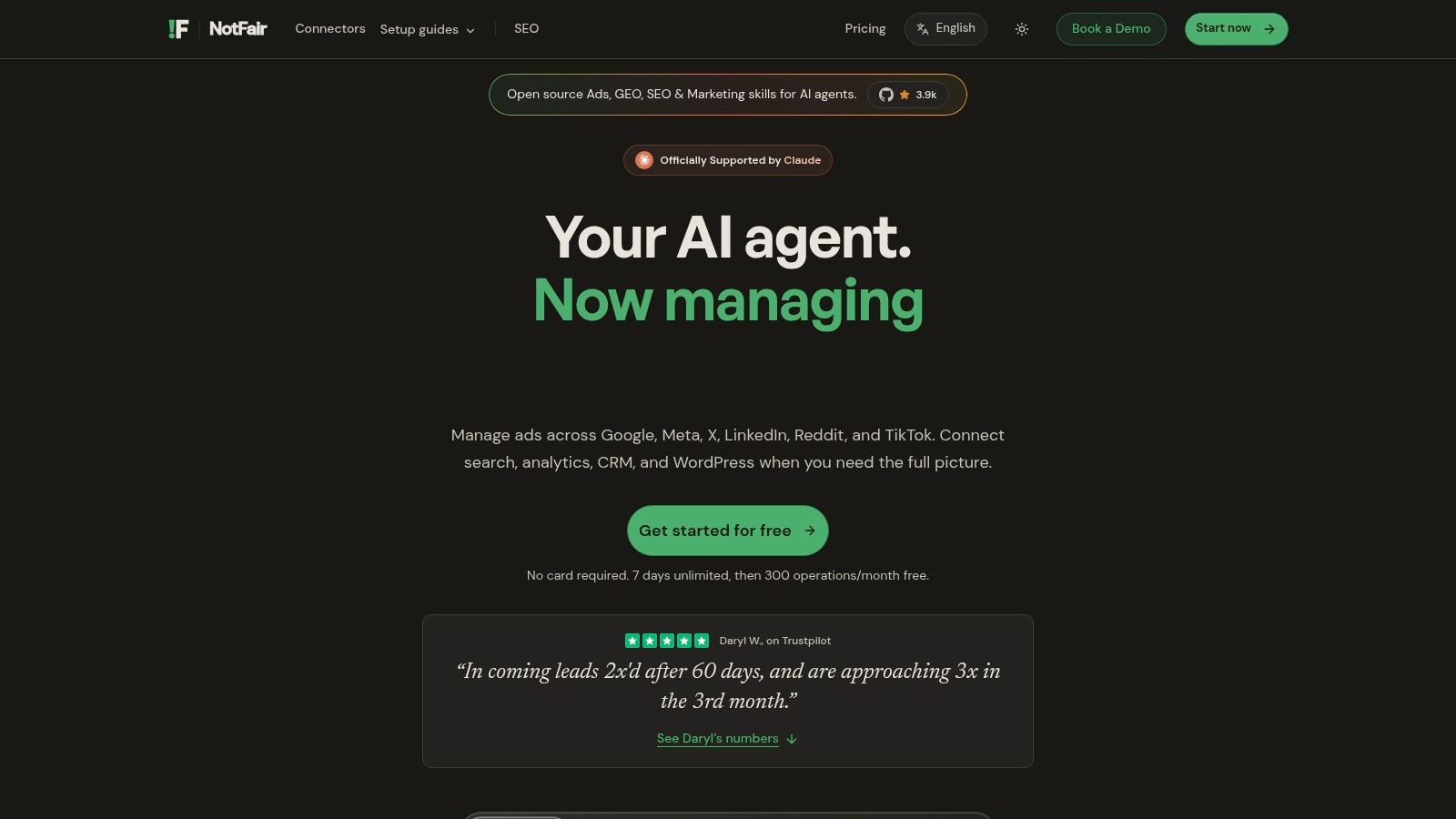
The operational difference appears in the next step. Instead of silently adding negatives or changing campaign structure, the agent produces a proposed set of edits. The marketer can review each term, see the intended destination, compare the proposed account state with the current state, and approve only the changes that fit the campaign strategy.
The same diagnosis under two operating models
A generic automation flow often looks like this:
- Export data from an advertising platform.
- Paste it into an AI tool or automation script.
- Ask for waste or query recommendations.
- Copy the recommendations back into the ad platform.
- Try to reconstruct what changed if performance deteriorates.
That process can be fast, but it creates weak traceability. The data may already be stale, the AI may not know about exclusions or promotions, and the manual copy step can introduce errors.
An approval-gated workflow keeps the chain connected:
- The agent reads current search-term and performance signals.
- It identifies patterns such as irrelevant loose-match queries.
- It ranks findings by spend at risk and explains the evidence.
- It drafts negative keywords or structural edits.
- The marketer reviews an explicit diff.
- The approved change is written and logged.
- The prior state remains available for a one-call undo.
A hosted MCP approach can outperform a collection of disconnected assistants. The same controlled access pattern can support clients such as Claude, Codex, Cursor, OpenClaw, and Hermes, while the marketing team retains responsibility for the business decision.
A useful demonstration should show the entire sequence, not just the recommendation screen.
The model also applies to paid social. A proposed pause or budget movement in Meta Ads carries a different risk from a draft headline, so the workflow should expose the exact campaign, current setting, proposed setting, reason, and approver. The Meta Ads MCP workflow illustrates the kind of channel-specific operation that should remain bounded by review rather than hidden behind a general “optimize” button.
The important lesson isn't that every edit needs a committee. Low-risk read-only diagnostics can move quickly. High-impact writes need proportionate friction, clear ownership, and recovery. Safety isn't the absence of automation. It's automation that leaves the operator in control.
How to Choose the Right Marketing AI Platform
Start with the risk of the action, not the length of the feature list. A platform that generates copy for review has a different control requirement from one that can pause campaigns, move budgets, edit keywords, or alter customer workflows.
Rank the decision by operational risk
Use this order when comparing vendors:
- Read access: Can the system inspect current data from the platforms that matter, or does it depend on uploads and scheduled exports?
- Diagnosis quality: Does it connect signals across advertising, analytics, search, and CRM systems, or does it report each channel in isolation?
- Approval design: Does every meaningful write show the proposed change before execution?
- Scope controls: Can administrators restrict agents by account, platform, action type, and user?
- Reversibility: Does the platform preserve the previous state and provide a practical undo function?
- Measurement: Can the team connect an action to downstream conversion or pipeline outcomes?
- Reporting: Can leaders see decisions, approvals, failures, unresolved risks, and business impact?
A vendor should answer these questions with a live demonstration. Ask the team to diagnose one known account problem, produce a prioritized action list, prepare a change, pause before execution, and undo it afterward. The quality of that walkthrough tells you more than a polished product tour.
Check integration readiness before buying
Your team needs clear owners for data access, approval, measurement, and incident response. If nobody knows who approves a budget move or who checks CRM definitions, the platform will expose an operating gap rather than solve it.
Also inspect authentication, account isolation, audit logs, retention, and failure behavior. A hosted service may reduce local setup and credential handling, but it still needs transparent permission boundaries. A platform that connects to many systems without explaining how it separates accounts and actions creates more risk than value.
Pricing deserves a practical reading too. Freemium access can help a team test a narrow workflow, while subscription plans may make more sense for shared accounts, agency operations, support, or broader operation volume. Don't compare plans only by the number of features. Compare the cost of governed execution with the time spent maintaining exports, reconciling reports, and investigating untracked changes.
Ask the vendor: “Show me the exact record that proves what the agent saw, what it proposed, who approved it, what changed, and how I would reverse it.”
The right platform fits your operating model today and makes the next controlled workflow easier. It shouldn't require the team to surrender judgment before it has earned trust.
Benefits, Tradeoffs, and Scaling AI Operations
A marketing AI platform can remove repetitive investigation from a performance marketer's day. It can scan current signals, organize anomalies, draft routine fixes, and give a strategist more time for positioning, experimentation, and difficult account decisions.
The tradeoff is that integration work becomes visible. Teams need consistent campaign naming, reliable conversion definitions, clean customer data, and people who understand both marketing performance and the limits of the AI system. Poor data management doesn't become accurate because an agent can process it faster.

What improves and what gets harder
The productivity gain comes from shortening the path between a signal and a useful diagnosis. A marketer can ask why costs are rising, which terms deserve attention, or whether a conversion issue is isolated to one channel without manually assembling the first report.
The management burden shifts toward permissions, review rules, data definitions, and change ownership. Without those roles, teams either block useful automation or allow unreviewed changes because nobody has designed a middle ground.
The strategic benefit is a better division of labor. AI handles repeatable inspection and structured preparation. A human strategist evaluates customer intent, commercial priorities, brand risk, and the tradeoff between short-term efficiency and longer-term growth.
Research on implementation supports that operating view. High-quality customer data and clear human roles support AI-powered automation, while employee technical and analytical competence and trust in the model influence adoption (implementation research). The platform doesn't create those conditions. The team has to build them.
Scaling therefore means standardizing workflows, not just adding more users or connectors. Start with read-only diagnostics, establish approval patterns, document rollback, and expand write access only when the evidence and operating discipline justify it.
Future Trends and the Evolving Operator Role
The market is moving from “Which marketing AI platform should we buy?” toward “How do we make this work across teams, systems, and approvals?” Research reported by the World Federation of Advertisers says 96% of major brands use AI in marketing, while integration and interoperability, governance and legal requirements, data quality and access, and skills remain major blockers (WFA research findings).
That changes the operator's job. The valuable marketer won't be the person who delegates every decision to an agent. It'll be the person who designs the boundaries, connects the right signals, reviews meaningful changes, and proves whether the workflow created business value. McKinsey describes many organizations as taking a “bolt on” approach and struggling to capture meaningful value, while Adobe's findings point to ad hoc, siloed AI use that makes impact difficult to quantify (McKinsey analysis of AI capabilities in marketing).
The future role is strategic orchestration. AI expands the operator's reach, but governance, measurement, and judgment determine whether that reach produces durable growth.
NotFair provides hosted MCP servers that connect AI clients to advertising, analytics, search, and CRM platforms with live reads, approval-gated writes, explicit diffs, logging, and one-call undo. Visit NotFair to evaluate a controlled workflow for your own campaigns and start with a diagnosis before giving an agent permission to make changes.