

You're looking at a paid media dashboard when the numbers stop making sense. An AI agent has moved budget across an account, the changes look reasonable in isolation, and the campaign owner hasn't received an alert. By the time someone notices, the agent has already changed the conditions that produced the anomaly.
That's the uncomfortable reality of human in the loop automation. The human isn't there to approve every harmless read or refresh. They're there to control actions that carry financial, operational, or reputational risk, with enough context to make a meaningful decision and enough authority to reverse a bad one.
Table of Contents
- "The Moment Automation Almost Cost You a Client"
- "What Human in the Loop Automation Actually Means"
- "The Four Design Patterns That Make HITL Real"
- "Why Selective Review Beats Reviewing Everything"
- "How HITL Works Inside Ad Operations Workflows"
- "The Rubber Stamp Problem and How to Avoid It"
- "Metrics That Prove Your Oversight Is Actually Working"
- "A Practical Checklist for Shipping HITL This Quarter"
"The Moment Automation Almost Cost You a Client"
It's Tuesday afternoon. An AI budget agent is monitoring a portfolio of ad sets and sees an opportunity to move spend toward what it identifies as stronger short-term performance. The agent reallocates budget, but it misses a manual bid cap recorded in the account notes. It also misreads a branded campaign's conversion pattern, treating recent activity as a reason to increase spend rather than a sign of low incremental value.
The first change happens quickly. A second follows as the agent recalculates the portfolio. A low-converting branded campaign begins consuming budget at an abnormal rate. The account owner is in another meeting, the agency owner is reviewing creative, and nobody sees the warning because the agent's write action succeeded technically.
The client notices the dashboard before the agency does. The conversation is no longer about whether the recommendation was sensible. It's about why the system was allowed to make the change without showing the affected campaigns, the before-and-after budgets, or the assumptions behind the move.
Operational lesson: A successful API call isn't evidence of a safe decision.
A properly designed control loop could have interrupted this sequence at several points:
- Before execution: The proposed reallocation would have shown the affected ad sets, the bid-cap conflict, and the expected budget movement.
- During monitoring: An unusual spend velocity would have routed the account to an exception queue instead of allowing another automatic adjustment.
- At the write boundary: An explicit diff would have required approval before the agent changed live budgets.
The point isn't to force a person into every step. A human doesn't need to approve a read-only performance query or a routine report. The review intensity should rise with spend exposure, uncertainty, impact radius, and reversibility.
That's the practical meaning of HITL in paid media. The agent can inspect live data, identify patterns, prepare a change, and execute low-risk actions. A responsible operator retains the ability to understand, block, modify, and reverse decisions that matter.
Human in the loop automation converts autonomous action into accountable action.
"What Human in the Loop Automation Actually Means"
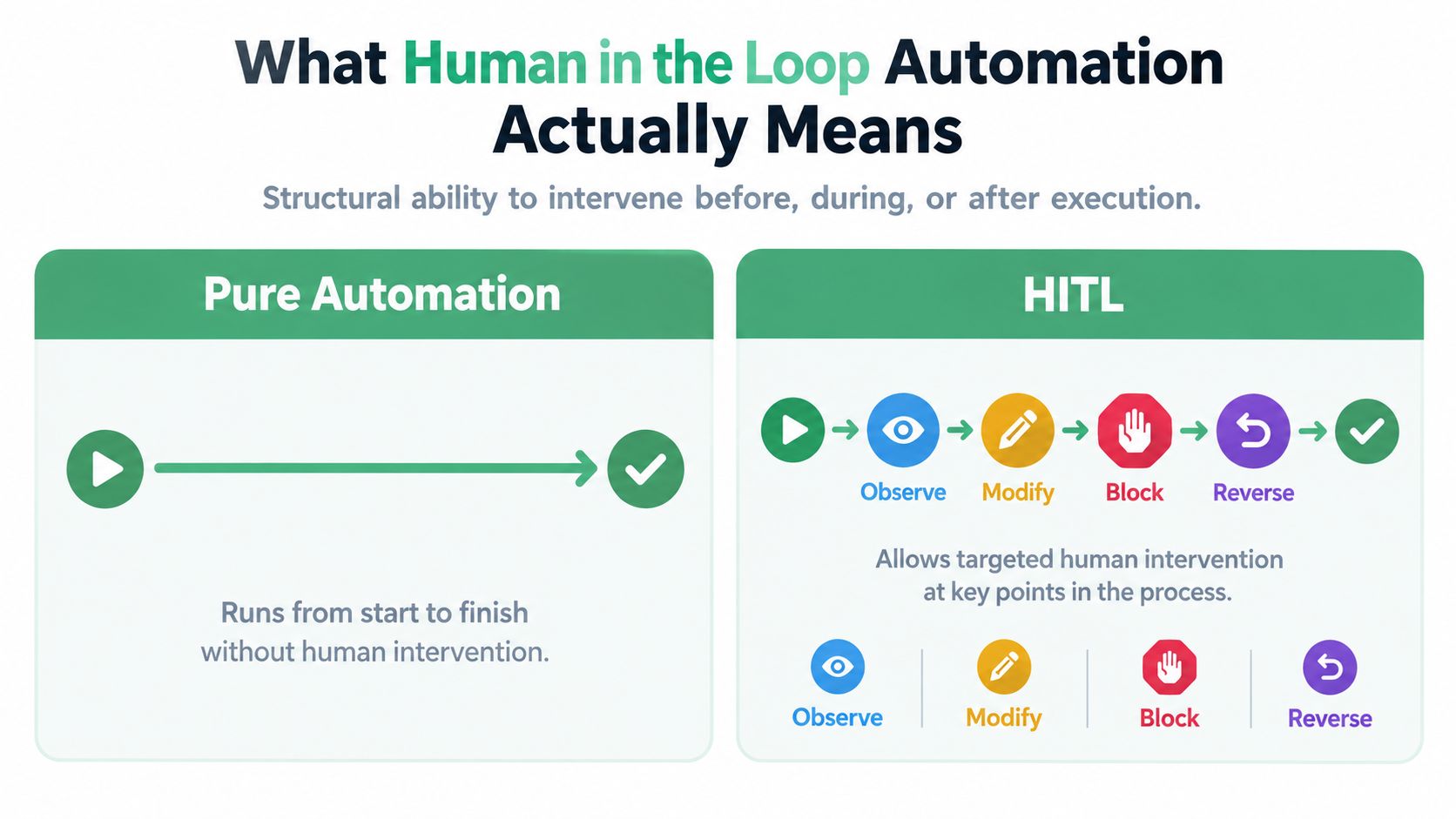
Human in the loop automation is a system in which a person has a structural ability to observe, modify, block, or reverse an automated decision before, during, or after execution. The important word is structural. A person receiving a vague notification after an agent has already changed a campaign isn't meaningfully in the loop.
The concept predates generative AI. J.C.R. Licklider's 1960 paper “Man-Computer Symbiosis” argued that computers should cooperate closely with people to improve decision-making. Jens Rasmussen later formalized human interaction with automation through the Skill–Rule–Knowledge framework, which was developed for complex and safety-critical environments. Semi-automated systems with human oversight then appeared across aviation, space exploration, and defense simulations, while Amazon's Mechanical Turk brought a large-scale software-managed task-routing model to market in 2005.
That lineage matters because HITL isn't a prompt-engineering patch. It's an operating model for dividing work between machine processing and human judgment.
Three different oversight models
The terms around human oversight often get blurred:
- Human in the loop: A person can decide or correct an individual action before the workflow continues.
- Human on the loop: A person monitors aggregate behavior and can intervene by exception, but doesn't necessarily review every action.
- Human out of the loop: The system runs without meaningful human intervention after deployment.
A related distinction is human in command. That person sets strategy, policy, and limits, but may not inspect each runtime decision. In an ad account, a marketing director can define budget policy while an operator reviews a specific campaign pause. Both roles matter, but they're not interchangeable.
The control surface inside the agent
A mature HITL workflow gives the human three practical roles:
- Approver: authorizes a proposed action before execution.
- Auditor: reconstructs what the agent saw, recommended, and changed.
- Override authority: blocks, edits, pauses, or reverses an action when context changes.
The review interface is therefore part of the agent, not an external administrative step. It should expose the proposed mutation, relevant evidence, risk classification, reviewer decision, and rollback path.
For teams evaluating AI vendors, this distinction is useful. Ask whether the product supports intervention at the action boundary, or whether it only sends a notification after the fact. Practical guidance on how to manage risk in social operations also helps frame oversight as an operating discipline rather than a single approval button.
"The Four Design Patterns That Make HITL Real"
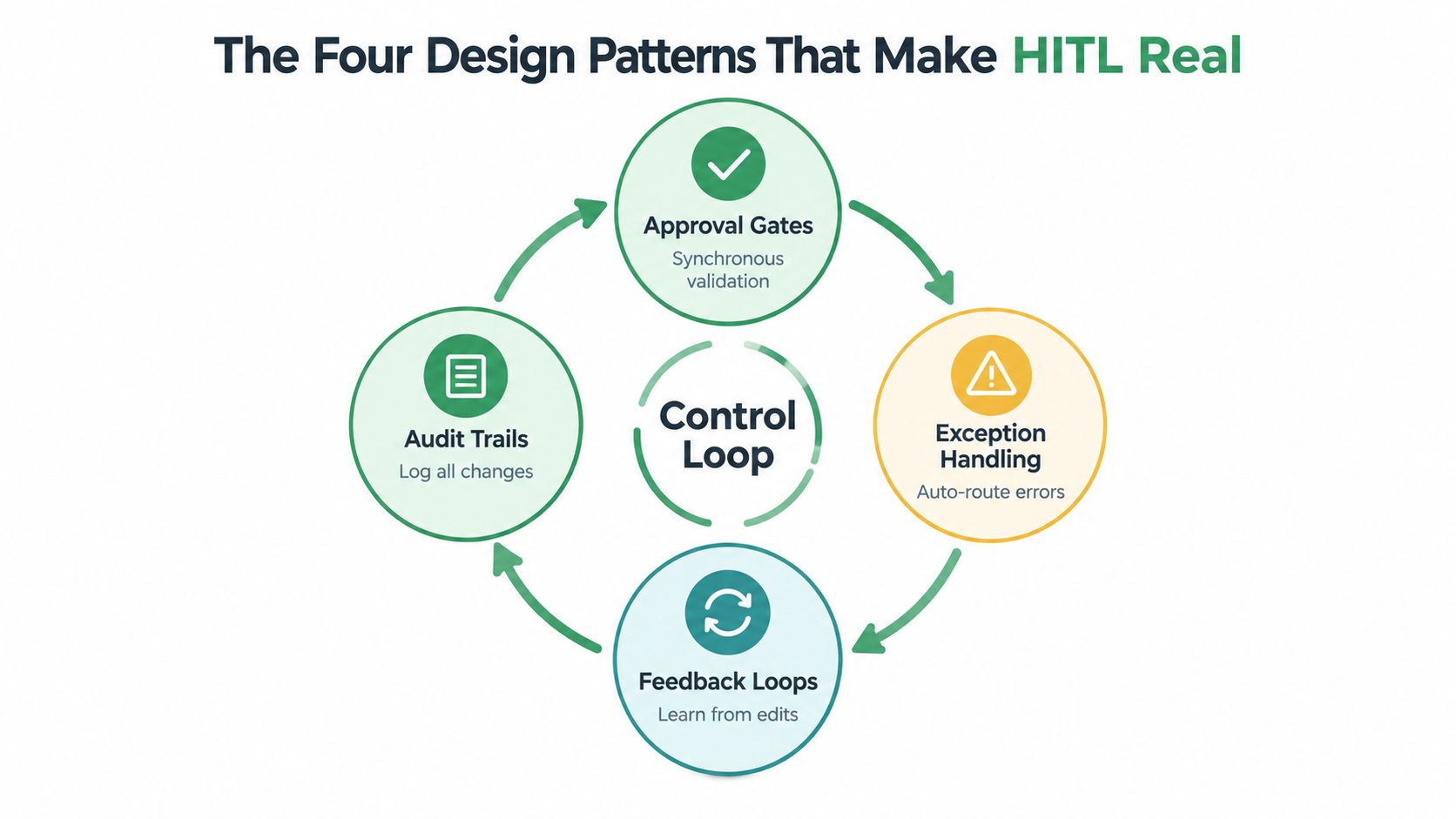
A control loop needs more than a reviewer's name in a workflow diagram. Four mechanisms turn the idea into something an operations team can test and run.
Approval gates
An approval gate pauses an action before a defined write occurs. The gate can be synchronous, where an operator responds immediately, or asynchronous, where the action waits in a queue. It should be triggered by a risk class, confidence signal, anomaly, or blast-radius rule.
For example, an agent might update a report automatically but route a budget move for approval. The gate should also define what happens when nobody responds. A safe default might be to hold the proposed change and escalate it, rather than allowing an expired approval to become an automatic write.
Explicit diffs
A recommendation is not a reviewable action until the operator can see what will change. An ad-operations diff should show the current and proposed budget, campaign or ad-set identifiers, targeting changes, bid settings, affected account scope, and any known downstream effects.
“Adjust budget” is not a diff. “Move budget from these campaigns to those campaigns, change these values, and leave these settings untouched” is.
Audit logs
The audit log records what the agent proposed, what evidence it used, who reviewed it, what decision they made, and when the system executed the action. It should also preserve the final outcome, not just the initial request.
NIST guidance recommends documenting oversight across the AI lifecycle, monitoring trustworthiness independently, and maintaining records of operator overrides, errors, and complaints. That makes the log a feedback mechanism, not merely a compliance archive.
One-call undo
Every write should have a tested rollback path. In ad operations, that means restoring the prior state through a single idempotent operation, with clear handling for cases where another change has occurred since the original execution.
The four patterns reinforce one another:
- The diff gives the reviewer something concrete to inspect.
- The gate uses risk in the diff to determine whether approval is required.
- The audit log captures the proposal and decision.
- The undo path gives the reviewer meaningful intervention power after execution.
Practical rule: Don't build the approval screen before you can describe the rollback operation.
A useful reference for designing control loops and safety gates is valuable here because the engineering problem isn't limited to advertising. Any agent that writes to an external system needs a controlled boundary between recommendation and execution.
"Why Selective Review Beats Reviewing Everything"
Reviewing every agent action sounds cautious, but it usually creates a queue that no operator can assess properly. The reviewer starts clicking through repetitive changes, attention declines, and the approval step becomes a throughput constraint rather than a safety mechanism.
Selective review allocates human attention where it has the highest value. A read-only query can run without approval. A routine status refresh may be automated if it's idempotent and easy to correct. A budget restructuring, targeting change, campaign pause, or external communication should receive a deeper review because the consequences are wider or harder to reverse.
A useful routing model combines several signals:
- Model confidence: How certain is the agent, and is that confidence calibrated against actual outcomes?
- Business impact: Could the action materially affect spend, lead flow, brand exposure, or account access?
- Reversibility: Can the prior state be restored cleanly?
- Anomaly evidence: Does the proposed action differ sharply from the account's recent pattern?
- Reviewer capacity: Is there a qualified person available to assess the change without rushing?
A 2023 image-classification study found that a learned gating model routed uncertain or unfamiliar cases to experts and achieved a utility score of 0.92 after 30 incremental-learning steps, compared with 0.51 for a fixed-allocation “perfect HITL” strategy. The same study found that hybrid AI and human systems outperformed traditional HITL systems when accuracy wasn't overwhelmingly more important than human effort.
The operational implication is clear. A threshold shouldn't be selected because it sounds conservative. It should reflect the cost of a wrong action, the cost of delay, and the capacity of the review team.
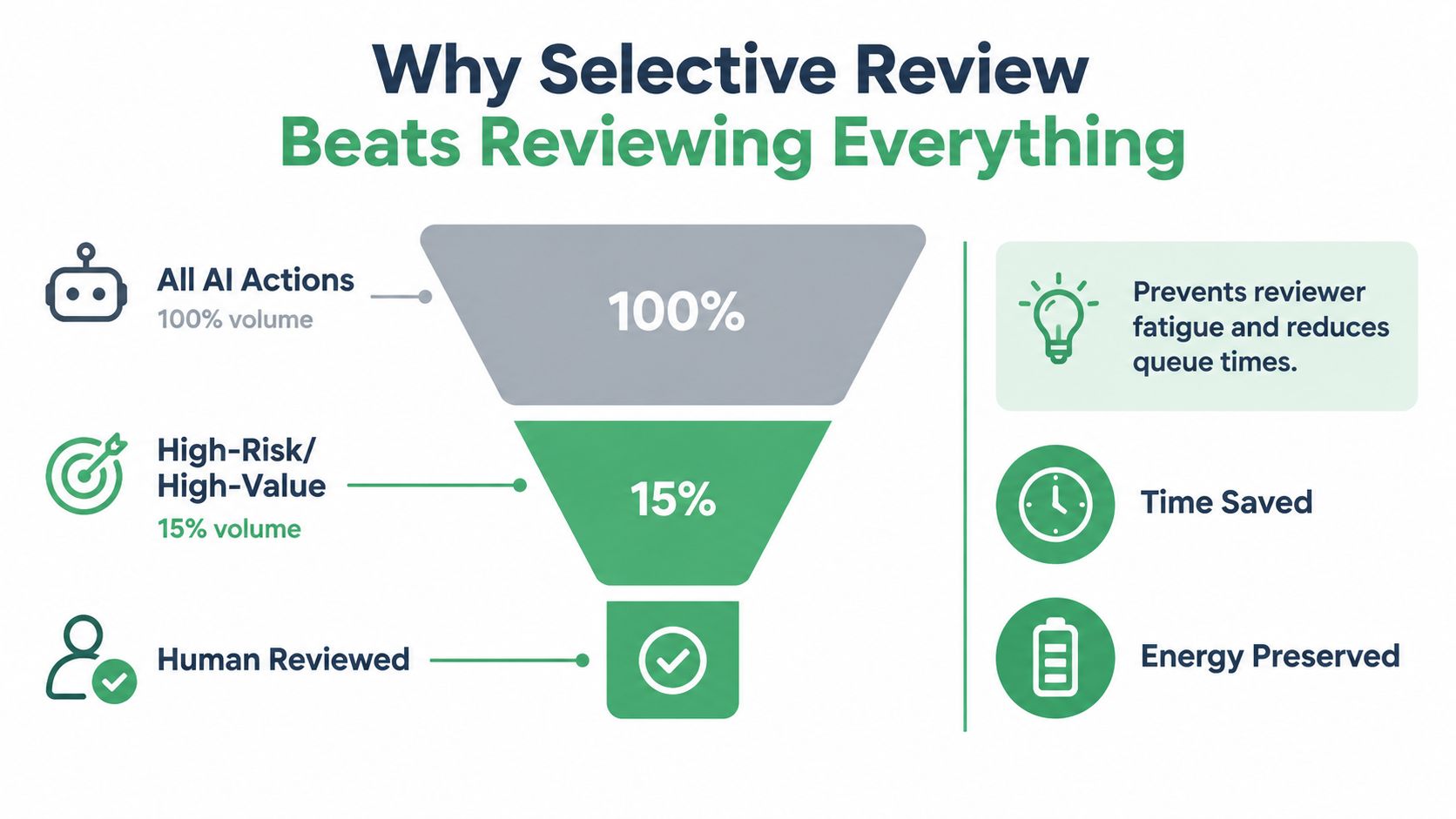
The right objective is not maximum intervention. It's maximum decision quality per unit of human attention. Teams building quality control with agentcentral can use the same principle, routing exceptions rather than making reviewers process every routine output.
For paid media teams, a practical pattern is to let low-risk diagnostics run automatically, send uncertain recommendations to light review, and require structured approval for actions that alter budget allocation or account structure. The system stays fast because the human sees fewer decisions, while each decision carries more evidence.
NotFair's Meta Ads MCP is one example of the type of connector pattern teams can evaluate when they need live account reads and controlled operations. The important evaluation criteria are the control mechanisms, not the presence of an AI label.
"How HITL Works Inside Ad Operations Workflows"
Consider a runaway ad set. The agent detects that spend is accelerating against the account's expected pattern and proposes a pause. It doesn't execute immediately. Instead, the control surface presents:
- The ad set's current status and spend context.
- The exact proposed change, from active to paused.
- The evidence that triggered the recommendation.
- A preview of the audit-log entry.
- A rollback action that can re-enable the ad set.
- The operator responsible for the approval.
The operator can approve, reject, or request more information. If the system has a reliable rollback operation and the action is clearly bounded, the interaction can remain brief without becoming careless. If the evidence is ambiguous, the workflow should escalate rather than pressure the reviewer into a binary decision.
A budget-reallocation workflow needs more context. Suppose the agent proposes moving spend from a saturated audience to an emerging audience. The review surface should show the affected campaigns side by side, the current and proposed allocation, the assumptions behind the recommendation, and relevant historical evidence. The reviewer may approve the plan, edit the proposed values, or reject it with a reason.
The two workflows share the same backbone:
- Read live data from the connected account.
- Generate a proposed action with evidence and uncertainty.
- Render an explicit diff before the write.
- Route the action according to risk.
- Capture the decision in an audit log.
- Execute only after authorization when the policy requires it.
- Preserve a tested undo path after execution.
The depth of review changes, but the control architecture doesn't. A pause may need a compact diff. A budget move may need projections, assumptions, and a comment field. Both need clear ownership and a way to reconstruct the outcome later.
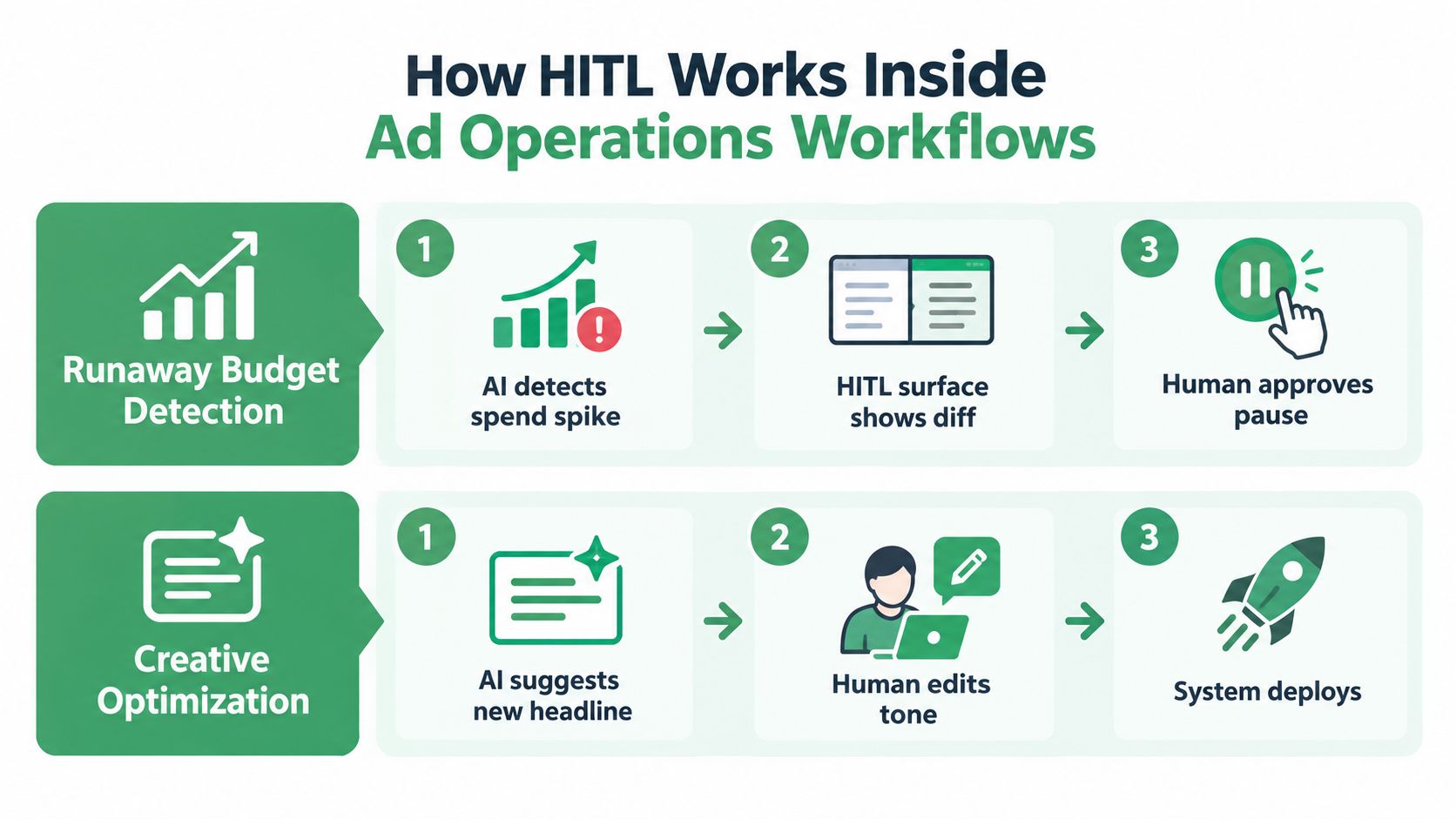
Creative operations use the same pattern. An agent can suggest a headline or identify a weak creative, while a human edits tone and checks claims before deployment. The agent handles comparison and preparation. The reviewer retains authority over the external change.
The NotFair documentation on how the system works describes the kind of workflow teams should look for: a live read, a proposed operation, a visible change set, and controlled execution rather than an opaque write.
"The Rubber Stamp Problem and How to Avoid It"
More checkpoints don't automatically produce more safety. A reviewer who lacks context, time, or authority can turn approval into theatre.
The problem is visible when approvals arrive almost instantly, rejection reasons are rare, and operators can't explain what they approved. A 2026 survey of 1,000 U.S. AI-using workers found that only 17% trusted AI to operate with minimal human involvement, while 70% preferred light review or dedicated oversight. The same survey reported that 42% had to edit or fix AI outputs, and 34% had to review and approve them, according to the reported survey findings.
That evidence points to a design problem, not a motivation problem. If the reviewer has to open several dashboards, infer what changed, and search for the relevant account policy, they'll either delay the queue or approve without sufficient inspection.
| Signal | Healthy Pattern | Rubber-Stamp Pattern |
|---|---|---|
| Diff presentation | The change appears before the approval control | The approval control dominates the screen |
| Reviewer context | Evidence, assumptions, scope, and risk are visible | The reviewer sees a short recommendation with little support |
| Rejections | Rejections capture a reason and route the case for learning | Rejections are difficult to record or simply disappear |
| Sampling | Approved actions are sampled for quality review | Only failed actions receive attention |
| Intervention power | The reviewer can edit, block, or reverse the action | The reviewer can only approve or ignore it |
| Queue health | Routing adjusts when reviewer capacity changes | The same person receives every exception |
A good interface presents the diff first and the approval button last. It asks the reviewer to confirm the affected entities and proposed outcome, then records the decision. Teams should also examine approval latency, override behavior, rollback activity, and incident patterns together. A near-zero override rate isn't automatically good. It may mean the agent is reliable, or it may mean the review step is ineffective.
"Metrics That Prove Your Oversight Is Actually Working"
HITL needs operational measurement. Without it, teams can report that a human reviewed an action while missing whether the reviewer had enough information or whether the control prevented harm.
Override rate
Calculate overrides by action class, risk tier, and confidence band. An override can mean the agent made a poor recommendation, but it can also reveal that the business policy changed or that the reviewer caught context the model couldn't access.
Don't collapse budget edits, creative changes, and read-only tasks into one figure. A low aggregate rate can hide meaningful problems in a high-impact class.
Rollback rate
Rollback rate measures how often executed actions need to be reversed. Pair it with the reason for reversal. A rollback caused by a deliberate strategic change means something different from a rollback caused by an agent error.
A system with no rollback data may be healthy, or it may have an untested undo path that operators avoid using. Treat rollback capability as a control to exercise, not a feature to leave untouched.
Median time to review
Median time shows how much attention each routed action consumes. Segment it by urgency and action type. A long review time may indicate insufficient evidence, poor routing, or a queue that exceeds reviewer capacity.
A very short time deserves scrutiny too. If reviewers approve complex changes without reading the diff, low latency is a failure signal.
Incidents per 1,000 agent actions
This metric connects agent activity to operational outcomes. Define an incident consistently, then segment it by action class and severity. Include incidents that were caught before execution as well as incidents discovered afterward, because early interception demonstrates that the control loop worked.
NIST recommends maintaining statistics on overrides, errors, complaints, and trustworthiness indicators. Those records support a weekly operating review where teams adjust policies, prompts, evidence requirements, and routing thresholds.
| Metric | Definition | Healthy Range | Warning Sign |
|---|---|---|---|
| Override rate | Share of proposed actions modified or rejected | Stable, explainable by risk tier | Falls sharply while incidents remain unchanged |
| Rollback rate | Share of executed actions reversed | Low and well understood | Rollback is unavailable, unused, or concentrated in one action class |
| Median time to review | Typical time from queue entry to decision | Consistent with action urgency | Queue time rises while reviewers receive more low-value work |
| Incidents per 1,000 actions | Recorded operational incidents divided by agent actions | Declining or stable after threshold changes | Incidents rise after broader auto-execution |
The useful question isn't whether the numbers look impressive. It's whether each metric helps the team decide what to change next.
"A Practical Checklist for Shipping HITL This Quarter"
Start with one action class that has a clear business owner and a reliable rollback path. A campaign pause, budget adjustment, or negative-keyword update can be easier to govern than an agent with permission to change everything in an account.
Build the control boundary first
Before creating an approval screen:
- Define the risk register: Record the action, affected systems, business impact, reversibility, owner, and escalation path.
- Implement the diff: Show the current state, proposed state, affected entities, evidence, and known side effects.
- Implement undo: Test restoration against repeated calls, partial failures, and intervening changes.
- Add the audit record: Store the proposal, reviewer, decision, timestamp, rationale, and final outcome.
- Set capacity limits: Create a reviewer rota and route overflow to a named backup rather than letting one operator absorb every exception.
Run the first deployment in shadow mode. The agent can generate recommendations and reviewers can assess them, but the system shouldn't write changes from those recommendations during the observation period. Use that time to discover missing context, ambiguous policies, noisy alerts, and actions that appear reversible but aren't.
Write the escalation policy
Document which actions can auto-execute, which need light review, and which require structured approval. Use confidence as one input, not the entire policy. A confident recommendation can still be risky if it changes a large budget or affects many campaigns.
Train reviewers to read diffs, inspect the evidence, reject unclear proposals, and use rollback without hesitation. Review the four oversight metrics on a weekly cadence, then run a formal retrospective after the first operating cycle. Adjust routing based on actual overrides, incidents, queue time, and rollback behavior before expanding the agent's permissions.
The NotFair quickstart offers a concrete starting point for teams connecting AI clients to marketing systems, but the implementation standard remains the same regardless of vendor: live context, explicit changes, approval where risk requires it, complete logs, and a tested undo path.
NotFair connects AI agents to advertising, analytics, search, and CRM systems with approval-gated writes, explicit diffs, logged change history, and one-call undo. Visit NotFair to evaluate a reversible control layer for the ad-operations workflows you're preparing to automate.