

By 9:07 on Monday morning, a paid media lead can already be behind. Cost per lead is climbing, search terms have drifted away from the offer, a Meta ad set has returned to learning, and the dashboard offers enough contradictory signals to justify almost any reaction. The temptation is to start clicking, but fast changes made without diagnosis can turn a recoverable fluctuation into a genuine performance problem.
PPC campaign optimization now depends less on who can adjust bids fastest and more on who can identify the right upstream signal, validate it, and make a reversible decision. Search query quality, conversion tracking, CRM feedback, landing page relevance, creative fatigue, and platform automation all influence the result. The practical challenge is building a repeatable loop that separates meaningful corrective work from dashboard activity that merely looks productive.
Table of Contents
- The Monday Morning Most PPC Marketers Actually Live
- What PPC Campaign Optimization Really Means in 2026
- Diagnose First, Rank by Spend at Risk
- Structural Fixes for Keywords, Bids, and Budgets
- Testing Cadence and Automation Safeguards
- Where AI Agents and MCP Workflows Fit In
- A 30 60 90 Day Plan Plus Common Questions
The Monday Morning Most PPC Marketers Actually Live
The dashboard says CPL is up 22% week over week. Four search ad groups are spending on queries that have little connection to the product. A Meta ad set has reset its learning status after an unnoticed budget edit. Standup starts soon, so someone suggests pausing the worst-looking ad, cutting bids, or moving budget into the campaign with the cleanest yesterday.
That sequence feels decisive. It can also be wrong.
The ad with the highest CPL may be carrying assisted conversions that the reporting window hasn't credited yet. The ad set with weak delivery may have been the only one finding a new audience. A bid cut can throttle a profitable query while leaving the underlying irrelevant traffic untouched. Moving budget can starve branded demand and make the receiving campaign look stronger only because it inherited money at the wrong time.
Practical rule: A performance change is a symptom until you've checked the query, conversion, attribution, and delivery context behind it.
The cost of guessing compounds quickly. A paused ad set can interrupt useful learning. A negative keyword added too broadly can remove valuable intent. A budget transfer can obscure whether the campaign works or benefited from temporary volume. That's why the first task on Monday shouldn't be “optimize the account.” It should be “rank the risks and prove the cause.”
The same discipline applies outside paid media. Teams that manage outbound acquisition, including cold callers, need clean lead definitions and reliable handoffs before they judge channel efficiency. Paid clicks, booked meetings, qualified opportunities, and revenue must connect through the same measurement logic.
A useful operating loop has four stages:
- Detect the deviation, using current data rather than a stale export.
- Diagnose the cause, separating auction movement from tracking failure, query waste, creative fatigue, or budget constraint.
- Draft the smallest sensible fix, with an expected risk and rollback path.
- Review the result, then keep, reverse, or refine the change.
That loop replaces reactive button-pushing with controlled iteration. It also gives the team a common language when the dashboard looks alarming but the underlying business result hasn't moved.
What PPC Campaign Optimization Really Means in 2026
PPC campaign optimization is a measurement and decision loop, not a recurring exercise in changing keywords and bids. The platforms now automate much of the auction mechanics, but automation only performs as well as the conversion signals, product data, audience inputs, and business rules feeding it.
Google's historical Quality Score reporting illustrates why diagnosis needs more depth than a current account snapshot. Google introduced historical reporting on May 15, 2017, with data available back to January 22, 2016, and exposed four components: Quality Score, Landing page experience, Ad relevance, and Expected CTR. The change allowed marketers to compare date ranges and identify whether changes to ads, landing pages, or targeting corresponded with later movement, as documented in the historical Quality Score reference.
Quality Score isn't a standalone optimization target. It's a diagnostic signal for the relationship between the query, ad, and landing page. That relationship now sits inside a fragmented search experience that includes shopping modules, local results, AI-driven features, and automated campaign inventory. Click-through rate still matters, but visibility and conversion quality can't be judged from one keyword report.
Four lever classes make the work easier to organize:
- Structural levers include campaign architecture, match types, budgets, bids, audience exclusions, and placement controls. Consolidating overlapping exact and phrase coverage can reduce internal competition, while broad match needs enough reliable conversion feedback for Smart Bidding to use it responsibly.
- Creative levers include responsive search asset combinations, Meta formats, offers, hooks, and landing-page continuity. Creative refreshes should respond to frequency, message fatigue, and audience saturation, not an arbitrary calendar.
- Measurement levers include enhanced conversion setup, offline conversion imports, CRM stage mapping, revenue values, deduplication, and attribution review. If the platform receives low-quality leads as equal conversions, its automation may optimize efficiently toward the wrong outcome.
- Automation policy defines what the platform or an AI agent may change, what requires approval, and how the team reverses a bad decision. A rule that pauses an out-of-stock product is different from an unrestricted budget increase.
The practical definition is simple: optimize the information entering the system, the decisions the system is allowed to make, and the evidence required before a human accepts the result.
Diagnose First, Rank by Spend at Risk
A useful triage doesn't begin with the most visually alarming metric. It begins with exposure. Pull the latest 14 days of spend by ad group, conversion cost variance, and search-term performance, then rank findings by the amount of money that could be wasted or misallocated if nothing changes.
The spend-at-risk figure doesn't need false precision. For a wasted query, start with spend that produced no meaningful business outcome. For a tracking issue, include the budget affected by unreliable conversion data. For an underfunded winner, estimate the opportunity separately instead of mixing potential upside with confirmed waste.
Build the queue before touching the account
A search term consuming $1,400 with no conversions deserves attention before a low-CTR ad associated with $200 of possible risk. Those values come from the account, not a generic benchmark, so they should drive the order of work.
For every finding, write a draft action in plain language:
- Add the term as a negative exact keyword.
- Pause the ad group after confirming it isn't supporting another conversion path.
- Lower the bid by 15% only if auction position and marginal conversion value support the change.
- Raise the budget by 10% when the campaign is constrained and its incremental traffic meets the target.
- Repair the conversion event before changing bids if the reporting discrepancy is upstream.
The draft should identify scope, expected effect, owner, and rollback condition. “Fix waste” isn't an action. “Add this query as a negative exact keyword in this campaign, preserve close variants, and review the next search-term window” is.
Use this Google Ads audit resource as a practical reference when you need a structured review of account settings, search terms, conversion signals, and campaign hierarchy.
| Finding | Spend at Risk (14d) | Priority | Draft Fix |
|---|---|---|---|
| Irrelevant search term with no conversion | $1,400 | Highest | Add negative exact keyword |
| Tracking mismatch on a conversion action | Account spend affected by unreliable data | High | Validate event and CRM mapping |
| Low-CTR ad with limited spend | $200 | Medium | Test replacement asset |
| Budget-limited campaign with qualified demand | Potential opportunity, not confirmed waste | Review separately | Draft a controlled budget increase |
Treat uncertainty as a finding
A report can look precise while hiding attribution drift, delayed CRM outcomes, duplicate events, or changes in lead quality. Mark those uncertainties beside the spend figure. The team should approve a smaller edit when the diagnosis is weak, and a stronger edit only when the evidence is clear.
Diagnosis ends when the findings form an ordered action list. Each item should carry a financial risk, a proposed edit, the data supporting it, and a way back. If the team can't explain why the first action outranks the second, the triage isn't finished.
Structural Fixes for Keywords, Bids, and Budgets
Structural changes still move CPA, but they work best when they follow the diagnostic queue. A new campaign layout won't repair broken lead tracking, and a bid strategy won't distinguish valuable traffic from irrelevant queries if the account sends both into the same conversion bucket.
Keywords need intent control
Start with search terms, not the keyword list. Remove non-converting queries that clearly fall outside the offer, then add negative exact terms where the intent mismatch is specific. Use phrase negatives cautiously because they can suppress useful variations.
For proven intent, add exact and phrase variants when the account needs clearer control over message, landing page, or budget. Broad match can uncover demand, but it should be gated by adequate conversion feedback, clean values, and a search-term review process. Otherwise, Smart Bidding may optimize confidently against weak signals.
A keyword should earn its place through qualified outcomes, not clicks alone. If several ad groups target the same intent with different messages, consolidate only after checking whether the separation serves a real business or landing-page distinction.
Bids should match the evidence
Automated bidding is useful when the account has dependable conversion data and a stable objective. Before handing over more control, confirm that the conversion action reflects the outcome the business wants. A form fill that never reaches sales shouldn't carry the same signal as a qualified opportunity.
Google Ads Quality Score matters because ad relevance, expected CTR, and landing-page experience influence auction economics. Independent benchmark summaries report that moving from a Quality Score of 5 to 8 can reduce CPC by about 37%, while scores below 5 are associated with substantial penalties, as summarized by this Quality Score benchmark source. Treat that figure as a benchmark direction, not a promise for a specific account.
Manual CPC can be appropriate while data is thin or control matters more than volume. Once conversion quality is established, tCPA or tROAS can manage bids across changing auctions more effectively than constant manual adjustments.
Budgets require operating discipline
Budget decisions should distinguish constraint from inefficiency. Don't fund a campaign because it has room to spend, and don't cut a campaign before checking whether its higher CPA comes from a temporary mix shift, delayed conversions, or a valuable audience segment.
On Meta, large budget edits can restart learning. Sources summarizing Meta guidance state that an ad set typically needs about 50 optimization events within a rolling 7-day window to stabilize, and budget changes above roughly 20% in one move can restart learning, according to this Meta budget guide. Make smaller changes, watch delivery, and avoid stacking several edits at once.
| Lever | Do | Don't | Risk If Ignored |
|---|---|---|---|
| Keywords | Match query intent to ad and page | Add negatives without reviewing variants | Qualified demand gets suppressed |
| Bids | Choose automation after validating conversion quality | Change strategy after every noisy day | The system keeps relearning |
| Budgets | Reallocate after checking delivery and lead quality | Reward spend without qualified outcomes | Waste becomes normalized |
| Campaign structure | Rebuild when intent, offer, and destination fundamentally differ | Rebuild for every small fluctuation | Historical learning and comparability are lost |
For hands-on query control, Google Ads negative keyword workflows can support the review process. Rebuild an ad group when its intent, offer, or landing page no longer has a coherent relationship. Refine it in place when the core structure is sound and only terms, assets, or exclusions need correction.
Testing Cadence and Automation Safeguards
Testing fails when teams confuse activity with evidence. A usable test names one variable, chooses a primary metric, defines the decision rule, and runs long enough to avoid reacting to auction noise. Changing the headline, audience, bid strategy, budget, and landing page together may produce a new result, but it won't tell you what caused it.
For responsive search ads, the operating plan in this brief calls for 50+ conversions per arm over 14 days. Bid strategies need 2 to 3 weeks of stable data before a meaningful read, and Meta creative tests should clear the learning phase before the team judges performance. These are testing requirements, not guarantees of statistical certainty.
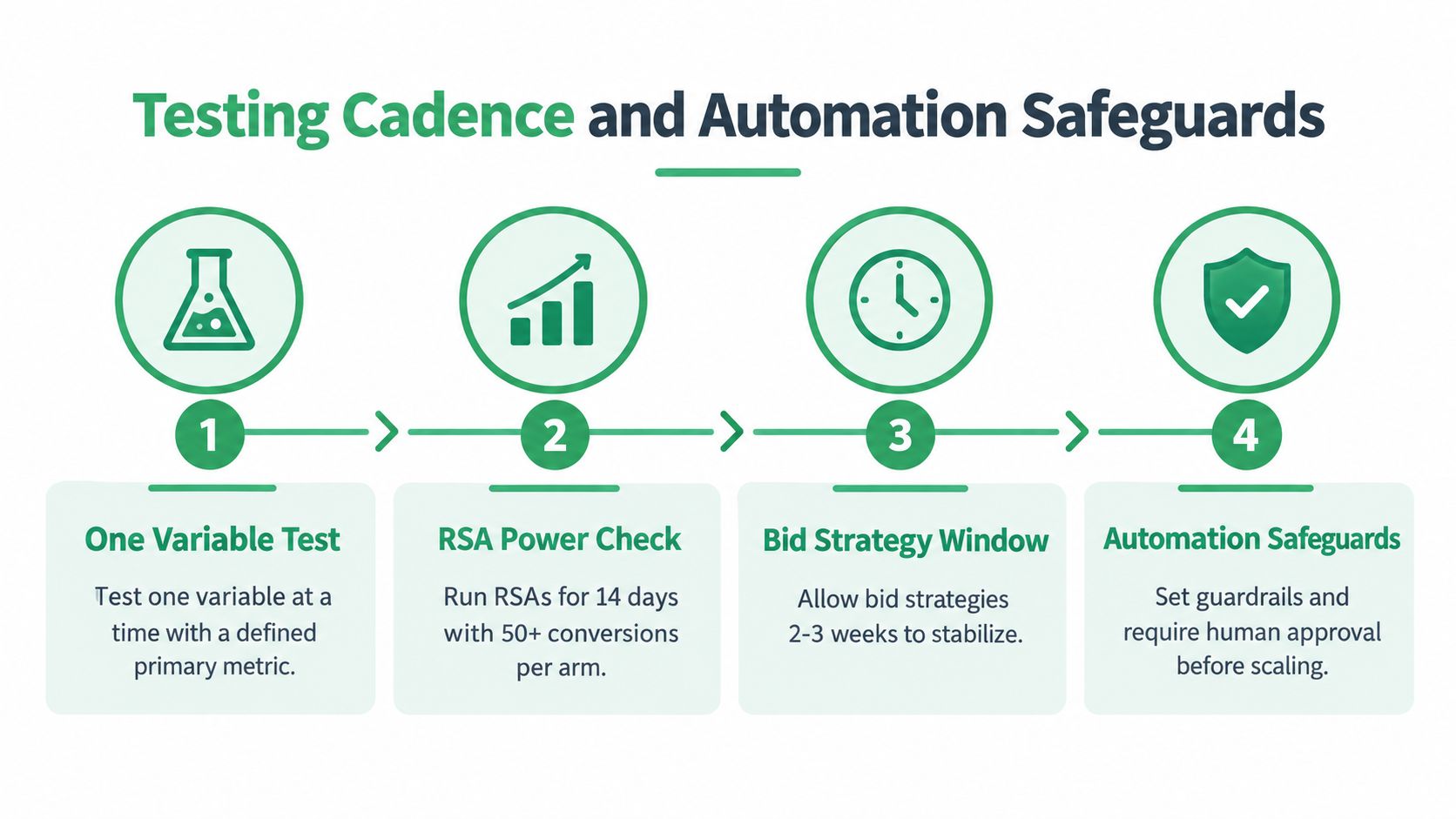
A practical cadence combines controlled experimentation with guardrails:
- Test design: Define the variable, primary metric, audience, budget boundary, and stopping condition before launch.
- Bid evaluation: Keep targeting and conversion definitions stable while the strategy gathers evidence.
- Creative review: Separate fatigue from audience quality by checking frequency, placement, message, and post-click behavior.
- Human review: Inspect change logs, search terms, conversion quality, and budget movement every week.
Automation should shorten the distance between detection and review, not bypass review. Portfolio bid strategies can reduce manual intervention after baseline CPA is understood. Automated rules can cap budgets, flag anomalies, and harvest negative keyword candidates, but they shouldn't receive unlimited write authority.
Hosted MCP workflows fit this model when they produce a live-data diagnosis, a proposed diff, an approval step, and a logged undo path. The agent handles repetitive comparison and draft generation. The marketer decides whether the offer, audience, brand risk, or business context justifies the change.
That distinction matters during auction shifts and changing SERP layouts. A thin win can look compelling in a dashboard, while a human reviewer can ask whether the result survives a different query mix, placement mix, or lead-quality check.
Where AI Agents and MCP Workflows Fit In
More dashboards won't automatically produce better optimization. Nor will more tests if the account can't distinguish a qualified lead from an unqualified form submission. The highest-value work increasingly sits upstream, where marketers validate conversion quality, first-party data, CRM feedback, and the rules governing automation.
Search economics make that discipline financially important. The cross-industry average Google Search CPC reached $2.96 in Q1 2026, up from $2.64 in Q1 2025, while another benchmark reported average paid-search CTR of 2.41% in Q2 2024 across countries, platforms, and industries, according to the 2026 paid-search benchmark summary. Those figures don't predict an individual account, but they show why small improvements in relevance, query matching, and conversion quality can matter at scale.
An AI agent earns a place in PPC operations when it performs the mechanical work without making unreviewable decisions. A hosted MCP workflow can:
- Pull live spend, search terms, keywords, budgets, conversion data, and learning status.
- Rank anomalies by spend at risk and compare them with the account's own targets.
- Draft negatives, budget changes, bid adjustments, or structural edits with explicit diffs.
- Route the proposal to a human reviewer before writing back to the ad platform.
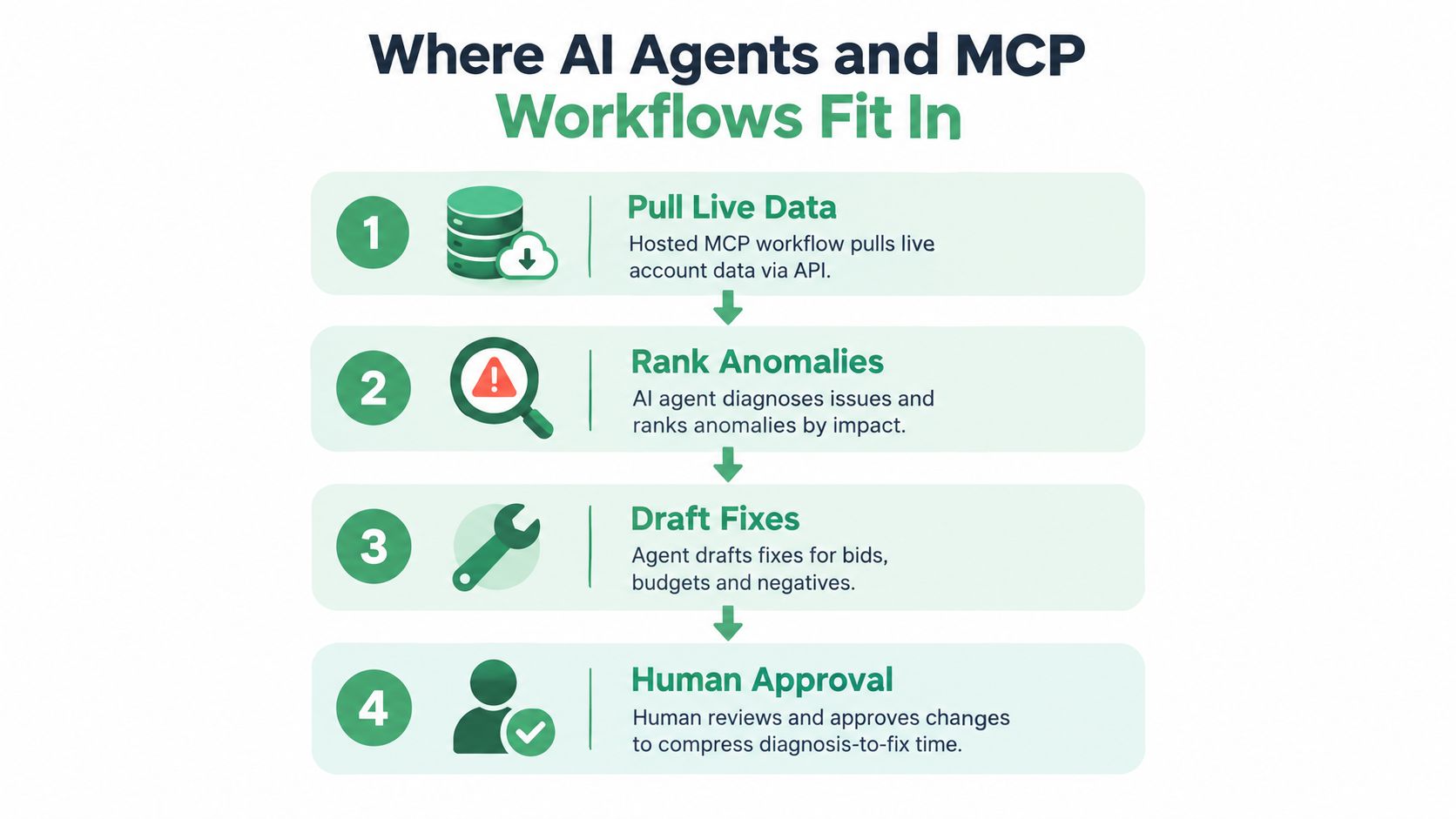
The change record should preserve the prior state, proposed state, reviewer, timestamp, and reversal method. That makes a bad draft operationally recoverable instead of turning it into a forensic exercise. One-call undo is useful because it makes cautious approvals easier, especially when several accounts need attention during the same workday.
NotFair is one option in this workflow category. Its hosted MCP servers connect AI clients with Google Ads and Meta Ads for live diagnosis, approval-gated campaign operations, explicit diffs, logged changes, and reversal workflows. Teams evaluating it can review the NotFair AI Google Ads agent alongside their existing connectors and permission model.
The marketer still owns judgment calls about positioning, audience strategy, offer quality, and brand protection. The agent should identify that a branded term is losing visibility or that a query cluster is wasting spend, but a person decides whether the answer is a negative, a new landing page, a brand campaign, or a broader coverage strategy.
Automation becomes a safeguard. It compresses diagnosis-to-fix time while preserving accountability.
A 30 60 90 Day Plan Plus Common Questions
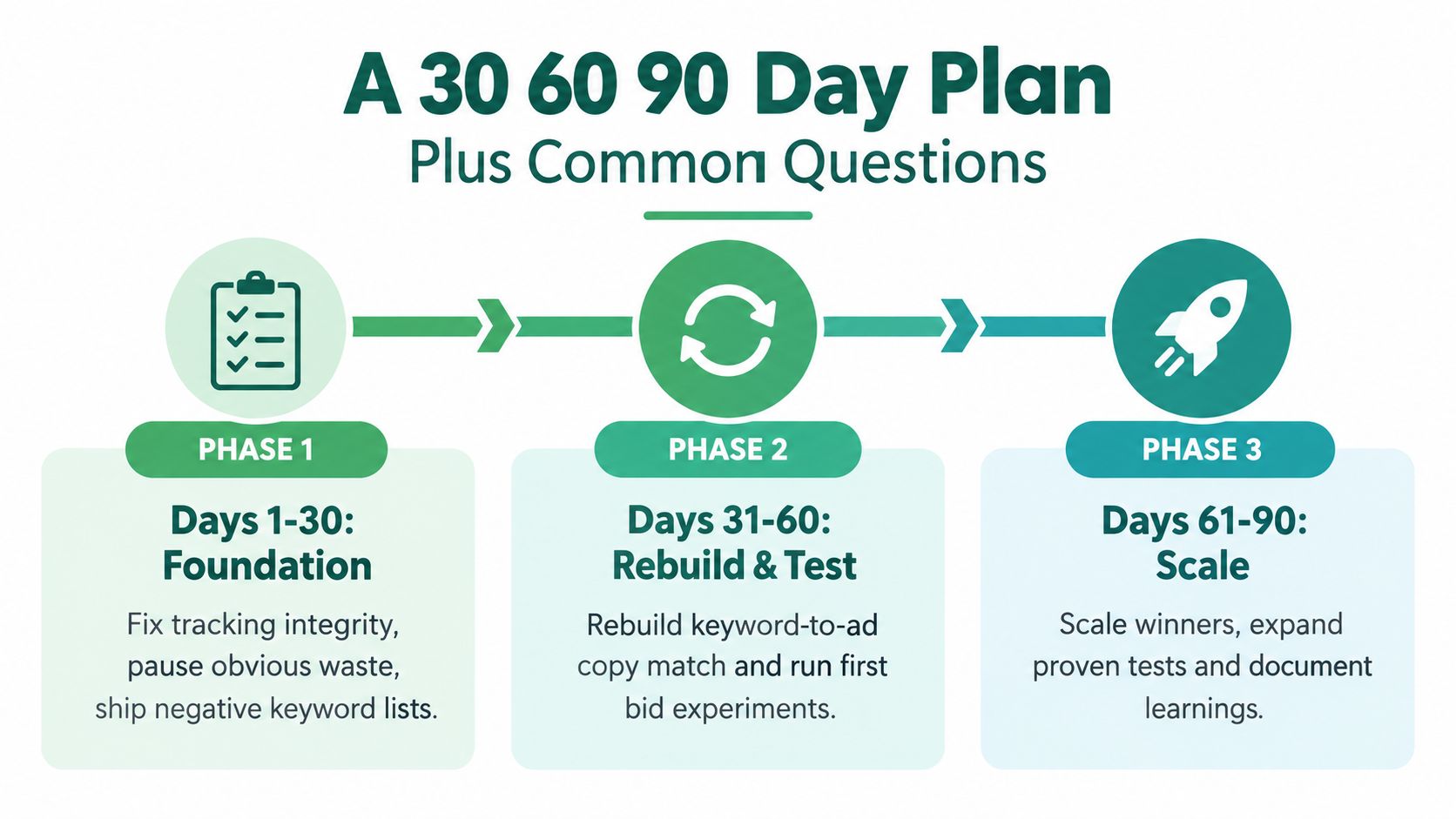
A staged rollout prevents the team from changing account structure, measurement, bidding, and creative all at once. Each phase should leave behind cleaner evidence for the next decision.
Days 1 to 30 build the foundation
Repair conversion tracking, validate deduplication, connect CRM stages where possible, and pause obvious waste. Review search terms, ship negative keyword lists, and document every approved change with its previous state. Don't scale automation until the account can tell a qualified outcome from a shallow event.
Days 31 to 60 rebuild and test
Improve keyword-to-ad-to-landing-page alignment, separate different intent, and run the first bid experiments within a controlled share of spend. On Meta, stabilize budgets and avoid large edits that can return ad sets to learning. Keep the primary metric fixed while the experiment runs.
Days 61 to 90 scale carefully
Scale proven Google responsive search assets, introduce structured Meta creative testing, and formalize the weekly review of change logs, search terms, conversion quality, and placement mix. Expand only what has survived the earlier checks.
Common questions from operating teams
What should we do after a Meta budget change resets learning? Stop stacking edits. Confirm the optimization event, allow delivery to stabilize, and evaluate the ad set only after it has gathered enough meaningful events to support a reliable decision.
How should we protect brand visibility as Google changes the SERP? Monitor branded queries, impression coverage, search terms, and assisted outcomes together. Preserve a deliberate brand presence where visibility matters, rather than judging the campaign only by last-click CPA.
Should automated rules replace portfolio bidding? They solve different problems. Rules enforce boundaries and alerts. Portfolio bidding allocates bids toward a defined objective. Use either only after conversion definitions and acceptable risk limits are clear.
What permissions should an MCP-connected agent receive? Start with read access for diagnosis. Add approval-gated write access only for narrowly defined operations, require explicit diffs, preserve change history, and confirm that every approved edit has a practical undo path.
NotFair connects hosted MCP servers to advertising, analytics, and CRM platforms so AI clients can inspect live data, rank PPC risks, draft reversible changes, and wait for human approval before writing them back. Visit NotFair to evaluate a controlled workflow for turning spend-at-risk findings into auditable campaign actions.