

Global mobile app install spend reached $94 billion in 2026, up from $81 billion in 2025 and $68 billion in 2023, yet iOS captured 58% of install spend while representing only 28% of global device share. The average global cost per install in Q1 2026 was $5.84 on iOS versus $1.92 on Android, a threefold difference, according to mobile app install data for 2026. That's the starting point for learning how to advertise an app profitably: acquisition is a unit-economics problem before it's a media-buying problem.
Cheap installs can still destroy a growth plan when users churn, attribution overstates performance, or a small team can't produce enough creative to keep campaigns healthy. The operating model has changed. You need platform-specific economics, post-install measurement, disciplined creative testing, and automation that lets people manage complexity without handing ad accounts over to uncontrolled scripts.
Table of Contents
- The New Economics of App Advertising
- Selecting the Right Acquisition Channels
- Structuring Campaigns and Creative Testing
- Rethinking Attribution in a Privacy-First Era
- Budget Allocation and Scaling Strategies
- Automating Operations with AI Agents
The New Economics of App Advertising
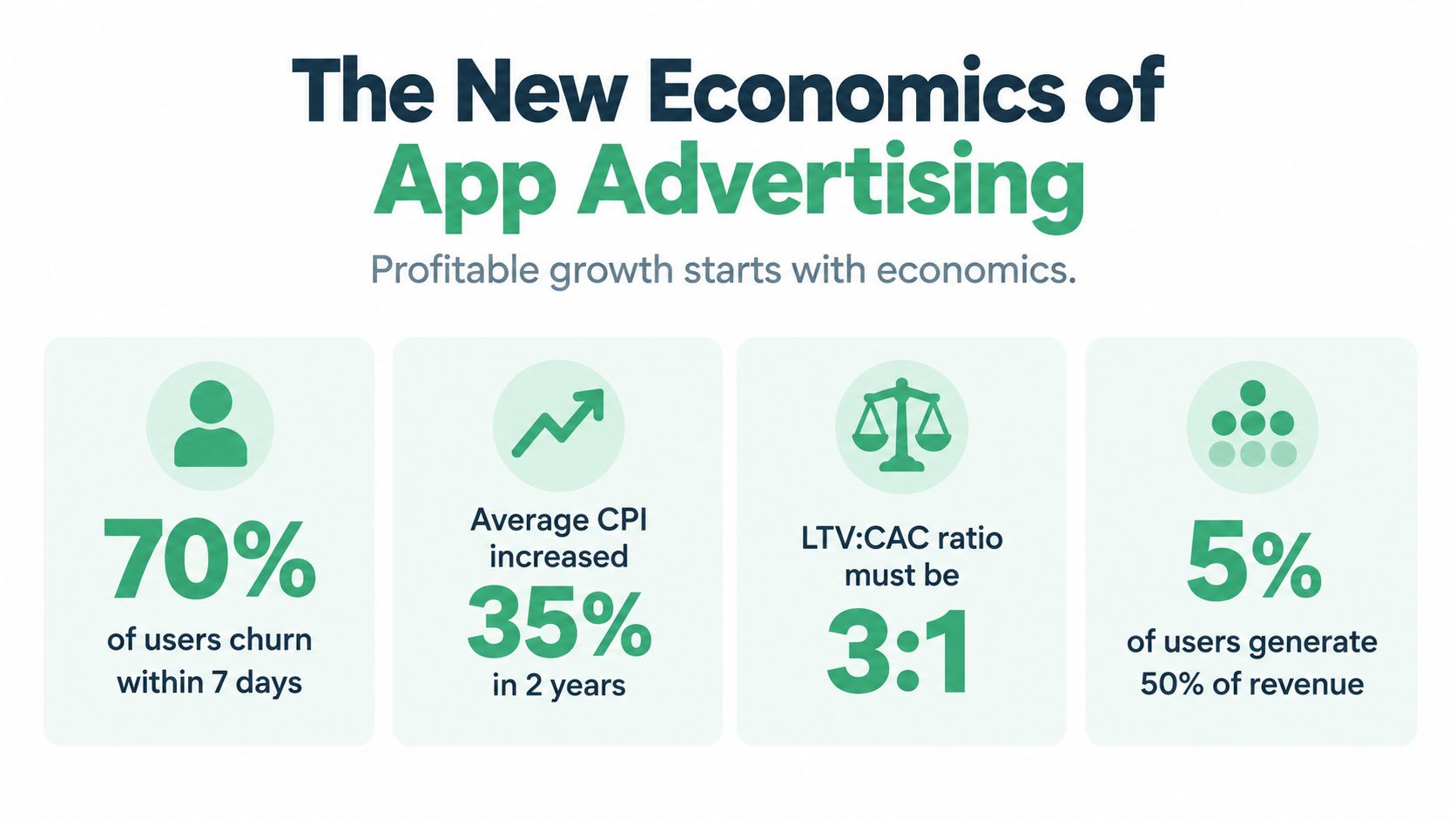
An app campaign can look efficient in an ad dashboard and still lose money for the business. CPI measures acquisition cost, not the value of the users acquired. Profitability requires connecting spend to retention, monetization, and contribution margin.
iOS and Android now play different economic roles. iOS provides access to premium audiences and receives a disproportionate share of install investment, but its average CPI is materially higher. Android can deliver lower-cost scale, yet a cheaper install does not prove stronger retention or monetization. Compare contribution margin by platform, campaign, geography, and cohort instead of ranking channels by CPI alone.
Retention exposes the cost of weak acquisition decisions. Across tracked apps, average retention was 26% on Day 1, 11% on Day 7, and 5.4% on Day 30, according to mobile app marketing benchmarks. An install report that stops at download volume hides where acquisition waste occurs.
Build the model before buying traffic
Start with the revenue event that determines value. A subscription app may use a trial that becomes paid. A commerce app may use a completed order with a known gross margin. A game may use a purchase or a retained payer cohort. Connect that event to acquisition source, platform, creative concept, and campaign.
Use CPI as a diagnostic, not the final decision rule. The cited campaign guidance recommends keeping CPI at no more than one-third of LTV, or maintaining an LTV:CPI relationship of at least 3:1. This guardrail does not replace a contribution-margin model, but it gives the team a clear threshold before scaling.
Your pre-launch model should answer four questions:
- What counts as value: Define the first in-app action that predicts revenue or durable retention.
- Which costs belong in the calculation: Include media spend and relevant platform or service costs instead of treating reported revenue as pure margin.
- How cohorts mature: Set checkpoints for activation, retention, and revenue rather than judging every campaign on install day.
- What can be paid for growth: Establish a maximum acceptable CPI for each platform and monetization scenario.
Store discovery also changes paid advertising's role. Store search generated 41% of installs, referral traffic such as paid user acquisition and web links generated 28%, and browse or recommendations generated 18%, according to the 2026 install-spend dataset. Paid media should support the store listing and wider demand system, while privacy-centric attribution and cohort analysis determine whether the resulting users justify the spend.
Selecting the Right Acquisition Channels
The best channel depends on intent, signal quality, creative requirements, and the conversion event you can measure. Treating every network as interchangeable is how teams end up comparing high-intent search with low-intent discovery using only CPI.
Apple Search Ads is usually the cleanest starting point for an app with existing demand. Users are already searching in the App Store, and the 2024 benchmark for search-results campaigns recorded an average Tap-Through Rate of 11.4% and a 67.2% conversion rate from downloads to taps, using consistent formulas for TTR, conversion rate, and CPA, according to Apple Ads install benchmarks. That conversion rate describes the tap-to-download step, not downstream value, so it shouldn't be mistaken for profitability.
Google App Campaigns can extend reach across Google inventory and work well when the advertiser supplies strong conversion signals. They're useful for scaling toward an in-app event, but automation needs reliable event definitions and enough quality feedback. Meta remains valuable for demand creation and creative discovery, although broad targeting makes the ad concept, opening hook, and landing experience carry more weight than finely segmented audience structures.
| Channel | User Intent | Cost Profile | Best Use Case |
|---|---|---|---|
| Apple Search Ads | High, users are searching the store | Higher iOS acquisition costs require stronger monetization assumptions | Capture category and competitor demand |
| Google App Campaigns | Mixed, intent varies by placement | Automated bidding depends on useful conversion signals | Scale installs or downstream events across Google inventory |
| Meta Ads | Discovery and demand generation | Competitive feeds increase creative pressure | Test hooks, use cases, and broad audience demand |
| TikTok | Discovery led by short-form video | Creative relevance matters more than complex targeting | Reach users through native-feeling video concepts |
| CTV | Lean-back brand and demand exposure | Requires careful measurement because the path to install is indirect | Build awareness and support web-to-app journeys |
| OEM placements | Device-level discovery and utility contexts | Inventory and audience quality vary by manufacturer and placement | Diversify beyond saturated social channels |
Sequence expansion instead of scattering budget
A small team shouldn't launch every channel at once. Establish a reliable measurement event, find repeatable creative themes, and then add a channel that gives you a different type of intent or inventory. TikTok can test native video storytelling, CTV can create broader demand, and OEM placements can add device-level reach. Recent app marketing strategy coverage for 2026 describes this diversification alongside the industry's shift toward short-form and interactive formats.
Use Crescade's mobile marketing coverage as a supplementary reference when mapping channel roles across acquisition, retention, and broader mobile growth. For teams expanding into TikTok, keep the account structure and event taxonomy simple enough to compare creative concepts rather than creating disconnected reporting silos. The TikTok Ads documentation can help teams understand the platform-specific operating surface before adding it to the portfolio.
Structuring Campaigns and Creative Testing
Privacy changes have reduced the value of narrow audience architecture. Creative now does more of the qualification work. A strong ad tells the algorithm who may respond, gives the user a reason to care, and creates a pre-install expectation that your onboarding experience must fulfill.
The account structure should protect learning while making creative iteration easy. Avoid creating a separate campaign for every tiny audience or message variation. Instead, group campaigns by meaningful business objective, platform, and geography, then organize creative around distinct hypotheses.
Use a modular production system
Start with the problem, not the format. A productivity app might test “recover lost focus,” “organize a chaotic day,” and “finish a recurring task faster.” Each concept can then receive multiple executions, such as a founder explanation, a screen recording, a customer-style demonstration, and an interactive walkthrough.
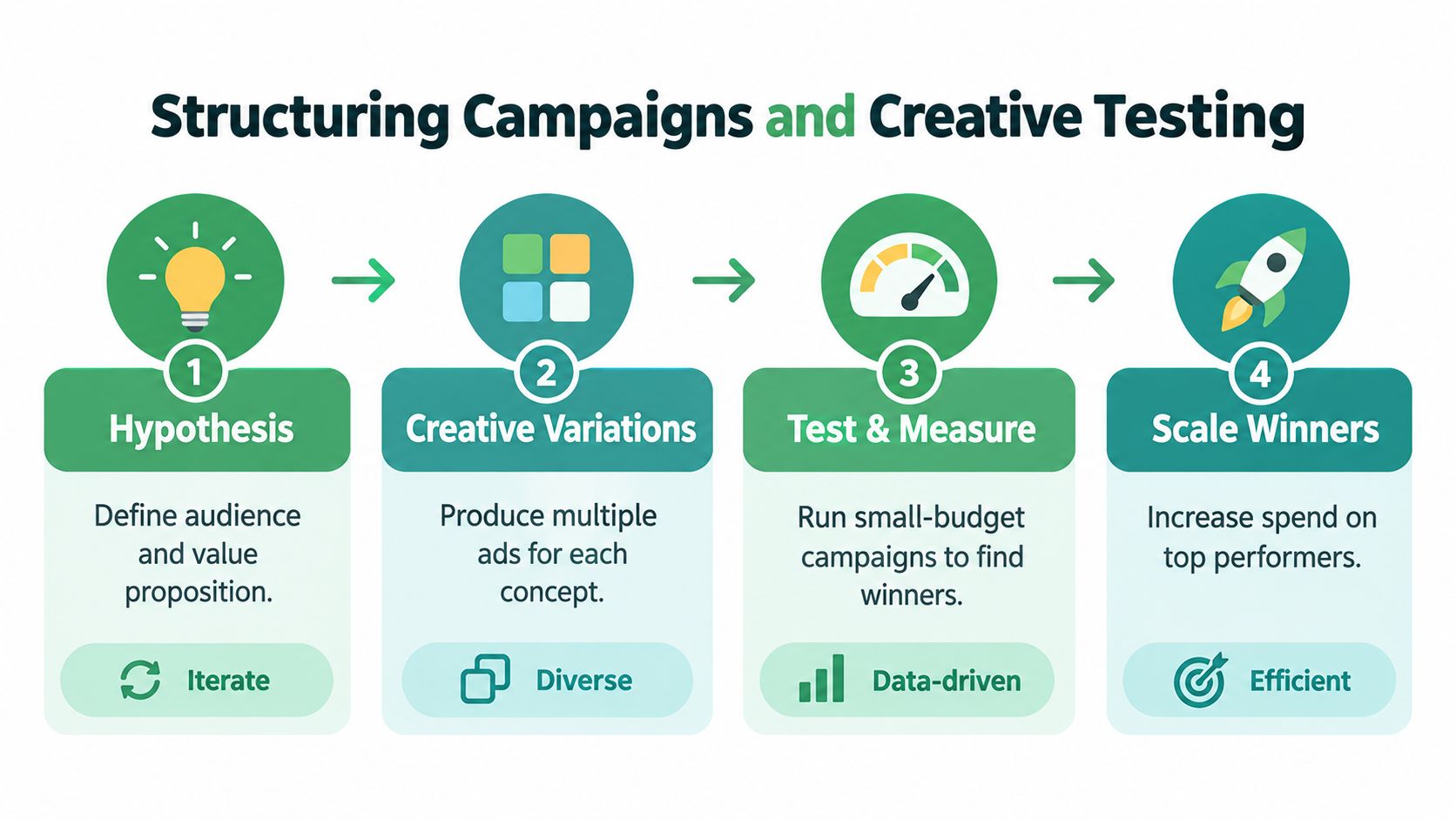
A practical testing loop looks like this:
- Write the hypothesis. State the user tension, promised outcome, and event you expect to improve.
- Create varied executions. Change the opening visual, spoken hook, proof method, pacing, and call to action. Don't produce cosmetic edits and call them separate tests.
- Measure the full path. Track impression, tap, install, activation, retention, and revenue where the platform and privacy framework allow.
- Promote durable winners. Scale concepts that produce valuable cohorts, not merely cheap clicks or downloads.
Short-form video and interactive formats deserve a place in the mix because they demonstrate an app's experience faster than static screenshots. For practical guidance on producing creator-style executions, use this UGC-style advertising guide from ClipCreator.ai. The goal isn't to imitate a creator mechanically. It's to make the product benefit feel native to the environment where users encounter it.
Creative fatigue requires a response based on evidence rather than panic. Monitor declining tap or activation quality, inspect frequency where available, and rotate the underlying idea before changing only colors or captions. The Meta Ads creative fatigue reference is useful when diagnosing whether performance is weakening because of repetition, audience saturation, or a broken post-click experience.
Give each test a clear decision rule. A concept wins when it improves the business event you care about at an acceptable acquisition cost, not when it produces the highest engagement rate in isolation.
Rethinking Attribution in a Privacy-First Era
Last-click CPI is no longer a sufficient operating system for app growth. It can tell you what a platform claims to have delivered, but it can't fully explain whether the campaign created incremental demand, whether users came from another touchpoint, or whether the install produced durable value.
The measurement architecture should connect three layers. First, capture acquisition signals such as campaign, creative, platform, and click context. Second, pass structured post-install events, including activation and revenue milestones, into the measurement stack. Third, compare observed performance with holdouts, geo tests, or other incrementality methods where practical.

Connect web demand to app value
Web-to-app journeys are especially easy to misread. A user may discover an app through a web search, compare alternatives on a landing page, and install later on a mobile device. If the reporting system only credits a final click or an app-store interaction, the acquisition team may undervalue the web campaign that created the demand.
Google expanded Web to App Connect in September 2025 so advertisers could measure app installs and first in-app conversions from web campaigns across Search, Shopping, YouTube, Hotel Ads, and Demand Gen, according to mobile app advertising strategy coverage. The operational implication is important: connect web sessions, deep links, store visits, installs, and first meaningful in-app actions wherever consent and platform capabilities permit.
First-party data should complete the loop. Use authenticated product events, CRM records, subscription status, and owned messaging to understand what happens after the ad platform's reporting window ends. For social video teams, this practical resource on measuring TikTok and Reels performance can support a broader framework for separating content engagement from business outcomes.
Measurement rule: If a campaign can't be evaluated against activation, retention, or revenue, it's only partially measured.
Modeled reporting can fill gaps, but it should be treated as an estimate with assumptions, not as ground truth. Keep platform-reported attribution, product analytics, cohort analysis, and incrementality results in the same operating review. Disagreement between them is a diagnostic signal, not an inconvenience to hide.
Budget Allocation and Scaling Strategies
Budget should follow validated economics, not whichever channel reports the most installs. A useful allocation process begins with a protected test budget, moves spend toward cohorts that meet the value threshold, and reserves capacity for new creative and channel experiments.
The cited app-install guidance recommends allowing campaigns about 7 days and at least 50 optimization events before deciding whether they've exited learning, as long as the campaign isn't producing clearly unacceptable outcomes. Pausing earlier can prevent an algorithm from receiving enough feedback, while leaving a broken campaign untouched can compound waste. The operator's job is to distinguish insufficient evidence from negative evidence.
Allocate by cohort quality
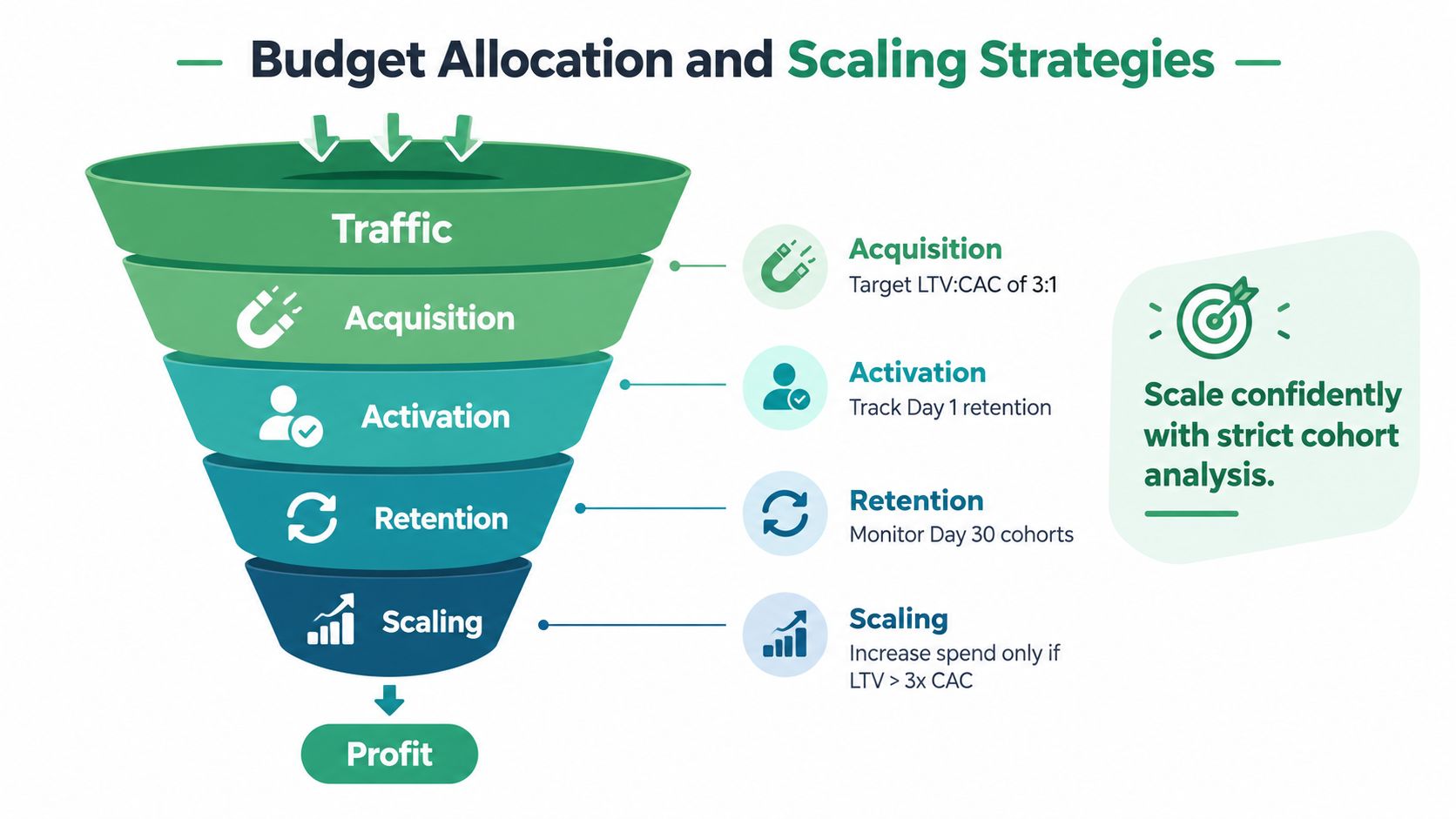
Review performance in layers:
- Acquisition: Compare CPI and conversion quality by platform, campaign, and creative concept.
- Activation: Identify whether users complete the first action that predicts later value.
- Retention: Inspect Day 1, Day 7, and Day 30 cohorts rather than relying on install totals.
- Revenue: Compare realized or modeled LTV with acquisition cost and contribution margin.
Scale only when the downstream relationship supports it. A campaign with a low CPI but weak activation is a candidate for creative or onboarding work, not automatic budget growth. A campaign with higher CPI and stronger monetization may be the better investment, particularly on iOS where acquisition costs are higher.
Increase spend gradually enough to preserve interpretability. If several variables change simultaneously, you won't know whether the improvement came from budget, creative, placement, geography, or an event-quality change. Keep a change log, record the reason for every material adjustment, and review cohorts on a consistent cadence.
Know when to diversify
Diversification becomes rational when a channel has reached a creative or inventory constraint, not merely because a new platform looks interesting. Add a different source of demand, such as search, short-form video, CTV, or OEM inventory, when the current portfolio can no longer produce additional qualified volume at acceptable economics.
Scaling discipline: Spend more only when the cohort earns the right to receive more budget.
Automating Operations with AI Agents
Cross-platform campaign management creates a repetitive workload that grows faster than a lean team can comfortably absorb. Someone has to inspect spend, search terms, budgets, creative delivery, learning status, analytics, and CRM outcomes, then decide which changes are safe. Manual dashboard switching also makes it harder to connect the cause of a problem with its downstream business impact.
AI agents can take over the mechanical parts of that workflow, but they shouldn't receive unrestricted authority. The useful design is an agent that reads live data, identifies issues, drafts an action, shows the exact change, and waits for approval before writing to an ad platform.
Give agents bounded operational access
A practical workflow separates diagnosis from execution:
- Read live account data. Pull current spend, campaigns, search terms, conversion events, and analytics rather than relying on stale exports.
- Rank problems by risk. Prioritize wasted spend, tracking breaks, budget constraints, and deteriorating cohort quality.
- Draft the fix. Produce proposed pauses, budget moves, exclusions, or structural changes with the expected rationale.
- Require approval. Show an explicit diff before the change reaches Google Ads or Meta Ads.
- Log and reverse. Preserve change history and provide a direct undo path when an approved edit produces an unexpected result.
This approach keeps strategic judgment with the growth team while reducing the time spent assembling reports and locating obvious account issues. It also supports cross-platform reasoning, such as comparing paid search demand with analytics behavior and CRM outcomes in the same investigation.
Hosted MCP infrastructure makes this pattern practical for teams using Claude, Codex, Cursor, OpenClaw, or other compatible clients. For Google Ads operations specifically, the Google Ads AI agent workflow describes a model based on live account analysis and approved changes. NotFair is one option that provides hosted MCP connections for advertising and analytics platforms, with approval-gated writes, explicit diffs, logged history, and one-call undo.
AI agents won't solve weak creative, poor onboarding, or undefined LTV. They can, however, shorten the distance between a signal and a reviewed action. That operational speed matters when campaigns span multiple platforms and the team needs to test more creative without sacrificing control.
Human responsibility stays intact: Let the agent find, explain, and prepare the change. Let a human approve decisions that affect spend, measurement, and customer experience.
If your app team needs to manage Google and Meta campaigns with live diagnostics, approval-gated edits, change history, and reversible operations, explore how NotFair connects AI agents to advertising and analytics workflows. Use it to reduce dashboard switching, prioritize spend at risk, and give your growth team more time for creative strategy and post-install optimization.