

The dashboard looks healthy. CPA is steady, conversion volume appears stable, and the account is ready for another round of bid and budget adjustments. Then sales reports that pipeline quality has weakened, qualified opportunities are harder to find, and the apparent efficiency exists mostly inside Google Ads.
That situation is common because Google Ads optimization is often treated as a bidding exercise. A safer approach starts by proving that the data represents real business outcomes, then ranks problems by spend at risk, repairs account structure, and makes every change reviewable and reversible.
Table of Contents
- The Optimization Trap: Optimizing a Dashboard Instead of the Business
- Audit Checkpoints Before You Touch a Single Bid
- Diagnose by Spend at Risk, Not by Whim
- When Broad Match and Smart Bidding Are the Wrong Default
- Fixing Bids, Keywords, and Structure Without Blowing Up the Account
- Running Experiments You Can Actually Trust
- Approval Gates, Change History, and Undo as Operating System
The Optimization Trap: Optimizing a Dashboard Instead of the Business
A performance marketer opens the account and sees familiar signals. One campaign has a rising CPA, another has lost impression share, and a third appears efficient enough for more budget. The routine response is to raise or lower bids, move budget, add keywords, and check the dashboard again later.
That workflow fails when reported conversions are accepted without checking what they represent. A conversion may be a duplicate browser and server event, a low-value form submission, or a lead that never reaches sales. Reported CPA can improve while qualified opportunities decline. Without a documented change history, the team cannot separate the effect of a bid adjustment from a tracking change, landing-page update, or conversion lag.
Practical rule: Measurement integrity comes before optimization. Otherwise, budget decisions rest on uncertainty.
The order of work matters. Validate the measurement layer first. Segment the account next, then rank findings by spend at risk rather than by the campaign making the most noise in the interface. Structural changes to bids, keywords, budgets, or ad groups come after that diagnosis.
Treat each edit as an operational decision, not a casual dashboard action. The proposal should record the previous state, new state, reason for the change, expected risk, and rollback path. A manager or policy should approve the write before it reaches the account, and the change should be reversible through a single, documented undo path.
That discipline may reduce the number of weekly edits. It improves the quality of the decisions that remain, keeps accountability clear, and makes failed changes easier to reverse. A week with three well-evidenced, reversible decisions beats a week of thirty undocumented dashboard edits.
Audit Checkpoints Before You Touch a Single Bid
Start by checking whether the account's primary conversion actions represent genuine business outcomes. A purchase, qualified opportunity, completed booking, or revenue-producing action can guide optimization. A page view, button click, or duplicate lead event may be useful for diagnosis, but it shouldn't become the signal that controls bidding.
Validate the event pipeline
Check browser and server implementations side by side. Deduplicate events using the identifiers available in the implementation, confirm that value and currency fields are populated correctly, and verify that the same action isn't imported through multiple systems. Then inspect attribution windows across devices and campaigns so a reported conversion isn't being credited under assumptions the business doesn't accept.
Google's guidance on data-driven attribution describes a model that evaluates converting and non-converting paths, including interaction order, device, timing, and ad format. For reliable DDA analysis, Google recommends at least 200 conversions and 2,000 ad interactions in 30 days. Certain conversion types require 300 conversions and 3,000 interactions for eligibility, followed by 200 conversions and 2,000 interactions every 30 days to remain eligible.
Those thresholds are decision rules, not targets to manufacture. If the account doesn't have enough volume, keep the attribution model simpler, aggregate over a longer period, and give greater weight to deterministic tracking and CRM feedback.
Separate observed data from modeled data
Consent Mode creates an important measurement caveat. When users deny consent, Google can restrict cookies and identifiers and use modeled conversions to estimate outcomes that can't be directly connected to ad interactions. Basic Consent Mode blocks tags until consent, while advanced Consent Mode sends consent-aware signals that support more detailed modeling, as described in Google's Consent Mode overview.
That capability can improve coverage, but modeled conversions shouldn't automatically receive the same business interpretation as directly observed outcomes. Report observed conversions and modeled conversions separately, then compare Ads-reported leads with qualified opportunities and revenue in the CRM. Track consent rates and modeled share by market, especially when regional behavior differs but the same bidding system operates across markets.
Delay major bid or budget changes when an apparent CPA improvement might be explained by declining observability. Wait for enough post-click and CRM evidence to determine whether the efficiency is real.
Define the observation window
Use a 30-day pre and post observation window for material changes. Don't judge a change while the campaign is still learning or before the account's conversion lag has completed. Evaluate marginal profit, qualified-lead rate, and incrementality, not platform-reported CPA alone.
Diagnose by Spend at Risk, Not by Whim
The loudest campaign isn't necessarily the most expensive problem. A small campaign can spend against irrelevant queries, while a larger campaign attracts attention because its fluctuations are easier to see. The first useful diagnostic is therefore a ranked queue, not a list of observations.

Build the account segments
Read current account data and segment it by:
- Campaign: Separate brand, non-brand, prospecting, remarketing, product, and regional intent where those distinctions exist.
- Query: Compare search terms with the conversion definition that matters, not merely with clicks or recorded micro-conversions.
- Device: Look for differences in lead quality, conversion lag, and landing-page behavior across device types.
- Geography: Identify locations where spend produces weak customer quality or where sales coverage doesn't exist.
- Audience: Separate returning users, prospecting audiences, and other relevant audience signals.
- Landing page: Connect traffic quality with the page experience, offer, form, and downstream qualification.
A finding should fit into one sentence and point to an action. “Broad-match queries in Campaign A are spending against a recurring low-intent theme, producing leads that fail CRM qualification, so draft a negative list and protect the proven exact terms.” That's more useful than “Campaign A needs optimization.”
Rank the queue
Rank findings by the amount of spend exposed, the likelihood that the issue is real, and the reversibility of the proposed fix. A high-spend query pattern with clear evidence and a safe negative keyword change belongs near the top. A subtle landing-page hypothesis with incomplete CRM data belongs lower, even if it sounds strategically interesting.
The same discipline applies to financial interpretation. If the team is deciding between revenue efficiency and profit efficiency, this explanation of deciding between ROI and ROAS provides useful context. A platform metric can look favorable while margin, fulfillment cost, sales effort, or lead quality changes the actual result.
A live diagnostic workflow, such as the one described in Google Ads wasted spend analysis, can return an ordered queue from current account data rather than forcing the team to rediscover the same issues in stale exports. The important operating principle is simple: start with the highest-cost credible problem, write the proposed fix as a diff, and leave low-confidence observations in a review queue.
When Broad Match and Smart Bidding Are the Wrong Default
A campaign can show cheaper conversions after switching to broad match and Smart Bidding while qualified revenue falls. That outcome is common enough to make automation a conditional choice, not an account-wide default. Before enabling it, check whether conversion feedback is reliable, irrelevant traffic is affordable, and the bidding system can distinguish a valuable customer from a low-quality lead.
The available evidence is more mixed than modernization advice suggests. An analysis of more than 2,600 Google Ads accounts reported that 72% achieved better ROAS with traditional exact-match targeting versus roughly 26% with broad-match automation. A 2025 Search Engine Journal analysis separately reported that 62% of advertisers using Smart Bidding had made broad match their primary match type. These findings do not establish a universal causal result, but they do show why account-specific testing matters.
Compare control with exploration
Compare broad and exact traffic under the same conversion definitions and attribution settings. Include CRM outcomes, intent, margin, customer quality, geography, and conversion lag. A broad-match term that produces inexpensive form fills may be a poor expansion candidate if those leads fail qualification or take much longer to close.
Protect proven exact-match terms from budget competition. If broad traffic shares a campaign and budget with valuable exact queries, exploration can consume capacity that the control layer needs. Separate campaigns or budgets make the comparison clearer and reduce the risk of an apparently efficient but commercially weak query theme taking over.
| Account Signal | Lean Toward Control | Lean Toward Exploration |
|---|---|---|
| Measurement quality | Conversion definitions are unstable or modeled share is difficult to interpret | Tracking is deterministic and CRM feedback is connected |
| Commercial risk | Margins are tight or irrelevant traffic is expensive | The business can absorb discovery costs |
| Query behavior | Search terms show recurring loose-match or brand leakage | New queries have a clear relationship to profitable intent |
| Account maturity | Exact terms have established quality and revenue evidence | The account lacks enough reach within proven themes |
| Evaluation signal | CPA looks efficient but qualification is weak | Qualified revenue and lag remain healthy after expansion |
Use exploration only after it earns approval from the evidence. Keep control where the account's strongest revenue signals already exist. A comparison of Google Ads native automation can help separate platform capability from the targeting rules, measurement quality, and approval policy the team still has to provide. Each change should have a defined success condition and a simple rollback path.
Fixing Bids, Keywords, and Structure Without Blowing Up the Account
Once a finding has a clear cause and priority, convert it into a small, reviewable change set. Don't combine a bid change, budget move, landing-page replacement, and campaign restructure in one edit. If performance changes afterward, you won't know which decision created the result.

Triage real search terms
Pull the recent search-term report and tag each meaningful term as keep, negate, or restructure. Keep terms that match commercial intent and produce acceptable business outcomes. Negate terms that repeatedly spend against irrelevant intent. Restructure terms that reveal a distinct, valuable theme requiring its own ad copy, landing page, budget, or bidding logic.
A negative keyword should reflect the problem you observed. Don't add an overly broad exclusion just because one query looked poor. Check close variants, campaign overlap, and whether the same term has value in another context. A maintained Google Ads negative keywords workflow should protect good demand while removing recurring waste.
Write every edit as a diff
Use a format that a reviewer can understand without opening several dashboards:
- Target: Campaign, ad group, keyword, or budget.
- Current state: Existing bid, match type, status, budget, or negative list.
- Proposed state: The exact new value or status.
- Reason: The observed query, device, geography, or quality issue.
- Risk: What could be excluded, delayed, or destabilized.
- Undo: The previous value and the command or action that restores it.
For example, a proposed change might pause a clearly irrelevant keyword, add a narrowly scoped negative to one campaign, or adjust a device bid after quality and revenue evidence support the pattern. The reviewer should see the old and new states before approval, not reconstruct them afterward from memory.
Separate structural work from budget work
Bid adjustments by device or geography are easier to interpret when budgets remain stable. Budget moves should not happen at the same time as bid moves. Larger restructures, including reorganizing campaigns by intent rather than product, belong in a draft-and-approve workflow because they can change query routing, learning behavior, and reporting continuity.
Single-keyword ad groups may also drift as matching behavior changes. Don't rebuild the entire account on principle. First identify where a theme has enough commercial distinction to justify separation, then move only the necessary terms, ads, negatives, and landing-page relationships. Every live change should be reversible.
Running Experiments You Can Actually Trust
A trustworthy experiment has a narrow question. “Will broader targeting improve qualified pipeline without weakening margin?” is testable. “Optimize the campaign” isn't.
Start by choosing one variable and holding the rest constant. That variable might be match-type treatment, bid strategy, ad message, landing page, or geographic allocation. Define success using qualified revenue, qualified-lead rate, marginal profit, or incrementality when possible. Platform CPA can remain a diagnostic metric, but it shouldn't be the only decision criterion.
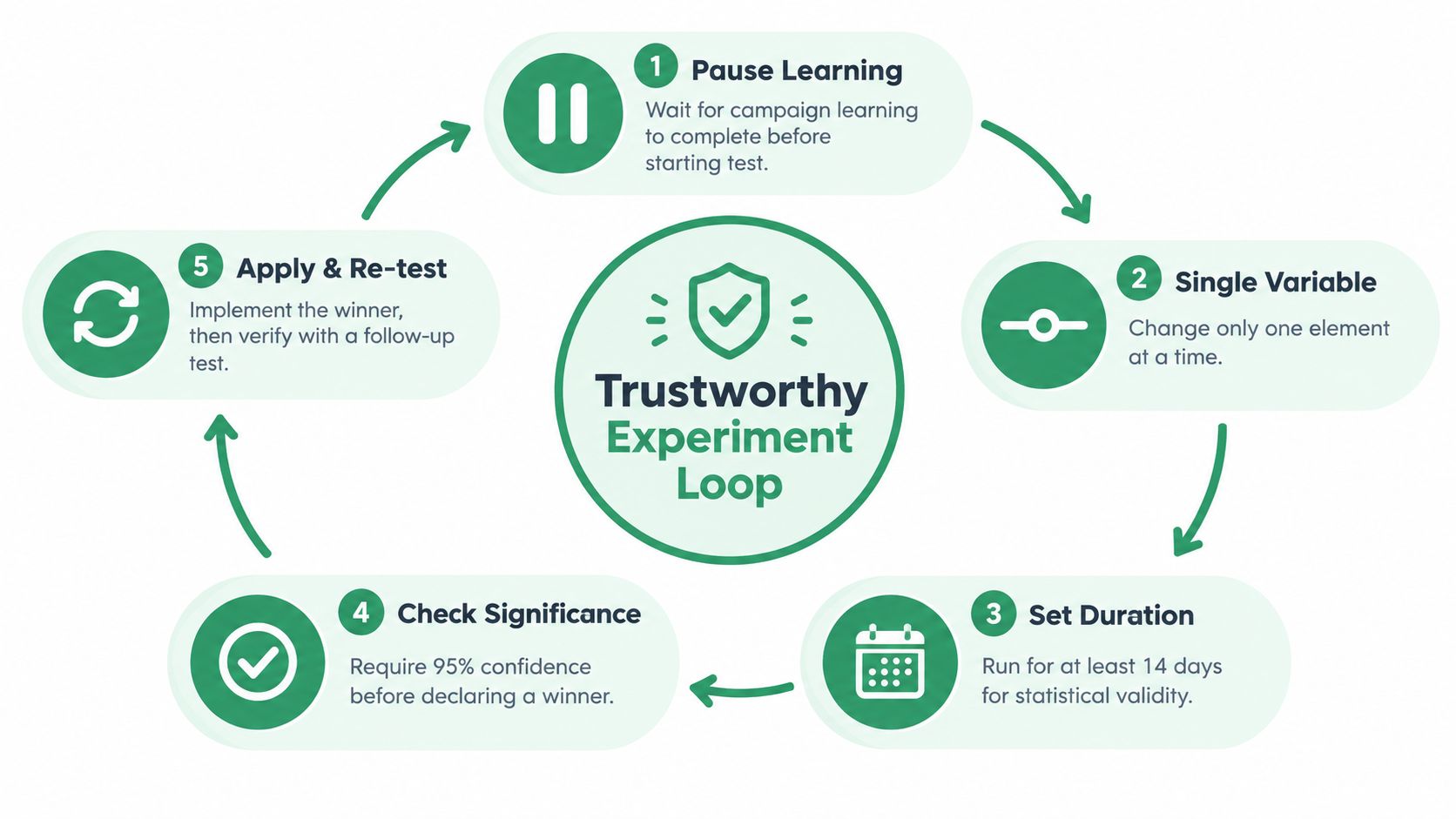
Use a 30-day pre and post observation window, and wait for learning and conversion lag to settle before judging the outcome. Don't declare a winner because the first few days look promising. A campaign can receive early conversions that don't represent the eventual mix of qualified opportunities, especially in longer sales cycles.
The verification loop is:
- Define the hypothesis: State the business outcome and the single variable.
- Freeze the comparison: Keep conversion definitions, budget logic, and relevant targeting conditions stable.
- Collect downstream evidence: Reconcile Ads conversions with CRM qualification and revenue.
- Assess the trade-off: Compare lift, marginal profit, quality, and incrementality rather than one dashboard ratio.
- Decide or wait: Apply the change only when the observation window and conversion lag support a confident conclusion.
Teams working on landing-page and funnel improvements may also find a broader B2B SaaS conversion playbook useful for connecting ad traffic with on-site conversion decisions. The key is to keep the experiment boundary clear. A landing-page test and a bid-strategy change shouldn't compete for the same explanation.
Write the rollback plan before launch. If the variant loses, reverse it through the same approval-gated diff used to publish it. That turns experimentation into a controlled learning process rather than a sequence of untraceable edits.
Approval Gates, Change History, and Undo as Operating System
Fast optimization is safe only when the account can explain and reverse every write. An agent or marketer can draft a bid update, negative keyword, budget adjustment, pause, or restructure, but the change shouldn't go live until the diff has been reviewed and approved.
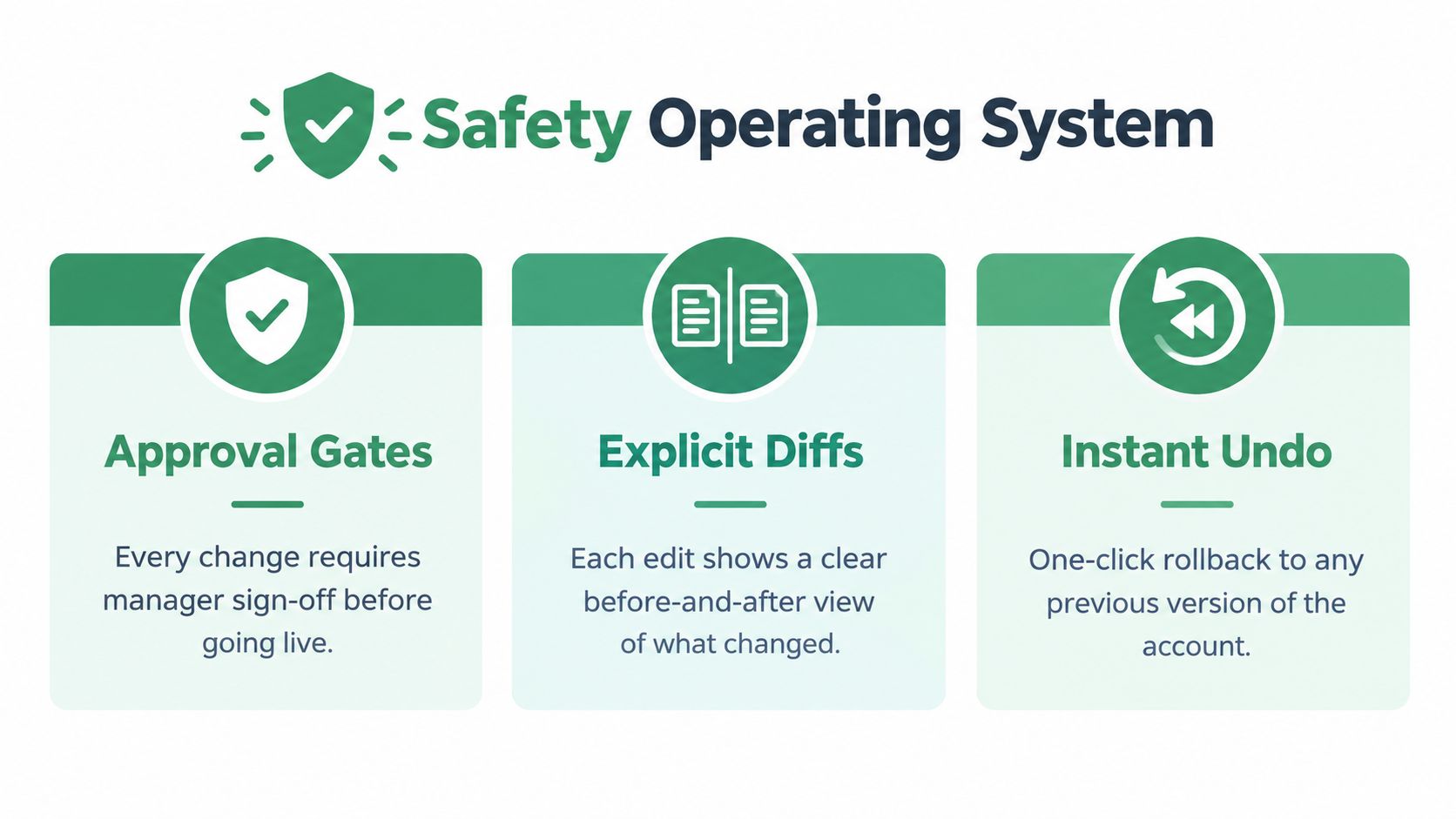
A practical operating system has three parts:
- Approval gate: A human or policy confirms the proposed action.
- Explicit diff: The interface shows the old state, new state, reason, and affected scope.
- One-call undo: The logged change can be reversed without reconstructing the previous account state.
A 30-day rollout can follow a controlled sequence. Begin with measurement validation, move to a ranked spend-at-risk queue, apply small structural fixes, then run isolated experiments. Keep the same review and rollback policy throughout.
Print this checklist beside the dashboard: validate the signal, rank spend at risk, separate control from exploration, change one variable, approve the diff, log the write, and keep undo one call away. The objective isn't more changes per week. It's more confident changes per week.
NotFair connects AI agents with Google Ads, analytics, and CRM data for live diagnosis, prioritized fixes, approval-gated edits, explicit diffs, change history, and one-call undo. Visit NotFair to turn this Google Ads optimization workflow into a reviewable operating process rather than another round of reactive dashboard changes.