

Your Google Ads account can look busy and still be underdiagnosed.
Leads get more expensive. Search terms start drifting. Broad match picks up queries that feel adjacent, not useful. The dashboard says clicks are happening, impressions are fine, and automated bidding is “learning,” but none of that answers the question your team has. What changed, and what should we do next?
That gap is where Google Ad specialists still matter.
A lot of teams assume the role is mostly pushing bids up and down inside the Google Ads interface. That was closer to the truth years ago. It's less true now. Google has automated more of the basic execution layer, which means the specialist's value has moved upward. The strongest operators don't just manage campaigns. They diagnose intent problems, connect ad behavior to analytics and CRM outcomes, and decide where spend is most at risk before waste spreads.
That matters even more on a platform this concentrated. Google's share of the U.S. search engine market was reported at 86.6% in 2026, with about 91.31% worldwide, and independent 2026 benchmarks estimated Google's share of U.S. search ad spending at 48.5%. Global digital ad revenue forecasts also put Google at 26.4% of worldwide digital ad spend in 2026. Those projections help explain why specialist judgment still has outsized impact on revenue and efficiency in real accounts (2026 Google Ads market share and spend benchmarks).
Table of Contents
- Introduction Why Google Ad Specialists Still Matter in 2026
- What Google Ad Specialists Actually Do
- Core Skills KPIs and How Specialists Prove Value
- Hiring Options Compared Freelancer Agency or Managed Service
- How to Evaluate and Hire the Right Specialist
- How Specialists Fit Into Your Paid Media Stack
- Making the Right Choice for Your Growth Goals
Introduction Why Google Ad Specialists Still Matter in 2026
You've probably seen some version of this. A campaign that worked for months starts slipping. Cost per lead rises, but the ad copy hasn't changed. Conversion volume gets less predictable. Someone says, “Let's trust automation.” Someone else says, “Let's rebuild the account.” Both reactions are understandable, and neither is a diagnosis.
A skilled specialist treats that situation like a systems problem. They don't start with a random list of optimizations. They ask where the loss began. Did query intent widen? Did the landing page stop matching the promise in the ad? Did lead quality drop in the CRM while platform conversion numbers still looked healthy? Did budget shift into campaigns that are good at generating activity but weak at generating outcomes?
Practical rule: When reporting gets more detailed but decisions get less clear, you don't have a visibility problem. You have an interpretation problem.
That's the modern job. Not just tuning Google Ads, but deciding which signal deserves action.
Why automation didn't remove the need
Automation reduced the value of mechanical tasks. It didn't remove the need for judgment. In some accounts, it increased it. Google's own guidance says switching from phrase match to broad match with Target CPA can produce an average of 25% more conversions while still meeting the cost target, and switching with Target ROAS can produce 12% more conversion value while still meeting the return target (match type and bidding guidance). That sounds simple until you remember what broad match can do in the wrong account structure.
A strong specialist knows when to let automation expand reach and when to fence it in with negatives, segmentation, and tighter intent mapping. They know the difference between a campaign that needs patience and one that is training itself on the wrong demand.
What this role looks like now
In 2026, the most useful Google Ad specialists are part analyst, part operator, part translator. They translate platform signals into business decisions. They connect search queries to landing pages, analytics, and sales feedback. They help teams avoid the two common mistakes: changing too much too quickly, or trusting machine recommendations without enough context.
By the end, you should be able to answer three practical questions:
- What the role includes in an automation-heavy account
- How to judge a specialist fairly without relying on vanity metrics
- When to hire one and what support model fits your situation
What Google Ad Specialists Actually Do
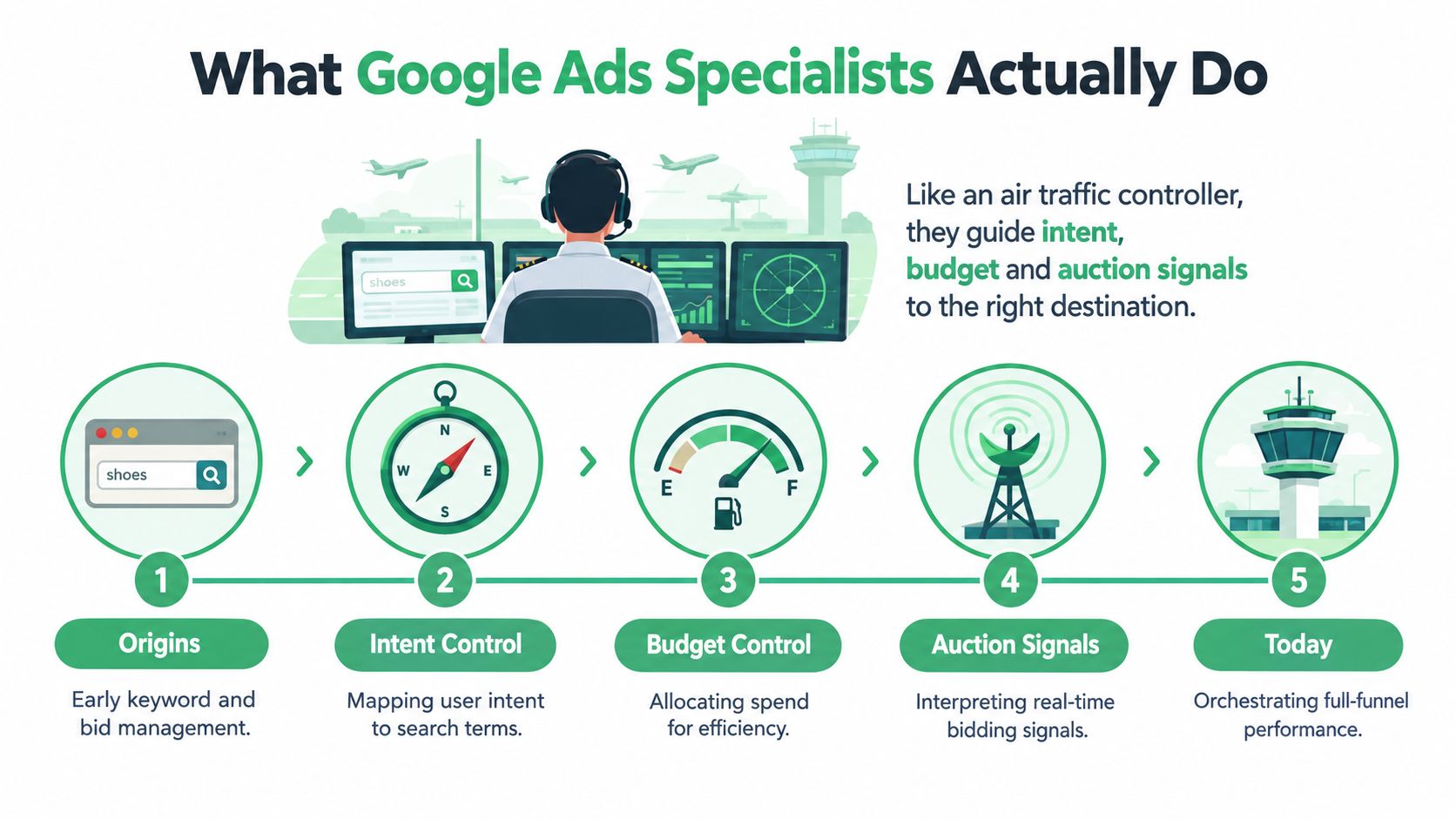
The simplest way to understand the role is this. A Google Ads specialist is an air traffic controller for intent, budget, and auction signals.
Searchers arrive with different levels of intent. Campaigns compete for limited budget. Google's auction processes relevance, bids, and context in real time. The specialist's job is to keep those movements organized so money flows toward the right searches and away from noise.
The role started with self serve search ads
Google's self serve search advertising system began in October 2000 as AdWords. Early accounts describe a launch with about 350 advertisers and CPM-based pricing before the platform evolved into the auction-based, cost-per-click model specialists work with today (Google Ads history and early launch context).
That history matters because it explains why the job exists at all.
Once advertisers could buy search ads directly, someone had to make choices about keywords, structure, budgets, and performance. A managed media buy became an operational discipline. As the platform scaled into a core performance channel, the specialist role became less about placing ads and more about managing search intent with accountability.
What the work looks like in practice
Most new hires picture the role too narrowly. They think specialists write ads, choose keywords, and adjust bids. That's part of it, but the work is closer to traffic control.
A specialist usually manages four moving parts at once:
- Intent mapping: They group keywords and queries by what the searcher is trying to do, not just by product category.
- Account structure: They decide how campaigns and ad groups should be separated so reporting stays useful and budget control stays clean.
- Auction management: They choose bidding approaches that fit the signal quality available in the account.
- Waste prevention: They monitor search terms, placement quality, and budget leaks, then close gaps with exclusions and structural changes.
One of the clearest examples is negative keyword control. If broad or phrase traffic starts pulling in research-heavy or irrelevant queries, the account can look active while performance weakens. That's why smart specialists spend real time on negative keyword management workflows, not just headline writing.
Good specialists don't just ask, “How do we get more clicks?” They ask, “Which clicks are training the account in the wrong direction?”
How the role differs from general marketing
General marketers often work from audience narratives, channel planning, and creative themes. Specialists work closer to the decision edge. They need to understand marketing strategy, but they're also responsible for turning it into precise operational logic.
That means they often make trade-offs like these:
| Decision area | What a specialist is balancing |
|---|---|
| Query coverage | Reach versus relevance |
| Budget allocation | Learning opportunity versus waste risk |
| Campaign structure | Simplicity versus diagnostic clarity |
| Automation use | Scale versus loss of control |
This is why good Google Ad specialists are hard to replace with templates or certifications alone. The interface can automate actions. It can't reliably decide which business question matters most today.
Core Skills KPIs and How Specialists Prove Value
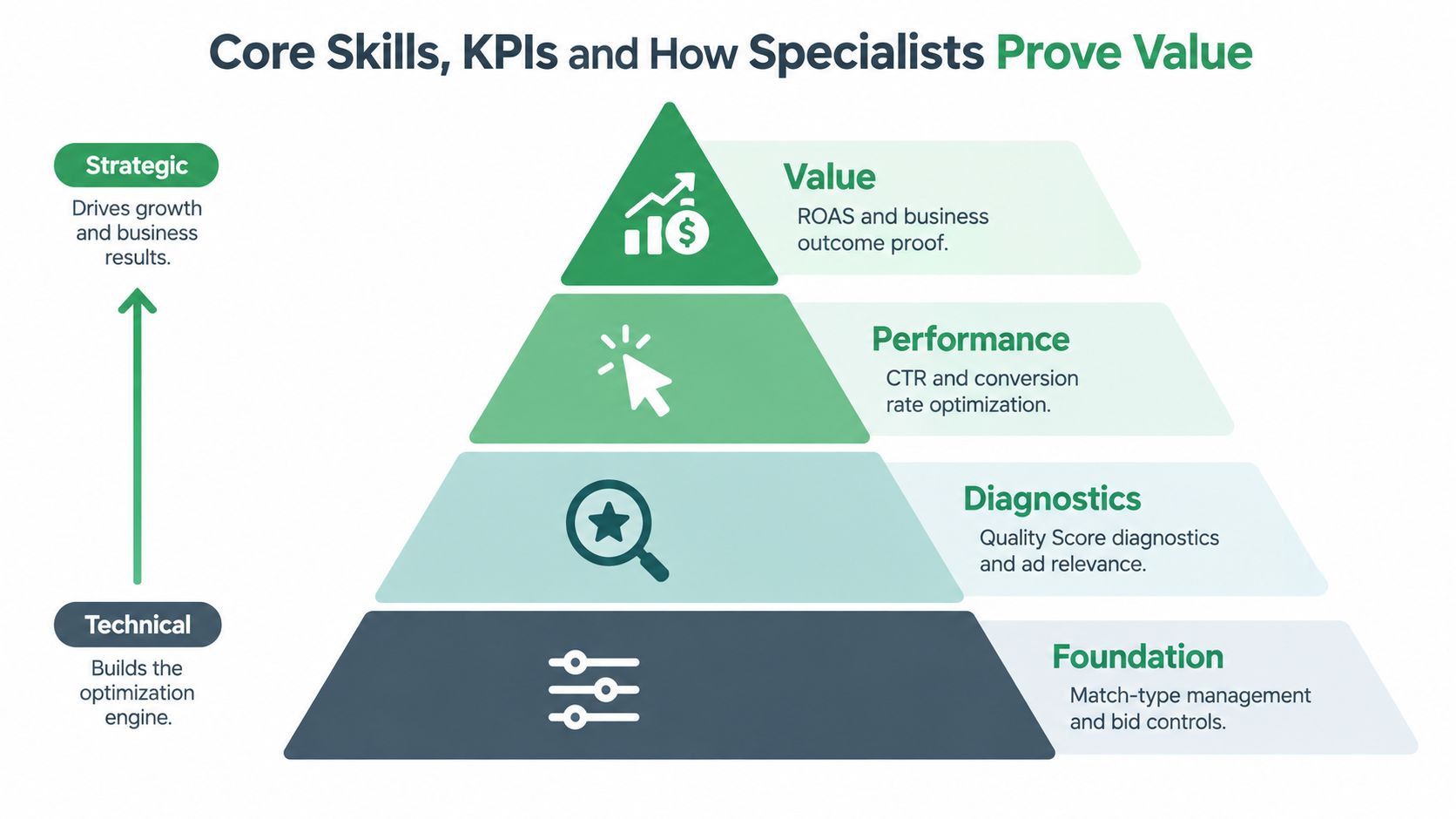
The cleanest way to evaluate a specialist is to separate diagnostics from outcomes.
Diagnostics help explain what's happening. Outcomes show whether the business is getting value. Confusing the two is one of the fastest ways to misjudge performance.
Match types are still one of the highest leverage skills
A lot of account performance comes down to how well someone manages the boundary between control and expansion.
Google's own guidance says that switching from phrase match to broad match with Target CPA can yield an average of 25% more conversions while meeting the cost target, and broad match with Target ROAS can produce 12% more conversion value while meeting the return target. But independent analysis across 30,000 accounts also showed the trade-off clearly. Exact match's spend share declined by 9.5 percentage points from 2022 to 2026, yet exact match still led on efficiency, with phrase match slightly ahead of broad match on conversion rate at 8.22% versus 8.18%, and exact match leading on CTR, conversion share, and ROAS for branded terms (keyword match type performance analysis and Google guidance).
That's why experienced specialists don't treat broad match as automatically bad or automatically smart. They pair it with automated bidding when the account has enough signal, then control drift through search term review and exclusions.
A fast account audit often starts here.
google ads audit workflows become useful when you need to see which campaigns are spending into weak intent, which search terms are expanding too far, and where structure is hiding waste.
Quality Score is a thermometer, not the treatment
New marketers often chase Quality Score like it's the main goal. It isn't.
Google defines Quality Score as a 1 to 10 estimate of ad performance versus other advertisers, based on expected CTR, ad relevance, and landing page experience. It's useful because it points to alignment problems, not because it guarantees profit. The same benchmark source notes average search CTR around 3% to 5%, top performers at 7% to 10%, strong search conversion rates around 3% to 5% overall, and 7% to 12% for lead generation (Google Ads benchmark ranges and Quality Score context).
A specialist uses that information the right way. If CTR is weak, they ask whether the ad promise is off. If conversion rate is weak, they check the landing page and offer. If Quality Score is mediocre but profit is strong, they don't panic.
What to watch instead: Look at where spend is exposed to weak intent, poor post-click experience, or low-value conversions. That's usually where specialist work creates the biggest return.
The KPIs that actually matter
When I train new hires, I tell them to sort metrics into three buckets.
Control metrics
Match types, negatives, bid strategy settings, segmentation choices.Diagnostic metrics
Quality Score, CTR, impression patterns, search term quality, landing page relevance.Business metrics
Conversion efficiency, lead quality, revenue contribution, and whether paid search is producing the kind of pipeline the company wants.
If a specialist can only talk about the first two buckets, they're still operating at the platform level. If they can connect those levers to business outcomes, they're doing the job.
Hiring Options Compared Freelancer Agency or Managed Service
Hiring help for Google Ads isn't one decision. It's three different models with different trade-offs.
The mistake many teams make is hiring based on résumé shape instead of operating need. If you need daily hands-on edits in one account, that's different from needing cross-channel oversight, executive reporting, and process discipline across multiple stakeholders.
Choosing by management style, not title
A freelancer usually gives you direct access to the person doing the work. That can be great when speed matters and the account is focused. An agency often gives you broader coverage, but sometimes with more layers between strategy and execution. A managed service can make sense when your team wants outcomes and visibility without building extra internal operating capacity.
Here's a practical comparison.
| Model | Best For | Control and Speed | Cost Structure |
|---|---|---|---|
| Freelancer | One account, clear goals, need for direct communication | High control, usually fast decisions | Typically project or retainer based |
| Agency | Multiple campaigns, channel breadth, stakeholder reporting | Moderate control, speed depends on process | Retainer or management fee |
| Managed service | Teams that want execution plus systemized oversight | High visibility if workflows are clear, speed depends on approval process | Ongoing service fee |
What justifies fees when Google automates more
This is the question buyers should ask directly.
Google's 2025 recap highlighted a wave of AI innovations in Google Ads, and industry commentary has noted that conversational AI and in-platform campaign creation are pushing less experienced advertisers closer to baseline competence (Google Ads 2025 AI recap). So what still separates a paid specialist from an attentive generalist?
Usually, it comes down to four things:
- Diagnosis under uncertainty: They can identify whether the problem is targeting, offer, tracking, landing page fit, or lead quality.
- Cross-account pattern recognition: They spot recurring failure modes faster because they've seen them before.
- Change control: They don't just make edits. They make reversible, prioritized edits.
- Communication: They explain trade-offs in a way a founder, sales lead, or CMO can act on.
For agencies managing multiple client workflows, operational tooling matters too. If your team is comparing support models, resources like Hooked for agencies can help you think through how service delivery, coordination, and client accountability should work beyond the ad platform itself.
You should also compare provider types in context, not in isolation. A side-by-side review of Google Ads agencies and alternatives is useful when you're deciding whether you need tactical execution, strategic review, or a more controlled operating layer.
How to Evaluate and Hire the Right Specialist
A good hiring process doesn't ask, “Do they know Google Ads?” It asks, “How do they think when the account gets ambiguous?”
That's the difference between someone who can run tasks and someone who can protect budget when performance gets messy.
Questions that reveal real skill
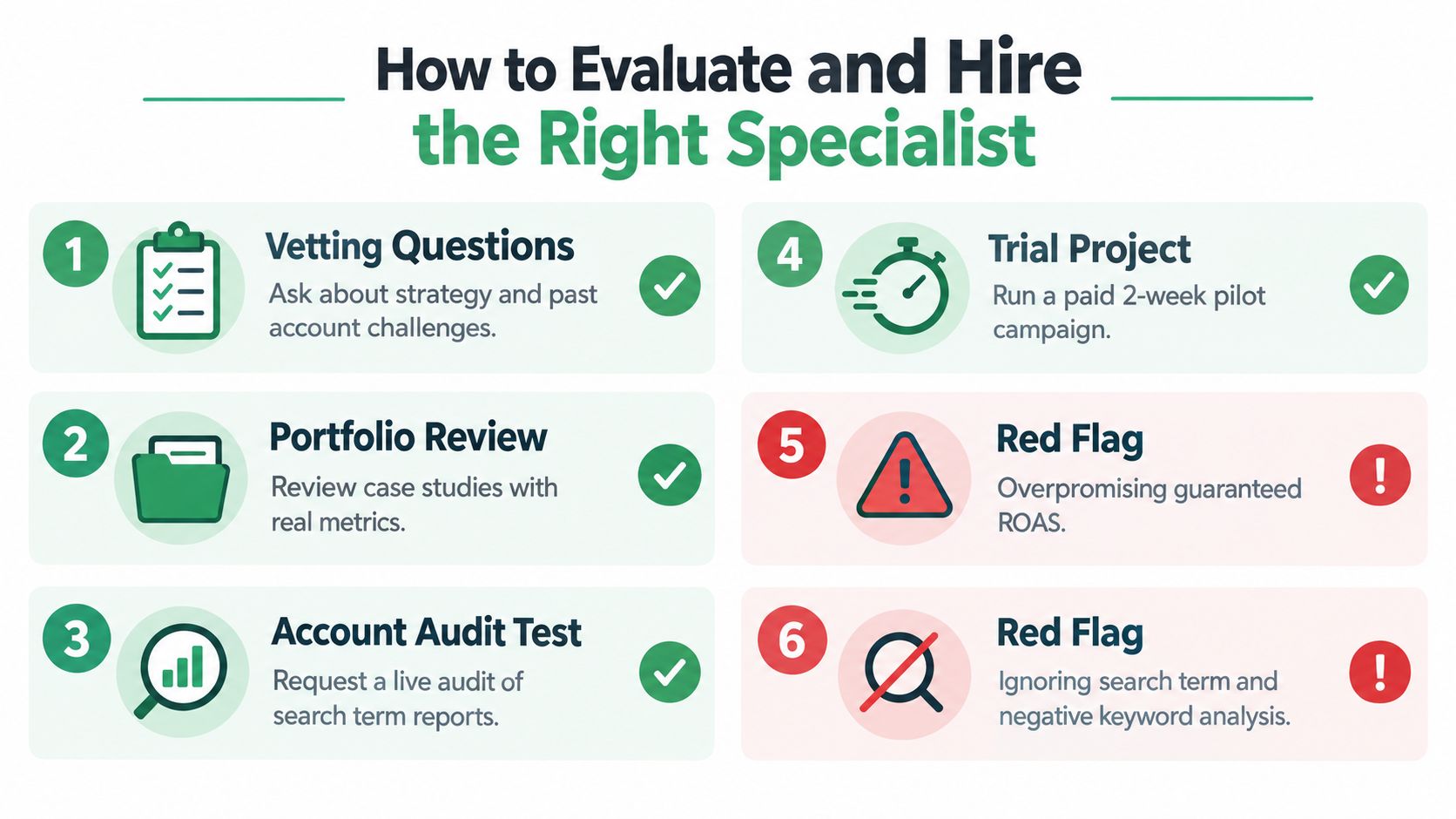
Start with scenarios, not theory. Ask what they'd check first if lead volume stayed flat but sales quality dropped. Ask how they decide whether broad match expansion is healthy. Ask what signals would make them reverse an automated recommendation.
The best answers usually include search terms, conversion quality, landing page alignment, and reporting gaps. Weak answers jump straight to bid changes.
Use a checklist like this:
- Ask for diagnosis order: What do they inspect first, second, and third when performance slips?
- Probe for control methods: How do they review search terms, negatives, and match type drift?
- Test reporting maturity: What would they show weekly versus monthly?
- Check reversibility: How do they document changes so bad edits can be rolled back?
A specialist who can't explain why a change should be reversible usually hasn't managed enough real budget.
Use a paid trial, not a trust fall
You learn more from a small live project than from polished credentials.
Give the candidate limited access, a clear objective, and a short time box. Ask for an audit, a prioritized action list, and a rationale for each recommendation. You're not just grading ideas. You're grading sequencing.
A helpful outside perspective on this relationship-building side of hiring is this guide to building a PPC partnership at Come Together Media LLC. It's useful because it pushes the conversation beyond credentials and toward working style.
Red flags worth taking seriously
Some warning signs show up fast:
- Guaranteed outcome language: Anyone promising guaranteed ROAS is ignoring the parts of performance they can't fully control.
- No search term depth: If they barely mention query review, they may not be close enough to intent quality.
- Platform-only thinking: If they never ask about CRM feedback, they may optimize for conversions that sales teams don't value.
- Opaque process: If they can't explain what changed, when, and why, you'll struggle to trust the work later.
The right hire doesn't need to sound flashy. They need to sound methodical.
How Specialists Fit Into Your Paid Media Stack
The specialist who only lives inside Google Ads is becoming less useful.
Recent industry commentary has argued that as Google automates more, specialists will spend less time in the interface and more time using scripts and external tools to keep visibility and control (PPC workflow shift toward external tools and automation oversight). That matches what strong teams already do. They diagnose across systems, not just inside one dashboard.
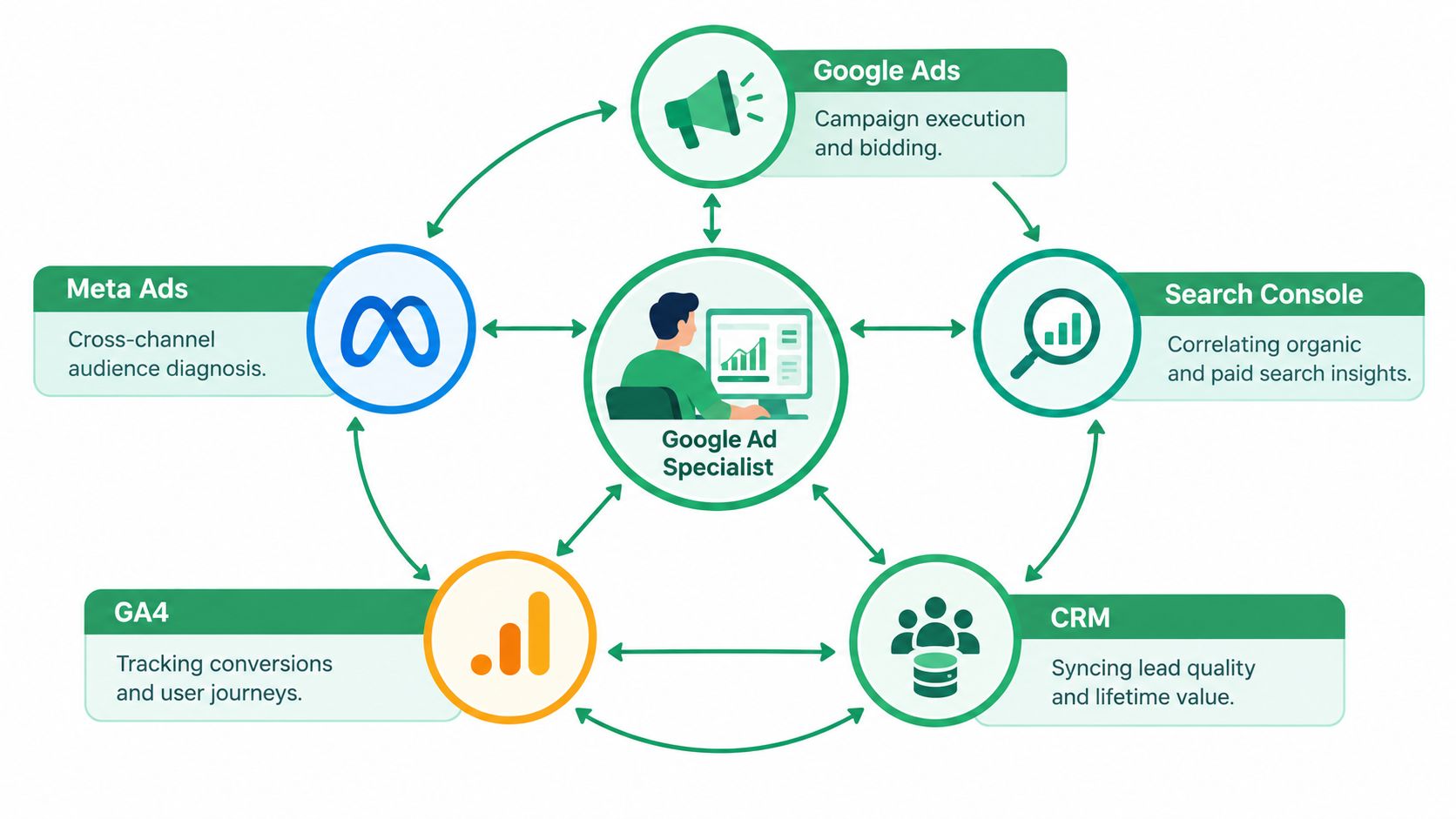
The stack matters because the answer rarely lives in one platform
A search campaign can look healthy in Google Ads while failing in the CRM. GA4 can show drop-off patterns that explain a weak conversion rate. Search Console can surface organic queries that suggest stronger paid segmentation. Meta Ads can reveal audience fatigue or message mismatch that changes how you interpret branded search demand.
That's why modern specialists often work across:
- Google Ads for spend, queries, match types, and bidding behavior
- GA4 for post-click paths and conversion patterns
- Google Search Console for query language and organic demand clues
- CRM systems for lead quality and downstream revenue reality
- Meta Ads for cross-channel audience diagnosis and creative context
What modern operating workflows look like
The valuable workflow isn't “log in and optimize.” It's closer to this:
- Pull live account data.
- Rank issues by spend at risk.
- Draft the smallest set of changes most likely to improve control.
- Review diffs before publishing.
- Keep logs so every change is attributable and reversible.
That process matters because teams don't just need recommendations. They need confidence. If an edit can't be reviewed clearly or undone quickly, operators become hesitant, and account quality drifts while everyone waits.
One option in this category is NotFair, which provides hosted MCP connections for Google Ads, Meta Ads, GA4, Search Console, and CRM systems, with read access for diagnosis and approval-gated write tools that show diffs, log changes, and support one-call undo. In practice, that means a specialist can investigate issues from chat, prioritize fixes by spend at risk, and move into controlled execution without adding another dashboard to the workflow.
The specialist's value now often comes from connecting systems fast enough to catch waste before the monthly report explains it too late.
Why this changes hiring expectations
Once you see the role this way, the hiring bar changes.
You're no longer just hiring someone to “run Google Ads.” You're hiring someone to trace cause and effect across media, analytics, and sales data. That's a different skill set. It favors people who are calm with ambiguity, skeptical of surface-level platform metrics, and disciplined about approved changes.
Making the Right Choice for Your Growth Goals
If your account is simple, your tracking is clean, and your team has time to review search terms and landing page alignment consistently, you may not need a specialized operator full time. You may need occasional expert review.
If performance is harder to explain, though, that's usually the signal. Rising lead costs, mixed query quality, unclear reporting, and disagreement between platform conversions and sales outcomes are all signs that specialist work can pay for itself through better decisions, not just more activity.
The practical rule is straightforward:
- Hire a freelancer when you need focused hands-on help in a contained setup.
- Hire an agency when your organization needs broader coverage and stakeholder management.
- Use a managed model when you want strategic diagnosis, controlled execution, and visibility without building more internal headcount.
The automation era didn't make Google Ad specialists irrelevant. It changed what relevant looks like.
The best ones don't sell button pushing. They reduce uncertainty, protect budget, and make paid search easier to trust.
If you want that kind of operating layer, NotFair gives teams a way to inspect live Google Ads, Meta Ads, analytics, and CRM data from AI tools, then move into approval-gated changes with diffs, logs, and undo built in. It's a practical fit for marketers who need specialists to diagnose faster, prioritize spend at risk, and keep campaign changes controlled.