

Click-through advertising is the model where advertisers pay when users click their ads, and its key metric is CTR, clicks divided by impressions. In Google Search, CTR also works as an auction-time quality signal alongside bid, relevance, and landing-page experience.
The counterintuitive part is that a higher CTR can signal better message alignment, or more invalid traffic, weaker intent, or an optimization system learning from contaminated data. A click is only the first observable action in a customer journey. The important work starts when you determine whether that click was valid, engaged, and commercially useful.
Table of Contents
- Where Click-Through Advertising Began
- What Click-Through Rate Actually Measures Today
- How CTR Works as an Auction-Quality Signal
- Why High CTR Can Be a Misleading Target
- Connecting Clicks to Conversions and Customer Journeys
- When to Optimize for Clicks and When to Pivot
- Building Click-Through Strategies Around Live Diagnostics
Where Click-Through Advertising Began
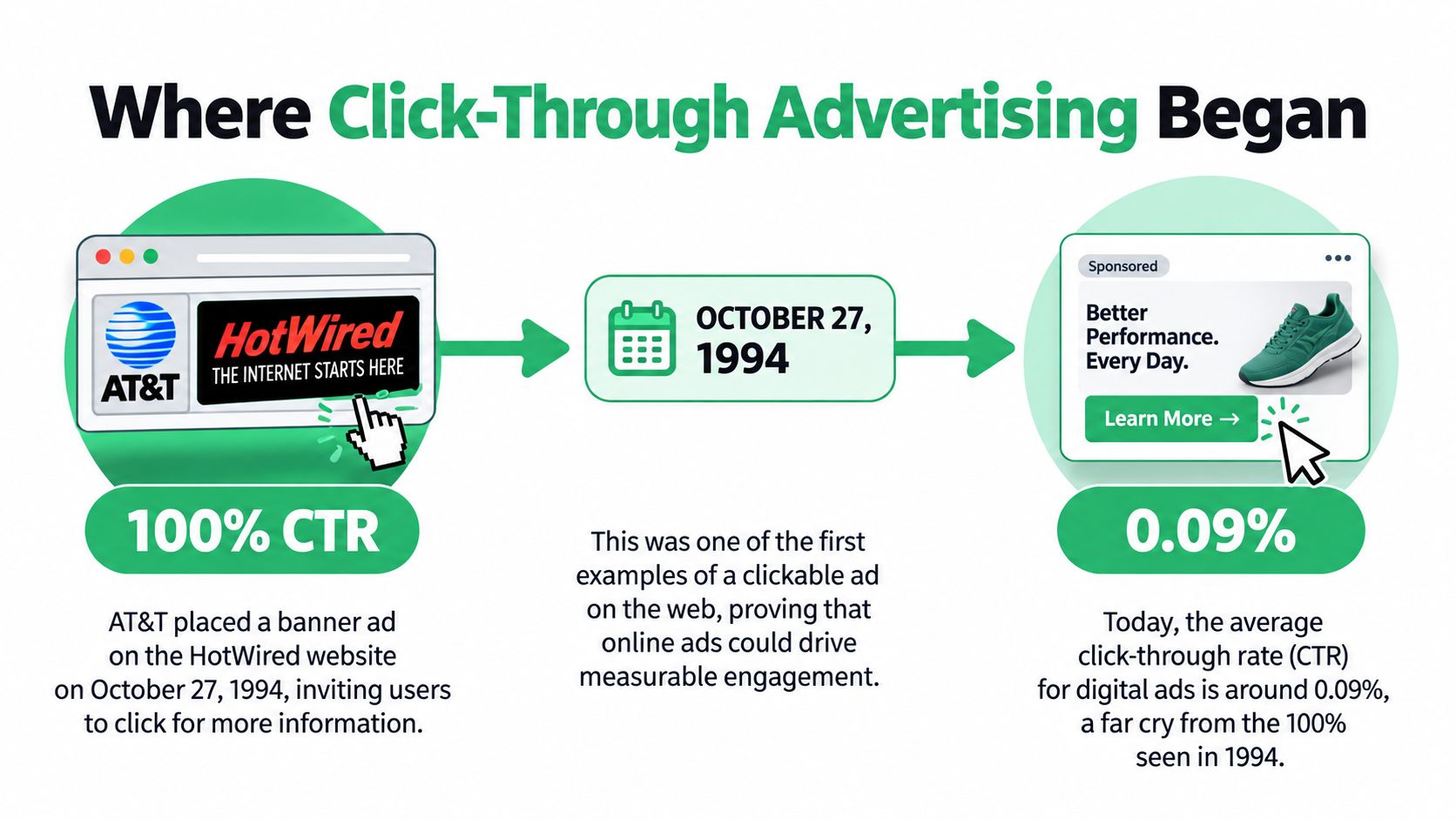
Click-through advertising began with a response rate that modern display campaigns rarely approach. On October 27, 1994, AT&T bought space on HotWired, the online publication associated with Wired magazine, for what became the first widely recognized web banner advertisement. Its creative promoted the company's “You Will” campaign and invited visitors to explore an online tour of seven major art museums. The reported click-through rate was 44%, or about 44 clicks for every 100 impressions, according to The Atlantic's account of the first web banner.
That result reflected the conditions of the early web, not a benchmark for modern display performance. Commercial messages, websites, and competing demands for attention were limited. AT&T also made the interaction itself the message, asking whether visitors had ever clicked their mouse “right here” and answering, “You will.”
The first measurable interaction
The banner's lasting contribution was measurement. Digital advertising could be assessed through an observable user action rather than estimated audience size. An impression could produce a click, and that click could send the visitor to a destination selected by the advertiser.
The museum tour also demonstrated the product. AT&T connected its brand with the internet's ability to link people to distant information, instead of placing a logo beside promotional copy.
The model soon spread beyond one banner. The Interactive Advertising Bureau's Internet Advertising Revenue Report began in 1996, establishing a recurring benchmark for digital advertising revenue across formats, as shown in the IAB and PwC Internet Advertising Revenue Report. Click-through advertising became part of a measurement-led industry concerned with impressions, clicks, costs, conversions, and revenue.
The practical lesson still matters: a click is evidence of response, not proof of business value. It begins the investigation into traffic quality, intent, fraud, and what happens after the visitor arrives. Display, search, social, and retargeting teams still rely on that first signal, while CRM records and downstream behavior reveal whether it was commercially useful. For a practical view of repeat exposure in ecommerce, this guide to retargeting for e-commerce provides relevant context.
What Click-Through Rate Actually Measures Today
CTR measures response frequency, not business value. Divide clicks by impressions to see how often an ad produced an interaction after appearing. That makes CTR useful for assessing creative, targeting, placement, and message relevance. It does not show whether those visitors bought, qualified, or generated profitable revenue.
Consider two hypothetical campaigns. One receives 500 clicks from 100,000 impressions, producing a 0.5% CTR. Another receives 100 clicks from 10,000 impressions, producing a 1% CTR. The second campaign earns the stronger response rate, while the first delivers more total visits. The figures illustrate why CTR needs both a rate and a volume view.
Why raw click volume misleads
A high-volume campaign can appear productive while attracting broad-query traffic, low-value placements, accidental mobile interactions, or visitors with no realistic path to purchase. A smaller campaign may produce fewer clicks yet reach an audience with stronger commercial intent. Rising CTR is a starting signal for investigation, not a finish line.
Review CTR with:
- Impressions: How often did the platform create an opportunity to respond?
- Clicks: How often did users interact with the ad?
- Cost per click: What did each interaction cost?
- Conversion rate: How often did the visit produce the defined action?
- CPA or ROAS: Did the action justify the media cost?
- Impression share and position: Did limited visibility restrict delivery or response?
A practical guide to click-through rate for PPC teams helps standardize the basic calculation across accounts. Interpretation requires more context: query intent, device, geography, placement, fraud indicators, and post-click behavior. CRM outcomes add another layer by showing whether clicks became qualified opportunities, customers, or low-value contacts.
AI-generated search results can also reduce available impressions and change which clicks deserve attention. Compare performance across search, social, display, and retargeting rather than treating one platform's CTR as a universal benchmark. A click may signal interest, accidental interaction, or incentivized behavior. Its value emerges only after the visit is connected to downstream actions.
Google Search adds an auction dimension. Expected CTR contributes to the system's quality assessment alongside bid, relevance, landing-page experience, device, location, query context, time, and competing ads. CTR can therefore affect competitive efficiency, while remaining a leading indicator rather than proof of profitability.
How CTR Works as an Auction-Quality Signal
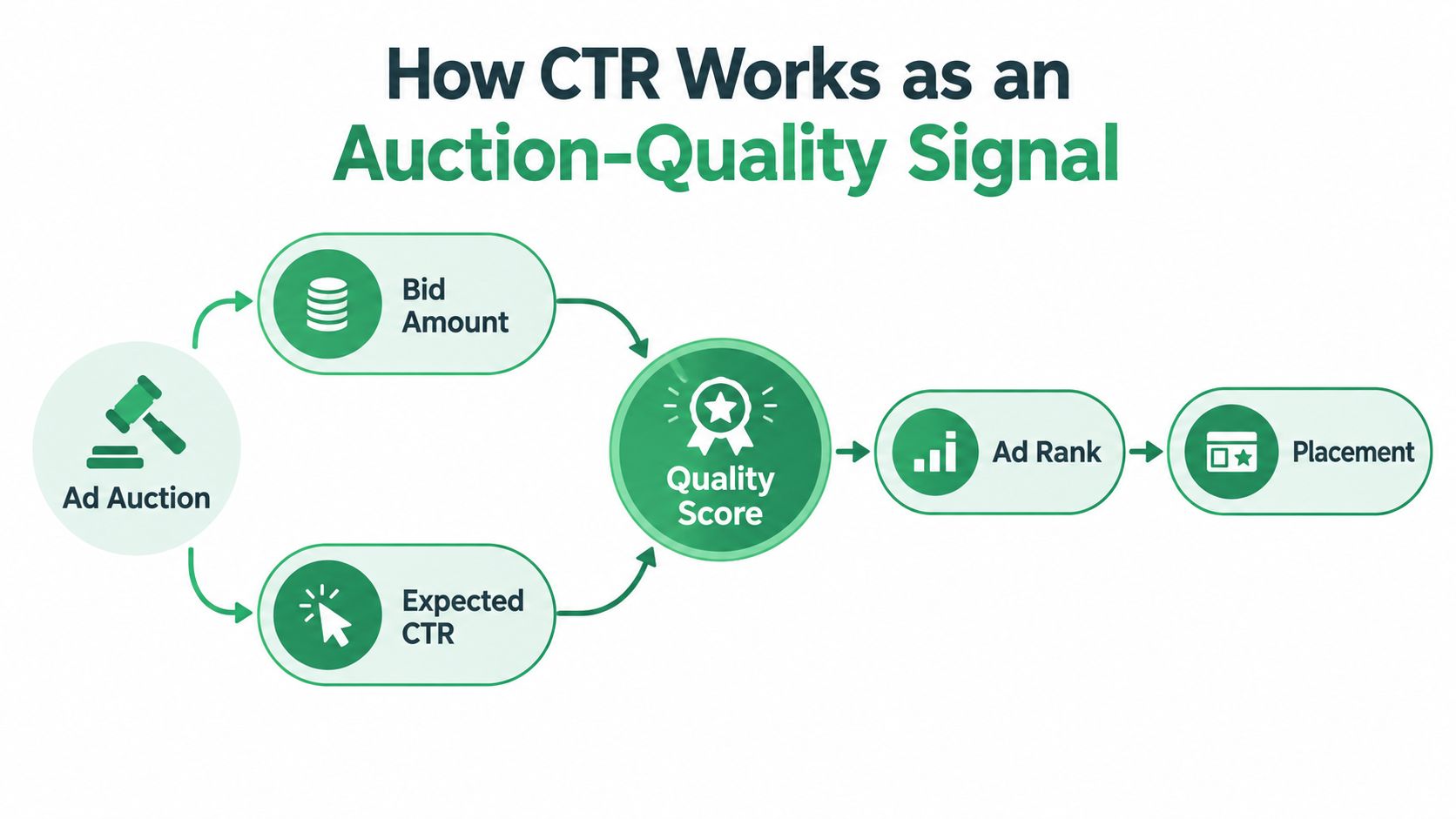
A high bid does not guarantee the best ad position. In Google Search, the auction weighs bid, expected click likelihood, relevance, landing-page experience, device, location, query context, time, and competing ads. These factors shape Ad Rank, which influences whether an ad appears and where it is placed, as explained in Google's explanation of ad position and Ad Rank.
CTR matters because expected click-through performance forms part of Google's quality assessment. A relevant ad can compete efficiently without paying more, provided the query, message, and destination support the same user need. That efficiency has limits: a stronger auction signal does not prove that the resulting traffic will convert.
Three campaign objectives create different trade-offs:
| Objective | What it prioritizes | Main risk |
|---|---|---|
| Click-focused | More responses from available impressions | Low-intent traffic can inflate spend |
| Conversion-focused | Qualified actions at an acceptable CPA | Narrow targeting can limit learning and reach |
| Awareness-focused | Reach and message exposure | CTR may understate influence before demand exists |
A specific commercial message usually gives users a clearer reason to click than a generic headline aimed at every possible search. Align the search query, ad copy, and landing page, then check whether the resulting visits engage and progress. AI-generated search results can also reduce available impressions, so a lower click count may reflect changing visibility rather than weaker relevance.
Account averages hide the useful detail. Segment performance by search term and keyword, device, geography, position and placement, intent, and asset. Compare research, comparison, brand, and purchase-oriented queries. Review whether mobile visitors, particular locations, or specific headlines produce qualified activity after the click.
The visible Quality Score from 1 to 10 is a diagnostic summary, not the literal real-time auction formula. Use it to locate possible weaknesses, then inspect the query-to-ad-to-landing-page path and the resulting economics.
Teams working in Google Ads can consult NotFair's Google Ads platform documentation when connecting campaign data to diagnostic workflows. Raise bids or broaden targeting only when the added clicks improve qualified traffic. If CTR rises while conversion rate falls and CPA worsens, auction efficiency has improved while business performance has deteriorated.
Why High CTR Can Be a Misleading Target
A high CTR can conceal traffic that weakens the campaign. Invalid activity, including fraudulent or non-human interactions, may inflate click counts, distort reporting, mislead automated optimization, and affect billing. Human Security's guide to click fraud in digital advertising explains how this problem appears in digital advertising.
Its measured web advertising data found an average invalid-traffic rate of 5.1% across measured web advertising in 2024, with some networks reaching 46.9%. The research also found that valid clicks converted at approximately 2.54%, compared with 1.29% for invalid clicks. These figures show why a platform can report more interactions while the campaign produces less commercial value.
CTR should therefore sit beside traffic-quality checks, not above them. Before increasing budget, compare the click signal with:
- Reported clicks, the platform's recorded interactions.
- Valid clicks, after suspicious activity is filtered.
- Engaged sessions, where visitors meaningfully use the site.
- Qualified leads, which meet sales or business criteria.
- Closed-won revenue, the outcome that determines commercial value.
The gap between these stages exposes bad traffic. A placement may generate repeated clicks from one device or location, yet produce few engaged sessions, form completions, qualified leads, or sales. Similar patterns can arise from poorly matched audiences, accidental clicks, or ad promises that attract curiosity instead of buying intent.
Use live campaign data alongside analytics and CRM records to separate a genuine response from a reporting artifact. Review clusters by placement, device, geography, time, and campaign. AI-driven bidding can process the available interaction signals quickly, but it cannot correct a conversion signal that rewards low-quality traffic.
Practical rule: Do not give CTR more budget until the added clicks produce trustworthy downstream signals.
The response may involve stronger copy, placement exclusions, audience refinement, traffic-quality investigation, or a revised conversion event. Higher CTR earns attention only when the extra visitors remain relevant, measurable, and capable of progressing toward revenue.
Connecting Clicks to Conversions and Customer Journeys
A click is only useful when it advances the customer journey. Trace the path from query alignment to ad response, landing-page experience, engagement, conversion, and qualified revenue. A broad promise can lift clicks while creating weak intent. A lower CTR can produce stronger commercial results when visitors understand the offer and act on it.

Start diagnosis where the decision is made: the search term, ad, landing page, placement, or audience segment. Connect those records with analytics and CRM outcomes through Google Analytics documentation for measurement workflows, then examine the journey rather than relying on an account average.
The landing page should carry the ad's promise forward. Check whether visitors can find the next action, engage with the content, and submit information that sales teams can use. Also measure assisted conversions and later CRM stages, because a click may influence a purchase without receiving final-touch credit.
A useful review asks:
- Message continuity: Does the page match the offer and intent expressed in the ad?
- Navigation clarity: Can visitors reach the next action without searching?
- Engagement depth: Do users interact with the page or leave immediately?
- Conversion quality: Do submitted leads fit the audience the business can serve?
- Revenue timing: Does measurement include later CRM progression, not only immediate actions?
Google's auction documentation emphasizes the role of ad and landing-page usefulness in ad quality and eligibility. That means a campaign can attract clicks while losing efficiency after the click. Improving the destination may create more value than rewriting the headline.
Review platform performance beside analytics behavior and CRM progression across channels. A placement with many clicks but no qualified pipeline deserves scrutiny. A source with fewer visits but consistent sales acceptance may deserve protection from broad cuts.
CTR measures the initial response. Analytics measures subsequent behavior. CRM records show whether the journey created business value. Read all three together before treating higher click volume as progress.
When to Optimize for Clicks and When to Pivot
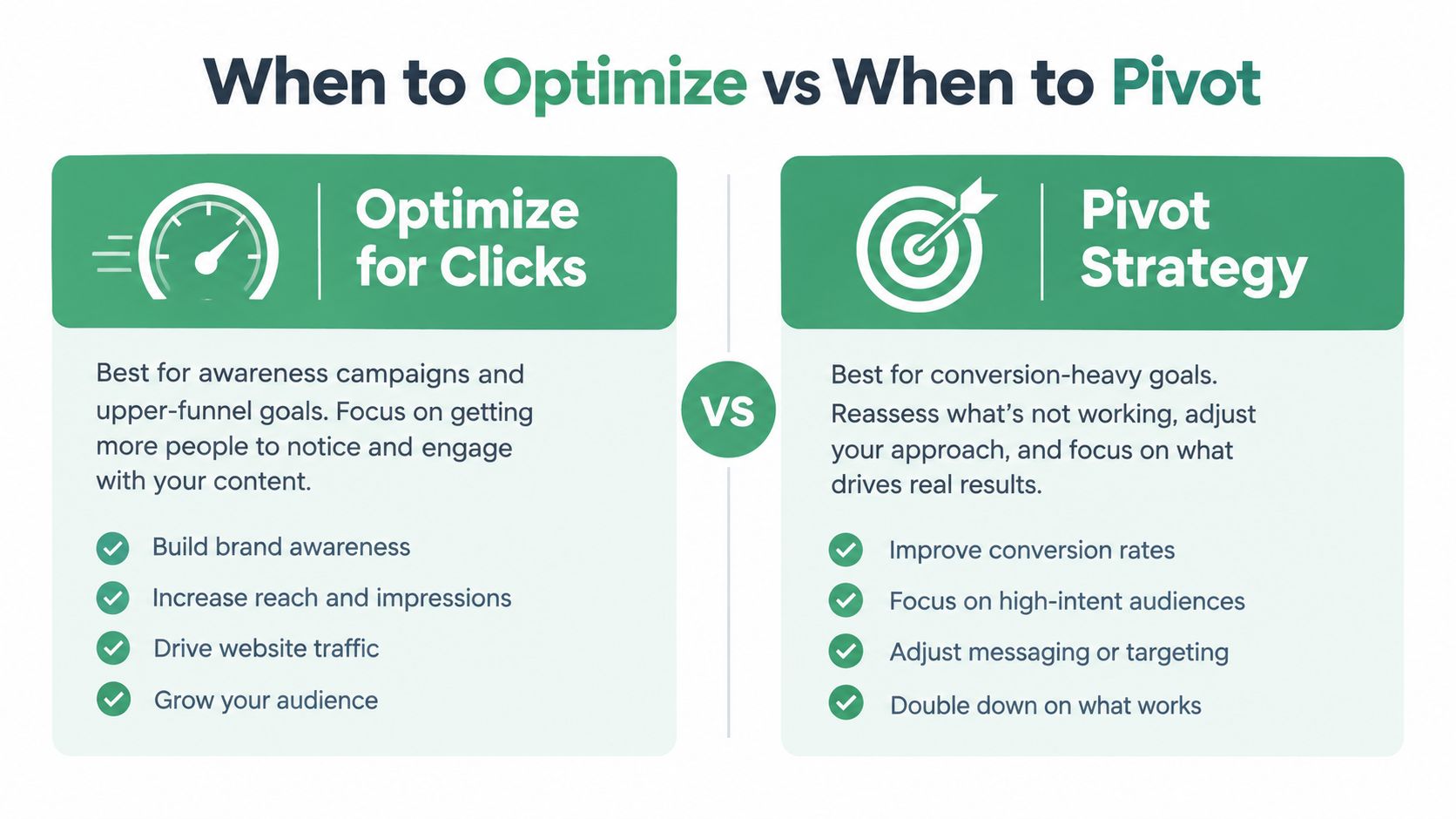
Optimize for clicks when the campaign needs a response signal and the traffic quality is already credible. This can make sense during creative testing, early audience exploration, or awareness work where the immediate objective is to learn which messages attract relevant attention.
Pivot when the campaign has enough evidence that clicks aren't the constraint. If landing-page engagement is weak, improve the destination. If leads don't qualify, refine targeting and message. If suspicious clusters dominate delivery, investigate traffic quality before asking automation to find more of the same behavior.
Use a decision sequence
Start with the objective. If success means reach or message response, CTR can be a useful primary signal. If success means qualified pipeline, revenue, or efficient acquisition, treat CTR as supporting evidence.
Check the post-click path. Compare engagement, form behavior, conversion rate, and sales acceptance. A low CTR with strong conversion quality may call for more relevant reach, not a complete strategy change.
Audit the query and placement mix. Add exclusions and refine targeting when unrelated searches or weak inventory create cheap interactions. NotFair's Google Ads negative keyword documentation is relevant to this type of search-term cleanup.
Test for traffic contamination. Examine repeated activity, unusual clusters, and the relationship between reported clicks and qualified outcomes. Don't increase spend just because a platform metric improved.
AI-generated search experiences add another complication. Seer Interactive reported year-over-year declines of 46% in organic CTR and 20% in paid CTR, regardless of whether AI Overviews appeared, in its fall 2025 study, as reported by Seer's cited search CTR research. Microsoft separately reported that users interacting with Copilot produced a 9% higher CTR for Responsive Search Ads than users who did not interact with Copilot, as described in Microsoft's analysis of human and AI discovery.
Those findings can coexist. Conversational environments may produce stronger clicks from certain high-intent users while answering more questions without sending anyone to a site. Measure AI-exposed and non-AI journeys separately, then inspect assisted conversions, delayed conversions, branded demand, and qualified visits before declaring a lower CTR a failure.
Building Click-Through Strategies Around Live Diagnostics
A reliable click-through advertising process connects four views in the same investigation:
- Ad platforms: Spend, search terms, delivery, CTR, bids, and placements.
- Analytics: Sessions, engagement, landing-page behavior, and conversions.
- Search data: Query patterns, organic CTR, and overlapping demand.
- CRM records: Lead quality, pipeline stages, and closed-won outcomes.
The point isn't to collect more dashboards. It's to identify which explanation best fits the live evidence. A CTR decline may come from weaker creative, changed query mix, reduced visibility, AI answers, or better filtering of invalid activity. A CTR increase may reflect stronger relevance, broader targeting, accidental clicks, or fraudulent traffic.
Turn diagnosis into controlled action
A practical operating loop looks like this:
- Read the current account state instead of relying on a stale export.
- Rank findings by spend at risk, not by the most visible metric.
- Trace each finding to query, asset, placement, device, and landing page.
- Compare the platform signal with analytics and CRM outcomes.
- Draft the smallest useful change, such as a negative keyword, budget adjustment, asset revision, or placement exclusion.
- Review an explicit diff before approval.
- Log the change and keep a reversible path available.
- Recheck the downstream result, not just the next CTR report.
NotFair is one option for this workflow. It provides hosted MCP servers that connect AI clients with advertising, analytics, search, and CRM platforms, with live reads, approval-gated writes, explicit diffs, logged history, and one-call undo. That operating model is useful when teams want AI assistance without allowing an agent to make opaque, irreversible campaign edits.
The same discipline applies without an MCP layer. Use platform reports, analytics events, CRM stages, fraud reviews, and change logs if those are the tools your team already trusts. The safeguard matters more than the interface.
For teams reviewing why campaigns lose efficiency, FOMOchat's perspective on rescuing ad ROI offers a complementary reminder: investigate the failure mechanism before applying another optimization.
Click-through advertising works best as a diagnostic loop. Measure message resonance, validate traffic quality, connect visits to qualified outcomes, and make controlled changes. A click can open the customer journey, but only live evidence tells you whether that journey deserves more budget.
NotFair connects AI agents with advertising, analytics, search, and CRM data so you can diagnose CTR, traffic quality, and conversion problems in one workflow. Visit NotFair to review live campaign data, prepare approval-gated changes, and keep every optimization auditable and reversible.