

The most popular advice on campaign budget vs ad set budget is to pick campaign budget, let the platform find cheap results, and stop micromanaging. That's sound advice only if your goal is the lowest cost per result this week. If you're trying to learn which audience, region or creative actually works, that same setting can destroy the comparison before you collect enough data. The budget level isn't a preference. It's a choice about who controls exposure, and therefore what your results can prove.
Table of Contents
- Campaign Budget vs Ad Set Budget at a Glance
- How Each Budget Level Allocates Spend
- Meta and Google Budget Levels Compared
- Delivery Rules and Test Validity
- Finance, Pacing and Client Approvals
- Choosing the Budget Level and Launch Checks
Campaign Budget vs Ad Set Budget at a Glance
Campaign budget lets the platform move money between ad sets, while ad set budget holds money fixed per ad set.
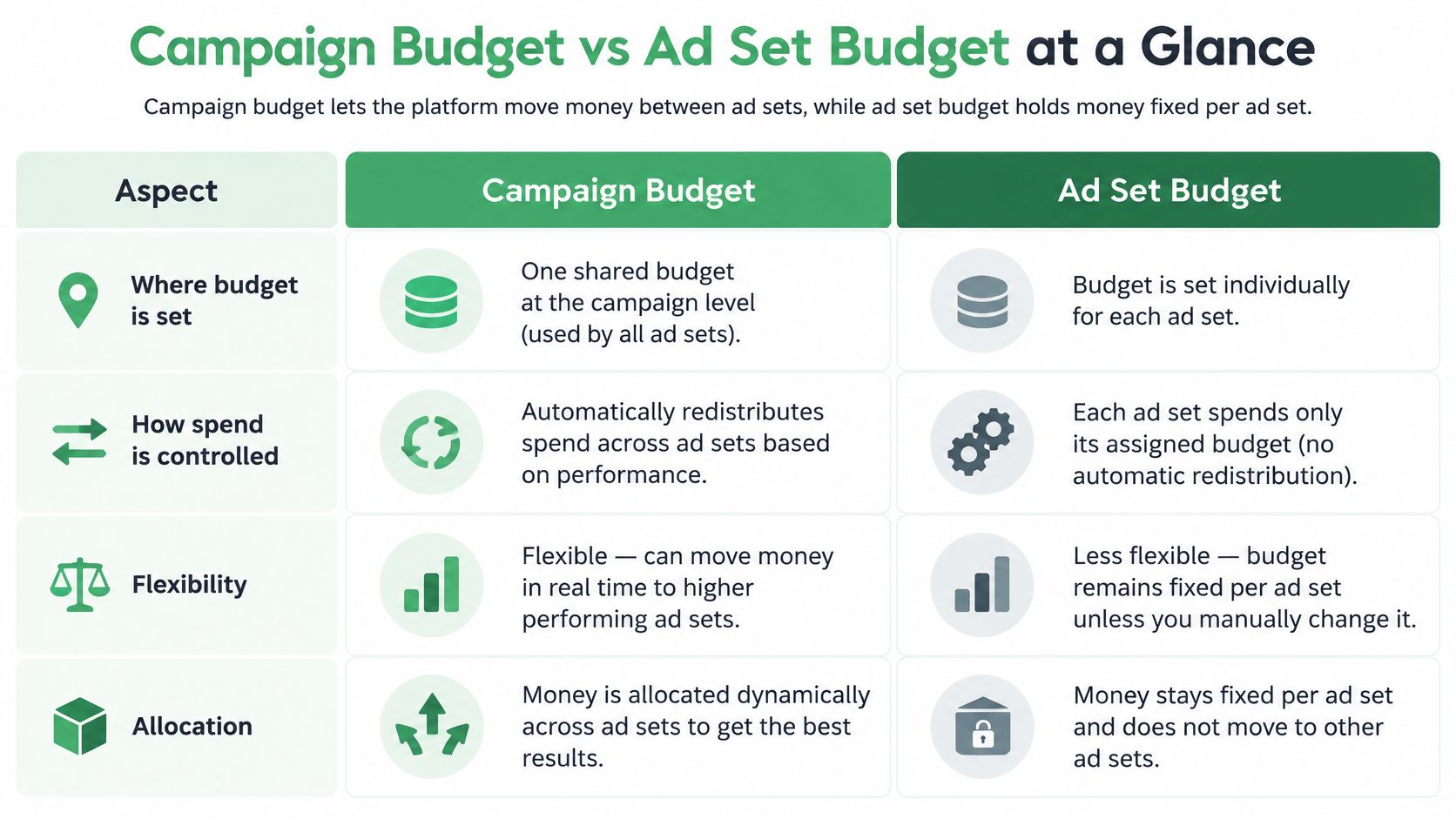
| Factor | Campaign budget | Ad set budget |
|---|---|---|
| Where the budget is set | One budget for the whole campaign | A separate budget for each ad set |
| Who decides allocation | The platform, in real time | The advertiser, with limited sharing between ad sets |
| Meta name | Advantage+ campaign budget (formerly Campaign Budget Optimization) | Ad set budget |
| Control over per-audience spend | Low: minimum ad set spend is a target, not a guarantee | High: spend stays where you set it |
| Setup burden | Fewer budgets to manage | More budgets to monitor and rebalance |
| Learning and volume | Concentrates spend in the strongest ad sets | Each ad set must reach enough events on its own |
| Best fit | Efficiency-focused prospecting with one shared goal and compatible bid strategies | Testing, audience quotas, mixed optimization goals, very different audience sizes |
| Main risk | Weaker segments can be starved, which can distort comparisons | The platform cannot move money toward the best opportunity |
On Google Ads, budgets sit at campaign level as daily or shared budgets and ad groups carry no budget of their own, so the ad-group version of this question applies mainly to Meta. Default to campaign budget when ad sets share one goal and compatible bidding, and switch to ad set budget when you must guarantee or measure separate segments.
How Each Budget Level Allocates Spend
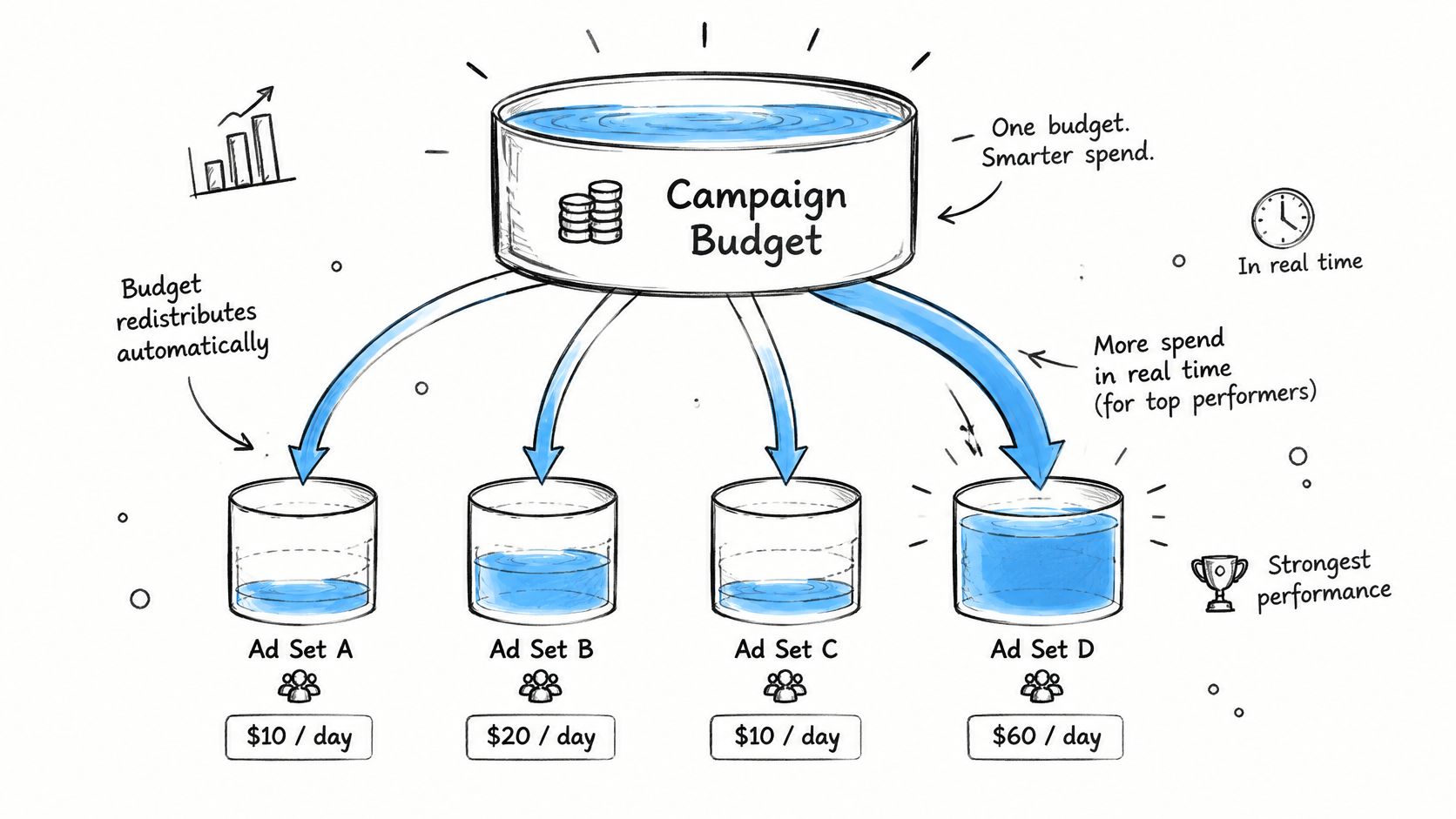
The diagram below shows the core mechanic: one pooled amount, redistributed as delivery finds stronger opportunities.
Campaign Budget as the Allocation Unit
A campaign budget sets one overarching budget at campaign level. The system continuously distributes spending in real time among the campaign's ad sets according to the best available opportunities, which reduces the number of individual budgets you manage. The Google Ads budget documentation describes this same trade-off between automated allocation and manual control that underpins Meta's setup. You're telling the platform you're flexible about where money goes, provided total results improve at lower cost.
An ad set budget assigns a separate amount to each ad set. That gives you direct control over delivery inside a specific audience or strategy. Meta identifies ad set budgets as especially useful when ad sets have mixed optimization goals or bid strategies, or when audience sizes differ substantially.
What a $300 Day Shows
Say a retailer runs three ad sets, broad, lookalike and retargeting, on $300 a day. Under ad set budgets, each holds $100 until you intervene. Under campaign budget, retargeting could take most of the $300 if it produces cheaper short-term results, while broad receives a token amount that tells you almost nothing about its potential.
This example walkthrough shows how quickly allocation can concentrate once the platform favors one ad set.
Attribution adds another layer, which is why it's worth reading how Exerta attributes AI-assisted purchases before you credit a cheap ad set with revenue it may only have assisted. For controlled changes, a workflow built around Meta Ads budget shifts lets you preview the allocation you're about to approve rather than discovering it after spend moves.
Practical rule: Campaign budget treats the campaign as the primary allocation unit, so stronger opportunities can receive more than an even share. Ad set budgeting preserves deliberate floors and ceilings, but it can prevent the platform from shifting money toward the best opportunity.
Meta and Google Budget Levels Compared
This choice is native to Meta, where one campaign pools spend across its ad sets. Google Ads works differently. Budgets live at campaign level, ad groups have none, and pooling happens across campaigns through a shared budget.
How Google Shared Budgets Pool Spend
A shared budget is one average daily budget distributed across multiple campaigns, allowing Google to reallocate money from an underutilized campaign to another campaign that is constrained by budget. In the example in Google's shared budget documentation, a $100-per-day total is split between two campaigns, and if one campaign spends only $40, the remaining $10 of its nominal $50 share can be redirected to the second campaign, subject to delivery and performance logic.
Google also reports that customers adopting Shared Budgets together with Portfolio Bid Strategies on Search campaigns typically see 13% more conversions on average. Treat that as Google's stated customer experience, not a guarantee for your account. It does show that pooled spend can pay off when campaigns compete for marginal budget under a shared goal, which is the exact condition that makes Meta's campaign budget defensible too.
Google separates average daily budgets, which act as a recurring pacing baseline, from campaign-total budgets, which govern spending over an entire campaign duration and cannot be shared. If you're running both platforms, a resource on Google Ads campaign management can help you keep the two budget structures straight in one plan.
Meta pools money across ad sets inside one campaign. Google pools money across campaigns. In both cases you're trading guaranteed funding for each segment against the platform's freedom to chase the next cheapest result.
Pooling is most defensible when the units share a goal and can compete fairly for marginal spend. Fixed individual budgets win when each segment needs guaranteed funding, separate pacing or strict experimental control. That distinction, not platform habit, should drive the setting.
Delivery Rules and Test Validity
Most advertisers discover, usually from an invoice, that a daily budget isn't a hard daily ceiling. Budget mode alone doesn't determine how tightly you control spend, and three separate controls are often conflated.
Delivery Rules That Change the Numbers
| Rule | What it means | What to check |
|---|---|---|
| Daily budget is an average | Delivery can spend up to 75% above the daily budget on stronger days, balanced over time | Compare weekly spend, not single-day spend |
| Ad set budget sharing | Up to 20% of an ad set's daily budget can move to other ad sets; campaign spend is unchanged | Check whether the intended audience still gets its planned share |
| Learning volume | At least 50 optimization events per ad set over seven days | Count events per ad set before splitting a budget further |
| Minimum ad set spend under campaign budget | Minimum ad set spend limits are targets, not guarantees | Check actual spend per ad set at day seven |
| Campaign spending limit | A maximum campaign total that stops delivery when reached | Does not change how money is split between ad sets |
| Cost controls | Cost-per-result goals, ROAS goals and bid caps are separate from budget | Set them deliberately, since they change delivery without changing budget mode |
The Meta ad set budget sharing documentation states that sharing can shift up to 20% of an ad set's daily budget to other ad sets when doing so is expected to improve campaign performance, while campaign-level spend remains unchanged. Separately, Meta states that daily delivery can spend up to 75% above the nominal daily budget on days with stronger opportunities, while balancing delivery over time. Learning depends on event volume too, and Meta recommends designing ad sets to obtain at least 50 optimization events over seven days, warning that insufficient volume can increase cost per result.
Keep three controls separate in your head:
- Budget allocation: Where money is allowed to flow between ad sets or campaigns.
- Spending limits: The maximum total that stops delivery when it's reached, without changing the split.
- Cost controls: Cost-per-result goals, ROAS goals and bid caps that change delivery behavior at a given budget.
On the operational side, out-of-range bid and budget changes are rejected on NotFair's servers, even when the AI proposes them, so a proposed move outside your agreed bounds never reaches the platform.
When Optimization Breaks the Test
The Meta campaign budget documentation says campaign budget automatically distributes spend across ad sets for overall performance, while ad set budgets provide manual allocation control, and that minimum ad-set spend limits are targets rather than guarantees. That's the detail most comparisons skip. A campaign-budget setup cannot reliably preserve equal exposure for every audience or geography, no matter how carefully you set minimums.
Campaign budget may optimize the campaign's immediate CPA while quietly weakening incrementality tests, audience comparisons, regional coverage, or creative learning.
Name the estimand first, meaning the exact question your test must answer. If the question is how to maximize total conversions under a shared objective, campaign budget fits. If the question is which audience or creative wins at comparable exposure, use ad set budgets or separate test campaigns. The cheapest ad set is often not the one you need to learn about, and optimization doesn't care about that distinction.
Say you're testing a new creative against a proven one, but the proven creative sits in a warm retargeting ad set and the new creative sits in cold prospecting. Campaign budget sends most spend to the warm audience because results come cheaper there. Seven days later, the new creative has a fraction of the planned impressions, a cost per result calculated on a handful of events, and a verdict you can't defend. You didn't run a creative test. You ran a delivery contest the warm audience was always going to win.
The Day Seven Validity Check
Before launch, write down the estimand and the planned spend share per cell. At day seven, compare four things: actual spend share, seven-day event volume, cost per result and delivery concentration. If one cell falls well below its planned share, treat the result as invalid rather than as evidence against that audience or creative.
An ad set meant to represent, say, 30% of the audience that receives 5% of spend needs a flag, not a conclusion. Either rerun it with its own budget or accept that the campaign answered a different question than the one you asked. Equal budgets don't guarantee equal impressions, since auction prices differ, but they're the closest you get to comparable exposure without a dedicated experiment design.
Splitting a small budget across many ad sets creates the opposite failure. Each ad set starves below the event threshold, learning stalls, and cost per result rises across the board. In that case the problem isn't your budget level. It's fragmentation, and consolidating ad sets matters more than the mode you pick.
Finance, Pacing and Client Approvals
Flexible allocations change what finance can promise a client, so quote ranges instead of fixed line items. Set the campaign spending limit as the hard total ceiling that approvals and invoices reference, since it stops delivery without changing the split between ad sets. Everything below that ceiling is an expected allocation, not a commitment.
Under the sharing rule, a $100 daily ad set can shift up to $20 a day in or out, so present that segment to a client as an $80 to $120 expected range. Plan pacing against monthly totals rather than single days. A $300 daily budget may spend up to $525 on a strong day under the 75% rule, but it balances over time, so a $9,000 monthly cap should still hold when you reconcile weekly spend.
- Reconcile weekly: Compare actual spend against each approved segment range and flag any ad set outside it.
- Protect fixed approvals: Where a client approved a set amount for one segment, keep that segment on its own ad set budget and record the sharing range in the approval.
- Log every move: Record the date, reason and approver so the change can be reversed and explained later.
That logging habit pairs naturally with Meta Ads approval-gated pauses, where stopping delivery also waits for a human decision instead of happening automatically.
Choosing the Budget Level and Launch Checks
Work in this order: objective first, then audience sizes, then whether optimization goals and bid strategies match, then whether exposure must be guaranteed. Skipping to the last question is how accounts end up with controlled budgets on campaigns where nobody needed control.
Matching the Level to the Situation
| Situation | Better fit | Reason |
|---|---|---|
| Broad prospecting with one shared goal | Campaign budget | Lets the platform shift spend toward the cheapest results for the same objective |
| Ad sets with mixed optimization goals or bid strategies | Ad set budget | Meta recommends separate budgets when goals or bid strategies differ |
| Audiences of very different sizes | Ad set budget | Prevents a large audience from absorbing most of the spend |
| Geographic or audience quotas | Ad set budget | Minimum spend under campaign budget is a target, not a guarantee |
| Incrementality or A/B test | Ad set budget or separate test campaigns | Keeps exposure comparable across test cells |
| Scaling one proven angle | Campaign budget | Concentrates spend where results already hold |
| Small budget with few ad sets | Campaign budget, consolidated | Avoids starving each ad set below the event threshold |
Two edge cases break the simple rule. A small budget spread across many ad sets starves each one below the learning threshold, so consolidate before you choose a mode. And don't split ad sets only for reporting. A split the algorithm can't learn from usually costs more in efficiency than the cleaner report is worth. Client-approved spend per segment favors ad set budgets, provided the client accepts the sharing range in writing.
Six Checks Before You Launch
- Write the objective: State the goal and the single metric that decides success.
- List every ad set: Record its audience size, optimization goal and bid strategy side by side.
- Check event volume: Confirm each ad set can plausibly reach about 50 optimization events in seven days at its planned budget.
- Pick the level: Use the table above rather than your account's default habit.
- Set guardrails: Add a campaign spending limit, plus cost-per-result or ROAS goals where you need them.
- Review at day seven: Judge event volume, cost per result, delivery concentration and budget share per intended audience.
That discipline applies beyond Meta. The same approve-before-you-publish habit governs work like Google Ads negative keywords, where a rushed change can cut converting traffic as easily as it cuts waste. Nothing goes live and no ad budget changes until the client approves it. Every write, including bid changes, negative keywords, ad copy, and campaign state, is approval-gated and logged with full provenance, while diagnostic queries run freely.
A diagnostic tool can flag under-delivering ad sets, propose moves and show the diff before anything ships. The decision still stays with you, because only you know whether this campaign exists to cut CPA or to answer a question. Pick the budget level that matches that purpose, and the numbers you read at day seven will mean something.
If you're weighing campaign budget vs ad set budget on a live account, NotFair connects your AI assistant to Meta Ads and Google Ads so it can diagnose delivery concentration, event volume and spend share, then stage budget moves with explicit diffs for your approval. Every change is logged and reversible, so you can test a new allocation without losing the audit trail your client will ask for.