

Your Google Ads account is spending, Meta is reporting a different conversion picture, and GA4 shows that the leads arriving on your site don't all become qualified pipeline. You need an agent to connect the evidence, identify what changed, and propose the next actions. You don't want it holding unrestricted write access to every advertising account.
That distinction determines which AI agent tools belong in your stack. A model client such as Claude or ChatGPT provides the conversational interface. A managed agent platform supplies runtime, identity, and deployment controls. Open-source frameworks such as LangGraph, LlamaIndex, and CrewAI give engineering teams control over orchestration. Connector layers expose live systems, while SaaS action surfaces package authentication and operations across many applications.
This list compares tools by the job they perform, not by how impressive their demos look. The criteria are practical: use case, setup model, governance, portability, operational burden, and fit for paid-media workflows. If you're comparing broader builder categories first, this guide to best AI agent builder platforms in 2026 provides useful context.
Table of Contents
- 1. NotFair
- 2. OpenAI Assistants API and GPTs
- 3. Claude with MCP connectors
- 4. Microsoft Copilot Studio
- 5. Google Gemini Enterprise Agent Platform
- 6. Agents for Amazon Bedrock and AgentCore
- 7. LangChain with LangGraph
- 8. LlamaIndex Agents
- 9. CrewAI
- 10. Zapier, AI by Zapier
- Top 10 AI Agent Tools, Features & Integrations
- Assemble the Stack Around the Risk
1. NotFair
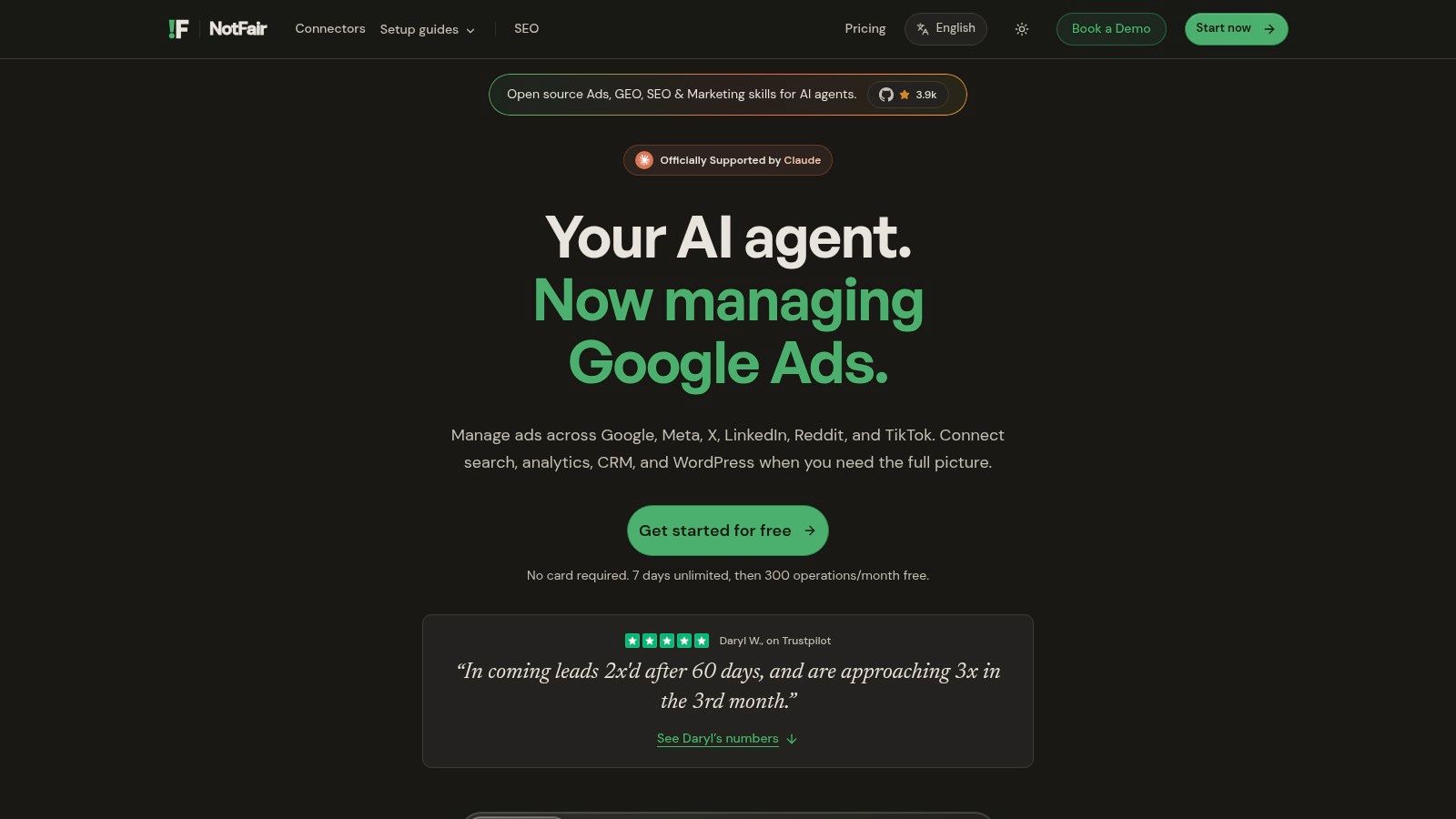
NotFair is the strongest fit when the agent must work with live advertising, analytics, search, and CRM data and the team needs controlled campaign operations rather than a conversational report. It acts as a hosted Model Context Protocol connector layer, so Claude, ChatGPT/Codex, Cursor, OpenClaw, and Hermes can request data and supported changes through one operational interface.
A paid-media diagnosis can combine Google Ads spend, search terms, keywords, budgets, GA4 conversions, Search Console queries, and GoHighLevel lead context in one session. The useful output isn't a generic recommendation. NotFair can turn findings into a prioritized fix list ranked by spend at risk, then show explicit diffs for negatives, pauses, budget moves, or other supported edits.
Why the governance model matters
The write path is approval-first. OAuth handles sign-in, server-side limits reject out-of-range bid or budget changes, and each proposed operation is staged for review before application. The system keeps a complete change history, supports reversible edits, and provides one-call undo.
That makes NotFair materially different from an agent framework with a custom API tool. With a framework, your engineering team must build permission checks, approval states, logs, and rollback behavior. NotFair delivers those controls in the connector layer, where they apply to the business systems being changed.
Practical rule: Let the agent diagnose freely, but make every consequential campaign write explicit, reviewable, and reversible.
NotFair supports Google, Meta, X, LinkedIn, Reddit, and TikTok advertising, along with GA4, Search Console, GoHighLevel, and WordPress. Its hosted delivery and OAuth reduce local credential handling, while its open-source agent skills, released under the MIT license, improve portability across supported AI clients. The trade-off is that teams still need a compatible client and accurate conversion instrumentation. The free plan includes a seven-day unlimited trial, followed by 300 NotFair operations per month at no charge. Growth costs $79 per month, or about $950 per year, and includes unlimited Google and Meta operations with five shared ad-account spots. Larger teams can request enterprise options.
For an agency, the account-sharing model and operation limits deserve review before rollout. For a performance team that wants live context without building and maintaining every integration, the hosted model is often the more practical choice.
2. OpenAI Assistants API and GPTs
OpenAI's developer platform is a good starting point for teams that want to build an agent application around OpenAI models and get to tool calling quickly. The platform supports function and tool calling, persistent threads, file handling, retrieval, code execution, and real-time application patterns. Teams can also package internal workflows as shareable GPTs.
The key strength is the short path between a business instruction and a working application. A developer can define a tool for a reporting query, pass the result back to the model, and retain conversational state across a thread. File search and vector-store features help when the agent needs campaign briefs, naming conventions, or historical documentation alongside live API results.
Where it fits in paid media
OpenAI works well as the agent client or application runtime above a dedicated connector. For example, a team can connect Google Ads to ChatGPT and let the model interpret live campaign context without building every advertising integration directly into the application.
The trade-off is provider dependence. If the workflow is tightly coupled to OpenAI-specific APIs, threads, retrieval behavior, or GPT distribution, moving to another model provider will require deliberate abstraction. Retrieval also introduces additional storage, indexing, and cost-management decisions. A team that only needs a chat interface over live marketing systems shouldn't recreate connector governance inside the application.
Best fit
Choose this option when your engineering team already standardizes on OpenAI and wants a model-centric application with custom tools. Keep account permissions, approval workflows, and rollback outside the model layer. OpenAI can decide what to request, but it shouldn't be the only control between that request and a production advertising account.
Explore the OpenAI developer platform for the API and runtime documentation.
3. Claude with MCP connectors
Claude is particularly useful when the team wants an AI client that treats external capabilities as connector-provided tools rather than embedding every integration in the model application. Anthropic's Model Context Protocol supports local and remote servers, allowing Claude web, Desktop, Cowork, and Claude Code to access approved data and actions through a shared protocol.
That separation is important for governance. The model can reason over a tool description, while the connector controls authentication, scopes, available operations, and the backend system. A centralized connector policy can also serve multiple Claude surfaces instead of relying on separate local configurations for every user.
The paid-media workflow
For advertising teams, a hosted MCP connector can expose read tools for spend, search terms, conversions, and account structure, then expose write tools only behind an approval process. A Claude connector for NotFair follows that pattern, giving Claude access to supported marketing systems without asking each marketer to maintain API credentials locally.
MCP itself isn't a complete agent platform. You still pay for Claude usage, and the connector must be selected or built for each business system. Coverage across SaaS applications is also less turnkey than a broad automation catalog. Teams should test how a connector handles expired OAuth tokens, partial failures, tool errors, and the difference between a read request and a state-changing operation.
The connector should own access policy. The model should not be the access policy.
Claude is a strong fit for analysts, marketers, and developers who want one client across conversational research, desktop work, and code workflows. It becomes more useful when paired with a governed hosted connector, especially for teams that need live context and reviewable changes rather than static exports.
See the Claude platform for current client and connector options.
4. Microsoft Copilot Studio
Microsoft Copilot Studio is a low-code agent builder for organizations already operating inside Microsoft 365, Power Platform, and Dataverse. It combines agent instructions with actions, Power Automate flows, enterprise connectors, analytics, and deployment channels such as Teams. For an IT department, that means the agent can fit existing identity, admin, compliance, and support processes.
What works well
The strongest use case is an internal operations agent that needs to retrieve information from approved business systems and invoke standardized flows. A marketing operations team might use it to route lead-quality issues, summarize campaign exceptions, or trigger a review workflow that hands a proposed change to a human owner.
The administrative model is familiar for Microsoft-centric organizations. Administrators can manage deployment and access through the Microsoft ecosystem, while business users can contribute workflows without building a complete agent runtime. This reduces the amount of custom infrastructure required for routine internal automation.
The trade-offs
Copilot Studio delivers less value when the organization doesn't already use Power Platform. Licensing can span multiple Microsoft products and capacity models, so procurement and usage modeling need to happen before a production rollout. A paid-media team that needs deep live access to Google Ads, Meta Ads, GA4, and CRM data may still need a specialized connector or custom action layer.
Don't confuse low-code setup with low governance effort. Someone still needs to define who can invoke an action, which changes require approval, how failures are reported, and how a campaign edit is reversed. Copilot Studio is best for a Microsoft-aligned organization that wants controlled business process automation, not necessarily for a specialist media team seeking the fastest route to cross-platform campaign diagnosis.
Review the Microsoft Copilot Studio platform before choosing it as the primary agent layer.
5. Google Gemini Enterprise Agent Platform
Google's Gemini Enterprise Agent Platform is designed for teams that need a managed agent runtime on Google Cloud. The platform provides managed execution, session and state interfaces, memory capabilities, code execution sandboxes, and observability features connected to Google Cloud services.
That makes it a runtime decision rather than just a chatbot decision. The platform can host agents that need durable sessions, controlled execution, and cloud-native monitoring. Teams already using BigQuery, Vertex AI services, Google identity, and Google Cloud operations will find fewer boundaries between the agent and the rest of their stack.
A natural option for Google marketing data
Google-heavy marketing teams may use the platform as the runtime while keeping advertising and analytics access in a separate connector layer. A Gemini CLI integration for Google Ads illustrates the value of separating the model client from the operational access path. The agent can reason about campaign data without the runtime needing to own every business-system credential.
Pricing requires careful modeling because the platform can involve several infrastructure and management meters, including compute and memory usage. Product naming has also changed across the Agent Builder, Agent Engine, and Agent Platform terminology, so internal documentation should pin the exact service and billing model being deployed.
Best fit
Choose it when your team can operate Google Cloud production workloads and wants managed runtime, memory, and observability in one environment. Don't choose it solely because your ad accounts are in Google Ads. Advertising ownership and agent-runtime ownership are different architectural decisions.
The Gemini Enterprise Agent Platform documentation is the right place to validate the current product boundaries before implementation.
6. Agents for Amazon Bedrock and AgentCore
Amazon Bedrock offers a managed path for agents that need action groups, knowledge bases, foundation-model choice, and AWS-native identity and security. AgentCore adds lower-level control over tool-use loops and enterprise runtime concerns. Together, they suit organizations that want to keep the agent close to AWS Lambda, IAM, serverless services, and existing security controls.
Why AWS teams choose it
AWS provides a broad foundation for production deployment. The agent can call action groups, retrieve organizational knowledge, and work with backend services protected by AWS identity controls. Bedrock also supports access to multiple foundation models, which can reduce dependence on a single model vendor at the application layer.
AgentCore is useful when the team needs more control than a rapid-setup agent configuration provides. It can become the governed gateway through which assistants reach internal and external tools, with policy, identity, logging, and tool registration handled centrally.
Where complexity appears
The platform has many cost and architecture levers. Model tokens, runtime services, knowledge bases, Lambda invocations, and surrounding AWS resources can all affect the operating model. Engineers must also understand the distinction between the higher-level Agents experience and AgentCore capabilities.
For paid media, Bedrock is usually a better fit as a managed runtime and governance environment than as a ready-made advertising optimizer. You still need solid Google, Meta, analytics, and CRM actions, with explicit parameter validation and rollback behavior. A generic action group that can write to an ad API is not equivalent to a safe campaign operations layer.
AWS customers with an established platform engineering function should evaluate Amazon Bedrock Agents alongside AgentCore capabilities. Smaller marketing teams may find a hosted connector simpler than assembling and operating the complete AWS stack.
7. LangChain with LangGraph
LangChain with LangGraph is for teams that want to own the agent workflow. LangGraph models execution as a graph of nodes and transitions, which makes state, tool calls, checkpoints, persistence, streaming, and human approval explicit. It supports Python and JavaScript ecosystems and can work across model providers and cloud environments.
The flexibility is the product. A team can create a diagnostic graph that reads campaign data, checks tracking, asks for clarification, produces a ranked action list, pauses for approval, and then calls a write tool. Each transition can carry structured state rather than relying on a single long prompt.
Where engineers gain control
LangGraph is valuable when the workflow has branching logic and failure handling that a simple agent loop can't express. For example, a budget-change node can require a policy check, route high-risk changes to a manager, and retry a read operation without repeating a write. Custom persistence and observability can match the organization's infrastructure standards.
That control comes with an operational bill. Your team must run the service, store state, manage secrets, monitor latency and failures, maintain model adapters, and design the approval and rollback paths. LangGraph won't automatically make an advertising integration safe because the framework doesn't know whether a budget change is appropriate.
Operational insight: A framework gives you control over the workflow. It doesn't give you a finished control system for the business action.
LangGraph is a strong choice for a mature engineering team building a reusable internal agent platform. It is a poor choice if the immediate need is just to connect an AI client to live advertising data with hosted OAuth and prebuilt safeguards.
Visit the LangGraph framework to assess its runtime and orchestration patterns.
8. LlamaIndex Agents
LlamaIndex Agents is oriented toward agents that need structured knowledge, retrieval, and data access. Its AgentRunner and AgentWorker abstractions support tool use and multi-agent workflows, while its retrieval ecosystem helps teams connect documents, databases, and other knowledge sources.
This makes LlamaIndex a natural fit for a marketing intelligence agent that must combine campaign data with briefs, tracking documentation, landing-page information, and historical operating rules. A retrieval-heavy workflow can answer not only what changed in an account, but also whether the change violates a documented naming convention or measurement policy.
Retrieval is not live operations
LlamaIndex can help an agent find and structure evidence, but retrieval shouldn't replace live reads from advertising and analytics systems. An indexed campaign export can become stale, and a document store may not reflect the account state at the moment an action is proposed. For paid media, use retrieval for context and live connectors for current spend, search terms, conversions, and account settings.
The framework is open source and extensible, but the team still operates the runtime and owns reliability. It must monitor retrieval quality, tool errors, token usage, persistence, and the handoff from recommendations to writes. Documentation breadth is useful, though it can also make architectural choices harder for a small team to narrow down.
LlamaIndex is a good fit for data teams building knowledge-centric agents around a controlled connector layer. It's less suitable as a turnkey campaign-operations product. The LlamaIndex developer platform provides the relevant agent, retrieval, and tooling documentation.
9. CrewAI
CrewAI takes a role-based approach to multi-agent work. Teams define specialized agents, tools, tasks, and processes, then coordinate them as a crew. A paid-media workflow might assign separate responsibilities to a search-term analyst, conversion-quality reviewer, budget analyst, and approval coordinator.
That structure can make a complex process easier to describe. One agent can inspect query waste, another can compare analytics outcomes, and a final agent can consolidate recommendations. The explicit roles also help teams decide which tools each agent should and shouldn't access.
Coordination isn't the same as autonomy
CrewAI's Python-first design is approachable for teams that want multi-agent primitives without adopting a large orchestration platform. The trade-off is that reliability, persistence, observability, permissions, and guardrails remain your responsibility. If one crew member proposes a destructive campaign edit, the framework won't provide approval gates or rollback unless you implement them.
Multi-agent designs also introduce more tool calls and more places for state to become inconsistent. For many paid-media tasks, one well-scoped agent with live reads and a clear approval workflow may be easier to test than a group of autonomous specialists. Use multiple roles when the decomposition improves accuracy or ownership, not because the architecture looks more advanced.
CrewAI suits a Python team experimenting with structured collaboration and willing to operate the surrounding service. It doesn't replace a connector layer for Google Ads, Meta Ads, GA4, or CRM access.
Explore the CrewAI documentation for its current role, task, and process model.
10. Zapier, AI by Zapier
Zapier is the fastest option when the main problem is connecting an agent to a large catalog of SaaS actions. AI by Zapier can combine model steps with app actions, code, and knowledge sources, while Zapier manages authentication and application connections across its ecosystem.
For a marketing operations team, that can mean routing a lead-quality signal, creating a task, sending an internal notification, updating a record, or triggering a review flow without building each API integration. Its action-oriented model is easier for business users to adopt than a custom orchestration framework.
The boundary for paid-media control
Zapier works best for workflow plumbing around campaign operations. It can notify an owner when a diagnostic finds an issue, create a task for approval, or move structured information between systems. It offers less control than a direct API integration when the agent needs live, multi-system diagnosis, precise advertising parameters, staged diffs, or one-call rollback.
Task-based metering also needs monitoring. Heavy use of model steps and application actions can increase operating costs, and the team should identify which events trigger agent calls before broad deployment. A workflow that runs on every small data change can become noisy and expensive without rate limits and batching.
Use Zapier when speed and integration breadth matter more than deep control over the agent runtime. Pair it with a specialist connector or governed action surface when advertising changes carry financial risk. The AI by Zapier platform explains its current action and agent capabilities.
Top 10 AI Agent Tools, Features & Integrations
| Product | Core capabilities ✨ | Safety & Quality ★ | Value / Pricing 💰 | Target audience 👥 | Unique strength / Best fit 🏆 |
|---|---|---|---|---|---|
| NotFair 🏆 | Live reads of Ads, GA4, Search Console, CRM; prioritized fixes, diffs & reversible edits | ★★★★, approval-gated writes, full logs, one-call undo | 💰 Free (7d unlimited → 300 ops/mo), Growth $79/mo (5 ad-account spots) | 👥 Agencies & marketers running paid media at scale | ✨ Multi-platform live context + auditable, reversible campaign operations |
| OpenAI Assistants API and GPTs | Tool/function calling, persistent sessions, file & retrieval support | ★★★★, mature runtime; governance depends on implementer | 💰 Transparent model/token pricing; pay-as-you-go | 👥 Teams standardizing on OpenAI models | ✨ Fastest path to production agents with robust tool-calling |
| Claude (Anthropic) with MCP connectors | First‑party MCP across web/Desktop/Cowork; connector catalog | ★★★★, MCP separates access from model; strong governance | 💰 Model usage fees; connector management overhead | 👥 Enterprises needing audited connector access | ✨ Native MCP support across Claude clients for centralized governance |
| Microsoft Copilot Studio | Low-code agent builder via Power Platform; enterprise connectors | ★★★, enterprise compliance from Microsoft stack | 💰 Licensing varies; best value if on MS365 | 👥 Organizations invested in Microsoft 365/Power Platform | ✨ Tight integration with Teams, Dataverse & M365 admin tools |
| Google Gemini Enterprise Agent Platform | Managed agent runtime, session/memory APIs, sandboxes | ★★★★, observability & governance integrated with GCP | 💰 Multiple meters (compute, memory, management) | 👥 Google Cloud teams building end-to-end agents | ✨ Managed runtime + deep GCP service integrations |
| Agents for Amazon Bedrock (AgentCore) | Multi-agent support, AgentCore control, AWS identity integration | ★★★★, enterprise AWS security & identity | 💰 Multiple cost levers (models, runtime, serverless) | 👥 AWS-native enterprises & security-focused teams | ✨ Deep AWS integration + access to multiple foundation models |
| LangChain with LangGraph | Graph-based agent execution, tool nodes, durable state | ★★★, open-source; you run guardrails & runtime | 💰 OSS (self-host costs for infra & ops) | 👥 Teams needing maximum flexibility & provider choice | ✨ Fine-grained control over planning, tools, and state |
| LlamaIndex Agents | Retrieval-first agents, AgentRunner/AgentWorker patterns | ★★★, self-managed reliability & guardrails | 💰 OSS base; hosting & infra costs apply | 👥 RAG-heavy, knowledge-centric agent builders | ✨ Strong retrieval and knowledge tooling for RAG scenarios |
| CrewAI | Python-first multi-agent "crews" with role/process modeling | ★★, lightweight OSS; you manage safety & persistence | 💰 OSS; operational costs for runtime | 👥 Python teams building coordinated multi-agent workflows | ✨ Lightweight primitives for multi-agent coordination |
| Zapier, AI by Zapier | AI Actions + thousands of app connectors; centralized auth | ★★★, centralized auth; less fine-grained control | 💰 Task-based metering; costs grow with usage | 👥 Non-dev teams needing quick SaaS automation | ✨ Massive integration catalog for rapid agent operationalization |
Assemble the Stack Around the Risk
There isn't one universal winner among AI agent tools because these products occupy different layers. OpenAI and Claude are primarily model clients and agent interfaces. Gemini Enterprise Agent Platform, Bedrock, and Copilot Studio provide managed runtime or low-code orchestration inside larger cloud ecosystems. LangGraph, LlamaIndex, and CrewAI are frameworks for teams that want to build and operate their own workflow logic. Zapier is an action surface and automation catalog. NotFair is a hosted connector layer focused on live business systems and controlled operations.
The market is growing quickly, but the adoption pattern is less mature than many tool roundups suggest. One estimate places the AI agent tools market at about $7.63 billion in 2025, $10.91 billion in 2026, and roughly $50.31 billion by 2030, while another forecast projects $182.97 billion by 2033. Those estimates imply about 43% year-over-year growth from 2025 to 2026 and a more than 4.6x increase over four years, but the different long-range figures also show that definitions vary across reports. See the AI agent market estimates and trends for the underlying comparison.
The infrastructure layer is changing too. Anthropic introduced MCP in November 2024, Google introduced Agent2Agent in April 2025, and Google donated A2A to the Linux Foundation in June 2025 with more than 50 launch partners. MCP and A2A were both donated to the Agentic AI Foundation in December 2025, reinforcing the move from isolated demonstrations toward shared agent infrastructure. The overview of AI agent market trends and standards provides the relevant timeline.
For paid-media teams, the practical architecture is staged:
- Start with a client: Use Claude, Codex, or another client your team already understands.
- Add a live connector layer: Connect advertising, analytics, search, and CRM systems through hosted MCP access rather than relying on stale exports.
- Begin with diagnosis: Let the agent inspect performance, correlate root causes, and produce prioritized recommendations.
- Gate every write: Require explicit diffs and human approval before pauses, budget moves, negatives, or structural changes.
- Test rollback: Verify that logs identify the actor and operation, and that supported changes can be reversed without reconstructing the original state manually.
This approach matches how enterprise adoption is developing. A 2026 survey reports that 72% of enterprises are using or testing AI agents, and 40% of that group is already running multiple agents in production. The same survey reports deployment among 49% of customer support teams, 47% of operations teams, and use for data management by 47% of enterprises. Those figures point toward operational workflows with clear data and action boundaries, not unrestricted general-purpose autonomy. The Zapier AI agents survey contains the cited findings.
Governance is the differentiator because agents connected to real systems can modify state. PwC identifies organizational barriers around agent adoption, while an IDC and AWS study found that 67% of organizations said users need more skills training and 55% said lack of skilled personnel is the top implementation challenge. PwC also reports that connecting agents across workflows was cited by 19%, below uncertainty about clear use cases. The PwC survey on AI agent adoption barriers gives the source context.
Before choosing, check the operating details rather than the demo:
- OAuth and permissions: Can each user or account receive scoped access without shared credentials?
- Hosted versus self-hosted delivery: Who patches connectors, rotates secrets, monitors uptime, and handles failures?
- Cost meters: Are you paying for tokens, runtime, memory, tool calls, tasks, storage, or several of these at once?
- Observability: Can you identify the user, agent, tool, parameters, result, and policy decision for every invocation?
- Human approval: Does the system pause before consequential writes and show exactly what will change?
- Rollback testing: Can the team undo a change safely, including after partial failure or an expired session?
- Portability: Can you change clients or models without rebuilding every connector and policy?
- Paid-media fit: Does the tool understand live account context, spend exposure, conversion quality, and platform-specific constraints?
For a small engineering team, a hosted connector paired with an existing client will usually reach value faster than building a complete runtime. For a cloud platform group, managed infrastructure may be the right foundation. For a product team with unusual branching logic, LangGraph or another open framework can justify its operational burden. The correct choice is the layer that removes your biggest bottleneck without hiding the risk.
NotFair provides hosted MCP access for Claude, ChatGPT/Codex, Cursor, OpenClaw, and Hermes, connecting live advertising, analytics, search, and CRM data with approval-gated changes, explicit diffs, logging, and one-call undo. If your paid-media team wants to move from agent recommendations to controlled campaign operations, visit NotFair and start with a read-only diagnostic workflow.