

Choosing among paid advertising platforms is not a matter of listing every network and putting the same budget into each one. A Google Ads manager may need to capture existing demand, a Meta Ads manager may need to create demand, and an agency may need a repeatable way to decide where a client’s next dollar belongs. The practical job is to match business intent, audience availability, measurement quality, creative supply, and operational control to the platform that can support them. This guide gives growth teams, agencies, consultants, and AI automation developers a decision system for selecting channels, diagnosing weak performance, and making changes without turning an account into an untraceable collection of experiments.
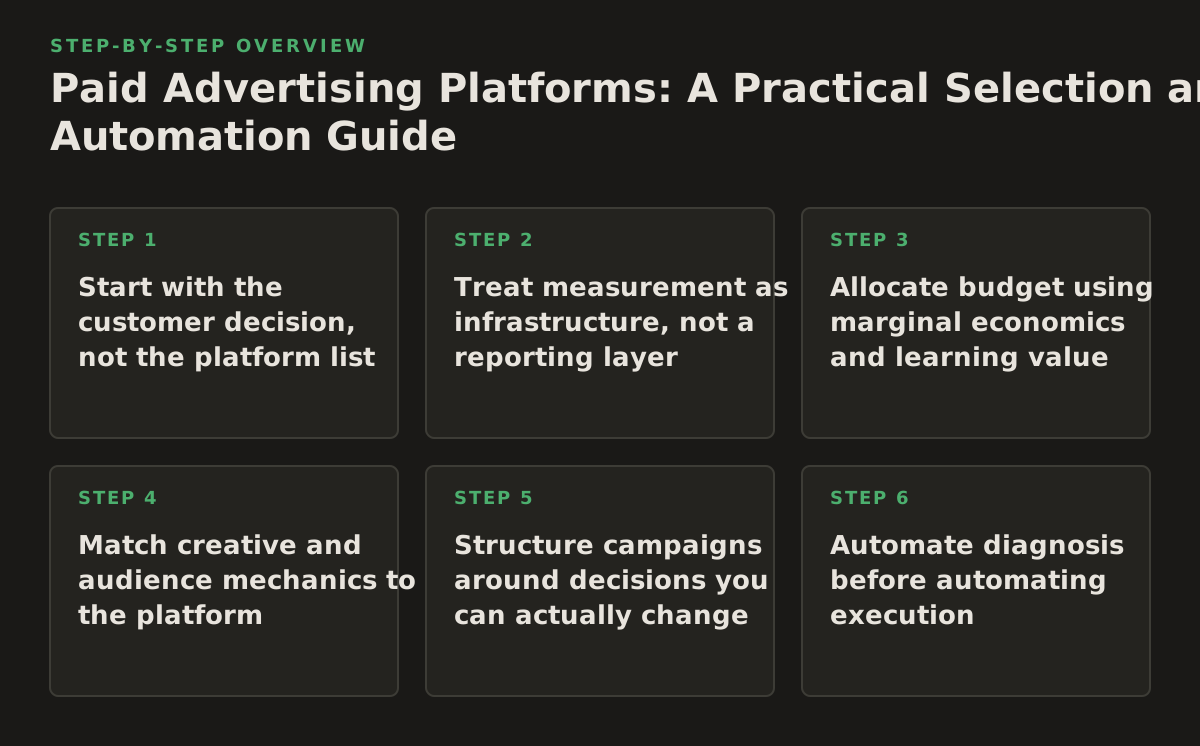
1. Start with the customer decision, not the platform list
When this applies: Use this principle before opening a campaign builder or reallocating budget. It is especially important when a business is considering Google Ads, Meta Ads, LinkedIn Ads, and X Ads at the same time, or when a client asks for “more channels” without defining the commercial job each channel must perform.
Why it works: Paid channels do not create demand in the same way. Search can intercept a person who is already expressing a problem or product need. Social feeds can introduce a product while a person is consuming unrelated content. LinkedIn can be useful when job role, company, or professional context affects the buying decision. Google’s campaign documentation describes campaign types in relation to advertising goals and available inventory, which is a useful reminder that campaign format is a consequence of the objective, not the objective itself (Google Ads campaign types).
Assign each channel a job
- Capture demand: Search campaigns for explicit queries, branded demand, urgent problems, or known categories.
- Create demand: Meta or other social campaigns for visual demonstrations, problem education, creator-led proof, and retargeting.
- Reach professional buyers: LinkedIn when role, industry, seniority, or account context is central to qualification.
- Re-engage known prospects: Remarketing, customer lists, sequential creative, and lead-nurture campaigns.
- Validate a new proposition: A controlled test designed to learn which promise earns qualified attention, not simply the cheapest click.
Failure mode: A team treats every platform as a direct-response auction and judges all of them on the same short-window CPA. That can make a discovery campaign look useless while allowing branded search to appear unbeatable because it receives credit for demand generated elsewhere. The correction is not to ignore CPA; it is to define the conversion role and attribution window before comparing results.
Implementation example: An illustrative B2B software company could assign Google Search to high-intent demo queries, LinkedIn to account-based reach among finance leaders, and Meta to customer-proof video plus retargeting. The planning sheet should name the expected action for each channel: “book a demo,” “visit an account-specific resource,” or “return to complete a form.” If an ad set cannot be tied to a distinct job, pause the expansion and clarify the strategy first.
2. Treat measurement as infrastructure, not a reporting layer
When this applies: Use this principle whenever platforms disagree, conversion volume falls unexpectedly, or an account is being optimized toward cheap actions that sales does not value. It should be completed before making large budget changes.
Why it works: Automated bidding and optimization systems use the signals supplied to them. If a form start, low-quality lead, duplicate event, or imported offline sale is counted inconsistently, the platform is not “making bad decisions” in a vacuum; it is responding to an unreliable objective. Google’s conversion tracking guidance distinguishes conversion actions and measurement setup, while Google Analytics documentation explains how important events can be marked as key events for analysis. These are different layers, so teams should document which events are used for optimization and which are used only for diagnosis (Google Ads conversion tracking; Google Analytics key events).
Build a measurement contract
- Primary outcome: The event that represents the commercial goal, such as qualified opportunity, purchase, or approved lead.
- Diagnostic events: Supporting actions such as pricing-page views, form starts, calls, or video engagement.
- Source of truth: CRM, ecommerce system, Google Analytics, or a reconciled warehouse.
- Allowed lag: The time between click, conversion, qualification, and revenue recognition.
- Action rule: The minimum evidence required before changing budget, bid strategy, audience, or creative.
For lead generation, the contract should answer whether the platform receives every submitted lead or only leads that pass a qualification rule. For ecommerce, it should specify whether revenue includes discounts, tax, shipping, refunds, or repeat purchases. For a long sales cycle, an offline conversion import may be more useful than optimizing exclusively for the first form submission.
Failure mode: A team fixes a tracking discrepancy by adding more duplicate events. Reported conversions rise, but the optimization signal becomes less meaningful. Another common failure is to compare platform-reported conversions with CRM revenue without aligning dates, time zones, click-through windows, and event definitions.
Implementation example: An illustrative agency can create a one-page event map with “lead submitted” as a diagnostic event and “sales-qualified lead” as the primary optimization event. The map records event name, trigger, owner, destination, deduplication method, and validation date. Before scaling, the analyst checks a sample of leads against the CRM and records whether the platform event represents a real commercial opportunity.
Privacy and browser changes also make first-party data practices more important, but that does not remove the need for consent, access controls, and clear retention decisions. Measurement quality is a technical and governance problem, not merely a tag-management task.
3. Allocate budget using marginal economics and learning value
When this applies: Use this principle when a business has several viable channels, when one platform is taking most of the spend by default, or when a manager must decide whether to fund a proven campaign or a promising but uncertain test.
Why it works: Average CPA or ROAS describes what happened across existing spend. The next dollar can behave differently because of auction depth, audience saturation, query expansion, frequency, or creative fatigue. A better allocation process asks what the next increment of spend is likely to buy and what information the test will produce.
Separate three budget buckets
- Core demand: Campaigns that reliably serve an established business need and have acceptable measurement.
- Expansion: New audiences, geographies, products, or placements that extend a validated proposition.
- Learning: Deliberate tests of creative, offer, landing page, or channel assumptions.
Set a starting policy rather than pretending there is a universal split. For example, an illustrative account might reserve the largest share for core demand, a smaller share for expansion, and a controlled portion for learning. The exact percentages should reflect cash-flow tolerance, conversion lag, sales capacity, and the cost of being wrong.
Failure mode: The team cuts every campaign above the blended target immediately. That can eliminate learning campaigns before they collect enough evidence, or remove upper-funnel activity that supplies future branded demand. The opposite failure is equally dangerous: “learning” becomes a permanent excuse for unbounded spend without a decision date or stop rule.
Implementation example: Suppose an illustrative ecommerce brand has a target contribution margin after advertising. Search brand terms are profitable but volume-limited; non-brand search has more volume but weaker efficiency; Meta prospecting has uncertain first-purchase economics. The budget review records each channel’s current marginal question: “Can non-brand search expand without low-intent queries?” “Can Meta prospecting produce first purchases at an acceptable payback?” Each test receives a spend ceiling, evidence requirement, and next action.
| Situation | Primary decision | Evidence to review | Starting action policy | Common mistake |
|---|---|---|---|---|
| Reliable demand, limited volume | Protect coverage without overpaying | Search terms, impression coverage, conversion quality | Maintain core coverage; expand only where intent is clear | Calling all branded efficiency “incremental growth” |
| Strong results with rising frequency or CPC | Find the saturation point | Reach, frequency, auction metrics, creative response | Refresh creative or test adjacent audiences before simply adding spend | Scaling a fatigued audience with budget alone |
| New channel or proposition | Buy information within a limit | Qualified actions, signal integrity, audience response | Use a time-boxed or spend-capped test with a written decision rule | Optimizing for cheap traffic |
| Platform and CRM disagree | Resolve measurement before allocation | Event definitions, dates, deduplication, lead status | Freeze major scaling decisions until reconciliation is complete | Choosing whichever dashboard looks better |
| Sales capacity is constrained | Control lead flow quality | Qualification rate, response time, opportunity creation | Optimize toward capacity-adjusted value, not raw lead count | Increasing spend on leads nobody can process |
4. Match creative and audience mechanics to the platform
When this applies: Use this principle when a campaign has adequate reach but weak response, when CPM or CPC changes after a creative refresh, or when the same asset is being copied across Google, Meta, LinkedIn, and other placements without adaptation.
Why it works: Creative does more than make an ad attractive. It identifies a problem, qualifies the viewer, communicates a promise, and gives the platform a response signal. A search ad must align with query intent and landing-page language. A feed ad must earn attention before the viewer has declared a need. A professional-network ad may need to establish relevance through role, account context, or business consequence. Creative is part of targeting because its wording determines who recognizes the offer as relevant.
Use a message matrix
- Audience state: Unaware, problem-aware, solution-aware, or ready to buy.
- Promise: What changes for the customer, stated without unsupported guarantees.
- Proof: Demonstration, comparison, customer evidence, process detail, or credible explanation.
- Friction: Price, implementation effort, switching cost, risk, or time to value.
- Next step: Watch, read, compare, request, start, or purchase.
Failure mode: A team changes audience settings when the actual problem is a weak promise or an offer that is difficult to understand. Another failure is producing many superficial variants that change punctuation but not the underlying angle. This creates activity without a meaningful learning question.
Implementation example: A consultant selling analytics services could create three distinct Meta concepts: a short audit walkthrough for problem-aware prospects, a before-and-after reporting workflow for solution-aware prospects, and a risk-reduction offer for buyers worried about migration. On Google Search, the landing page and ad would instead mirror high-intent terms such as implementation, audit, or migration. The team reviews qualified actions by message angle, not only by platform average.
For an agency, the reusable asset is not merely a folder of ads. It is a record of angle, audience state, proof type, format, and planned successor. That makes creative fatigue and message gaps easier to diagnose than a spreadsheet of asset IDs.
5. Structure campaigns around decisions you can actually change
When this applies: Use this principle during account builds, migrations, restructures, or audits where campaigns contain too many audiences, products, locations, or bidding objectives to interpret cleanly.
Why it works: Structure determines whether performance data can answer a question. If budget, creative, landing page, geography, and audience all change at once, an apparent improvement has several possible causes. A useful structure isolates the variables that matter commercially while avoiding fragmentation that leaves each segment with too little evidence.
Choose a structure by decision type
- Separate by economics: Different margins, sales cycles, or allowable acquisition costs usually deserve distinct reporting and budget logic.
- Separate by intent: Brand, category, competitor, and problem queries may require different copy and landing pages.
- Separate by operational owner: Regions or product lines may need separate approvals, budgets, or lead routing.
- Keep together when the action is identical: Do not split campaigns merely because a platform offers another setting.
Google Ads experiments are designed to compare a test against a base campaign under a defined setup, which supports the broader principle that experiments need a controlled comparison rather than a before-and-after story (Google Ads experiments).
Failure mode: Over-segmentation creates campaigns with thin data and makes every fluctuation look decisive. Under-segmentation hides important differences, such as a high-margin product subsidizing a low-margin product or a strong region masking a weak one.
Implementation example: An illustrative agency managing a multi-location service business might keep one shared campaign for a common service and split locations only where budgets, landing pages, or lead handling differ materially. A landing-page test changes one major variable at a time, records the start date and traffic allocation, and has a prewritten rule for keeping, reverting, or extending the test.
The operational test is simple: if a manager cannot explain what decision a campaign boundary enables, the boundary may be cosmetic. Conversely, if a change requires exporting several reports and manually reconstructing the comparison, the account may be too consolidated for responsible optimization.
6. Automate diagnosis before automating execution
When this applies: Use this principle when managing multiple accounts, when daily checks consume analyst time, or when connecting an AI client to advertising data through an MCP server. It is also the right starting point for teams concerned that automation could make many changes faster than humans can review them.
Why it works: Diagnosis is usually safer than direct execution. An automated system can collect delivery, spend, conversion, search-term, creative, and change-history data; identify anomalies; and produce a ranked explanation. Execution should come later, after the team has defined permissions, evidence requirements, and rollback behavior. The Model Context Protocol architecture describes a way for AI applications to connect with external tools and data sources, but the protocol itself does not decide which advertising changes are commercially safe (Model Context Protocol architecture).
Use an approval ladder
- Observe: Read performance, settings, diagnostics, and change history.
- Explain: Generate a finding with affected campaigns, time range, comparison, and confidence.
- Recommend: State the proposed change, expected mechanism, downside, and validation plan.
- Stage: Prepare a reversible change without publishing it.
- Approve: Require a named human or policy gate for material changes.
- Execute and verify: Publish, confirm the setting changed, and monitor the intended metric.
Failure mode: An AI agent sees a CPA increase and immediately lowers bids or pauses a campaign. The increase may have come from conversion lag, tracking failure, a temporary budget constraint, or a high-value segment still in its sales cycle. A fast wrong action can destroy the evidence needed to identify the original problem.
Implementation example: A useful agent task is: “Find campaigns where spend is active but the primary conversion signal has stopped, compare the last seven days with the prior seven, check recent changes, and return the top three plausible causes.” A second task can draft a budget reallocation, but it must include source rows, affected entities, maximum change, rollback value, and an approval request. This design lets Claude, Codex, Cursor, OpenClaw, or Hermes assist with analysis while preserving human control over consequential actions.
For Google Ads teams, Google Ads MCP can provide a focused way to connect an AI client with account data and workflows. For Meta operators, Meta Ads MCP is the corresponding place to evaluate a Meta-specific connection. In both cases, the useful design question is not “Can the agent change campaigns?” but “Which changes are reversible, bounded, attributable, and worth approving?”
7. Turn platform alerts into a cross-channel operating rhythm
When this applies: Use this principle for weekly performance reviews, agency reporting, or any business where Google Ads, Meta Ads, analytics, CRM, and landing-page data are reviewed in separate dashboards.
Why it works: Alerts identify symptoms; operating rhythms create decisions. A cross-channel review should distinguish delivery problems, measurement problems, message problems, and commercial problems. For example, a fall in leads may be caused by reduced impressions, a broken form, weaker creative, a change in search intent, or slower sales follow-up. Each diagnosis has a different owner and remedy.
Use a four-layer diagnostic sequence
- Delivery: Did campaigns spend, reach the intended inventory, and serve under the planned constraints?
- Signal: Did clicks, visits, events, and conversions record correctly?
- Response: Did the audience engage, qualify, and progress at expected rates?
- Economics: Did the resulting customers produce acceptable margin, payback, or pipeline value?
Google Search Console can add an organic-search context to a paid-search review by showing queries and pages receiving search visibility, but it should not be treated as a direct substitute for paid query or conversion data. Its role is to help identify overlap, gaps, and landing-page opportunities (Google Search Console).
Failure mode: Reporting begins with a blended ROAS number and ends with a recommendation to “optimize.” That skips the causal question. Another failure is sending a dashboard with dozens of metrics but no owner, decision date, or threshold for action.
Implementation example: Every Monday, an illustrative growth team could review a compact exception queue: spend without primary conversions, sudden impression loss, rising frequency, new search-term clusters, lead-quality changes, and unreviewed account edits. Each exception receives a cause hypothesis, evidence request, owner, and next checkpoint. A monthly review then revisits channel roles and budget assumptions rather than merely extending the weekly trend line.
For teams managing several paid advertising platforms, the report should preserve platform-level detail while presenting a shared business layer: qualified leads, purchases, margin, pipeline, or payback. That prevents false comparability without forcing stakeholders to inspect six separate interfaces.
8. Select professional support and tooling by the bottleneck
When this applies: Use this principle when an in-house team lacks specialist capacity, an agency is expanding its account roster, or a company is deciding between a managed service, a reporting product, an automation layer, and custom engineering.
Why it works: Tools and services solve different constraints. A dashboard can improve visibility but not fix an offer. A rules engine can enforce a budget guardrail but not judge lead quality. A specialist can redesign account economics but may not provide the repeatable data connection an agency needs. Choose against the bottleneck, not against the longest feature list.
Score the option against operational requirements
- Coverage: Does it support the platforms, accounts, conversion sources, and workflows actually used?
- Depth: Can it expose the entity-level data needed to diagnose the issue?
- Control: Are permissions, approvals, limits, audit history, and rollback practices clear?
- Fit: Does it match the team’s technical ability and review capacity?
- Economics: Is the cost justified by analyst time saved, risk reduced, or decisions improved?
Failure mode: A business buys automation to compensate for missing strategy or poor tracking. The result is a faster workflow around an undefined objective. The reverse mistake is hiring manual help for a repetitive data-access problem that could be standardized safely.
Implementation example: If the bottleneck is weekly data collection across client accounts, prioritize a reliable connection, normalized reporting, and exception detection. If the bottleneck is poor creative iteration, prioritize research, message development, production, and landing-page collaboration. If the bottleneck is high-risk account editing, prioritize approval gates, change previews, and rollback procedures before adding more autonomous actions.
Teams seeking outside help can use performance marketing solutions to find professional help managing and optimizing paid advertising campaigns for business growth. That resource is most useful when you already know whether the missing capability is media buying, growth marketing, creative strategy, or conversion optimization, so you can evaluate specialists against a defined job rather than a vague promise to “scale.”
Implementation plan: make the decision in sequence
Use the following sequence for a new account, channel review, or automation project in 2026. The order matters: later decisions depend on earlier evidence.
- Write the commercial brief. Record the customer, offer, buying trigger, sales capacity, margin or pipeline objective, geography, and acceptable failure cost. Name the business outcome before naming the channel.
- Map channel jobs. Assign each candidate platform a role such as demand capture, demand creation, professional reach, retargeting, or proposition learning. Remove channels that have no distinct job.
- Audit the measurement contract. Define primary and diagnostic events, source of truth, conversion lag, attribution conventions, deduplication, and CRM qualification. Resolve broken or ambiguous signals before scaling.
- Build the budget policy. Separate core demand, expansion, and learning. For each bucket, specify a starting allocation, spend ceiling, review date, and evidence required to increase or reduce investment. Label numeric thresholds as internal starting policies, not universal benchmarks.
- Design the message matrix. Connect audience state, promise, proof, friction, format, landing page, and next step. Adapt the execution to the platform instead of exporting one creative concept everywhere.
- Choose the minimum useful structure. Split campaigns where economics, intent, ownership, or operational treatment differs. Keep similar activity together when separation would only fragment evidence.
- Run controlled tests. Change one material assumption at a time where practical. Record hypothesis, baseline, start date, traffic or budget treatment, primary outcome, and stop or continuation rule.
- Automate observation first. Connect reporting and diagnostics, then generate evidence-backed recommendations. Add staging and approval before allowing any write action.
- Review exceptions on a fixed cadence. Check delivery, signal, response, and economics in that order. Assign every finding an owner and next checkpoint instead of burying it in a dashboard.
- Revisit channel roles quarterly or after a major business change. New products, pricing, sales capacity, privacy constraints, and creative supply can change which platform deserves the next dollar.
The practical recommendation is to begin with measurement clarity and bounded decisions, then add channel breadth and automation only where they answer a documented business question. NotFair’s hosted MCP servers connect AI clients with advertising, analytics, search-console, and CRM systems, while approval-gated agents can help diagnose issues and execute reversible campaign changes; NotFair is a sensible next step when your team wants that workflow connected without giving up review control.
Authored with NotFair SEO