

Tuesday at 10:42 a.m., the campaign is burning cash, Slack is lighting up, and nobody wants another 20-minute Ads Manager scavenger hunt just to pause the right ad set. That's where Meta Ads MCP matters. It turns a chat thread into a governed action path, so a buyer can review a diff, approve the change, and stop waste before lunch instead of after the daily pacing report is already stale.
The part agencies should care about is not the launch hype. It's whether the connector is safe to write through, whether the approval gate is real, and whether the hosted provider can prove what changed, who approved it, and how to undo it if the model gets too aggressive.
Table of Contents
- The Moment an Agency Pauses a Campaign From a Chat Thread
- What a Meta Ads MCP Server Actually Is
- The Four Safeguards That Make Hosted MCP Servers Work for Ad Ops
- Meta's Official Ads MCP Versus Third-Party Hosted MCP Providers
- Governance, App Review, and the Ads MCP Management Permission Gap
- Diagnosing Wasted Spend and Drafting Fixes Through Live MCP Reads
- A Practical 30-Day Rollout Plan for Performance Marketers and Agencies
The Moment an Agency Pauses a Campaign From a Chat Thread
At 10:42, the buyer sees the alert, opens Claude, and asks for a pause on the exact campaign ID. The assistant comes back with a diff preview showing which ad sets and ads would stop serving, the buyer clicks approve, and the spend shuts off before the second coffee. That's the whole point of Meta Ads MCP, the action stays inside a controlled path instead of bouncing between chat and the UI.
What happened behind the scenes is simpler than the user experience sounds. The chat client called a hosted Meta Ads MCP server, the server authenticated against Meta, translated the request into a supported Marketing API operation, and logged the result. Meta's official connector ships as a hosted remote service at mcp.facebook.com/ads, exposed through OAuth 2.0 and documented as providing 29 Marketing API tools for AI clients, which is exactly why this can happen in-session without local connector plumbing (Meta Ads MCP setup guide).
That's the operational shift agencies buy into. The model isn't “thinking” about ads in the abstract, it's acting on live account state with a permissioned tool surface.
Practical rule: if you can't show a reviewer the proposed change before it lands, don't let the model write to production.
The better mental model is this. Chat is the control room, MCP is the translator, and the hosted server is the gatekeeper that makes the translation auditable. If any of those layers is missing, the workflow isn't agency-safe yet.
What a Meta Ads MCP Server Actually Is
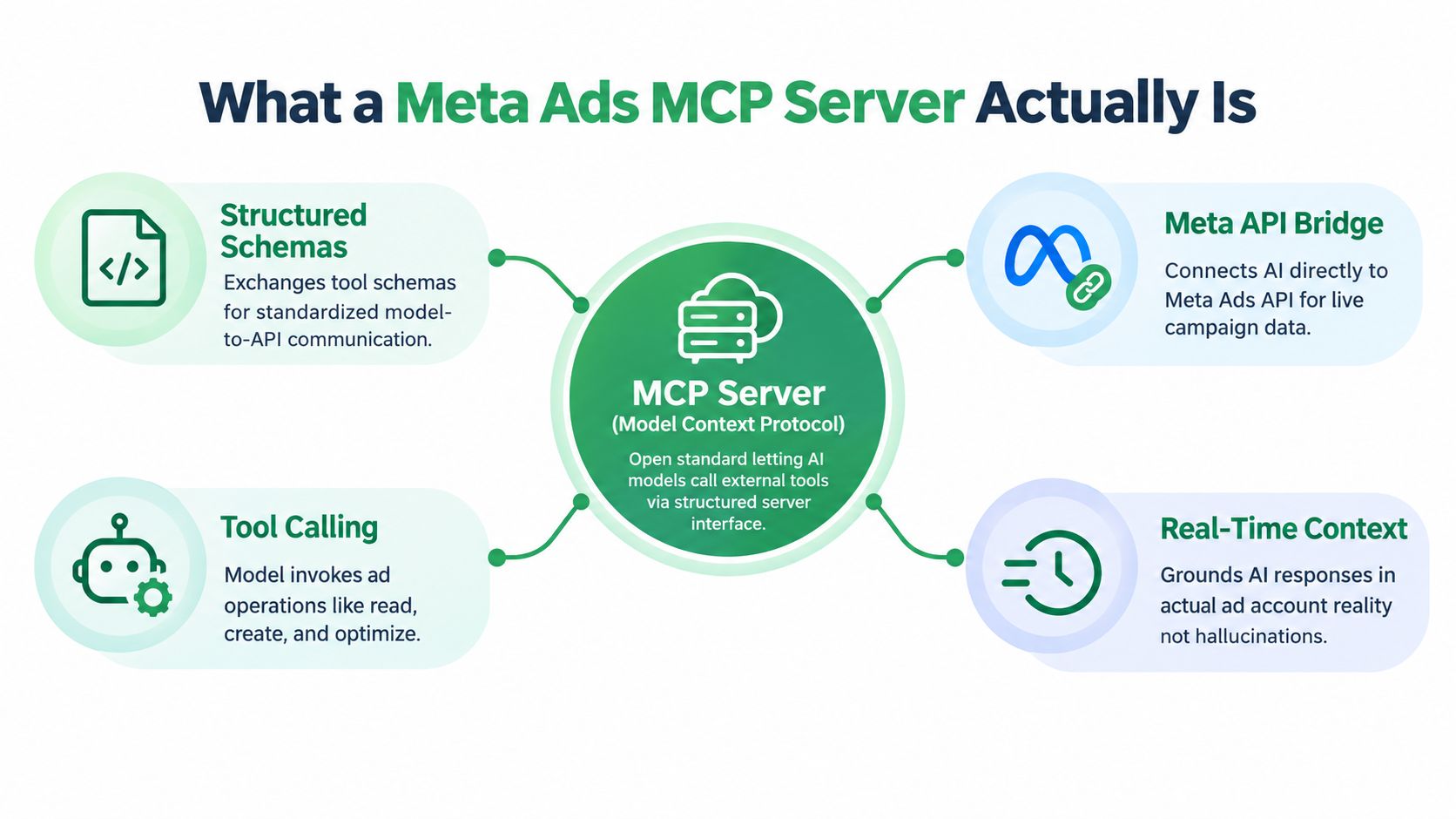
MCP, or Model Context Protocol, is an open standard for letting a model call external tools through a structured server interface. Instead of scraping screens or guessing from memory, the model exchanges schemas, capabilities, and tool results with a server that sits between the chat client and the platform.
In Meta Ads, that server exposes Marketing API actions as typed tools. Think list campaigns, get ad set, update budget, pause ad, and account diagnostics. Meta's hosted endpoint is described as a remote service that provides access through OAuth and a bundle of 29 tools, which is why the agent can query live account data and perform supported operations without a local API integration (Meta Ads MCP setup guide).
Why hosted MCP exists
Hosted servers remove connector burden from the agency side. They handle OAuth, rate limiting, token refresh, and logging, so the team doesn't have to wire raw API calls into its own stack just to get conversational access. Independent coverage also says Meta opened Ads MCP to any developer with a Meta app, which pushed the model away from one-off custom code and toward a standardized MCP layer that keeps the action scope explicit through permission flow (Meta opens Ads MCP).
That's the value of a hosted provider. It isn't novelty, it's operational maintenance, especially when Meta changes the surface and the connector has to keep up.
For a plain-English primer on MCP in another context, the guide to MCP explained for DTC brands is a useful reference point. The concept is the same even if the ad-platform stakes are higher.
What an agency should expect to see exposed
A serious Meta Ads MCP surface should include reporting and read tools, campaign and ad-set controls, catalog operations, and signal diagnostics. It should also make clear which tools are read-only and which are write-capable. If the provider can't explain that separation cleanly, it's not ready for live accounts.
The expectation is simple. The model reads reality first, then proposes change, then writes only after approval.
The Four Safeguards That Make Hosted MCP Servers Work for Ad Ops
Live reads
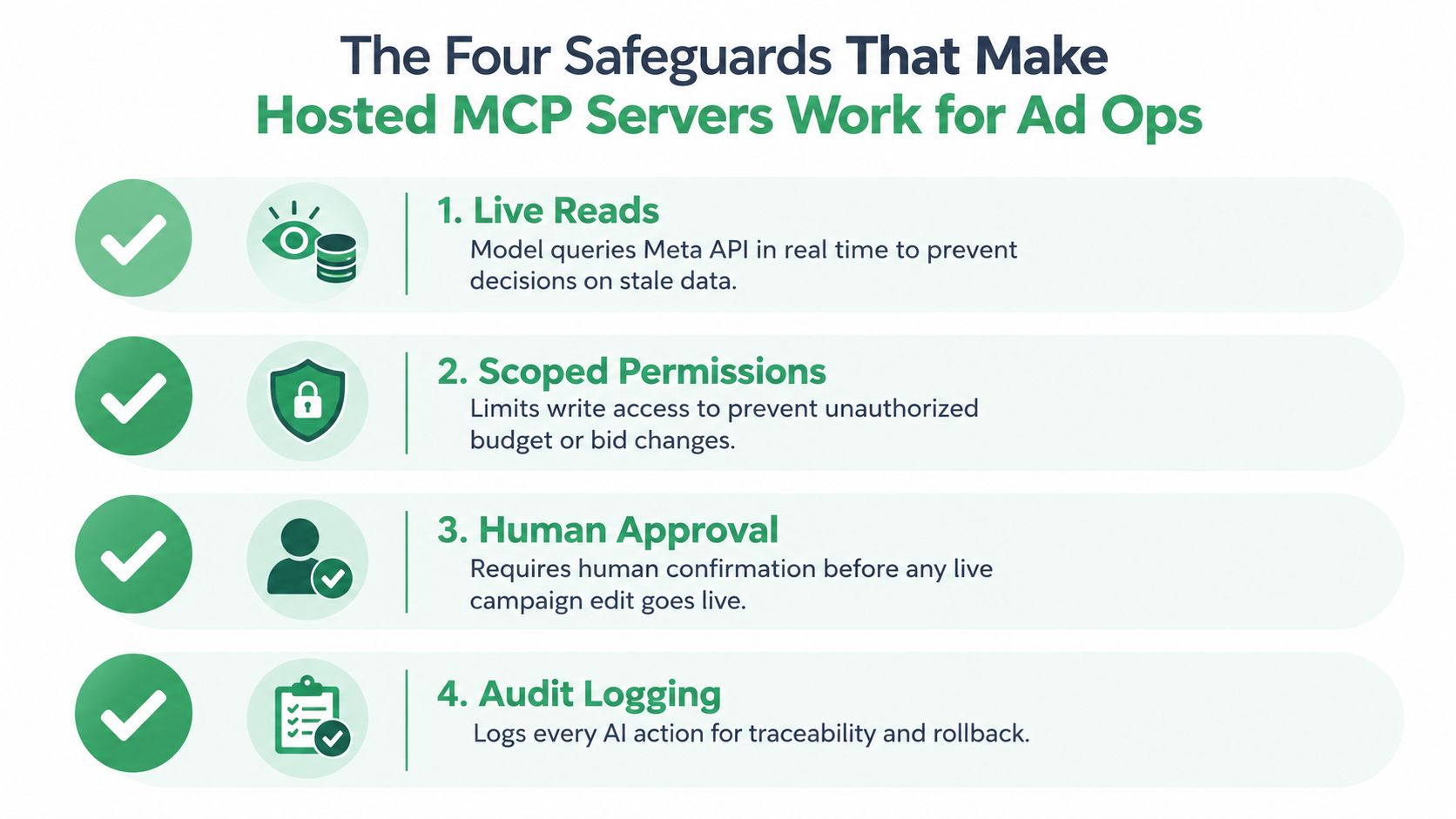
Live reads prevent the worst kind of bad decision, one based on stale budgets or an already-paused status. If the model is pulling from memory, exports, or cached context, it can recommend changes against yesterday's account reality and waste your team's time. Verify this by checking that the provider hits Meta at query time and returns current account state, not a static snapshot.
Approval-gated writes
Approval gating blocks the classic failure mode, an overeager model editing live campaigns in the middle of a sprint. In a safe setup, every mutating request returns a proposed change and waits for a human click. If the provider can't hold the write until approval, it doesn't belong near production spend.
Diffs
Diffs stop silent edits. A reviewer should see the before-and-after view of the affected campaign, ad set, or ad before anything goes live. That gives the operator an audit trail and makes it obvious whether the model is pausing one thing or touching a wider set of entities.
One-call undo
One-call undo is the backstop when someone pauses the wrong campaign or applies the wrong budget move. The server should retain the previous state and expose a direct revert path, not a vague promise that support can fix it later. If rollback requires a ticket and a manual archaeology session, the setup is too loose.
If the write path doesn't show live state, human approval, diff preview, and reversible action, keep it read-only.
Do not enable any write tool in production until all four safeguards are active and tested on a low-risk account. A hosted MCP that only has one or two of them is still a risk, just with a prettier interface.
For a tighter implementation checklist, the internal safety notes on Meta Ads MCP safety are the right place to pressure-test your assumptions.
Meta's Official Ads MCP Versus Third-Party Hosted MCP Providers
Meta's first-party connector is the cleanest default when the agency is Meta-only and governance matters more than convenience. It inherits Meta's own permission model and it's the path most likely to stay aligned with platform changes. Third-party hosted providers are stronger when the agency wants one interface across multiple platforms or needs richer workflow layers around approvals, logging, and cross-account routing.
| Dimension | Meta Official Ads MCP | Third-Party Hosted MCP |
|---|---|---|
| Account reach | Native Meta ad-account access through Meta's own app and OAuth flow | Usually spans one or more Meta business managers, sometimes multiple ad platforms |
| Read and write surface | Official reads and supported writes on Meta's own tool set | Can expose reads, writes, or both depending on provider policy |
| Approval handling | Baked into Meta's own permission model and action scope | Often adds its own review layer before writes execute |
| Latency | Direct to Meta's hosted endpoint | Usually one extra provider hop before Meta |
| Cost model | Platform-native during beta, subject to Meta's own access model | Typically subscription-based or bundled into a broader service |
The right answer depends on the stack. If your team runs only Meta and wants the safest path for writes, stick with the official connector. If you need one chat surface for Meta, Google, or TikTok, a third-party hosted server makes more sense because it consolidates operations and reporting in one place.
That's where a provider like NotFair fits the conversation, it offers hosted MCP servers with approval-gated writes, explicit diffs, and one-call undo across advertising and analytics workflows. That's useful for agencies that care more about control-plane design than about whether the connector came from Meta itself.
For a more detailed side-by-side, the internal comparison at Meta Ads MCP servers is worth using as a decision memo.
Governance, App Review, and the Ads MCP Management Permission Gap
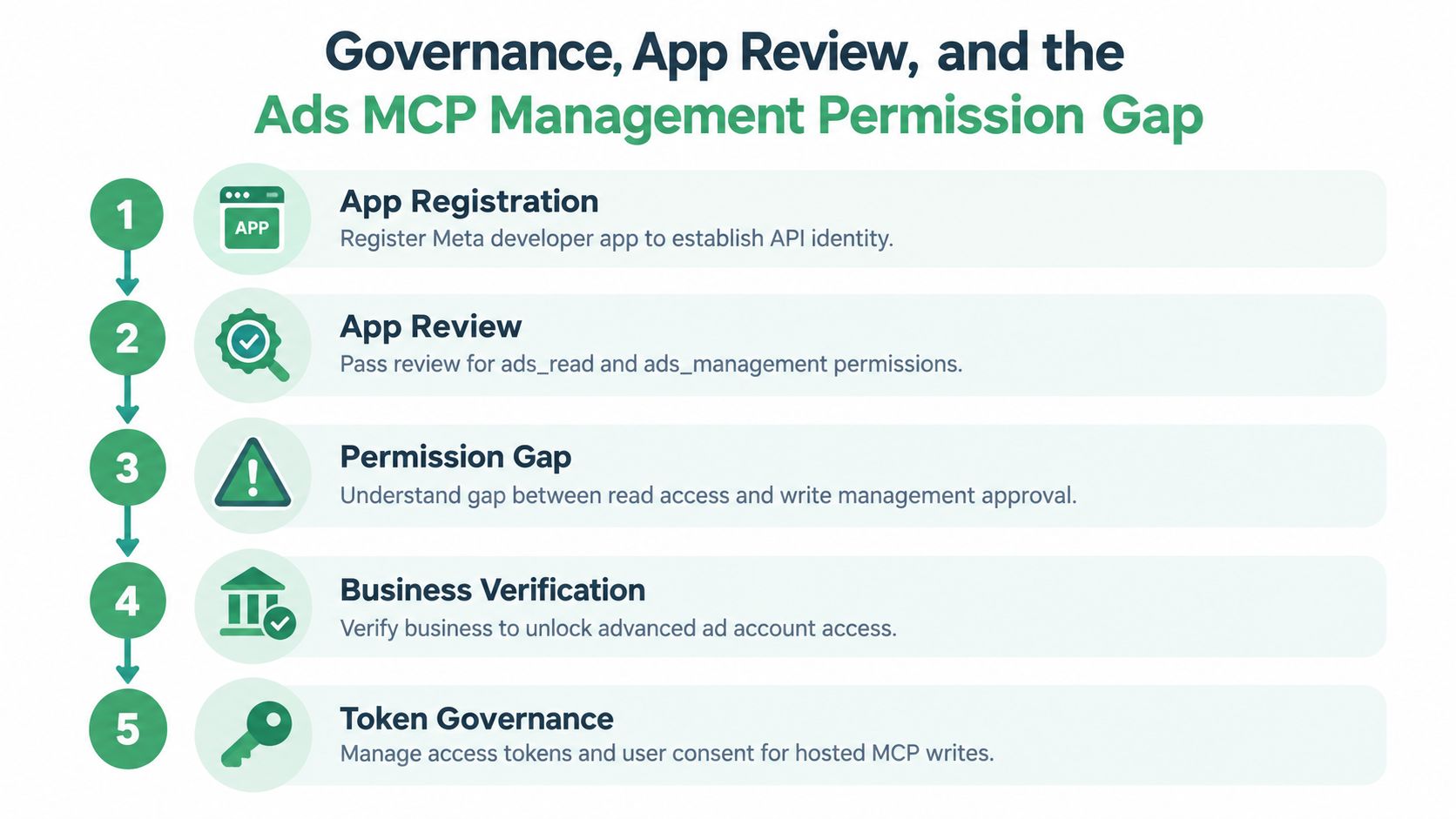
Meta's July 2026 update reportedly lets any developer with a Meta app wire AI agents into live ad accounts, but agencies still have to clear the governance layer before writes should turn on. That means app registration, app review, and the specific ads management permission path all need to be handled cleanly before the first live edit.
The governance checklist that should already exist
Start with the obvious. Someone at the agency needs admin rights on the business manager and the ad account. The app has to be registered properly, reviewed for the relevant ads permissions, and documented in a way that names the human approver for every write action. If those basics aren't explicit, the connector will create more friction than it removes.
The harder part is the permission gap. Meta's own review and approval layers don't always line up neatly with an agency's internal change-control rules, so a team can get read access before it gets the right to manage writes. That's where many rollouts stall, not because the model failed, but because the operational owner didn't define who can approve, when, and under which audit rules.
What to lock before writes go live
Use a written pre-flight checklist and keep it boring. The checklist should cover admin naming, audit log retention, business verification, and the exact person who can approve a change in-session. If the provider or Meta asks who owns the action, the answer should be obvious in under a minute.
The role of the permission tier is not cosmetic. It separates “can inspect” from “can modify,” and agencies that ignore that distinction usually discover it the hard way when a write tool stays inactive.
The internal walkthrough on Meta Ads MCP OAuth is the right companion if you're mapping the auth path before rollout.
Diagnosing Wasted Spend and Drafting Fixes Through Live MCP Reads
The biggest win from live reads is not reporting. It's prioritization. When the model can pull spend, CPA, frequency, and creative fatigue from active ad sets, it can rank the problems by spend at risk instead of dumping a flat list of anomalies on the buyer.
From read to ranked fix list
A useful workflow starts with a read across the active account, then turns that data into a fix list ordered by impact. The model should call out which item is burning the most cash, which one is showing fatigue, and which one looks structurally off, then propose the least disruptive fix first. That's a lot better than chasing four dashboards and trying to remember which alert came from which campaign.
A practical example is easy to picture. One account shows a prospecting set with high burn, an ad set with rising frequency, and a creative that has clearly gone stale. The model should rank them in that order, then propose a pause, a budget shift, and a creative swap as three separate approved actions.
Operational rule: rank by spend at risk, not by whichever metric looks worst in isolation.
How the handoff should work
The output of the read step should be a clean proposal, not a wall of raw numbers. Each item should become a proposed change with a diff, and the human reviewer should approve the bundle in one pass. That keeps the operator in control while still compressing the amount of manual diagnosis work.
The video below shows the kind of workflow this enables in practice.
If the read path can't turn diagnostics into an ordered action list, it's just reporting with a chatbot wrapper. The value is in making the next decision obvious.
A Practical 30-Day Rollout Plan for Performance Marketers and Agencies
Start read-only. If a provider wants write access on day one, that's a red flag, not a feature. In week one, connect the MCP, allowlist the right accounts, and use diagnostics only, with no write scopes enabled.
Weeks two and three are for controlled writes in a sandbox or low-spend account. Test diff previews, one-call undo, and audit logging on small budget changes, then review whether the output matches what a senior media buyer would have done manually. If the model keeps proposing sensible, reversible changes, you can move on.
What changes in the final phase
By week four, governance needs to be formalized. Scope ads_mcp_management to named operators, lock the app review settings, and switch to managed mode if the provider owns token rotation, compliance posture, and uptime. That's the point where the operating model becomes a process, not a pilot.
The decision to buy or build should be blunt.
- Buy hosted MCP when speed-to-value matters, the team needs shared maintenance, and the agency wants compliance documentation without building its own connector layer.
- Build internally when data residency, custom toolchains, or very high spend volume justify the engineering overhead.
- Stay read-only longer if the team can't name a human approver for every write.
The rollout is simple because the risk is simple. The first dangerous mistake is always the same, letting a write surface go live before the agency has a rollback habit.
If you're mapping this against your own stack, NotFair's hosted MCP setup is built around the same operating logic, live reads, approval-gated writes, diffs, and rollback, so it's a decent benchmark for what a governed connector should look like.
If you're serious about using Meta Ads MCP without handing control to an unreviewed automation layer, treat governance as the product, not an afterthought. NotFair gives you hosted MCP servers, approval-gated writes, explicit diffs, and one-call undo across ad and analytics workflows, so your team can move faster without losing auditability. Visit NotFair if you want a connector layer built around controlled execution instead of blind automation.