

This meta ads guide explains how to plan, launch, measure, and improve advertising across Meta platforms and related partner inventory. The practical answer is to align the campaign objective with the business event you can measure, give the auction enough usable signal, test creative by message rather than cosmetic variation, and make decisions from incrementality and unit economics—not clicks alone. That framework applies whether you manage one local account, an agency portfolio, or an approval-gated automation system.
What Meta Ads are and how the system makes decisions
Meta Ads are paid placements purchased through Meta’s advertising system and delivered across surfaces such as Facebook, Instagram, Messenger, and, where selected, Audience Network and other partner inventory. That distinction matters: an ad may reach people outside Meta’s owned apps, so reporting, placement controls, creative rendering, and brand-safety decisions should account for the inventory actually enabled. Meta describes its auction as a process that considers factors including bid, estimated action rate, and ad quality rather than simply awarding every impression to the highest monetary bid. See Meta’s overview of its ad auction and delivery system for the platform’s explanation of these factors: Meta Business Help.
The campaign hierarchy is the operating map:
- Campaign: the business outcome or objective, such as sales, leads, traffic, engagement, or awareness.
- Ad set: the audience, placements, budget allocation, schedule, optimization event, and bidding controls.
- Ad: the creative, copy, destination, tracking parameters, and social proof associated with the message.
Changing the wrong layer creates confusing data. A new offer belongs at the ad level; a genuinely different audience belongs at the ad-set level; a different business outcome may require a separate campaign so delivery and reporting are not forced to serve incompatible goals. Treat the hierarchy as a set of hypotheses, not a filing cabinet.
Objective, optimization event, and conversion are different
The objective describes the business direction, while the optimization event tells delivery what kind of person or action to seek. A sales campaign optimized for purchase is not equivalent to a sales campaign optimized for landing-page views. The former may produce fewer visible actions but can be closer to revenue; the latter may generate cheap visits that never become qualified opportunities.
Choose the deepest event that is both valuable and sufficiently observable. If purchases are rare or tracking is unreliable, an account may need to optimize temporarily for a qualified intermediate event, such as completed lead form or booked consultation. That is a compromise, not proof that the intermediate event is the desired outcome.
Budget is a signal-allocation decision
Budget determines how many auctions the system can enter and how quickly it can collect evidence. It does not rescue a weak offer, broken event tracking, or an audience that cannot plausibly convert. Before increasing spend, identify the constraint:
- Reach constraint: the audience or budget is too narrow to generate delivery.
- Signal constraint: the platform receives too few reliable optimization events.
- Conversion constraint: the landing page, offer, price, or sales process loses intent.
- Economics constraint: the allowable cost per acquisition is below what the auction and funnel can support.
For example, a campaign can have a healthy click-through rate and still be unprofitable because the post-click conversion rate or gross margin is weak. Diagnose the next step in the funnel before treating higher CPM as the root cause.
Why Meta Ads matter to performance teams
Meta often contributes more than direct last-click conversions. It can create demand, introduce a product to people who were not actively searching, recover consideration through retargeting, and supply creative feedback that informs search and lifecycle marketing. Its value is therefore split between direct response, assisted demand, and incremental outcomes.
For a Google Ads manager, the contrast is useful. Search commonly captures existing intent through a query; Meta can create or shape intent through audience, context, and creative. The channels should not be judged by identical click metrics. A Meta prospecting campaign may have weaker last-click efficiency than branded search while still influencing later branded searches and direct visits.
That does not justify vague attribution. Set a decision rule before launch. For example, an illustrative starting policy might say: scale only when contribution margin after advertising remains positive for two consecutive reporting periods, hold when volume is below the minimum evidence threshold, and investigate when lead quality falls even if cost per lead improves. The numbers in that policy should come from the business model, not a universal Meta benchmark.
Translate business economics into account metrics
Start with the unit you can defend:
- Ecommerce: contribution margin per order, allowable cost per purchase, and new-customer payback.
- Lead generation: qualified-lead rate, sales acceptance rate, close rate, and revenue per closed opportunity.
- Subscription: trial-to-paid rate, gross retention, payback period, and expected contribution over the chosen horizon.
- Local services: booked appointments, show rate, close rate, and gross profit per completed job.
Illustrative example: if an account needs 20 qualified leads, 25% become sales opportunities, 40% of those close, and the average contribution from a closed customer is $1,000, the expected contribution before ad cost is $2,000. That is a planning model, not a forecast. If the actual close rate deteriorates, optimizing for cheap form submissions can conceal the commercial problem.
How to build a campaign that can learn
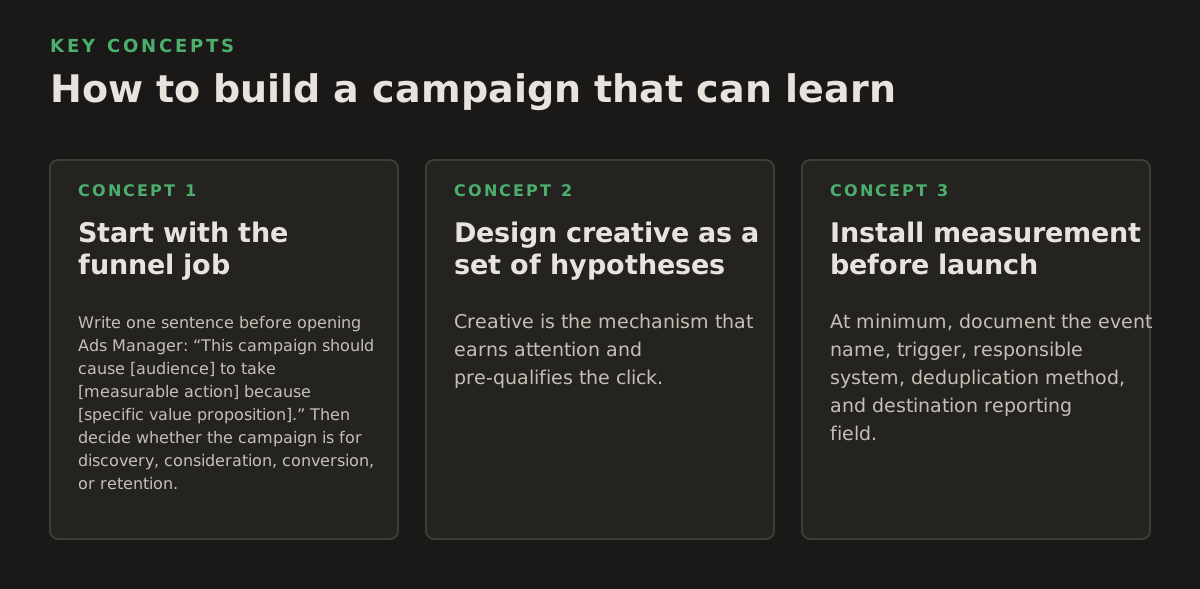
A workable build connects message, audience, event, destination, and economics. If any link is incoherent, delivery data becomes difficult to interpret. A high-intent offer sent to an awareness audience can look like a targeting failure when the real issue is mismatch between promise and readiness.
Start with the funnel job
Write one sentence before opening Ads Manager: “This campaign should cause [audience] to take [measurable action] because [specific value proposition].” Then decide whether the campaign is for discovery, consideration, conversion, or retention. Keep prospecting and remarketing separate when their audiences, frequency tolerance, and offers differ enough to require different decisions.
Do not create many small ad sets merely to make the account look sophisticated. Fragmentation can split budget and signal across audiences that are not meaningfully distinct. Separate ad sets when a difference changes the decision—geography, legal eligibility, language, offer, or a controlled audience test—not simply because two interest labels are available.
Design creative as a set of hypotheses
Creative is the mechanism that earns attention and pre-qualifies the click. Test a meaningful variable:
- Problem framing: time saved versus risk reduced.
- Proof: customer story, demonstration, comparison, or quantified process detail.
- Offer: consultation, trial, discount, audit, or downloadable resource.
- Format: founder-led video, product demonstration, static image, carousel, or user-generated-style explanation.
Keep the destination and conversion definition stable when the purpose is a message test. If the ad, landing page, audience, and event all change simultaneously, a result may be useful commercially but weak diagnostically. Label ads with structured names that record the hypothesis, audience role, offer, and date; avoid names that merely say “new creative.”
Use placements deliberately, but do not assume a placement is bad because its click-through rate is lower. Compare downstream conversion rate, qualified rate, cost, frequency, and creative fit. A placement that produces inexpensive clicks but poor lead quality may be worse than one with a higher click cost and stronger commercial intent.
Install measurement before launch
At minimum, document the event name, trigger, responsible system, deduplication method, and destination reporting field. Meta’s Conversions API documentation explains how server-side event sharing can complement browser-based signals and how event matching and deduplication fit into the setup; use the official developer documentation rather than assuming that a browser pixel alone represents every eligible action: Meta Conversions API documentation.
For ecommerce, reconcile purchase count and value between the website, payment system, analytics platform, and ad account. For lead generation, pass a stable lead identifier into the CRM and define when a lead becomes qualified. If later-stage outcomes can be sent back through an approved integration, the optimization target can better reflect sales quality—but only if the CRM status is timely and consistently defined.
Use UTMs that answer operational questions: source, medium, campaign, audience role, creative concept, and landing-page variant. Google Analytics describes campaign URL parameters and their use in identifying traffic sources in its official documentation: Google Analytics Help. UTMs support analysis; they do not replace platform conversion configuration or a controlled test.
Where Meta Ads reporting breaks
Most account confusion comes from treating different measurement questions as interchangeable. Platform attribution is not incrementality. A reported conversion may have been influenced by an ad, but the report alone does not prove that the ad created a sale that would otherwise not have occurred.
Platform totals can also differ from analytics and CRM totals because systems use different attribution windows, identity resolution, event rules, time zones, consent states, and counting methods. Meta’s attribution setting documentation describes the role of attribution settings in reporting and delivery, so record the selected setting whenever you compare periods: Meta Business Help.
Separate delivery diagnosis from business diagnosis
Use a sequence that prevents premature edits:
- Delivery: Is the campaign spending, reaching the intended geography, and serving acceptable placements?
- Attention: Do people watch, click, or otherwise engage with the message at a reasonable cost for the objective?
- Post-click behavior: Does the landing page load, match the ad promise, and produce the intended event?
- Commercial quality: Do leads qualify, appointments show, orders carry acceptable margin, or customers retain?
- Incrementality: Does a holdout, geo test, or carefully designed comparison suggest added outcomes beyond baseline demand?
Each stage has a different owner. A marketing manager should not ask the creative team to fix a broken purchase event, and an analyst should not label a sales-process failure as “bad targeting.” This separation also makes automation safer because an agent can be restricted to the layer supported by evidence.
Know when the data is not decision-ready
Pause interpretation when a material tracking change, landing-page outage, offer change, policy restriction, or CRM import failure overlaps the reporting period. Record the change log with the date, affected campaigns, expected direction, and validation status. A sudden improvement after a purchase-event repair may be measurement recovery rather than true performance growth.
Do not apply a fixed “winner” threshold across every account. An illustrative example: a high-volume retailer might review creative after 1,000 impressions, while a low-volume B2B campaign may need a longer observation period and a qualified-pipeline check. Those are starting policies, not benchmarks. The correct threshold depends on spend, conversion frequency, sales-cycle length, and the cost of a wrong decision.
How practitioners improve an account without destroying evidence
Optimization is a controlled sequence of changes, not constant editing. Begin with the highest-leverage uncertainty: tracking integrity, economics, offer-market fit, creative fatigue, audience breadth, or landing-page friction. Then change one decision variable where possible and preserve a comparison period.
Use a simple operating record containing:
- Observation: the exact metric or business signal that changed.
- Hypothesis: the mechanism believed to explain the change.
- Action: the smallest reversible edit that tests the hypothesis.
- Guardrail: the spend, CPA, frequency, or quality limit that triggers rollback.
- Review date: when enough evidence should exist, accounting for the sales cycle.
Examples of mechanism-based actions include replacing a fatigued opening hook while keeping the offer constant, repairing a missing value parameter before changing bids, or splitting a regulated geography when its legal copy differs. Avoid simultaneous budget, audience, bid, creative, and landing-page edits unless the account is in an emergency state; otherwise the post-change result cannot identify what helped.
Budget changes deserve special care because delivery can reallocate. Use gradual, pre-approved changes as an illustrative starting policy, and define what “too much volatility” means for that account. A budget increase is justified by profitable marginal demand, not by the fact that the campaign is currently spending less than the available budget.
Use automation with approval gates
AI can summarize anomalies, compare naming conventions, classify creative themes, draft test plans, and identify missing fields. It should not silently convert uncertain diagnosis into irreversible account changes. A safe workflow distinguishes read access, recommendation access, and execution access, with permissions and rollback behavior appropriate to each.
For example, an automated system may be allowed to:
- flag a sudden zero-purchase day for human review;
- propose pausing an ad whose destination returns an error;
- draft a budget change with the reason, expected effect, and rollback condition;
- execute only a pre-approved, reversible edit within a defined limit.
That pattern is relevant when connecting AI clients to advertising APIs. NotFair’s Google Ads MCP and Meta Ads MCP are relevant when a team wants a shared interface for diagnosis and controlled operations across paid-media workflows. The implementation still needs account permissions, event definitions, audit logs, and human ownership; an MCP connection does not make an ambiguous metric reliable.
A practical decision framework for your next campaign
Before launch, answer five questions in writing:
- What outcome pays for the campaign? Name the commercial event, not just the platform objective.
- What signal can Meta observe reliably? Check event firing, value, deduplication, consent behavior, and CRM handoff.
- What message should change behavior? State the audience problem, proof, offer, and destination promise.
- What would make you stop or change direction? Define delivery, quality, and economics guardrails in advance.
- What evidence would justify scaling? Require both platform performance and downstream business quality.
For an existing account, audit in this order: event integrity, campaign-to-business alignment, funnel quality, creative coverage, audience structure, and only then bidding or budget controls. This order prevents teams from using auction settings to compensate for a broken measurement layer or an uncompetitive offer.
For agencies, make the framework visible in client reporting. Show spend and platform conversions, but place them beside qualified outcomes, revenue or contribution where available, tracking changes, and the next decision. For in-house teams, preserve the same definitions across Meta, Google Ads, analytics, and CRM reporting so channel comparisons do not become arguments about whose dashboard is correct.
For AI and MCP developers, model recommendations as typed actions with evidence, confidence, scope, approval state, and rollback data. A useful system should be able to say “insufficient evidence,” identify the affected campaigns, and defer execution. That restraint is a feature: advertising accounts are production systems, and a plausible explanation is not the same thing as a validated cause.
The best next step is to turn this framework into a short account-specific runbook: one business outcome, one trusted event path, a small set of creative hypotheses, explicit guardrails, and a review cadence matched to the sales cycle. If you want that process connected to approval-gated AI workflows, NotFair can help you evaluate whether NotFair’s hosted advertising MCP servers fit your operating model.
Authored with NotFair SEO