

The Meta Ads API is the foundation for pulling campaign data and making programmatic changes in Meta advertising accounts, but it is not automatically the right tool for every reporting or automation job. A growth team may need raw API control, an agency may need governed data delivery to a warehouse, and a marketer using Claude or Cursor may need an approval-gated layer that can diagnose performance and execute reversible actions.
This comparison is for people who already manage Meta campaigns, build marketing systems, or need to decide whether to use Meta’s own developer stack or a third-party connector. It compares six approaches to the same broad job: turning Meta Ads data and operations into a repeatable workflow. These are not interchangeable products, so the categories matter:
- Native development: Meta Marketing API and Facebook Business SDK give engineers direct control.
- Data connectors: Supermetrics, Funnel, and Adverity move advertising data into reporting, warehouse, and business-intelligence workflows.
- AI action layer: NotFair connects AI clients to advertising systems and places approval controls around operational work.
The ranking is not a universal winner list. I evaluate each option on four practical criteria: what it can actually change or extract, implementation and maintenance burden, governance and failure control, and commercial model. Capability and pricing can change, so the links in each section are the sources to check in 2026 before committing.
Important distinction: a connector that refreshes spend and conversion data is not the same thing as a system that can edit budgets, targeting, bids, or ads. Choose based on the action your team must perform, not the word “integration” on a product page.
1. Meta Marketing API
What it does and where it fits
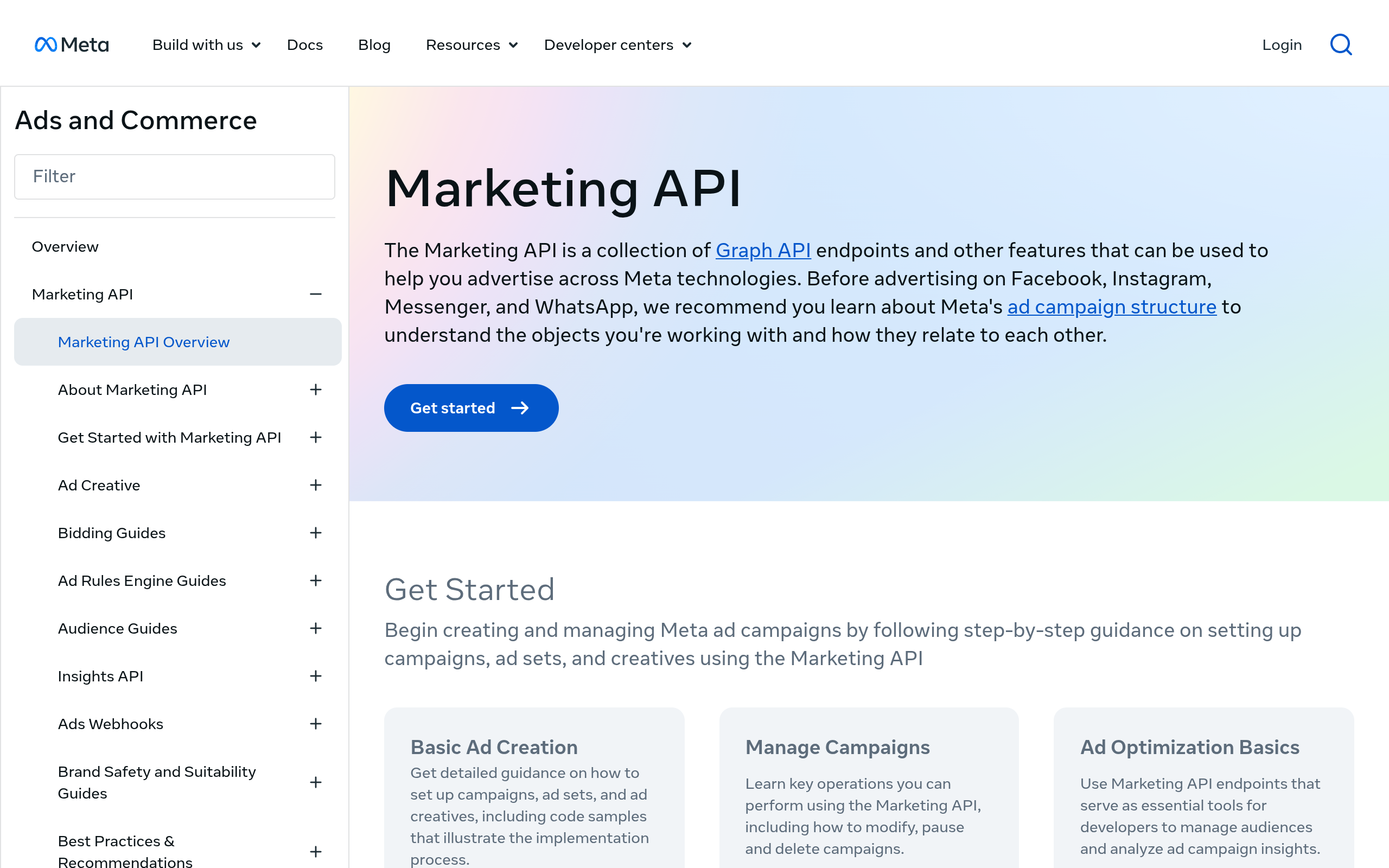
Meta Marketing API is the direct, official route for software that works with Meta advertising objects such as campaigns, ad sets, ads, creatives, insights, and audiences, subject to the permissions, account access, review requirements, and endpoint behavior applicable to the app. Meta’s own Marketing APIs documentation is the authoritative starting point for the available interfaces and requirements.
This is the strongest option when the job is to build a proprietary campaign-management system, an internal optimization service, or a high-volume data pipeline where your engineering team needs control over request logic. For example, an agency could build a service that reads spend and purchase data each morning, flags ad sets with tracking anomalies, and submits budget changes only after a human approval event.
Implementation, cost, and poor fits
- Best for: engineering teams that need direct control over Meta campaign objects and data retrieval.
- Does not suit: a marketer who needs a working dashboard this week without maintaining authentication and API code.
- Standout: it is the underlying interface that many other Meta advertising tools depend on.
Implementation burden is high. Your team owns app configuration, access tokens, permission handling, pagination, rate-limit behavior, retries, schema changes, logging, and safeguards against modifying the wrong account. A useful production design also needs idempotency: if a retry occurs after a timeout, it should not accidentally duplicate an operation or apply a change twice.
The commercial model is not a simple SaaS subscription for the API itself. Engineering, hosting, monitoring, data storage, and any applicable Meta platform requirements become your cost base. Verify current access and review conditions in Meta’s developer documentation. This is a poor fit if the real need is scheduled reporting rather than campaign control.
2. Facebook Business SDK
What it adds to direct API work
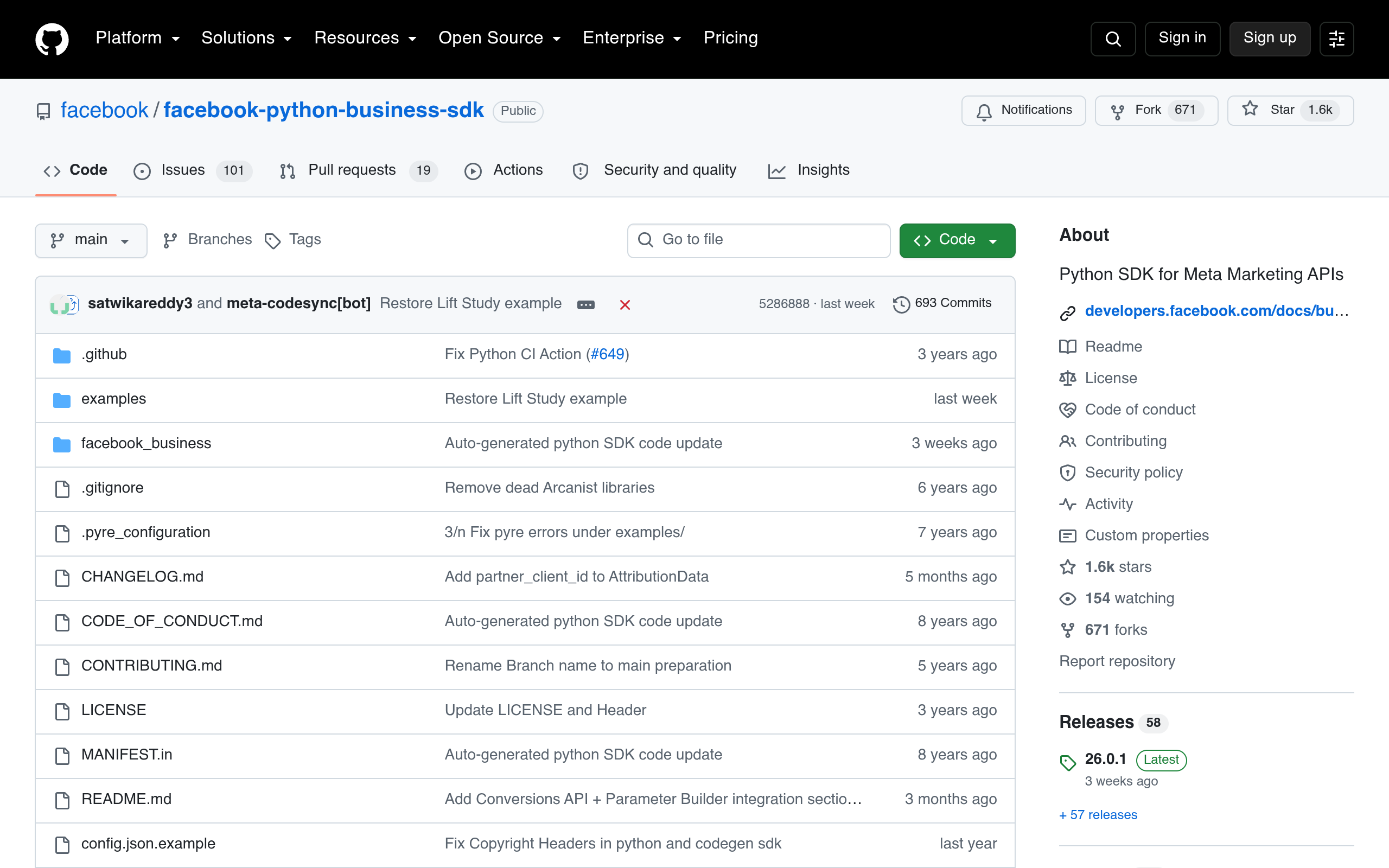
Facebook Business SDK is a set of language-specific libraries that helps developers call Meta’s business and marketing interfaces without hand-writing every HTTP request. The official Python SDK repository documents the package and its examples; equivalent SDK repositories exist for other supported languages.
The SDK is best understood as a development aid, not an alternative advertising platform. It can make object construction, request handling, and code organization more familiar for a Python, PHP, Java, or other application team. It does not remove the need to understand account permissions, API versions, asynchronous jobs, rate limits, validation errors, or the consequences of changing live ads.
Implementation, cost, and poor fits
- Best for: developers building custom services who want a maintained client library rather than raw HTTP calls.
- Does not suit: nontechnical teams looking for a no-code reporting or optimization interface.
- Standout: it can reduce repetitive API plumbing while leaving application logic under your control.
The implementation burden remains substantial. A developer still has to define which campaigns are eligible, distinguish account-level from ad-set-level changes, validate inputs, and create rollback or audit mechanisms. The SDK also does not decide whether a recommendation is strategically sound. A request that is syntactically valid can still be commercially damaging.
There is no conventional per-seat marketing-automation price implied by the SDK repository. The commercial model is effectively open-source client code plus your engineering and infrastructure costs, with Meta platform access governed separately. Check the repository’s current maintenance status and version guidance before using it as a foundation in 2026. For a small business with occasional edits, the SDK is usually overbuilt.
3. Supermetrics
What it does and where it fits
Supermetrics is a data-movement and reporting product rather than a general-purpose campaign-editing API. Its official Facebook Ads connector page describes its role in bringing advertising data into supported destinations and reporting environments. That makes it relevant when the buyer job is consistent Meta Ads reporting, not autonomous campaign changes.
A performance agency could use this type of connector to standardize delivery of spend, impressions, clicks, conversions, and breakdowns into spreadsheets, dashboards, or a warehouse-supported workflow. The value is operational: fewer manual exports, reusable report structures, and a shared data path for recurring client reporting.
Implementation, cost, and poor fits
- Best for: agencies and marketing teams that need repeatable Meta Ads reporting across accounts and destinations.
- Does not suit: teams whose core requirement is to create ads, alter budgets, or execute optimization decisions through software.
- Standout: it can be much faster to deploy than a custom ingestion service when the required fields and destination are supported.
Implementation is moderate rather than trivial. You still need to map account naming, select attribution and date settings, handle currency and time zones, document metric definitions, and check whether the connector’s refresh behavior matches the reporting deadline. A dashboard can look precise while mixing incompatible attribution windows or comparing incomplete current-day data.
Supermetrics uses a commercial SaaS model, with plans and limits depending on the product, destination, users, and connector scope. Current pricing and included capabilities should be verified on the vendor’s pricing and product pages before purchase. It is a poor fit when the business wants an AI operator to investigate an anomaly and then make an approved change inside Ads Manager.
4. Funnel
What it does and where it fits
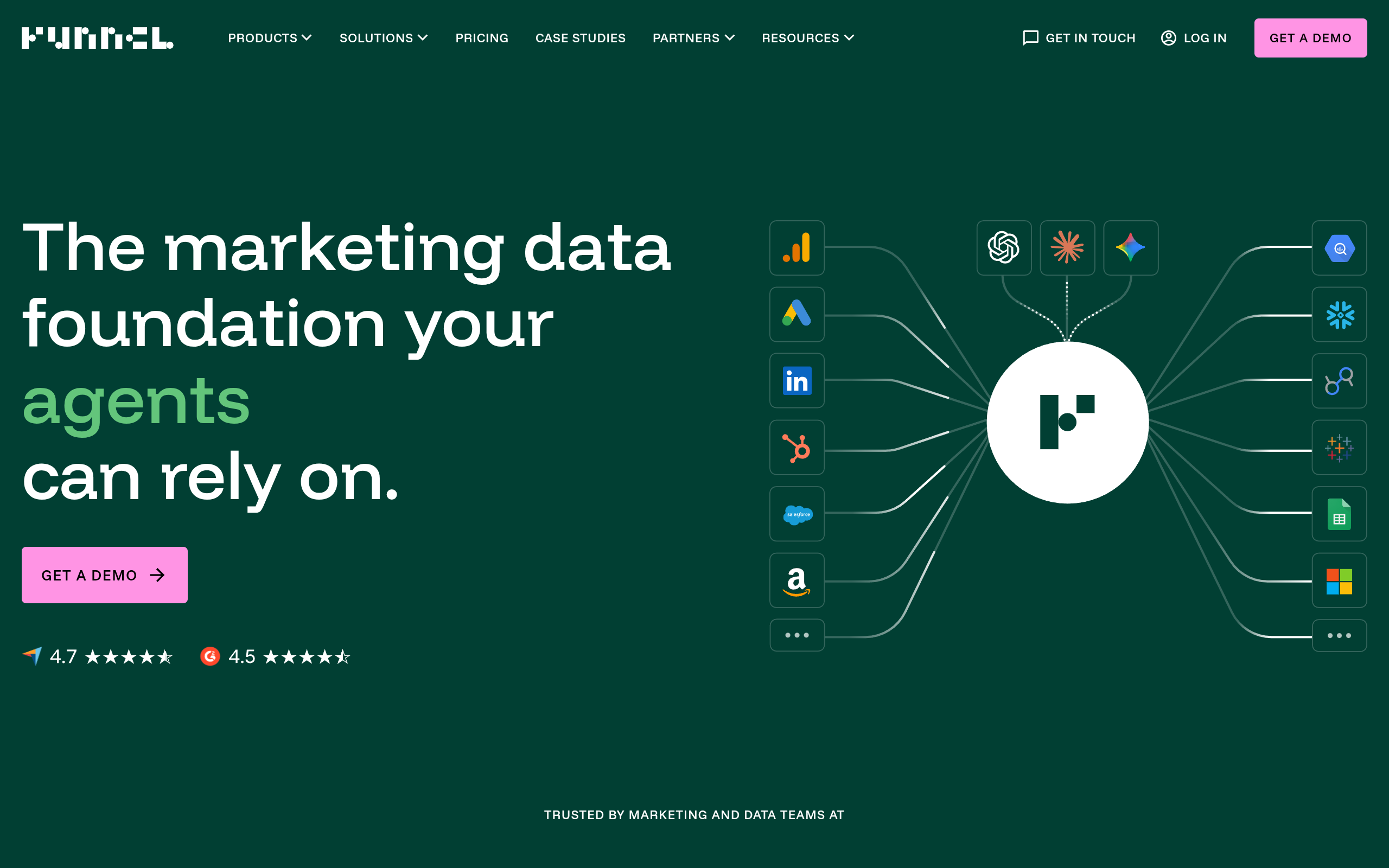
Funnel is a marketing data hub focused on collecting, transforming, and distributing advertising and marketing data. Its Facebook Ads data-source page is the relevant official reference for how Meta data fits into its connector catalog. Funnel belongs in the data-connector category, alongside tools used to create centralized reporting models rather than direct ad-buying interfaces.
It can suit an in-house demand-generation team that wants Meta Ads data normalized alongside Google Ads, analytics, CRM, and other sources. The important mechanism is the transformation layer: teams can define naming, grouping, and calculated fields once, then reuse them in recurring reports. That is useful when the business problem is inconsistent campaign taxonomy across channels.
Implementation, cost, and poor fits
- Best for: multi-channel teams that need governed marketing data and reusable reporting transformations.
- Does not suit: a developer seeking a thin wrapper around every Meta Marketing API endpoint.
- Standout: the central data model can reduce repeated spreadsheet manipulation across clients or brands.
Implementation burden shifts from coding to data governance. Someone must define source-of-truth rules, channel mappings, campaign classifications, refresh expectations, and ownership for broken fields. Agencies also need a client-by-client policy for account authorization and offboarding. This is less code than a native integration, but it is not a set-and-forget reporting switch.
Funnel is sold as a commercial SaaS product, with pricing and plan scope subject to the selected data sources, destinations, and usage requirements. Verify current pricing directly with Funnel. It does not suit a team that needs closed-loop action execution—for example, detecting a CPA spike and automatically lowering a budget—unless another system performs that action.
5. Adverity
What it does and where it fits
Adverity is an enterprise-oriented marketing data and analytics platform. Its official Adverity website describes the broader product; buyers should confirm the current Meta connector, destination, transformation, and activation scope with the vendor because enterprise feature packaging can vary.
Adverity is relevant when Meta Ads is one source in a larger marketing-data estate. A multinational organization may need standardized ingestion, data quality controls, governance, and distribution to analytics systems rather than another isolated Meta dashboard. The decision is less about “can it fetch clicks?” and more about whether the organization needs a controlled operating layer for many data sources and stakeholders.
Implementation, cost, and poor fits
- Best for: larger organizations with complex cross-channel data governance and analytics requirements.
- Does not suit: a small advertiser that only needs a weekly Meta Ads export or a lightweight spreadsheet connector.
- Standout: its value is most defensible when data quality, scale, and governance matter across the whole marketing stack.
Implementation burden is high on the operating side. Expect to involve analytics, marketing operations, security, and data owners in source authorization, taxonomy design, validation, and destination management. Before signing, require a field-level answer for the Meta metrics you use, including breakdowns, attribution settings, historical backfill, refresh cadence, and error handling.
Adverity generally follows an enterprise commercial model, with pricing typically dependent on scope and configuration rather than a simple public self-serve rate. Do not infer a current price or included Meta capability from a general product description; request a 2026 proposal and verify the exact connector terms. It is a poor fit if a team wants a narrowly scoped AI assistant for day-to-day campaign diagnosis.
6. NotFair
What it does and where it fits
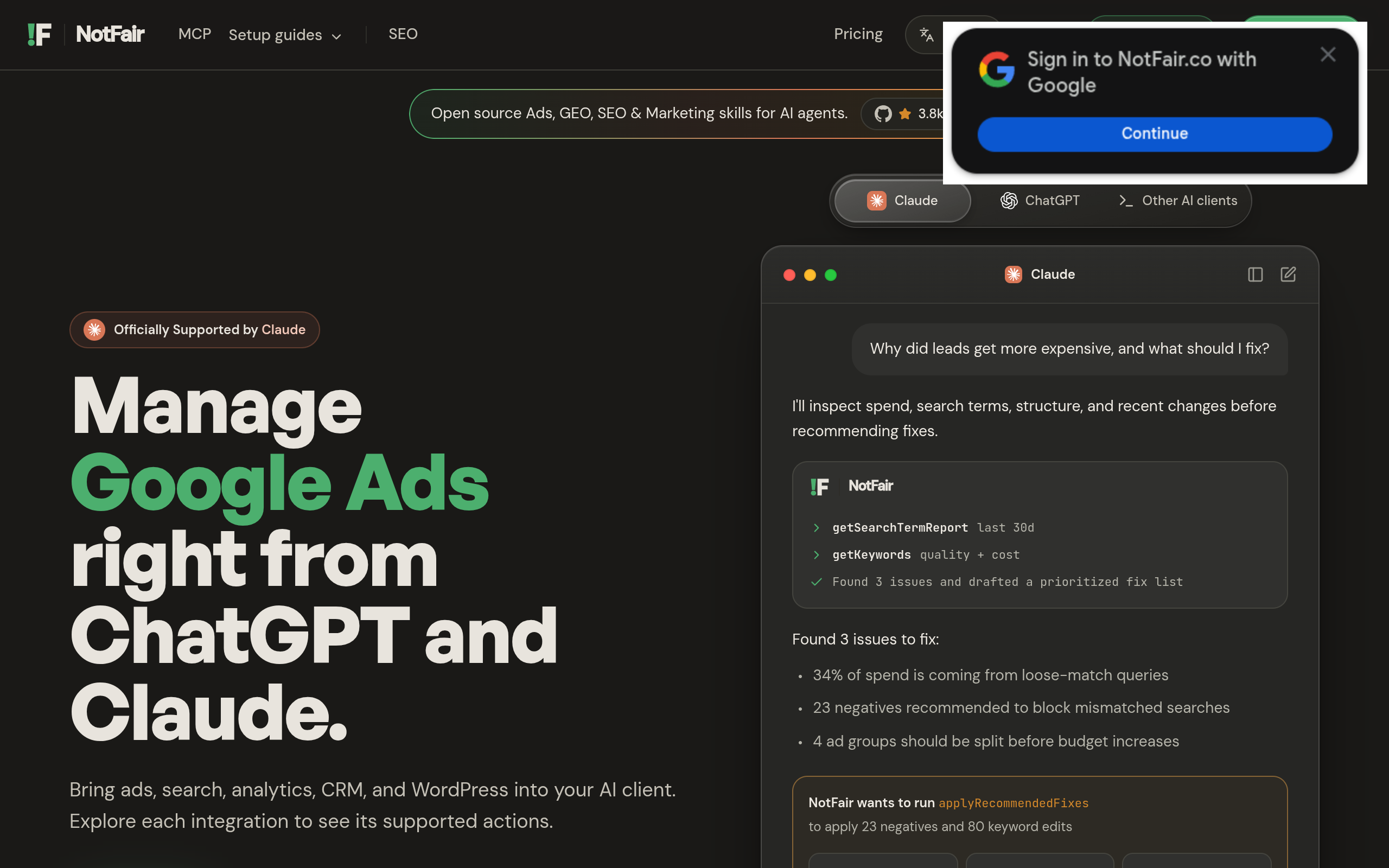
NotFair provides hosted MCP servers that connect AI clients such as Claude, Codex, Cursor, OpenClaw, and Hermes with advertising and marketing systems. Its Meta Ads MCP page is the relevant product reference. This is an action-layer approach: the buyer is not merely exporting Meta data, but giving an AI client a controlled way to inspect account performance, reason about problems, and—where approved—execute operational changes.
The distinction matters for a concrete workflow. An agency strategist could ask an AI client to identify ad sets spending without recent purchase signals, inspect delivery and creative context, propose a budget adjustment, and wait for approval before making a reversible change. The AI is useful for investigation and orchestration; the approval boundary remains part of the system design rather than an assumption that every recommendation should execute.
Implementation, cost, and poor fits
- Best for: marketers and agencies that want AI-assisted Meta Ads diagnosis and approved operational workflows.
- Does not suit: organizations that only need a stable warehouse feed, or teams unwilling to define permissions and review policies.
- Standout: it connects the reasoning interface used by an AI client with advertising operations without requiring every marketer to build an API application.
Implementation is lower than building from the native API, but governance is still your responsibility. Connect the relevant accounts, choose the AI client, define who may approve changes, and establish policies for budgets, targeting, creative, and data access. Start with read-only diagnosis or recommendations, then expand to reversible actions after the team has reviewed logs and approval behavior.
NotFair is a hosted commercial service, so pricing and included account or action scope should be confirmed on its current product and service pages. It is not a replacement for a mature warehouse when the central requirement is long-term data modeling and broad historical reporting. It also does not suit teams seeking fully autonomous, unreviewed campaign changes; approval-gated operation is a deliberate constraint.
Comparison
The table compares the same buyer-facing dimensions across all six options. “Campaign action” means changing advertising objects, not merely refreshing a report. A connector may expose useful data while leaving execution to another system.
| Entity | Primary job | Campaign action | Implementation burden | Commercial model and fit |
|---|---|---|---|---|
| Meta Marketing API | Direct programmatic access to Meta advertising objects and insights | Broadest direct control, subject to permissions and API rules | High: engineering, auth, monitoring, safeguards | Platform access plus internal engineering and infrastructure; best for custom systems |
| Facebook Business SDK | Developer libraries for building against Meta interfaces | Supports custom actions through application code | High: SDK reduces plumbing but not product responsibility | Client-library approach plus internal build costs; best for developers |
| Supermetrics | Move Meta Ads data into reporting and supported destinations | Primarily data access, not general campaign editing | Moderate: connectors, metric definitions, refresh checks | Commercial SaaS with plan and destination scope; best for recurring reports |
| Funnel | Centralize and transform multi-channel marketing data | Primarily data access; use another action system | Moderate: source mapping and governance | Commercial SaaS with scope-dependent plans; best for normalized reporting |
| Adverity | Enterprise marketing data management and analytics workflows | Confirm current activation scope; not a default campaign operator | High: enterprise implementation and governance | Enterprise sales model; best for complex data estates |
| NotFair | AI-assisted diagnosis and approval-gated advertising operations | Designed for approved operational workflows where supported | Moderate: connect accounts, AI client, permissions, policies | Hosted commercial service; best for AI-enabled marketer and agency workflows |
How to choose the right Meta Ads API approach
Start with the irreversible decision
First write down the action your system must take. “Improve Meta performance” is too vague to select technology. These are materially different jobs:
- Scheduled reporting: deliver spend, conversions, and breakdowns to a dashboard or spreadsheet.
- Data unification: combine Meta, Google Ads, CRM, and analytics data under shared naming rules.
- Custom execution: create, edit, pause, or budget campaigns through software you own.
- AI-assisted operations: let an AI investigate performance and propose or execute approved changes.
If the first job is the only requirement, start with a connector rather than building against the native API. If the third job is central, evaluate Meta Marketing API or the SDK. If the fourth job is the priority, assess the approval model, auditability, reversibility, and supported actions before comparing superficial “AI” labels.
Match the data design to the decision cycle
Reporting and optimization have different freshness requirements. A monthly executive report can tolerate a slower refresh and stable historical definitions. A budget-pacing workflow may need current-day data, clear time-zone handling, and explicit treatment of incomplete conversion lag. Do not buy a connector until you can answer:
- Which attribution setting and conversion columns will be used?
- Are account, campaign, ad set, ad, placement, and creative breakdowns required?
- How will deleted, archived, renamed, or duplicated objects be handled?
- What happens when Meta returns partial data, a permission error, or a rate-limit response?
- Where will the audit record live when someone changes a budget?
For an agency, add client isolation and offboarding to the checklist. A convenient connector that makes it difficult to identify which client authorized which account is an operational risk. For an in-house team, document ownership: paid media should own business rules, while engineering or analytics owns reliability and schema monitoring.
Use staged permissions for AI and automation
AI adds a reasoning layer, not certainty. A sensible starting policy is to allow read access and recommendations, then permit a narrow class of reversible changes after review. This is an illustrative starting policy, not a universal benchmark:
- Observe: retrieve delivery, spend, conversion, and change-history context.
- Explain: require the system to identify the evidence behind a diagnosis.
- Propose: show the exact account, object, field, old value, and new value.
- Approve: require a named human or policy engine to authorize the change.
- Verify: re-read the object and record whether Meta accepted the operation.
This sequence prevents a common failure mode: an assistant notices a high CPA, changes several variables at once, and leaves the team unable to attribute the result. Keep one meaningful variable per experiment where possible, preserve the previous state, and define a rollback path before granting write access.
Make the final selection
Choose Meta Marketing API when you are building a durable product or internal platform and can fund engineering ownership. Choose the Facebook Business SDK when you already have that application team and want language-specific development support. Choose Supermetrics for a relatively direct reporting workflow, Funnel for reusable multi-channel data modeling, and Adverity when enterprise governance and data complexity justify a larger implementation.
Choose NotFair when the job is to put Meta Ads context in front of an AI client and turn diagnosis into controlled, approval-gated operations rather than build the entire integration yourself. NotFair also connects AI workflows to Google Ads and other marketing systems; start with NotFair if that cross-channel operating model matches your team’s requirements.
Authored with NotFair SEO