

Marketing campaign examples are most useful when they show the business problem, audience, offer, channel, measurement rule, and next action—not just an attractive ad. For paid media teams, the strongest reusable patterns are a high-intent search campaign for qualified leads, a product-led shopping campaign, a Meta prospecting-and-retargeting sequence, a local service demand-capture campaign, a win-back campaign, a measurement-recovery campaign, and a controlled experiment. This guide explains when each pattern applies, why it works, where it fails, and how to adapt it across Google Ads, Meta Ads, and analytics workflows.
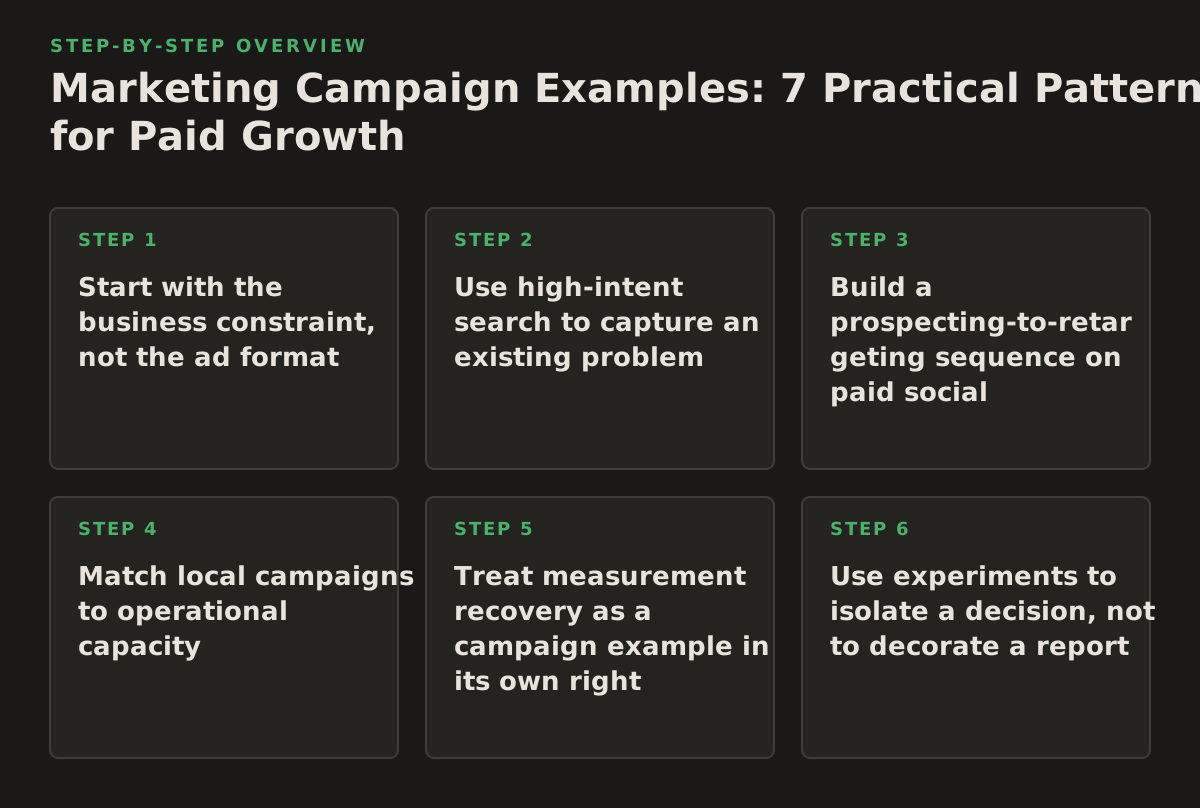
1. Start with the business constraint, not the ad format
A campaign example should begin with a constraint that can be diagnosed. “We need more conversions” is too broad to guide targeting or budget. “Sales-qualified leads have fallen while form volume is stable” creates a specific decision: investigate lead quality, routing, search intent, or measurement before increasing spend.
Use one primary outcome and one guardrail. The primary outcome might be completed purchases, qualified opportunities, booked appointments, or activated accounts. The guardrail protects the business from a misleading win, such as cheaper leads that never reach sales.
A reusable campaign brief
- Constraint: What is not working, and over what comparison period?
- Audience: Who has the problem, and what evidence shows they are in-market?
- Offer: What action is the campaign asking for?
- Friction: What could stop the person after the click?
- Measurement: Which event proves progress, and who validates it?
- Decision rule: What would cause you to scale, revise, pause, or investigate?
Example: A commercial cleaning company has steady website traffic but too few quote requests from office managers. The campaign objective is not “more clicks.” It is quote requests from businesses within its service area, with a guardrail that calls and forms must be screened for residential inquiries.
Why it works: the campaign can align keywords, landing-page copy, form fields, and sales feedback around one economic outcome. Failure mode: choosing a platform metric such as click-through rate as the primary goal. A high click-through rate can coexist with poor lead quality when the ad promises something broader than the sales team can fulfill.
2. Use high-intent search to capture an existing problem
This pattern fits products or services that people actively research: legal help, replacement parts, software categories, emergency repairs, or professional services. Search is strongest when the wording reveals a problem, a category, or a buying stage—not merely an interest.
Example: B2B software lead generation
A payroll software company creates separate ad groups for “multi-state payroll software,” “payroll compliance platform,” and “replace payroll provider.” Each group receives a landing page whose headline reflects the query, a short qualification form, and a calendar option for higher-intent visitors.
- Demonstrates: message-to-market alignment across query, ad, landing page, and sales handoff.
- Why it works: the searcher’s language supplies a useful proxy for urgency and category fit.
- Adapt: map each profitable problem phrase to one promise and one proof point.
- Watch: irrelevant variants, competitor terms, job-seeker traffic, and informational searches.
Google’s documentation describes responsive search ads as a format that combines multiple headlines and descriptions to serve combinations relevant to prospective customers; use that flexibility to test distinct messages rather than repeating minor wording changes. See Google’s official guidance on responsive search ads.
Implementation example: For “multi-state payroll software,” test headlines such as “Payroll for 50-State Teams” and “Reduce Manual Compliance Work,” while keeping the landing page specific to multi-state employers. Use negative keywords for “jobs,” “free template,” and “course” if those visitors cannot become customers.
Failure mode: combining every payroll-related query into one campaign and sending all traffic to the homepage. That hides intent differences and makes it difficult to determine whether poor performance comes from targeting, creative, or the destination page.
3. Build a prospecting-to-retargeting sequence on paid social
Meta campaigns often need to create demand as well as capture it. This pattern applies when buyers need education, visual proof, or repeated exposure before conversion—consumer products, courses, memberships, apps, and considered B2B offers.
Example: ecommerce product education
A direct-to-consumer skincare brand runs prospecting ads around a problem—sensitive skin and inconsistent routines—rather than immediately leading with a discount. People who watch or engage with the education receive a second ad featuring ingredients, reviews, or a routine demonstration. Product viewers receive a final retargeting message with delivery information and a clear purchase route.
- Stage one: introduce the problem and product category to qualified cold audiences.
- Stage two: answer objections with demonstration, comparison, or customer proof.
- Stage three: recover high-intent visitors with product detail, availability, and friction removal.
Why it works: each stage answers a different question. “Is this for me?” comes before “Why this product?” and “Why buy now?” Adaptation: define audiences by behavior and recency, but keep exclusions explicit so purchasers do not continue receiving acquisition ads.
For measurement, Meta documents the Conversions API as a way to send web or offline events from a server or other direct connection to Meta’s systems. That is relevant when browser-only signals are incomplete, but event quality and consent requirements still need review. See Meta’s official Conversions API documentation.
Illustrative example: Failure mode: treating retargeting as a perpetual discount machine. If every site visitor sees “20% off,” the campaign can train buyers to wait, spend against low-intent visitors, and obscure whether the product education actually worked.
Concrete policy: use an illustrative starting sequence of seven-day product-view retargeting and thirty-day engaged-user retargeting, then adjust based on buying cycle, frequency, margin, and incrementality evidence. Those windows are a starting policy, not a universal benchmark.
4. Match local campaigns to operational capacity
Local advertising works only when media demand and fulfillment capacity agree. This pattern fits clinics, trades, restaurants, dealerships, franchises, and service businesses where geography, opening hours, phone response, and appointment availability materially affect conversion rate.
Example: emergency HVAC service
An HVAC company separates urgent repair searches from planned replacement searches. The urgent campaign uses call-focused messaging, service-area language, and a landing page with hours and response expectations. The replacement campaign explains financing, efficiency, and consultation steps rather than promising immediate arrival.
Demonstrates: different customer urgency requires different offers, routing, and qualification. Why it works: a person with a failed furnace does not evaluate the business like someone comparing a planned installation. Adapt: create a campaign-to-operator map that identifies who answers, during which hours, and what happens after a missed call.
- Exclude locations the business cannot serve profitably.
- Match ad schedules to real call-answering coverage.
- Record call outcomes, not only call duration.
- Send appointment or revenue status back to the reporting system where practical.
Failure mode: optimizing toward form fills while the dispatch team cannot respond quickly. A cheap lead can be economically worthless if the customer books with a competitor during the delay.
For a local business, a useful guardrail is “qualified appointments per staffed hour,” not just cost per lead. If a campaign produces more inquiries than the team can process, reducing volume or improving triage may create more revenue than adding budget.
5. Treat measurement recovery as a campaign example in its own right
Sometimes the right campaign is temporarily not to scale acquisition, but to repair the evidence used for decisions. This applies when reported conversions fall suddenly, platform totals disagree with the CRM, duplicate events appear, or revenue is missing from a channel.
Example: ecommerce tracking discrepancy
Illustrative example: An online retailer sees Google Ads purchases decline 35% in reporting while backend orders remain stable. Instead of rewriting ads, the team compares the order system, analytics events, consent behavior, browser and server event counts, and attribution settings. It discovers that a checkout change removed the purchase event from one payment path.
Demonstrates: performance symptoms can originate in instrumentation rather than demand. Why it works: the team verifies the measurement chain before allowing an algorithm or budget decision to react to corrupted data.
Google Analytics distinguishes key events as events important to business success, and its official documentation explains how to mark events as key events in a property. Use a controlled event taxonomy so “view item,” “begin checkout,” “purchase,” and “qualified lead” do not get treated as equivalent outcomes. See Google’s key events guidance.
- Check whether the event fires once or multiple times.
- Compare platform conversions with CRM or order-system records.
- Inspect changes to checkout, forms, consent, tagging, and redirects.
- Document the date the discrepancy began and the affected conversion paths.
Failure mode: changing bids or creative while the conversion signal is broken. That can create a second problem: the account is optimized toward an incomplete or unrepresentative subset of customers.
6. Use experiments to isolate a decision, not to decorate a report
An experiment is appropriate when the team faces a choice between plausible alternatives: broad versus narrow match coverage, lead form versus landing page, price-led versus proof-led creative, or automated bidding versus a controlled budget rule.
Example: landing-page qualification test
A B2B agency wants more demo requests but sales complains that many leads are too small. It tests a short form against a longer form that asks for company size and use case. The success metric is qualified opportunities per advertising dollar; form completion rate is a diagnostic metric.
Why it works: the test reflects the business trade-off between volume and quality. Adapt: define the decision before launch: if qualified opportunity rate improves without exceeding the agreed acquisition-cost ceiling, keep the longer form; otherwise investigate traffic mix and sales follow-up before rejecting it.
Google provides an official framework for creating and managing Google Ads experiments. Use that structure for a defined control, treatment, budget allocation, and evaluation window rather than changing several account variables at once. See Google Ads experiments.
Failure mode: changing audience, offer, landing page, budget, and bid strategy simultaneously. Even if results move, the team cannot identify the cause. A useful experiment has one main variable, a stable measurement definition, and a written stop condition.
7. Prioritize examples with a repeatable selection framework
When several campaign ideas compete for attention, score them by evidence and operational readiness. The goal is not to select the most creative idea; it is to select the example with a credible path from problem to measurable action.
| Campaign pattern | Use when | Primary metric | Guardrail | First action |
|---|---|---|---|---|
| High-intent search | Demand already exists in query language | Qualified conversion cost | Search-term relevance | Cluster queries by problem and buying stage |
| Social education sequence | Buyers need proof before purchase | Incremental purchases or qualified leads | Frequency and audience overlap | Map objections to creative stages |
| Local capacity campaign | Geography and response speed matter | Booked or completed appointments | Staffed-hour capacity | Align targeting with coverage and routing |
| Measurement recovery | Platform and business records disagree | Validated event accuracy | Data completeness | Trace one conversion from click to revenue |
| Controlled experiment | Two plausible strategies need comparison | Predefined business outcome | Statistical and operational risk | Write the decision rule before launch |
Prioritize evidence over novelty. A campaign with an existing audience, proven offer, functioning conversion event, and available sales capacity usually deserves attention before a new channel with uncertain economics. Conversely, if tracking is unreliable, measurement recovery outranks creative iteration.
For Microsoft Advertising accounts, the same principle applies to event instrumentation: Microsoft’s official Universal Event Tracking documentation describes using UET to track conversion goals and audience activity. Treat the tag and goal definition as prerequisites for optimization, not as an afterthought. See Microsoft’s UET guide.
8. Execute the plan with approval gates and reversible changes
AI can make these patterns easier to monitor, but automation should preserve the distinction between diagnosis, recommendation, and execution. An agent that notices rising cost per qualified lead should first show the affected campaigns, date range, conversion definition, and plausible causes. It should not silently change bids or budgets.
A sequenced implementation plan
- Choose one business constraint. Write the primary outcome, guardrail, owner, and comparison period.
- Select one campaign pattern. Use the table to decide whether the problem is demand capture, education, local operations, measurement, or experimentation.
- Audit the evidence. Confirm search terms or audience signals, landing-page behavior, conversion events, CRM outcomes, and operational capacity.
- Build the smallest useful structure. Separate materially different intents, offers, locations, or lifecycle stages; avoid fragmentation that cannot gather useful evidence.
- Set an illustrative starting policy. Define budget limits, exclusions, review dates, and a stop condition. Label assumptions clearly rather than presenting them as benchmarks.
- Launch with an approval gate. Require a human to approve targeting, creative, budget, bid, and destination changes before they go live.
- Review diagnostic and business metrics together. Explain movement with search terms, audience overlap, lead quality, appointment status, revenue, and tracking health—not one platform metric.
- Keep, revise, pause, or roll back. Record the reason and the evidence so the next campaign starts with institutional knowledge.
For teams managing several accounts, a hosted workflow such as NotFair can connect AI clients to advertising and analytics systems while keeping campaign changes approval-gated and reversible. Its Google Ads MCP and Meta Ads MCP are most relevant when the job is to inspect performance, explain a discrepancy, and prepare a bounded change rather than let an agent operate without review. Explore what NotFair offers through NotFair when you need that diagnostic-to-approved-action workflow.
Authored with NotFair SEO