

For a plumbing company, law firm, clinic, or home-services operator, local service ads create a deceptively practical decision: should your team run them directly, hire a specialist, add broader Google Ads and local SEO support, or automate the monitoring layer? The right answer depends on lead quality, response capacity, service-area rules, tracking maturity, and how much execution risk the business can absorb. This guide gives paid search managers, agencies, and operators a way to choose the service category, evaluate providers, set measurable controls, and build a repeatable operating system around local service ads.
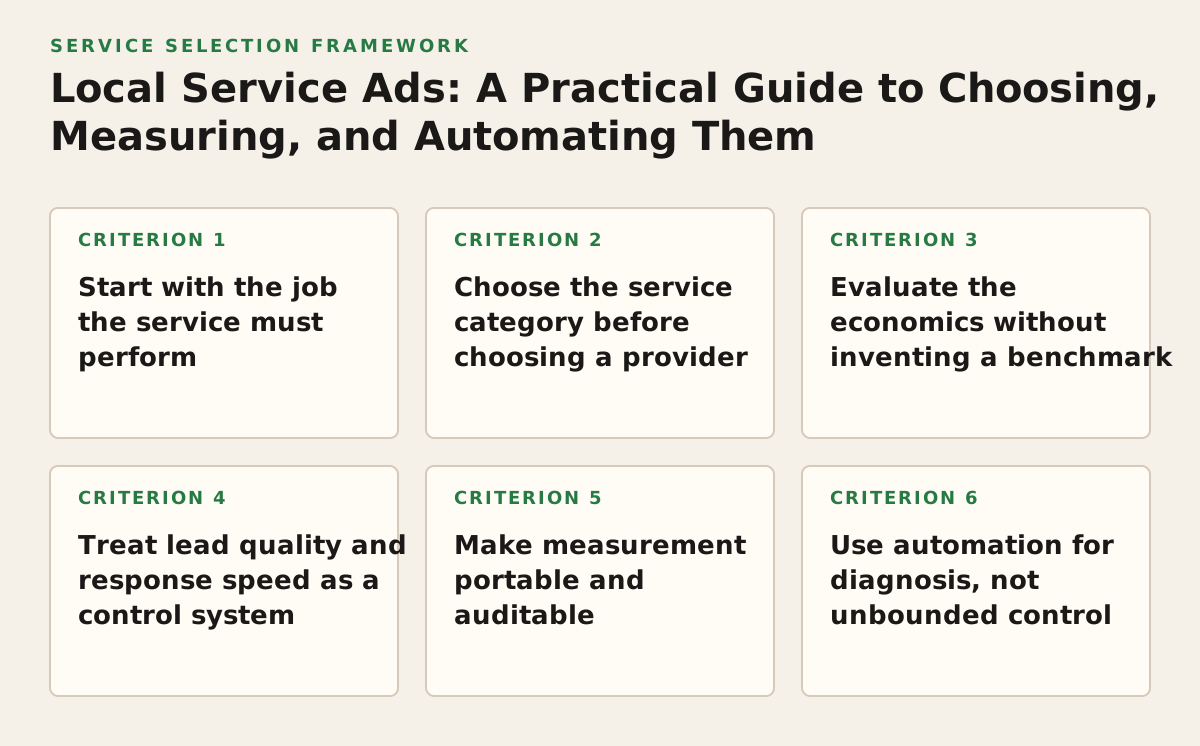
1. Start with the job the service must perform
“Run the ads” is not a useful brief. A local campaign can be responsible for generating calls, filling a calendar, protecting a branded search presence, expanding into a new service area, or helping an agency manage many client accounts. Each job requires a different service design. A provider optimized for lead volume may be a poor fit when your constraint is dispatcher capacity or booked-job rate.
Google describes Local Services Ads as a format in which customers can contact eligible businesses directly, and its official guidance explains the relationship between business verification, service categories, service areas, and lead handling. Those details matter because eligibility and profile completeness are operational prerequisites, not creative optimizations. Review the current requirements in Google’s Local Services Ads overview before comparing vendors; availability and requirements can change by location and category.
Translate the commercial objective into an operating brief
- Acquisition objective: Are you seeking more qualified calls, booked appointments, estimates, or completed jobs?
- Constraint: Is the limiting factor budget, ranking visibility, staffing, geographic coverage, or slow follow-up?
- Economic event: What is the value of a qualified lead, booked appointment, sold job, or recurring customer?
- Decision owner: Who can approve budget changes, service-area edits, dispute decisions, and landing-page or CRM work?
- Evidence standard: Which records will prove that a lead was relevant and that revenue was attributed fairly?
For example, a two-person HVAC company may not need more inquiries at all. It may need fewer out-of-area calls and an automatic alert when a lead is unanswered. An agency with 40 local accounts has a different problem: it needs standardized diagnostics, change logs, permissions, and exception handling. A single dashboard cannot solve both without a clear priority hierarchy.
Failure mode: buying activity instead of an outcome. A report full of impressions, profile views, or “optimization actions” can conceal a weak booking process. Make the provider state which business event it is accountable for influencing and which events remain your team’s responsibility.
2. Choose the service category before choosing a provider
Most buyers are comparing categories without naming them. Separate the options first; then assess suppliers inside the category. The following framework is intentionally practical rather than promotional.
| Buyer need | Best-fit service type | Implementation burden | Primary trade-off |
|---|---|---|---|
| One location, competent operator, limited complexity | DIY account management with platform support | High internal time; low external coordination | Lower service cost can mean slower diagnosis and inconsistent follow-up |
| Small team needs campaign setup and recurring decisions | Specialist managed service | Medium; requires access, approvals, and weekly business feedback | Less internal labor, but quality depends on the specialist’s understanding of service economics |
| Multiple channels, CRM, creative, and sales process need alignment | Full-service local lead-generation agency | Medium to high; onboarding data and sales integration are substantial | Broader accountability may come with less channel-level control |
| Agency or in-house team needs repeatable monitoring | Automation, reporting, or MCP-connected workflow | High initially; lower after permissions, schemas, and approval rules are stable | Automation amplifies bad inputs unless humans govern changes |
| Organic visibility is weak and paid demand is expensive | Local SEO and website improvement partner | Medium to high; requires content, technical, and reputation work | Results are less immediate and attribution is harder to isolate |
| Brand serves several nearby markets or service lines | Hybrid: managed paid media plus internal sales owner | Medium; clear ownership is essential | Coordination overhead increases, but channel and revenue decisions stay connected |
When DIY fits: the account has a narrow service area, one or two service categories, dependable call handling, and someone who can inspect lead quality every week. DIY does not mean “ignore the account”; it means your team owns verification, budget decisions, business-profile accuracy, and the feedback loop.
When a specialist fits: the business has enough lead flow to expose patterns but not enough internal time to investigate them. A specialist should bring structured diagnosis, not merely a login and a monthly PDF. Ask for examples of how they handle irrelevant leads, missed calls, temporary closures, and service-area exclusions.
When a full-service agency fits: the bottleneck crosses channels or departments. If paid leads reach a sales team that cannot distinguish a new customer from an existing one, campaign management alone will not fix the economics. The agency should be able to define handoffs between advertising, website conversion, call handling, CRM stages, and revenue reporting.
When automation fits: the account has recurring checks, multiple properties, or a team that loses time collecting data. Automation is strongest at detection, normalization, alerts, and draft recommendations. It is riskier when allowed to make unrestricted changes to targeting, budgets, or business information.
Failure mode: selecting a broad agency for a narrow operational problem. More services do not automatically produce better lead quality. If the actual issue is missed calls, pay for a response workflow or call-routing fix before adding another channel.
3. Evaluate the economics without inventing a benchmark
There is no universal “good” cost per lead for local businesses. A lead that is expensive for a low-margin maintenance job may be cheap for a high-value legal matter. Even within one category, geography, urgency, competition, close rate, labor availability, and repeat value change the allowable acquisition cost.
Build the financial model from your own records. Use separate fields for advertising cost, service or management fees, lead-dispute credits, sales labor, and revenue. Then distinguish “contacted,” “qualified,” “booked,” “sold,” and “collected.” If those stages are collapsed into one lead count, a vendor can appear efficient while the business absorbs poor-fit inquiries.
A useful starting calculation
Use this as an illustrative policy, not a universal benchmark:
- Maximum cost per sold job = expected gross profit per job × the share your business permits for acquisition.
- Maximum cost per booked appointment = maximum cost per sold job × expected booked-to-sold rate.
- Maximum cost per qualified lead = maximum cost per booked appointment × expected qualified-to-booked rate.
- Required lead volume = target sold jobs ÷ expected lead-to-sold rate.
Suppose an operator uses an illustrative gross profit of $800, permits 25% for acquisition, expects 60% of qualified leads to book, and expects 50% of booked jobs to sell. The implied ceiling is $200 per sold job, $100 per booked appointment, and $50 per qualified lead. Those figures are planning assumptions, not claims about market pricing; replace them with observed margins and stage rates after enough clean data exists.
Questions about pricing and contract structure
- Is the provider charging a flat management fee, a percentage of media spend, a per-lead amount, a performance fee, or a hybrid?
- Is media spend paid directly to the platform or routed through the provider?
- Who owns the account, business profile, call recordings, landing pages, tags, audiences, and historical data?
- Are setup, tracking, creative, CRM integration, call review, and reporting included or separately scoped?
- What happens when the business pauses service, changes location, or needs seasonal budget control?
- Can the contract be ended without losing access to the advertising account or measurement assets?
Failure mode: comparing fees without comparing delivery scope. A low fee may exclude call review, tracking repair, landing-page work, or sales feedback. A higher fee may still be wasteful if it pays for generic reports. Compare the outputs, owner time, data access, and decision rights—not just the invoice line.
4. Treat lead quality and response speed as a control system
Local lead generation fails between the ad and the sale more often than buyers expect. The ad may attract a relevant prospect, but the phone is unanswered, the office is closed, the technician does not cover that ZIP code, or the CRM fails to create a task. A service evaluation should therefore inspect the entire path from inquiry to disposition.
Define a lead taxonomy before a provider starts. At minimum, classify each inquiry as qualified, wrong service, wrong geography, duplicate, spam, existing customer, price shopper, or unable to contact. Add a reason code for disputed leads. Without consistent labels, “lead quality” becomes an argument rather than a dataset.
Build the handoff
- Capture the source, campaign context, timestamp, caller or form identifier, and service requested.
- Route the inquiry to a person or queue that is staffed during the advertised hours.
- Record first response, contact outcome, qualification, appointment, and sale status.
- Send structured outcomes back to the reporting system on a defined cadence.
- Review a sample of calls or conversations against the taxonomy.
- Change one operational variable at a time: coverage, service category, response routing, or targeting.
Use response-time reporting as a management signal, not as a vanity metric. A sudden increase in unanswered calls may be a staffing problem, a tracking problem, or an ad scheduling problem. The correct intervention depends on which stage changed.
Google’s documentation for conversion measurement explains why conversion actions and their settings need to reflect the business’s actual goals rather than a generic form submission. Review the current Google Ads conversion tracking guidance when deciding which calls, forms, and offline outcomes should count as conversions. The factual point is simple: measurement configuration determines what the advertising system is allowed to learn from.
Failure mode: optimizing to every inquiry. If spam and unqualified calls are counted as successes, automated bidding or budget recommendations can favor the wrong audience. Keep a top-of-funnel count for diagnosis, but optimize decision-making around qualified or revenue-linked events where data volume permits.
5. Make measurement portable and auditable
A provider should be able to explain how a lead becomes a row in a report and how that row connects to a business outcome. Ask for the raw fields, naming convention, attribution window, conversion definition, and treatment of duplicates. If the answer is “the dashboard handles it,” the implementation is not auditable enough.
The minimum measurement map
- Identity: account, location, service category, lead identifier, and timestamp.
- Acquisition: channel, campaign or profile context, device where available, and landing or call path.
- Quality: service fit, geography, urgency, duplicate status, and qualification outcome.
- Sales: appointment, estimate, sold job, revenue, gross margin, and cancellation where relevant.
- Governance: source system, data owner, last refresh, change history, and access level.
Do not force every source into one attribution story. A phone call can be influenced by a local profile, a branded search, an organic result, and a prior referral. Report platform-reported conversions for optimization, then maintain a separate business-outcome view for finance and sales decisions. Differences are diagnostic; hiding them is not reconciliation.
Google Analytics documentation explains how events and key events are used to represent meaningful user actions in measurement implementations; the current GA4 event documentation is a useful reference when aligning website actions with CRM stages. Use it for event design, but do not assume a browser event alone proves a qualified lead or closed job.
Search Console can add context when organic visibility changes alongside paid demand. Its official API documentation describes ways to query search performance data programmatically, which can support a combined paid-and-organic diagnostic rather than treating every decline as an advertising issue. See the Search Analytics API guide when your team needs repeatable query and page data.
Failure mode: letting the vendor own the only copy of the data. Require exportable records and documented definitions before launch. If you change providers, you should be able to preserve historical lead stages, not restart measurement from zero.
6. Use automation for diagnosis, not unbounded control
Automation is valuable when the work is repetitive, rules are explicit, and errors are detectable. It is less suitable when the correct action depends on a nuanced business fact, such as a storm creating temporary demand, a location closing for renovation, or a service category becoming unavailable.
A sensible automation ladder has four levels:
- Observe: collect spend, leads, status, service areas, schedules, and outcome data.
- Diagnose: identify anomalies such as lead-quality deterioration, missing conversion data, or unusual geography.
- Recommend: produce a proposed change with evidence, expected consequence, and rollback steps.
- Execute with approval: apply only bounded, reversible changes after a named person accepts the proposal.
For agencies and in-house teams, an MCP-connected workflow can make platform data available to an AI client for investigation and drafting. For example, a marketer could use a Google Ads MCP workflow to ask for locations with rising unqualified-lead rates, inspect the supporting records, and prepare a change for approval. The important design choice is not the interface; it is the permission model, evidence trail, and rollback path.
The same principle applies when diagnosing paid social alongside search. A Meta Ads MCP connection may help a team compare lead volume, creative, audience, and downstream outcomes across accounts, but cross-channel comparisons need normalized definitions. A form submission from one channel is not automatically equivalent to a qualified call from another.
Guardrails worth specifying
- Read-only access by default; write access only for approved workflows.
- No budget, service-area, business-profile, or conversion changes without human approval.
- Every proposed change includes affected entity, reason, timestamp, approver, and rollback instruction.
- Block actions when tracking is stale, lead outcomes are missing, or the business is marked closed.
- Use small, reversible changes before broad changes across locations or categories.
- Alert on anomalies; do not automatically “fix” an anomaly whose cause is unknown.
Failure mode: automating the symptom. If lead quality falls because a call-routing number broke, narrowing targeting may reduce volume while leaving the revenue leak intact. Require the automation to show evidence from at least the relevant operational stages before proposing a channel change.
7. Evaluate vendors through deliverables and evidence
A credible provider can describe what happens during onboarding, what is reviewed weekly, what requires client input, and how an unsuccessful hypothesis is retired. “We optimize constantly” is not a process. Look for a defined cadence and a clear owner for each dependency.
Evaluation criteria
- Relevant operating experience: Can the provider explain service-area, schedule, call, and lead-disposition problems?
- Measurement competence: Can it trace a reported conversion to a source record and a business stage?
- Implementation clarity: Does it provide a launch checklist, access map, naming standards, and acceptance criteria?
- Change governance: Are recommendations approved, logged, bounded, and reversible?
- Commercial transparency: Are fees, media, pass-through costs, ownership, and cancellation terms explicit?
- Communication quality: Does reporting distinguish facts, hypotheses, actions, and unresolved questions?
- Capacity: Who performs the work, how many accounts do they manage, and what happens during absence?
Vendor interview checklist
- “Show us the fields you need to classify a lead as qualified, booked, and sold.”
- “What would you investigate if lead volume stayed flat but sold jobs fell?”
- “How do you handle wrong-area, duplicate, spam, and existing-customer inquiries?”
- “Which changes can you make without approval, and which always require written approval?”
- “What assets remain in our account if we end the engagement?”
- “How do you separate platform-reported conversions from CRM or revenue outcomes?”
- “What is included in setup, recurring management, call review, reporting, and tracking maintenance?”
- “What information must our staff provide each week for your recommendations to be valid?”
- “Give us an example of a recommendation you would reject because the evidence is insufficient.”
- “What would success look like after the first review cycle, and which result would make you change the plan?”
Red flags: guaranteed lead counts without qualification definitions, refusal to grant account access, reports with no raw-data path, unclear ownership of tracking assets, pressure to approve broad changes immediately, and contracts that make data export or cancellation ambiguous. A polished case study cannot compensate for missing governance.
For a local business whose organic visibility is weak, evaluate paid management alongside local SEO support; following it helps the team improve local organic visibility alongside a Local Services Ads strategy rather than treating paid demand as the only growth lever.

8. Prioritize the first changes with an evidence score
Teams often have more possible fixes than they can safely implement. Use a simple scoring model to prevent the loudest stakeholder or newest dashboard anomaly from determining the roadmap.
| Factor | Question | Illustrative score |
|---|---|---|
| Business impact | Could this materially affect qualified leads, booked work, or margin? | 0–3 |
| Evidence strength | Do platform, CRM, call, or sales records point to the same cause? | 0–3 |
| Reversibility | Can the change be undone without losing data or eligibility? | 0–2 |
| Implementation effort | Can the owner complete it without blocking other work? | 0–2 |
| Measurement readiness | Will the team be able to observe the result cleanly? | 0–2 |
Use the scores as a prioritization aid, not as mathematics pretending to be certainty. A high-impact, high-evidence, reversible fix—such as correcting an incorrect service area or restoring broken call tracking—usually outranks a speculative creative test. A low-evidence change should first generate information, not consume budget.
Worked example
An agency sees a 30-day decline in booked estimates for one roofing client. Three candidate actions emerge:
- Change the service area immediately: potentially high impact, but weak evidence until geography is checked.
- Audit call recordings and CRM dispositions: moderate effort, strong evidence potential, highly reversible.
- Rewrite every ad asset: high effort and weak causal connection to the reported booking decline.
The audit should come first. It may reveal that calls increased but were routed after hours, or that the CRM stopped recording appointment outcomes. The correct campaign change might be no campaign change at all.
Failure mode: measuring the test with the same broken instrument. Before judging a new schedule, service category, or workflow, verify that timestamps, call status, lead identifiers, and sales stages are arriving. Otherwise the team is optimizing a reporting defect.
Sequenced implementation plan for 2026
Use the following sequence when launching or rebuilding a local services program. Keep the stages separate enough that a failure in one does not get disguised as a failure in another.
- Write the commercial brief. Name the service categories, covered locations, hours, target customer, economic event, capacity constraint, and accountable owner.
- Audit eligibility and assets. Confirm business information, verification status, service areas, phone routing, website paths, account ownership, and access before discussing optimization.
- Choose the service model. Decide whether the work belongs with an internal operator, specialist, full-service agency, automation layer, local SEO partner, or hybrid team. Record why the rejected options were rejected.
- Document the economics. Enter actual or explicitly labeled starting assumptions for margin, qualification rate, booking rate, close rate, and allowable acquisition cost. Define what would cause those assumptions to be revised.
- Implement measurement. Map inquiry, qualification, booking, sale, revenue, and dispute fields. Test calls, forms, CRM creation, source capture, and reporting before scaling spend.
- Launch with a review cadence. The operator checks lead relevance and response handling; the manager checks spend and delivery; the sales owner checks booked and sold outcomes. Each role should have a written decision right.
- Prioritize diagnosis before edits. Score proposed fixes by impact, evidence, reversibility, effort, and measurement readiness. Start with operational leaks and tracking defects that can invalidate media decisions.
- Add guarded automation. Begin with read-only collection and alerts. Introduce recommendations next, then approval-gated execution for narrow, reversible actions with logs and rollback instructions.
- Review the provider or process. At the agreed review point, compare qualified leads, booked work, sold work, response handling, data completeness, and decision quality against the brief—not against an invented industry benchmark.
- Expand only after the loop is stable. Add locations, service categories, channels, or automated actions only when ownership, measurement, and rollback work for the existing scope.
For teams that need an approval-gated operating layer across advertising and analytics, NotFair provides hosted MCP servers that connect AI clients with major marketing platforms; the practical fit is strongest when your team wants diagnosis and reversible execution without surrendering human control.
Authored with NotFair SEO