

Choosing an ai marketing agency is not primarily a software decision. Google Ads and Meta Ads managers need to decide which work should be automated, which judgments require a strategist, and who remains accountable when a change damages performance. This guide helps agencies, in-house growth teams, consultants, and SMB operators compare service models, estimate implementation burden, set measurable controls, and interview providers without accepting vague promises about “AI-powered growth.”
The right choice depends on the job. A business with poor conversion tracking needs measurement repair before campaign automation. A mature agency with clean data may need an approval queue and faster account diagnostics. A lean team may need execution help but cannot afford to surrender budget control. Treat the service as an operating model with software, people, permissions, and escalation rules—not as a magic layer placed over an ad account.
1. Start with the service category, not the vendor’s AI label
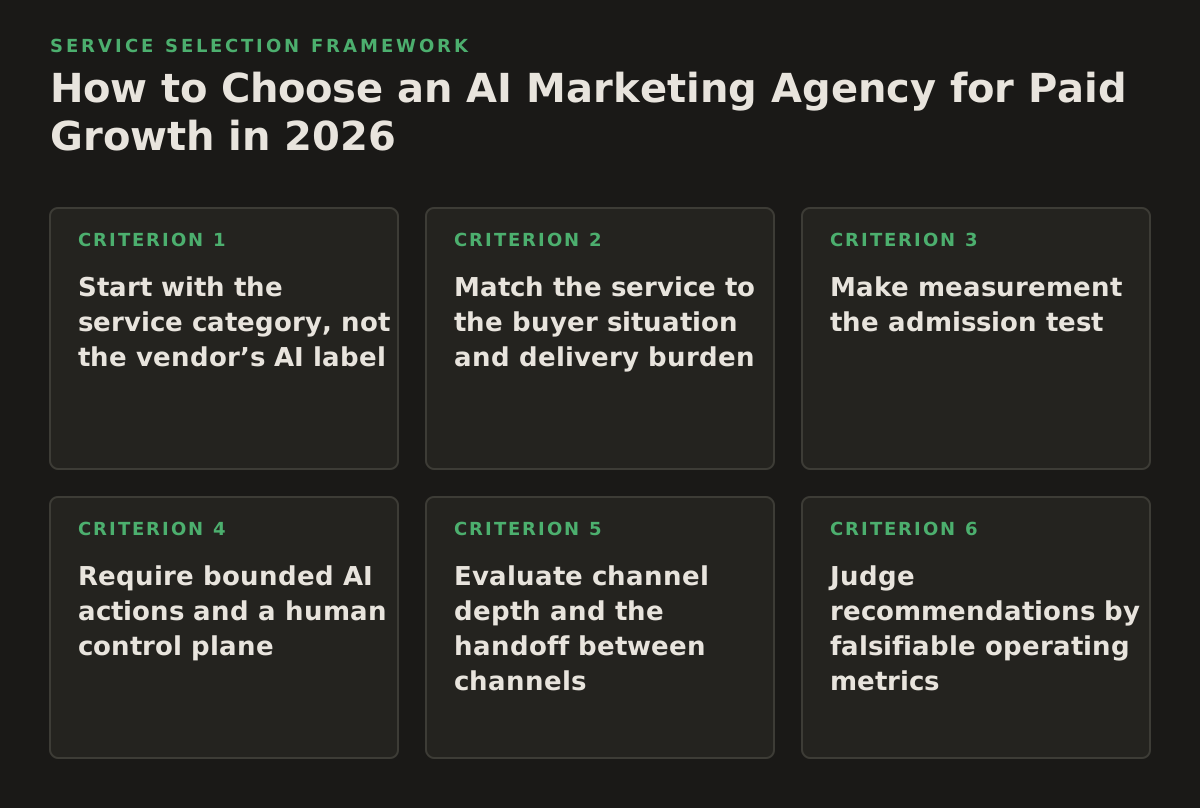
Most providers sell a blend of four categories. The categories overlap, but their delivery burden and risk are different. Write down the primary job before taking sales calls.
- Strategic advisory supplies account audits, channel planning, offer analysis, forecasting, and experiment design. It suits an experienced in-house team that can execute recommendations.
- Managed media assigns specialists to build, monitor, optimize, and report on campaigns. It suits a business that lacks paid-search or paid-social operating capacity.
- Automation software provides rules, alerts, dashboards, recommendations, or workflow actions for an internal operator. It suits teams that want leverage while retaining execution ownership.
- AI-assisted operations combines natural-language diagnosis, structured data access, recommended changes, and sometimes human-approved execution. It suits teams with recurring analysis work and a defined review process.
When this principle applies: use it before comparing proposals that use identical language such as “autonomous optimization.” A managed service and an approval-gated agent may both claim to reduce manual work, but one transfers day-to-day responsibility while the other requires your team to operate a control system.
Why it works: the category exposes the real bottleneck. If nobody owns landing-page fixes, creative production, tracking QA, and budget governance, an AI layer cannot solve the operating gap. Conversely, paying for full management when your team only needs anomaly triage can create unnecessary dependency and slow approvals.
Failure mode: selecting the provider with the most impressive demo rather than the service that fits the team’s available hours, permissions, and decision rights. A system that drafts ten changes per day is not useful if the account owner cannot review them until the following week.
A practical classification exercise
List the last 30 days of recurring work and mark each item as diagnose, recommend, approve, or execute. For example:
- Diagnose a week-over-week conversion-rate drop.
- Recommend a budget reallocation between campaigns.
- Approve a bid, audience, or negative-keyword change.
- Execute the change and record the previous state.
If the provider only automates diagnosis, do not evaluate it as a media-buying service. If it can execute, ask whether execution is reversible, logged, scoped to named accounts, and blocked by approval. Those details matter more than whether the interface calls the system an agent.
2. Match the service to the buyer situation and delivery burden
Different buyers need different levels of hands-on support. An agency managing many client accounts may value repeatable workflows and permission boundaries. An SMB may need a specialist to interpret lead quality and sales feedback. An in-house demand-generation team may need a temporary measurement project followed by internal ownership.
| Buyer need | Best-fit service type | Delivery and implementation burden | Main trade-off | Success evidence |
|---|---|---|---|---|
| Clear strategy, capable internal execution | Strategic advisory | Briefing, data access, workshops, and internal follow-through | Lower external control; recommendations can languish | Prioritized roadmap, completed experiments, and improved decision speed |
| No reliable paid-media operator | Managed media | Onboarding, account access, creative and tracking coordination, recurring reviews | More dependency and possible communication latency | Defined business outcomes, reporting accuracy, and agreed optimization cadence |
| Internal operator overwhelmed by repetitive checks | Automation software | Data connections, rule design, alert tuning, and user training | Team still owns judgment and execution | Fewer manual checks, faster anomaly response, and no increase in uncontrolled changes |
| Agency needs scalable analysis across accounts | AI-assisted operations | Structured prompts, account scopes, approval workflow, logs, and QA policy | Bad inputs can produce confident but unsuitable recommendations | Recommendation acceptance rate, review time, documented reversals, and account-level outcomes |
| Broken attribution or unreliable lead data | Measurement implementation | Tagging audit, event design, CRM reconciliation, and validation | Less immediately visible than campaign changes | Stable event definitions, reconciled lead status, and fewer unexplained reporting gaps |
When this principle applies: use the matrix when a proposal bundles media management, creative, analytics, and automation into one monthly engagement. Separate the jobs so you can see which part requires specialists and which part can be standardized.
Why it works: it turns a vague service purchase into a capacity decision. Implementation burden includes account permissions, naming conventions, conversion definitions, CRM fields, creative inputs, approval time, and the process for undoing mistakes.
Failure mode: treating onboarding as a one-time form. A provider may connect an ad account quickly but still lack a usable definition of qualified pipeline, profit margin, refund rate, or sales acceptance. Ask for a data and ownership plan, not merely a connection checklist.
Budget and pricing questions without false precision
Do not infer value from a percentage-of-spend fee, a flat retainer, usage-based automation fee, project rate, or hybrid model. Ask what the fee covers and what creates additional charges.
- Is pricing tied to media spend, account count, seats, data volume, action volume, or service hours?
- Are strategy, creative revisions, tracking work, reporting, and emergency support separate line items?
- What is the minimum commitment, renewal rule, notice period, and handover process?
- Who pays for required third-party data, landing-page work, call tracking, or CRM development?
- Can the engagement start with a bounded diagnostic or pilot before a broader commitment?
Set an internal budget using the cost of the problem, not a guessed industry rate. An illustrative starting policy might reserve enough staff time to review every proposed account change during a pilot; that is a governance assumption, not a universal staffing benchmark. The provider should show how the service reduces wasted analysis, improves qualified pipeline decisions, or increases execution capacity.
3. Make measurement the admission test
Automation is only as useful as the data and definitions behind it. Before asking an AI system to shift budget, establish which conversion actions matter, how they are valued, and where the signal originates. Google’s documentation distinguishes conversion setup and measurement workflows across Google Ads, so use the official Google Ads conversion tracking guidance to verify the account’s conversion actions and sources rather than accepting a platform screenshot as proof.
When this principle applies: apply it whenever a provider promises better optimization, lower acquisition cost, or more qualified leads. It is especially important for B2B, lead generation, regulated categories, long sales cycles, and businesses where a form fill is not the commercial outcome.
Why it works: it separates a true performance change from a reporting change. If an agency renames events, imports duplicate conversions, or changes attribution settings, reported efficiency can move without more profitable customers. A sound provider can trace an outcome from ad interaction to landing page, CRM status, revenue, and optimization decision.
Failure mode: optimizing to the easiest event. A campaign may generate cheap “leads” because the form is too broad, the event fires twice, or spam is counted. An AI system will efficiently pursue the target it receives, even when that target is commercially wrong.
Build a measurement brief
- Define the primary business outcome: for example, accepted opportunities, completed purchases, or contribution margin.
- List secondary diagnostic events such as calls, qualified forms, product views, or checkout starts.
- State the source of truth for each outcome and the delay between ad interaction and revenue confirmation.
- Document exclusions, duplicate rules, consent limitations, offline imports, and known data gaps.
- Specify which metric can authorize a budget change and which metrics are for investigation only.
For analytics teams, Google’s official GA4 setup documentation is a useful reference for separating event collection from reporting and analysis: Google’s GA4 documentation. The vendor should be able to explain how its recommendations behave when data is delayed, sampled, incomplete, or contradictory.
Ask for a measurement acceptance test before optimization begins. A concrete example: submit a test lead, confirm the event appears once, confirm the CRM record receives the correct campaign identifiers, and verify that a later sales-status update can be joined back to the acquisition source. Do not approve automated changes until this path is understood.
4. Require bounded AI actions and a human control plane
An AI recommendation is not automatically safe because a person can theoretically undo it. Evaluate the entire action lifecycle: data retrieval, reasoning, proposed change, approval, execution, monitoring, and rollback.
When this principle applies: use strict controls for budget edits, targeting changes, bid strategy changes, creative launches, exclusions, and any operation that can spend money or alter customer eligibility. Looser controls may be reasonable for read-only summaries, anomaly alerts, and draft analysis.
Why it works: bounded automation limits blast radius. Google’s developer documentation describes the Google Ads API as a programmatic way to manage advertising resources; that makes permission scope, request logging, and change review operational requirements rather than abstract security language. See the official Google Ads API overview when assessing what a technical provider is connecting to.
Failure mode: giving an agent broad access because setup is easier. A single ambiguous instruction—“move budget to the winners”—can produce an unsuitable change if “winner” means click volume instead of qualified pipeline, or if a seasonal campaign is judged against the wrong period.
Controls to demand in a demonstration
- Read-only mode for the initial audit and baseline period.
- Explicit approval before any spend, targeting, creative, or bid change.
- Change diffs showing old value, new value, reason, scope, and timestamp.
- Spend and object limits that prevent an action from affecting an entire portfolio accidentally.
- Rollback instructions that a trained operator can execute without vendor intervention.
- Identity and permission clarity so the account owner knows which user, token, or connection performed the action.
- Conflict handling for simultaneous human edits, stale data, failed requests, and partial execution.
Use a worked example in the interview: “The branded search campaign has a lower CPA, but qualified pipeline is falling. Show how the system retrieves the relevant data, states uncertainty, proposes a change, requests approval, records execution, and measures the result.” A serious provider should discuss missing data and alternative explanations, not jump straight to a budget recommendation.
5. Evaluate channel depth and the handoff between channels
AI assistance is often strongest within a defined data surface. Do not assume that a provider’s competence in Google Ads transfers automatically to Meta Ads, LinkedIn, X, Search Console, analytics, or CRM data. Ask which decisions are channel-specific and which require a cross-channel business view.
When this principle applies: apply it when the account mixes search intent, paid social discovery, retargeting, and offline sales. It also matters for agencies promising one unified dashboard or agent across multiple clients and platforms.
Why it works: each channel has different objects, attribution behavior, naming conventions, and failure modes. Meta’s official Marketing API documentation is the appropriate place to verify the available programmatic surface and object model before accepting a claim about automated campaign management: Meta’s Marketing API documentation.
Failure mode: comparing platform metrics as if they were interchangeable. A click, view-through conversion, engaged session, lead, and qualified opportunity can all appear in a unified report while representing different stages and counting rules.
Ask for a channel responsibility map
Require the provider to map each proposed workflow to:
- The platform and account object it reads or changes.
- The metric definition and attribution window used for the decision.
- The business question the workflow answers.
- The owner of creative, landing-page, feed, audience, and CRM dependencies.
- The escalation path when channels disagree.
For example, a search query diagnosis can recommend negative keywords, but it cannot by itself determine whether a high-intent query should be added as a paid keyword if the landing page does not support that intent. Likewise, a social creative recommendation may identify fatigue signals while the final decision depends on offer margin, brand constraints, and production capacity.
For technical teams, insist on a test environment or a narrowly scoped production account where possible. Validate pagination, rate limits, failed writes, deleted objects, timezone handling, and delayed conversions. “The API connects” is not the same as “the workflow is reliable enough to control spend.”
6. Judge recommendations by falsifiable operating metrics
A provider should define success before it has permission to optimize. Do not accept “better performance” without specifying the outcome, comparison period, guardrails, and decision rule.
When this principle applies: use this approach for pilots, renewals, agency reviews, and any proposal claiming efficiency from AI. It is particularly useful when auction conditions, promotions, creative changes, or tracking repairs make a simple before-and-after comparison misleading.
Why it works: operational metrics reveal whether the service is creating leverage even when market performance is noisy. Useful measures include time to detect an anomaly, time to approve a recommendation, percentage of recommendations with usable rationale, rollback frequency, unresolved data incidents, and proportion of changes made within policy.
Failure mode: allowing the provider to choose only metrics that flatter the engagement. More alerts are not better if they create noise; more automated changes are not better if they increase reversals; a lower platform CPA is not better if sales acceptance declines.
Use a scorecard with guardrails
- Business outcome: qualified revenue, contribution margin, accepted pipeline, or another agreed commercial measure.
- Media efficiency: cost per qualified outcome, return on ad spend where revenue is reliable, or budget pacing against plan.
- Process quality: review time, recommendation acceptance, documentation completeness, and rollback success.
- Safety: unauthorized changes, spend-limit breaches, duplicate actions, and unresolved access issues.
- Learning: number of documented hypotheses, experiment results, and decisions made from evidence.
Set a baseline and a review window appropriate to the buying cycle. Any numeric threshold or timeline should be treated as an illustrative starting policy, not a universal benchmark. For instance, an agency could require every automated recommendation to include a hypothesis, expected direction, guardrail, and review date before approval. The exact review cadence belongs in the operating agreement.
Also ask how the provider handles negative results. A credible service can say that an experiment failed, distinguish implementation failure from hypothesis failure, and stop repeating an intervention that does not improve the agreed outcome.
7. Interview the provider as an operator, not a storyteller
A polished demo tests presentation. A structured interview tests whether the provider understands your account’s constraints. Give every shortlisted provider the same scenario and request written answers so proposals remain comparable.
Vendor interview checklist
- Which service category are you providing, and which responsibilities remain with our team?
- What data do you need before making a recommendation, and what happens when it is missing or delayed?
- Can we begin read-only, with a bounded pilot and explicit exit criteria?
- What exact actions can the system or team perform, and which always require approval?
- How are changes logged, attributed, reviewed, and reversed?
- What account, campaign, budget, audience, and creative limits can we configure?
- How do you prevent duplicate conversion events and distinguish leads from qualified outcomes?
- How do you handle platform outages, API failures, rate limits, stale data, and partial writes?
- What is included in the fee, and what triggers usage, service, data, or implementation charges?
- Who owns the account connection, historical data, naming conventions, scripts, prompts, and documentation if we leave?
- What will you report when performance is flat or worse, and what decision follows?
- Can you show a redacted change log and a rollback procedure rather than only a dashboard?
When this principle applies: use it for every vendor interview, including referrals. A referral may establish credibility but does not answer whether the workflow fits your permissions, data quality, approval capacity, or commercial model.
Why it works: questions force the provider to expose mechanisms. The best answer is not necessarily the one with the most automation; it is the one that makes responsibility, failure handling, and measurement visible.
Failure mode: accepting “the AI learns your account” as an implementation plan. Ask what it learns from, who labels outcomes, how changes are constrained, and how you can inspect or correct a bad recommendation.
If paid media is only one part of the growth plan, keep adjacent work separate during evaluation. For example, link building services can help you choose a link building provider that complements an AI marketing agency’s campaign strategy, especially when you need to compare link building, guest posting, and digital PR capabilities rather than confuse organic acquisition with paid-media optimization.
8. Build a reversible rollout instead of switching everything on
Even a well-qualified provider should earn broader access in stages. A rollout protects historical performance, gives operators time to learn the workflow, and makes disagreement observable before it affects the full budget.
When this principle applies: use staged deployment for new agents, new vendors, multi-account agency rollouts, and any system that can write changes to advertising platforms. It is also appropriate when measurement is being repaired at the same time as campaign management.
Why it works: reversibility converts a high-stakes purchase into a sequence of smaller decisions. Start with diagnosis, then recommendations, then approved execution on low-risk objects, and only later consider broader automation.
Failure mode: measuring the pilot only by immediate media results. If the pilot changes tracking, creative, budgets, and landing pages at once, nobody can identify which mechanism caused the result or whether the apparent lift survives after the engagement ends.
Example rollout policy
- Baseline: freeze the evaluation definitions, export current settings, document owners, and record business and process metrics.
- Observe: grant the minimum read access needed for diagnosis; prohibit writes while data quality and recommendations are reviewed.
- Recommend: require a written rationale, expected effect, downside risk, and rollback for every proposed change.
- Constrain: allow approved changes only in named campaigns or objects, within an illustrative spending or percentage limit set by the account owner.
- Review: compare results against the agreed scorecard and investigate data, seasonality, creative, and sales-quality explanations.
- Expand or stop: broaden scope only when the provider meets the acceptance criteria; otherwise revert access and retain the documentation.
For Google Ads operators, a dedicated connection such as the Google Ads MCP may be relevant when the job is structured account diagnosis and approved workflow execution. For Meta teams, the Meta Ads MCP is a separate consideration; evaluate it against the same permission, logging, and rollback requirements rather than assuming that one channel’s workflow transfers unchanged to another.
Implement the decision in six controlled steps
Use this sequence to turn the evaluation into an accountable purchase and operating plan.
- Write the job statement: name the bottleneck, affected channels, decision owners, and the work the provider must remove or improve.
- Audit measurement: verify primary outcomes, event duplication, CRM joins, attribution assumptions, and reporting delays before comparing optimization claims.
- Shortlist by service category: separate advisory, managed media, automation, AI-assisted operations, and measurement implementation so trade-offs remain visible.
- Run the same scenario: ask each provider to diagnose a realistic performance problem, show uncertainty, propose a bounded action, and explain rollback.
- Contract the controls: document permissions, approvals, limits, logs, ownership, pricing variables, data handling responsibilities, reporting, and exit terms.
- Launch read-only and earn scope: baseline first, review recommendations second, authorize narrow reversible actions third, and expand only against written success criteria.
For teams that need a connection between AI clients and advertising data, NotFair provides hosted MCP servers for supported marketing platforms with approval-gated workflows; assess that option as one component of the control plan, not as a substitute for measurement ownership or channel strategy. Start with the narrowest useful workflow, keep human approval for spend-changing actions, and expand only when the evidence and operating discipline justify it.
Authored with NotFair SEO