

Choosing a meta ads agency is not mainly a question of whether a team can launch campaigns in Ads Manager. The useful decision is narrower and more commercial: what work do you need to transfer, what evidence will prove it is working, and how much control should remain with your team? This guide helps paid media managers, agencies, founders, and demand-generation teams compare service models without confusing polished reporting with profitable growth.
A suitable partner may improve account structure, creative testing, tracking, budget allocation, or the speed of routine decisions. It may also add unnecessary meetings, lock you into opaque processes, or optimize for platform metrics that do not match your sales pipeline. Start by identifying the service category that fits your operating constraint, then evaluate measurement, delivery mechanics, commercial terms, and exit conditions.
1. Match the service category to the job you need done
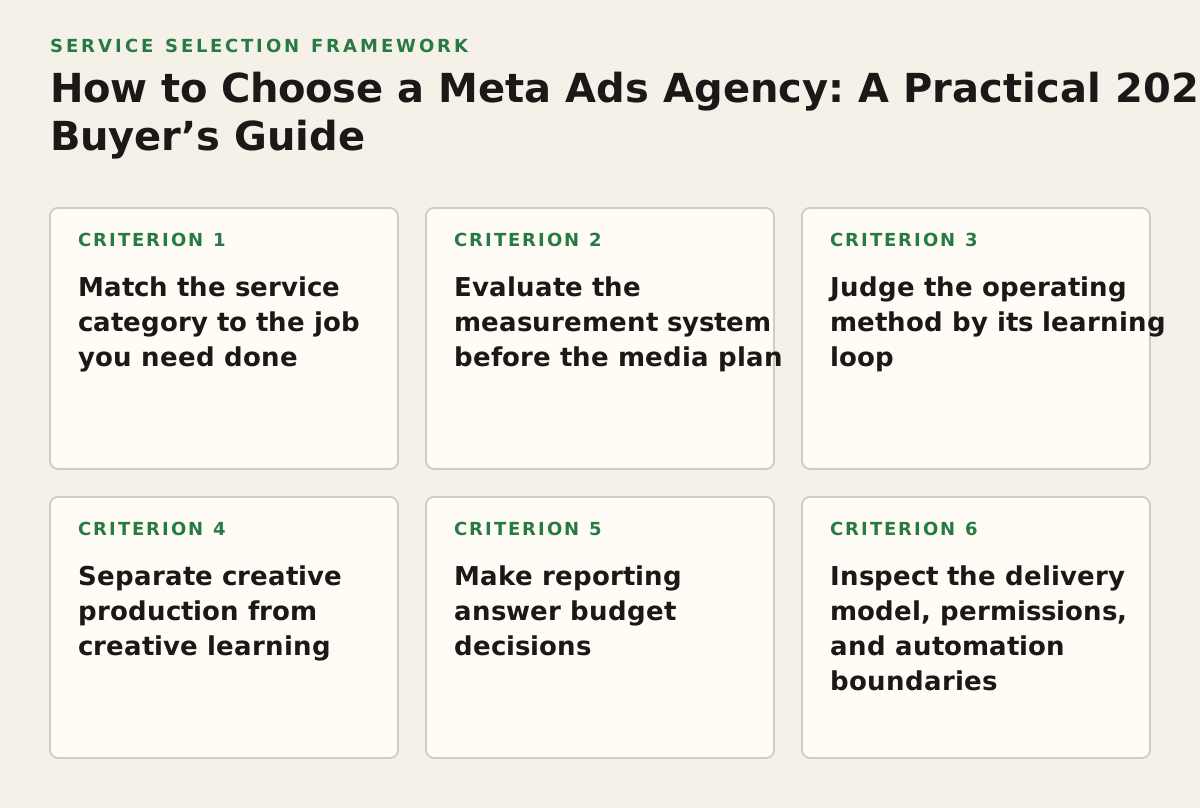
“Agency” describes a relationship, not a standardized service. Two firms can both call themselves full service while one supplies weekly recommendations and the other owns creative production, tracking, budget changes, and reporting. Define the category before comparing vendors.
| Buyer need | Best-fit service type | Typical trade-off | Questions to resolve |
|---|---|---|---|
| Experienced team needs specialist diagnosis | Audit or strategy engagement | Lower ongoing burden, but execution remains internal | Will the deliverable include prioritized changes, evidence, and implementation instructions? |
| Campaigns need regular optimization but creative is covered | Media buying or account management | Clear ownership of paid media, but creative and landing pages may remain bottlenecks | Who changes budgets, audiences, bids, exclusions, and conversion settings? |
| Internal team lacks paid social capacity | Managed performance service | Less operational work internally, with greater dependency on the partner | What is included in reporting, experimentation, creative, tracking, and sales feedback? |
| Creative fatigue or weak offer communication | Creative strategy and production | More testing capacity, but production volume can outrun learning | How are concepts chosen, approved, versioned, and evaluated? |
| Several channels, inconsistent data, or slow decisions | Fractional growth or performance lead | Broader strategic coverage, but less day-to-day execution than a managed service | Will this person coordinate media, analytics, CRM, finance, and sales? |
| High-volume repetitive monitoring and controlled actions | Automation or AI-assisted operations | Faster review cycles, but governance and permissions become central | Which actions are read-only, approval-gated, reversible, and logged? |
Choose by constraint, not channel label. If the problem is that nobody reviews spend anomalies between weekly meetings, buying more creative is unlikely to solve it. If the problem is weak offer-market fit, automated budget rules will only redistribute spend around a weak proposition.
When each category applies
- Use an audit when you can execute internally and need an outside diagnosis before committing to recurring fees.
- Use account management when the account has a clear offer and adequate creative, but lacks disciplined testing and optimization.
- Use a managed service when ownership is the bottleneck and you need a partner to coordinate media, creative, measurement, and reporting.
- Use fractional leadership when the business needs prioritization across paid media, conversion rate optimization, CRM, and forecasting.
- Use automation support when the team already knows the decisions it wants to make and needs faster detection, preparation, or execution.
Failure mode: selecting a broad “full-funnel” package to solve a narrow delivery problem. The result is usually a large scope with unclear accountability. Implementation example: write a one-page scope stating, “The partner owns Meta campaign operations and weekly testing recommendations; our team owns landing pages, sales follow-up, and final creative approval.” Require every proposal to map its deliverables to that sentence.
2. Evaluate the measurement system before the media plan
A media plan cannot repair unreliable outcome data. Before discussing lookalikes, placements, or campaign naming conventions, determine whether the agency can connect impressions and clicks to the business event that matters: qualified lead, booked appointment, opportunity, purchase, or contribution margin.
Meta describes the Conversions API as a way to send web and offline events from a server or other direct connection to Meta’s systems; its implementation documentation covers event parameters, deduplication, and troubleshooting. Review the current guidance in the Meta Conversions API documentation before accepting a vendor’s claim that a browser pixel alone is a complete measurement design.
For Google Analytics 4, attribution and reporting settings can affect how conversions are credited and interpreted. Google documents the differences between attribution models and reporting dimensions in its GA4 attribution documentation. The practical implication is simple: your agency’s Meta-reported results, analytics results, CRM results, and finance results may legitimately differ, but the reason must be documented.
Request a measurement map
- Business outcome: what counts as a successful conversion?
- Event source: browser, server, CRM, call system, or offline upload?
- Event owner: which system is authoritative for revenue and lead quality?
- Deduplication: how are browser and server events prevented from counting twice?
- Time window: how long after an ad interaction can credit be assigned?
- Quality feedback: how do qualified or rejected leads return to optimization?
- Reconciliation: what variance between platforms and the CRM triggers investigation?
Failure mode: approving a dashboard because the numbers look precise. A report can display two decimal places while importing the wrong event, counting duplicate leads, or excluding sales-cycle lag.
Implementation example: for a B2B advertiser, define three conversion layers: “form submitted,” “sales-accepted lead,” and “opportunity created.” Use the first for diagnostic volume, the second for lead-quality monitoring, and the third for commercial evaluation. The agency should show the handoff between those events instead of presenting form volume as revenue.
Ask for access to the underlying account, event configuration, tag manager, analytics property, and CRM fields. Account ownership and data portability are evaluation criteria, not administrative details. A partner should be able to explain what happens to historical data, audiences, creative files, naming conventions, and automations if the contract ends.
3. Judge the operating method by its learning loop
Good account management is a sequence: observe, form a hypothesis, change one or more controlled inputs, measure an appropriate outcome, and decide what to keep. A calendar full of “optimizations” is not evidence of learning. Ask how the agency distinguishes a real test from routine maintenance.
Meta’s Marketing API includes an Insights endpoint for retrieving reporting data, with dimensions and breakdowns that affect how results can be analyzed; the official Meta Insights documentation is the right reference for checking what a reporting workflow can actually request. This matters when a vendor promises custom reporting or automated diagnosis: confirm that the proposed analysis is supported by available data and not just a slide title.
Look for a specific experimentation protocol
- State the business hypothesis, such as “A shorter lead form will increase qualified submissions without increasing invalid leads.”
- Name the variable being changed: offer, hook, format, audience, placement, landing page, form friction, or budget.
- Define the primary decision metric and one or two guardrail metrics.
- Set a review condition, labeled as an illustrative starting policy rather than a universal benchmark.
- Record the result, confidence level, and next action in a shared change log.
Why it works: it prevents the common mistake of treating every week’s performance movement as proof that the last edit caused it. It also gives finance and sales a comprehensible explanation of why budget moved.
Failure mode: changing creative, audience, budget, attribution settings, and landing page at the same time. Even if results improve, the team cannot identify the mechanism or reproduce it.
Implementation example: an ecommerce team can keep the audience and offer constant while testing two creative concepts against the same product page. The primary metric might be contribution-margin-per-purchase, with click-through rate and landing-page view rate as diagnostics. If the agency cannot describe which variable remains fixed, ask how its testing conclusions will survive scrutiny.
4. Separate creative production from creative learning
Creative is often the largest practical difference between a media buyer and a growth partner. Production means making assets. Creative strategy means identifying the customer tension, proof, objection, format, and message that should be tested. A vendor can deliver many variations without generating useful learning if the variations are merely cosmetic.
Evaluate the creative pipeline
- Who supplies customer research, testimonials, product demonstrations, and legal claims?
- How are concepts linked to funnel stage and audience problem?
- What is the approval service level, and who has final authority?
- Does the agency create new angles or only resize existing assets?
- How are creator rights, music rights, usage periods, and source files handled?
- What feedback from comments, calls, sales objections, and refunds enters the next brief?
Why it works: a repeatable creative brief turns ad production into an information system. Comments can reveal objections, sales calls can reveal missing proof, and post-purchase feedback can reveal a mismatch between promise and experience.
Failure mode: measuring the creative team on asset volume. Ten versions with the same claim and opening frame are not ten meaningful hypotheses. The account may show activity while audience fatigue and message fatigue continue.
Implementation example: for a software product, create three message families: implementation time, operational risk, and reporting visibility. Within each family, produce one demonstration, one customer-problem narrative, and one proof-led asset. Tag the family and format in the creative log, then evaluate whether downstream lead quality differs by message family.
Also check whether the agency understands the difference between creative fatigue and offer fatigue. A declining thumb-stop rate may call for a new opening. A stable click rate with falling qualified leads may indicate a landing-page, pricing, or targeting problem instead.
5. Make reporting answer budget decisions
Reporting should reduce uncertainty for the person responsible for the budget. It should not merely reproduce Ads Manager with a new color palette. A useful report explains what happened, why it may have happened, what changed, what remains uncertain, and what decision follows.
Google’s conversion tracking documentation emphasizes that conversion actions and their settings determine what actions are counted and how they are used for optimization; see the Google Ads conversion tracking overview. Although the document concerns Google Ads, the same operational lesson applies when evaluating a Meta partner: the definition and configuration of the conversion event matter more than the dashboard’s visual polish.
Require three reporting layers
- Delivery layer: spend, reach, frequency, impressions, clicks, CPM, and creative delivery.
- Conversion layer: cost per lead, purchase rate, qualified rate, revenue, and conversion lag.
- Decision layer: budget changes, tests started, tests ended, risks, blocked dependencies, and next actions.
For lead generation, insist on a cohort view. A lead created on Monday may not be accepted by sales until Friday and may not become an opportunity for several weeks. Label any short-window result as provisional. For ecommerce, ask whether reported revenue is gross, net of refunds, or adjusted for margin. Choose the economic metric before choosing the optimization story.
Failure mode: using return on ad spend as the only success metric when average order value, gross margin, repeat purchase rate, or sales acceptance varies materially by campaign.
Implementation example: define a weekly decision memo with five fields: “what changed,” “evidence,” “business impact,” “uncertainty,” and “approved next action.” A campaign with strong platform ROAS but weak margin should be flagged for investigation, not celebrated automatically.
Be precise about reporting frequency. Daily dashboards can support monitoring, but they do not necessarily justify daily strategic changes. Monitoring cadence and decision cadence are different. An agency should explain which signals trigger an alert, which trigger a review, and which are ignored until enough data accumulates.
6. Inspect the delivery model, permissions, and automation boundaries
The service will be delivered through people, systems, or a combination. Clarify who works in the account, how changes are approved, and how you can reconstruct an action after the fact. This is particularly important when an agency uses scripts, rules, APIs, or AI assistants.
Google’s official Google Ads API documentation explains that API access supports programmatic interaction with account data and operations; the Google Ads API getting-started guide is a useful baseline for discussing credentials, developer access, and integration responsibilities. Do not assume that “API-connected” means autonomous or safe. Ask what the integration can read, propose, change, and delete.
Use a permission ladder
- Read-only: inspect campaigns, ads, spend, conversions, and change history.
- Draft: prepare recommendations or changes without publishing them.
- Approval-gated: require a named person to authorize each material action.
- Bounded execution: permit narrowly defined reversible changes within documented limits.
- Emergency control: pause or escalate under a written incident policy.
Why it works: it aligns automation authority with the cost of a mistake. Reading performance data is not equivalent to changing a budget, editing an audience, or publishing a new claim.
Failure mode: granting broad access because the onboarding process is easier. A vendor may then have more authority than the business intended, while nobody knows which changes were human-approved.
Implementation example: allow an internal analyst or AI workflow to identify campaigns with unusual spend and prepare a change proposal. Require a human approval before a budget edit, and store the old value, new value, reason, timestamp, and approver. For high-risk edits—tracking, billing, account access, or broad targeting—retain manual execution.
NotFair’s model is relevant here as a category example: hosted MCP servers can connect AI clients to advertising and analytics systems, while approval-gated agents can support diagnosis and reversible campaign changes. The operational question is still yours: define the allowed tools, approval owner, audit trail, and rollback procedure before connecting any system. For Google workflows, see Google Ads MCP; for Meta-specific workflows, see Meta Ads MCP.
7. Compare commercial terms, proof, and risk—not just the fee
Pricing models shape incentives. A fixed retainer can make scope predictable but may be expensive for a small or inactive account. A percentage-of-spend model may scale with budget but can reward more spend even when efficiency is deteriorating. A performance-linked model may appear aligned while introducing disputes over attribution, sales-cycle timing, refunds, or factors outside the agency’s control.
Questions about the commercial model
- Is the fee based on spend, scope, hours, outcomes, or a combination?
- What happens when spend rises because of a seasonal promotion?
- Are creative, landing pages, tracking, reporting, and strategy included or separate?
- Are media spend, software, creator costs, and production costs billed independently?
- What minimum commitment, notice period, pause rule, or renewal process applies?
- Which outcomes are within the agency’s control, and which depend on sales, pricing, inventory, or site conversion?
- Who owns accounts, pixels, datasets, ad assets, dashboards, and automation credentials?
Budget fit is not the same as affordability. A low fee can be costly if your team must repair tracking, write every brief, approve every asset, and explain results to leadership. Conversely, a broad engagement can waste budget when the actual need is a one-time audit and implementation plan.
Ask for a proof format rather than vague case-study promises. A credible example should state the starting problem, scope, measurement definition, time period, major changes, constraints, and what the agency did not control. Claims about performance should be treated cautiously when they do not distinguish platform-reported results from CRM or finance outcomes.
Red flags to treat as decision blockers include:
- Guaranteed results without a documented dependency list.
- Refusal to provide account access, change history, or exportable reporting.
- Optimization promises based only on clicks or impressions for a revenue-led business.
- Unclear ownership of tracking, audiences, creative source files, or landing pages.
- Large upfront scope with no milestones, acceptance criteria, or exit process.
- AI or automation described as autonomous without permissions, approvals, logs, or rollback.
- Case studies that omit spend context, attribution method, time period, and business constraints.
Failure mode: negotiating the fee before agreeing on the work and the success measure. This encourages vendors to remove the least visible but most important components, usually measurement, experimentation, or communication.
Implementation example: ask each finalist to price the same three phases: account diagnosis, first implementation cycle, and ongoing operation. Require a separate line for media management, creative, tracking, reporting, and automation. You can then compare like with like without assuming that a lower headline fee means lower total operating cost.
8. Use a structured vendor interview
A short sales call rewards confidence. A structured interview reveals method. Give every finalist the same account context and ask them to explain what they would inspect first, what they would leave unchanged, and what evidence would make them reverse a recommendation.
Vendor interview checklist
- What would you audit in the first two weeks, and what would you explicitly not change?
- Which conversion event would you optimize toward, and what data would validate it?
- How would you reconcile Meta reporting with our analytics, CRM, and finance data?
- Show an anonymized example of a test log, change log, or decision memo.
- How do you separate creative fatigue, offer weakness, audience mismatch, and tracking failure?
- Who performs the work, how senior are they, and what happens during absence?
- What changes can you make without approval?
- How are budget changes, tracking edits, and rejected ads documented and reversed?
- What dependencies do you need from our team each week?
- How do you handle a period when results are below target?
- What would make you recommend reducing spend rather than increasing it?
- What assets and access do we retain if the engagement ends?
Give extra weight to answers that name uncertainty. An agency that says, “We would first verify whether qualified-lead data is returning to the platform,” is more useful than one that immediately prescribes a campaign rebuild. Specific questions reveal operating maturity.
Request a paid diagnostic when the account is complex or the stakes are high. The diagnostic should produce a prioritized backlog, not a generic deck. Require each recommendation to include the problem, evidence, expected mechanism, owner, effort, risk, and validation method.
Failure mode: choosing the agency with the most impressive audit presentation. A diagnosis is only valuable if it can be translated into owned tasks, approved changes, and measurable follow-up.
Implementation example: score each finalist from one to five using an internal starting policy: measurement quality, strategic reasoning, creative process, reporting usefulness, permission discipline, commercial clarity, and team fit. Keep the scoring policy constant across interviews, and record evidence beside every score rather than relying on recall.
Sequenced implementation plan for selecting and onboarding the partner
Use this sequence to reduce both hiring risk and operational disruption. The timing below is an illustrative starting policy, not a universal schedule.
- Write the decision brief. Document the business outcome, current channels, internal capabilities, constraints, required service category, and decisions the partner may own.
- Inventory the measurement stack. List Meta assets, analytics properties, CRM stages, conversion events, data owners, account administrators, and known discrepancies. Mark each system as authoritative, diagnostic, or untrusted.
- Build a comparable scope. Ask vendors to quote the same deliverables: audit, implementation, creative, reporting, optimization, meetings, and automation. Separate optional work from required work.
- Run the structured interview. Supply the same scenario, ask the same questions, and score evidence. Include the person who will actually operate the account, not only the salesperson.
- Validate the first 30-day backlog. Before signing a long commitment, require a sequence of changes with owners, dependencies, risk levels, and success criteria. Reject a plan that starts with a wholesale rebuild without an account-specific reason.
- Set access and approval rules. Use least-privilege access, name approval owners, define prohibited actions, and document rollback. Treat tracking and billing changes as higher risk than routine reporting.
- Establish the reporting contract. Agree on the source for spend, conversions, qualified outcomes, revenue, and margin. Define reporting cadence, reconciliation rules, and the format of the decision memo.
- Run a baseline period. Preserve a record of current campaigns, creative, tracking, budgets, and business outcomes before major changes. Label the baseline date and any data-quality limitations.
- Review the first operating cycle. Evaluate whether the agency completed the agreed work, improved visibility, documented changes, and learned from tests—not merely whether one short period produced a favorable metric.
- Renew, narrow, or exit deliberately. Continue only when the service is creating measurable value and reducing the intended bottleneck. If not, use the documented export and handoff process rather than allowing dependency to decide for you.
For teams considering AI-assisted operations, begin with read-only diagnosis and recommendation workflows, then add approval-gated execution only after the account’s data definitions and rollback procedures are stable. NotFair provides hosted connections between AI clients and advertising or analytics platforms, with approval-oriented workflows for marketers who want automation without handing every decision to an unchecked agent; assess whether that approach fits your governance needs at NotFair.
Authored with NotFair SEO