

Choosing a google ads agency is not mainly a matter of finding the most persuasive pitch or the lowest management fee. Your real job is to decide which operating model can turn budget into qualified pipeline while preserving account control, trustworthy measurement, and a clear explanation of every material change. This guide helps Google Ads managers, agencies, consultants, and in-house growth teams compare service categories, test vendor claims, estimate implementation burden, and choose an execution model that fits the account’s risk and complexity.
A useful decision has three parts: what work you need done, how much control you need to retain, and how success will be measured. A local contractor with a small service area needs a different partner from a multi-market ecommerce team, and both differ from an agency that wants automation without handing over client accounts. The sections below turn those differences into a practical selection and implementation process.
1. Match the service category to the actual job
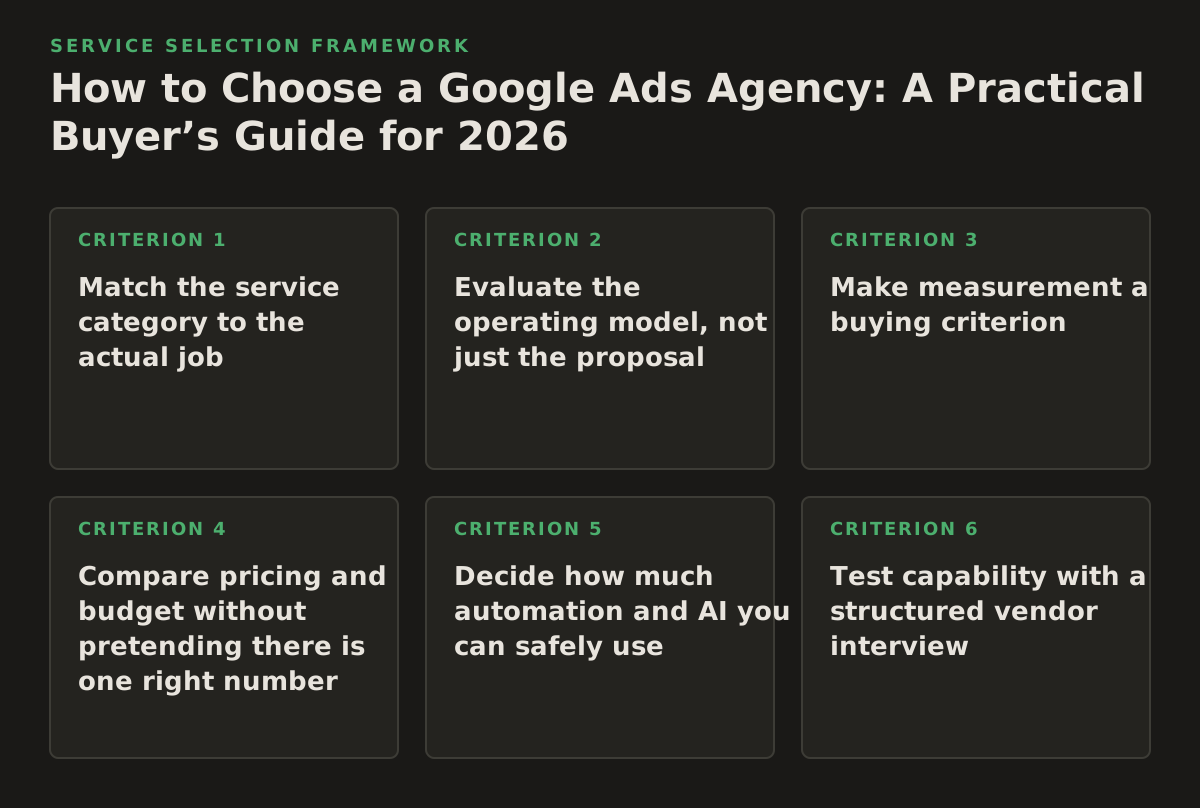
“Google Ads management” describes several very different services. Before comparing firms, identify whether the constraint is strategy, execution capacity, measurement, creative production, or speed of diagnosis. The wrong category creates predictable waste: a strategy consultant may not monitor bids daily, while a high-volume operator may not fix a broken lead-quality feedback loop.
| Buyer need | Best-fit service type | Advantages | Trade-offs and questions |
|---|---|---|---|
| New account structure, market research, and channel plan | Paid search strategy consultant | Senior diagnosis and a focused roadmap | Execution may remain with your team; ask who implements recommendations |
| Recurring campaign builds, optimization, reporting, and testing | Full-service search agency | One accountable operating partner and broader capacity | Higher coordination burden; clarify account access, communication, and scope |
| Internal expertise exists, but monitoring and repetitive changes consume time | Specialist contractor or fractional PPC manager | Flexible access to expertise without a large delivery team | Coverage can depend on one person; establish backup and documentation |
| Many accounts need standardized checks and reversible actions | Automation or AI-assisted operating layer | Consistent surveillance, alerts, and faster investigation | It does not replace business judgment; define approval and rollback controls |
| Lead quality, landing pages, CRM stages, and reputation affect paid results | Integrated growth or demand-generation partner | Can address the full conversion path rather than clicks alone | Broader scope makes attribution and accountability harder; assign metric owners |
Use the category that removes your bottleneck
A service category works when its delivery mechanism matches the bottleneck. If your team cannot turn search-term patterns into negative keywords, recurring hands-on management may be appropriate. If campaigns are adequately maintained but sales rejects half the reported leads, another round of bid adjustments is unlikely to solve the problem; the priority is call classification, CRM stages, and conversion imports.
Failure mode: buying a broad retainer because it sounds comprehensive. “Strategy, optimization, reporting, and growth” can conceal whether the provider actually owns landing-page changes, conversion tracking, feed work, or only recommendations.
Implementation example: suppose a fence, shed, or deck builder receives form fills but cannot distinguish homeowners in its service area from low-intent inquiries. Start by assigning a lead-quality and tracking workstream, not just a bid-management workstream. Google Ads for builders helps compare Google Ads management options for a fence, shed, deck, or outdoor-structure building company, including how local SEO, lead generation, website conversion, reputation management, and Google Business Profile work fit together rather than treating clicks as the whole job.
2. Evaluate the operating model, not just the proposal
A proposal is a promise; the operating model is what produces the result. Ask how work enters the team, who makes decisions, how changes are documented, and what happens when performance moves outside plan. A credible provider should be able to describe a repeatable cycle from observation to hypothesis, change, measurement, and review.
Questions that expose delivery quality
- Account ownership: Does the advertiser retain the Google Ads account, billing relationship, historical data, audiences, and conversion assets?
- Named responsibility: Who is the strategist, daily operator, analyst, and escalation contact?
- Cadence: Which checks happen daily, weekly, monthly, and after major launches?
- Change records: Will the team record what changed, why it changed, the expected effect, and the review date?
- Coverage: Who acts during holidays, staff changes, tracking outages, and sudden spend spikes?
- Scope boundaries: Are landing pages, creative, Merchant Center, offline conversions, call tracking, and CRM integration included or referred elsewhere?
Google Ads manager accounts can let an agency work across client accounts from a central account, but access architecture still needs deliberate governance. Google’s official manager-account documentation explains how manager accounts organize and access linked accounts; use it as a reference when deciding which permissions a vendor receives and which assets remain under your ownership: Google Ads manager accounts.
Why it works: a defined operating model makes quality inspectable. You can see whether the provider is learning from evidence or merely applying a list of generic optimizations. It also lowers switching cost because decisions and account history are not trapped in private spreadsheets or a departing employee’s memory.
Failure mode: accepting “we optimize continuously” as a process description. Continuous optimization can mean disciplined monitoring, or it can mean frequent changes with no valid test period. Require examples of the decision log and the conditions that trigger an intervention.
Implementation example: for a lead-generation account, require a weekly change log with four fields: observation, action, expected consequence, and validation date. A query-quality issue might lead to a negative-keyword change; the review should examine qualified lead rate and lost impression share, not merely whether clicks fell.
3. Make measurement a buying criterion
Performance cannot be managed more precisely than it is measured. A vendor may report conversions while your sales team measures accepted opportunities, booked appointments, revenue, or contribution margin. Resolve that mismatch before launch. Otherwise, an agency can improve the platform metric while the business outcome stays flat.
Build a measurement chain
- Define the business event: for example, a qualified consultation, completed purchase, or sales-accepted lead.
- Map the event path: ad interaction, landing-page action, call or form, CRM record, qualification, opportunity, and revenue.
- Assign source ownership: specify which system is authoritative for each stage and how duplicates are handled.
- Set a diagnostic layer: retain micro-events such as form starts or engaged sessions, but do not confuse them with the primary outcome.
- Agree on review windows: account for sales-cycle delay before judging recent campaigns.
Google describes conversion tracking as a way to understand actions after users interact with ads, but the implementation still depends on choosing and configuring the actions that matter to your business. Review the official setup guidance with the prospective provider and ask them to identify every conversion action, its source, and its optimization role: Google Ads conversion tracking.
For analytics governance, distinguish platform-reported conversions from behavioral analysis. Google Analytics documentation describes events as interactions measured in an app or website; that makes event design useful for diagnosis, but an event such as “form_start” should not automatically become a bidding conversion: Google Analytics events.
Success criteria should be falsifiable. A useful agreement might say that the account will be evaluated against qualified lead volume, cost per qualified lead, opportunity rate, revenue, or contribution margin, with guardrails for spend and lead acceptance. Those are illustrative measurement policies, not universal benchmarks. The exact target should reflect historical performance, sales capacity, seasonality, and gross economics.
Failure mode: letting the provider choose the success metric after seeing the data. A low cost per conversion may look excellent if calls of a few seconds, duplicate forms, or unserviceable locations are counted. Require a reconciliation between the ad platform, analytics system, CRM, and finance or sales records.
Implementation example: a B2B advertiser could set “sales-accepted opportunity” as the primary business KPI, “qualified lead” as the optimization signal when volume permits, and “form submit” as a diagnostic only. The agency’s report should show the movement between stages so a cheaper lead does not silently become a more expensive opportunity.
4. Compare pricing and budget without pretending there is one right number
Pricing models are useful only when you understand what behavior they encourage. Common structures include a fixed management fee, a percentage of media spend, project-based work, hourly or day-rate consulting, performance-linked compensation, or a hybrid. None is automatically superior. The right choice depends on spend volatility, scope stability, the amount of strategic work, and how much influence the provider has over revenue.
Questions to ask about money
- Is the fee tied to media spend, number of platforms, account count, lead volume, or a defined scope?
- Are onboarding, tracking repair, feed work, landing-page recommendations, creative production, and migration billed separately?
- Does the minimum commitment change when spend rises or falls?
- Who pays for software, call tracking, data connectors, experiments, and specialist subcontractors?
- What happens if campaigns pause, inventory changes, or the business enters a seasonal shutdown?
- Are there incentives that could encourage unnecessary spend or low-quality conversion volume?
Separate media budget from management cost and from conversion infrastructure cost. Then model the full decision in business terms: planned spend, expected conversion rate, qualification rate, close rate, average gross profit, and acceptable acquisition cost. Use your own historical data where possible. Any budget or threshold used in a forecast should be labeled as an illustrative scenario or starting policy, not a universal industry benchmark.
Why it works: a transparent cost model prevents an inexpensive retainer from hiding expensive internal work. It also makes alternatives comparable. A consultant’s project may cost less than a full-service engagement but leave your team responsible for implementation, monitoring, and incident response.
Failure mode: selecting the lowest fee while underfunding the learning system. If the provider cannot afford enough analysis, creative iteration, tracking maintenance, or account attention, the apparent saving can show up as stale campaigns and delayed problem detection.
Implementation example: create a 12-month comparison with three columns: external fees, internal hours, and required tools. Add a fourth column for accountable business outcomes. Do not assign invented performance lifts; instead, show break-even economics using conservative, base, and upside scenarios based on your own records.
5. Decide how much automation and AI you can safely use
Automation is most valuable when it shortens the path from anomaly to informed action. It is least valuable when it makes broad changes without context. A useful automation layer can check spend pacing, search-term quality, tracking health, disapproved ads, budget constraints, and unusual performance shifts. An AI assistant can help summarize evidence or propose a next step, but the account should still have permission boundaries and a human approval path for consequential actions.
Google’s developer documentation describes the Google Ads API as a way to programmatically manage and report on Google Ads accounts. That capability is relevant when an in-house team or agency is evaluating custom monitoring, bulk workflows, or an MCP-connected AI client; it does not by itself prove that an automation is safe or suitable for a particular account: Google Ads API documentation.
Use a risk-based automation policy
- Observe automatically: flag tracking outages, unusual spend, conversion drops, policy issues, and search-term changes.
- Recommend with evidence: propose negatives, budget reallocations, ad-group changes, or landing-page tests with the supporting rows and rationale.
- Approve selectively: require a named person to authorize budget changes, bidding-strategy changes, geographic expansion, and broad match expansion.
- Execute reversibly: preserve the previous state, record the actor and timestamp, and define a rollback condition.
- Review outcomes: compare the expected effect with business KPIs after an appropriate observation period.
For teams building this layer, the Google Ads MCP can be evaluated as an interface between an AI client and Google Ads workflows. For advertisers also managing paid social, the Meta Ads MCP provides a comparable place to examine Meta campaign data and actions. In either case, ask what the system can read, recommend, change, approve, and undo before connecting production accounts.
Failure mode: treating an AI-generated recommendation as a verified diagnosis. A spend spike can result from a budget change, a tracking discrepancy, a seasonal demand event, or an accidental location setting. The remedy is not “more AI”; it is evidence retrieval, a confidence level, approval gating, and a rollback plan.
Implementation example: begin with a read-only daily account review. Have the system identify campaigns whose spend, conversions, or cost per qualified lead moved outside an illustrative starting policy, then attach search terms, change history, budget status, and conversion diagnostics. After a human validates the recommendations for several review cycles, allow narrowly scoped actions such as adding an explicitly approved negative keyword list.
6. Test capability with a structured vendor interview
Interview the provider using your account’s difficult facts, not a generic questionnaire. Give them a short brief containing business economics, service area, sales process, conversion definitions, seasonality, existing campaigns, and known tracking concerns. You are testing whether they ask the right questions before prescribing an answer.
Vendor interview checklist
- Diagnosis: What would you inspect first, and what evidence would change your initial hypothesis?
- Measurement: How would you connect platform conversions to qualified leads, opportunities, sales, or revenue?
- Account structure: What would you preserve, rebuild, or leave untouched during the first phase?
- Testing: How do you distinguish a test from an optimization, and when would you stop or roll it back?
- Budget control: What triggers a spend pause, escalation, or reallocation?
- Search quality: How do you evaluate intent, geography, brand traffic, competitor terms, and irrelevant queries?
- Landing pages: What can you change directly, and how do you validate message-to-page alignment?
- Reporting: Can you show a sample change log and explain which metrics are primary versus diagnostic?
- Exit: What assets, documentation, audiences, scripts, and access will be transferred if the relationship ends?
Ask for a live walkthrough of a redacted account or a written response to a realistic scenario. Do not judge only the proposed tactics. Judge whether the explanation names constraints, separates facts from assumptions, and states what would make the recommendation wrong.
Red flags include:
- Guaranteed rankings, lead volume, or performance without access to economics, history, and tracking quality.
- Requests for ownership of the advertising account, website, analytics property, or conversion assets.
- Reports dominated by impressions, clicks, or platform conversion counts with no lead-quality reconciliation.
- Large rebuilds proposed before basic tracking, geography, budget, and search-term diagnostics.
- Vague answers about change logs, approval rights, data retention, or account handover.
- AI claims that omit permissions, human review, audit trails, or rollback procedures.
Why it works: scenario-based interviewing reveals operating judgment. A provider may know the vocabulary of paid search while lacking the discipline to protect budgets, explain uncertainty, or work with a CRM. Your evaluation should reward the latter.
Failure mode: asking every vendor to present the same polished audit. That encourages rehearsed recommendations and gives little evidence about implementation. Give each provider one constrained problem and compare the quality of their questions, assumptions, and proposed validation.
Implementation example: ask, “Lead volume rose 30%, accepted leads fell, and branded search spend increased after a tracking change. What do you inspect before changing bids?” A strong response should investigate attribution, query mix, duplicate conversions, CRM timing, and change history before claiming that bidding caused the decline.
7. Build governance into the contract and account setup
Governance is not bureaucracy added after performance improves. It is the mechanism that protects performance while people, vendors, platforms, and automation change. Put account access, data handling, approval rights, reporting definitions, and exit obligations in writing.
Minimum operating controls
- Ownership: keep the advertising account, analytics property, domain, CRM, audience assets, and billing relationship under the business or client entity.
- Permission levels: give each operator the narrowest access needed and review it when personnel or scope changes.
- Change history: retain platform history plus an external log for rationale, expected impact, approver, and rollback.
- Budget guardrails: define daily or monthly escalation rules, including who can pause campaigns.
- Data quality: document consent, lead deduplication, offline conversion imports, phone-call rules, and CRM status mappings with the responsible owners.
- Continuity: require current documentation, export access, and a handover process before termination.
Meta’s official Marketing API documentation is a useful reminder that programmatic advertising work involves both account data and actions, not just reporting. When a vendor proposes cross-platform automation, ask them to map each permission and action to a business owner and approval rule rather than treating all integrations as equivalent: Meta Marketing API documentation.
Why it works: governance converts a relationship from dependency into a controlled operating system. It also makes incident response faster. If conversions suddenly disappear, the team can identify recent changes, test the source system, and restore a known state instead of arguing over who touched the account.
Failure mode: confusing read access with accountability. A client may technically retain access but still lack the naming conventions, decision log, exports, or context needed to operate independently. Require usable documentation, not merely credentials.
Implementation example: set a policy that any budget, location, bidding, or conversion-action change requires an entry in the change log and a named approver. For low-risk read-only diagnostics, allow automation; for production writes, require an approval ticket or equivalent recorded decision.
Sequenced implementation plan for your 2026 selection
Use the following sequence to avoid hiring before the problem is defined or automating before measurement is trustworthy.
- Write the business brief. Document the service area or market, customer economics, sales capacity, margin, sales-cycle length, seasonality, current media budget, and the business outcome that matters. Include what the team will not accept, such as out-of-area leads or unprofitable orders.
- Audit the measurement chain. List every conversion action, analytics event, call source, CRM stage, and offline import. Mark each as primary, diagnostic, duplicated, unverified, or obsolete. Do this before comparing performance promises.
- Choose the service category. Decide whether you need a consultant, recurring operator, full-service agency, integrated growth partner, automation layer, or combination. Base the choice on the bottleneck and internal capacity, not the vendor’s preferred package.
- Shortlist by operating evidence. Request a sample change log, reporting view, escalation policy, account-handover terms, and a response to one constrained scenario. Remove providers that cannot explain ownership, measurement, or scope.
- Model the complete cost. Compare external fees, media, tools, internal hours, implementation work, and likely specialist dependencies. Label all forecasts as illustrative scenarios and use sensitivity analysis instead of a single promised outcome.
- Run a controlled starting phase. Begin with access validation, tracking checks, account documentation, search-term review, geography checks, and budget controls. Avoid simultaneous structural rebuilds, landing-page changes, and bidding changes unless there is a documented reason.
- Set the review protocol. Schedule a recurring review of qualified outcomes, spend pacing, conversion integrity, query quality, tests, and unresolved risks. Require every major recommendation to state its evidence, expected effect, owner, and validation date.
- Add automation gradually. Start with read-only monitoring and evidence summaries. Introduce approval-gated, reversible actions only after the team has validated the data and understands false-positive cases. Reassess permissions whenever the workflow changes.
- Make the renewal decision from business evidence. Continue, change scope, or replace the provider based on qualified outcomes, decision quality, documentation, responsiveness, and controllability—not on a single month of platform-reported conversions.
The practical recommendation is to choose the smallest service model that reliably removes your bottleneck while keeping measurement and account ownership under your control. If your team wants approval-gated AI workflows alongside human campaign expertise, NotFair offers hosted MCP connections and reversible advertising operations that can be evaluated as part of that governed model; explore NotFair when you are ready to compare that option with agency and in-house execution.
Authored with NotFair SEO