

Google Display Ads place visual ads across eligible websites, apps, YouTube surfaces, and other Google advertising inventory to create demand, re-engage visitors, or drive conversions. They are useful when search volume is limited or when a business needs to reach an audience before that audience searches, but success depends on separating targeting, bid optimization, and billing. A conversion-focused strategy does not automatically mean Google charges only for conversions: the campaign’s charging model still determines whether spend is based on clicks, impressions, or an eligible pay-per-conversion arrangement.
What Google Display Ads are
A Display campaign is an auction-based campaign that serves visual creative against available Google Display Network inventory. The advertiser provides assets, audience or contextual signals, location and language settings, budget, bidding instructions, and conversion goals. Google then decides when an eligible impression can enter an auction and which ad, if any, wins.
The key distinction for account managers is that a Display campaign is not simply “search ads with banners.” Search usually captures an expressed query. Display can reach a person based on audience membership, browsing context, content, prior site activity, or automated combinations of signals. That creates more reach, but also more uncertainty about immediate intent.
Google describes Display campaigns as a way to reach people across websites, apps, and Google-owned properties using audience and content signals. The available campaign options and inventory can change, so check the current campaign documentation before planning a new build: Google’s Display campaign overview is the appropriate starting point for the current setup.
Three jobs a Display campaign can do
- Demand creation: introduce a product to a relevant audience that is not actively searching for it.
- Remarketing: reconnect with people who visited a site, viewed a product, or started but did not complete an action, subject to audience eligibility and policy.
- Conversion support: generate leads or sales when the account has enough reliable conversion data and the landing-page experience can absorb additional traffic.
These jobs should not be judged by the same primary metric. A prospecting campaign may need qualified reach, engaged visits, or assisted conversions as diagnostic signals, while a remarketing campaign can usually be held to a tighter cost-per-action target. Combining both jobs in one campaign often hides that difference.
Why the distinction between bidding and billing matters
Many explanations of Display advertising use “pay for conversions” as shorthand for any conversion-optimized campaign. That is misleading. Smart Bidding is an optimization system: it uses auction-time signals to adjust bids toward a selected outcome such as conversions or conversion value. Billing is the charging rule: it determines what interaction or delivery event produces a bill.
For example, an advertiser can use a conversion-focused bid strategy while the campaign remains charged on a click-based or impression-based model. A campaign may seek purchases but still incur cost on clicks that do not convert. Conversely, an eligible pay-per-conversion arrangement changes how charges are incurred, but it is not a general charging option available to every advertiser, campaign, or conversion action. Google’s documentation describes pay-per-conversion eligibility and requirements separately from its broader Smart Bidding documentation; review both before representing the model in a forecast: Google’s pay-per-conversion guidance and Smart Bidding documentation.
A practical cost model
For planning purposes, use the campaign’s actual billing basis rather than the bid strategy’s name. A simple click-based forecast is:
Estimated spend = expected clicks × average cost per click
An impression-based forecast is:
Estimated spend = impressions ÷ 1,000 × average CPM
These are planning equations, not guarantees. The auction, inventory mix, quality signals, targeting restrictions, budget pacing, and market demand can change actual delivery. If the campaign is eligible for pay per conversion, model that separately and confirm the specific account terms in the Google Ads interface or official support material.
- An illustrative CPC example: 20,000 impressions × a 0.8% click-through rate = 160 clicks; at an illustrative $1.25 average CPC, spend is $200.
- An illustrative CPM example: 100,000 impressions at an $8 CPM produces $800 in media cost.
- An illustrative conversion example: 160 clicks at a 4% conversion rate produces 6.4 expected conversions; the implied cost per conversion is about $31.25 in this simplified model.
The numbers above are examples for building a spreadsheet, not universal Display benchmarks. An agency should show clients which inputs are assumptions, which are account history, and which are contractual or platform settings.
How Google Display Ads work from setup to conversion
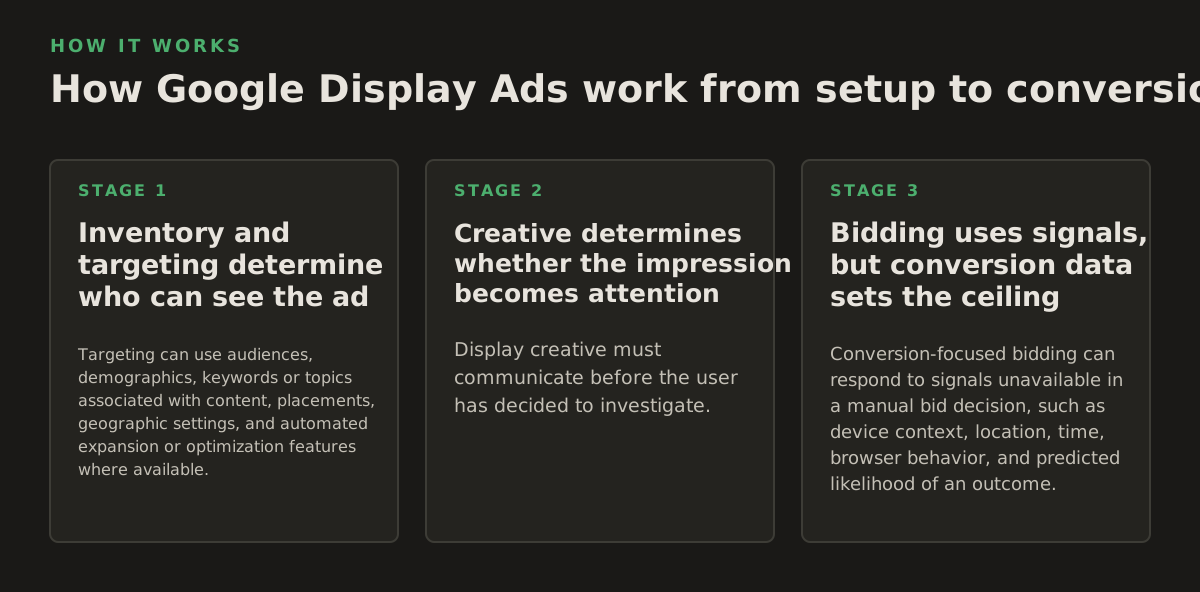
Performance is produced by a chain of decisions rather than by targeting alone. A useful implementation review follows the path from eligibility to revenue.
1. Inventory and targeting determine who can see the ad
Targeting can use audiences, demographics, keywords or topics associated with content, placements, geographic settings, and automated expansion or optimization features where available. The important question is not “how large is the audience?” but “what rule made this impression eligible?”
For a prospecting campaign, contextual signals can help the ad appear beside relevant content. Audience signals can help Google find people whose behavior or profile resembles a desired customer. For remarketing, the audience definition depends on the underlying first-party data, consent requirements, membership duration, and volume.
Keep targeting tests interpretable. If an account changes audience type, creative format, bid strategy, landing page, and budget at the same time, a later performance change cannot be assigned to one cause. Start with a clear hypothesis, such as “high-intent product-page visitors will produce more qualified leads than all-site visitors,” then isolate that comparison where practical.
2. Creative determines whether the impression becomes attention
Display creative must communicate before the user has decided to investigate. A strong asset set makes the proposition, audience, and next action obvious without relying on search intent. Use distinct creative angles instead of producing many cosmetic variations of the same message.
- Problem angle: identify the costly or frustrating situation the product solves.
- Proof angle: show a credible result, process, qualification, or customer evidence without implying unsupported outcomes.
- Offer angle: explain the next step, such as a consultation, calculator, trial, or product comparison.
- Objection angle: address price, setup effort, switching risk, or compatibility before the click.
Use landing-page continuity as a diagnostic. If the ad promises “same-day quote” but the landing page leads with a general company description, the problem is not necessarily the audience or bid. It is a broken message path.
3. Bidding uses signals, but conversion data sets the ceiling
Conversion-focused bidding can respond to signals unavailable in a manual bid decision, such as device context, location, time, browser behavior, and predicted likelihood of an outcome. That does not make the system omniscient. It still depends on conversion definitions that are accurate, timely, deduplicated, and aligned with business value.
Before selecting a target cost or value goal, audit:
- whether primary conversions represent real business outcomes rather than page views or duplicate events;
- whether imported offline outcomes are mapped to the correct lead or transaction;
- whether revenue values are stable enough to support value-based optimization;
- whether the campaign has enough recent signal for the chosen strategy to make sensible decisions;
- whether consent, attribution windows, and data loss make reported conversions systematically incomplete.
Google Ads conversion tracking supports actions such as purchases, sign-ups, phone calls, and other business events, but the implementation details determine what optimization can learn. Google’s official setup and troubleshooting guidance is available in its conversion tracking documentation. Do not treat a green tracking status as proof that the business is measuring the right outcome.
Where Display campaigns commonly break
Display usually fails through a mismatch between the campaign’s job and its measurement, not because banners are inherently ineffective. The following failure modes are common enough to make them part of the launch checklist.
Cheap clicks that are not useful visits
A low CPC can result from broad inventory, accidental clicks, weak placements, or a message that attracts curiosity without purchase intent. Review post-click behavior by placement, device, geography, and landing page. A click is a delivery event; it is not evidence of commercial value.
Remarketing that is too broad or too persistent
Remarketing can waste budget when audiences include low-value visitors, existing customers who need no further promotion, employees, or people who completed the desired action. Frequency also matters: repeated exposure can create fatigue and annoyance without adding incremental conversions.
Build exclusions deliberately. Examples include:
- exclude recent converters from acquisition messaging when the next action is no longer relevant;
- separate customers from prospects when the offer, value, or lifecycle stage differs;
- exclude internal traffic and test users from audience pools where possible;
- use a shorter membership window for urgent offers and a longer one only when the buying cycle justifies it.
Do not assume an exclusion is working merely because it exists in the account. Confirm audience sizes, eligibility, delivery, and conversion paths after the change.
Attribution that rewards the wrong channel
Display impressions and clicks can occur before a conversion that is ultimately influenced by search, email, sales outreach, or direct navigation. If the team evaluates Display only on last-click conversions, it may undervalue prospecting. If it accepts every view-through or assisted conversion as incremental revenue, it may overvalue it.
Use at least two views: a platform-reported view for optimization and a business or analytics view for budget decisions. Google Analytics documentation explains how campaign traffic and events are measured in its reporting framework; align campaign tagging and event definitions before comparing Google Ads with other channels: Google Analytics campaign measurement guidance.
How practitioners should apply Google Display Ads
The right operating model depends on the job, the quality of data, and the tolerance for wasted reach. A small business with one conversion event should not copy an agency’s multi-stage structure without the same measurement foundation.
Choose the campaign job before choosing the bid strategy
| Business situation | Useful starting approach | Main risk to monitor |
|---|---|---|
| New category or limited search demand | Prospecting with a tightly defined audience or context and several creative angles | Reach that looks efficient but creates no qualified demand |
| Long consideration cycle | Separate education, lead capture, and sales-qualified outcomes | Optimizing toward low-value form fills |
| Established product with first-party visitors | Segmented remarketing with exclusions and lifecycle-specific messages | Audience overlap, fatigue, and existing customers receiving acquisition offers |
| Reliable transaction values | Conversion-value optimization after revenue tracking is validated | Incorrect values or delayed imports teaching the system the wrong economics |
The table is a decision framework, not a promise that one campaign type will work. If the business cannot define a meaningful conversion or cannot connect a lead to eventual quality, start with measurement and audience diagnostics rather than forcing automated optimization.
Use a controlled launch and an explicit review cadence
A launch plan should make failure visible. Set the budget, exclusions, conversion actions, creative variants, and reporting dimensions before the campaign starts. Label any budget, threshold, or timeline as a policy choice. For example, an agency might use a two-week initial review window and pause a placement after a client-approved spend limit without a qualified action; those are governance rules, not Google benchmarks.
- Before launch: verify destination URLs, mobile rendering, conversion firing, consent behavior, audience membership, exclusions, and brand-safety settings.
- During the initial delivery period: check spend pacing, placements, frequency, search-lift assumptions, invalid-looking traffic patterns, and conversion latency.
- After enough data accumulates: compare qualified conversion rate and downstream value, not just CTR and CPC.
- When changing settings: record the hypothesis, expected direction, date, and success condition so later results remain interpretable.
For teams managing multiple accounts, automation can reduce inspection time, but it should not remove approval controls. A useful workflow is to pull campaign, placement, spend, conversion, and change-history data; identify anomalies; propose a reversible action; and require a human approval before applying it. Google Ads API documentation is the appropriate reference for building programmatic access and respecting current resource and authorization requirements: Google Ads API getting started documentation.
That workflow is where an Google Ads MCP connection can be relevant for agencies and in-house teams: an AI client can help summarize account evidence and draft changes, while the operating policy decides which actions require approval. If the same organization runs paid social, compare equivalent business outcomes rather than forcing identical platform settings; a separate Meta Ads MCP workflow may need different data fields and controls.
Recommendation for managing Display in 2026
Use Google Display Ads when you can state the campaign’s job in one sentence, identify the event that proves progress, and explain how the campaign is charged. Start with a narrow audience or context, credible creative variations, explicit exclusions, and a validated conversion path. Then widen reach only when the incremental conversions or qualified demand justify the additional uncertainty.
Most importantly, report billing basis, optimization goal, and business outcome as three separate fields in every performance review. That simple separation prevents the common mistake of calling a conversion-optimized campaign “pay per conversion” and gives stakeholders a more accurate view of what the budget actually bought.
For teams that want AI-assisted diagnosis and reversible execution across advertising and analytics systems, NotFair provides approval-gated hosted MCP connections designed for that workflow. Explore NotFair when you need automation that keeps the proposed change and the human decision visible.
Authored with NotFair SEO