

Useful google ads examples are not collections of clever headlines or screenshots; they are decision patterns that help a manager choose the right campaign structure, conversion signal, budget rule, and automation boundary. This guide is for paid search managers, agencies, consultants, and growth teams deciding what to build next—and what not to automate yet.
The job is usually more specific than “get more traffic.” You may need qualified demo requests without flooding sales with poor-fit leads, profitable ecommerce revenue while protecting margin, or a diagnosis of why clicks increased but pipeline did not. The examples below connect each objective to an operating model. They also show where Google Ads data should be reconciled with analytics, CRM, Search Console, or Meta before anyone changes a live campaign.
As a practical rule, treat every campaign recommendation as a hypothesis with four parts: business outcome, eligible traffic, measurement signal, and safe action. If one part is missing, the campaign may still spend, but you will not know whether it is doing useful work.
1. Build the campaign around the business decision
This principle applies when a brief starts with a channel request—“launch search,” “add Performance Max,” or “increase branded coverage”—rather than a commercial problem. Campaign type is an implementation choice, not the objective. Start by writing the decision the account must support.
For a B2B software company, the decision might be whether to fund high-intent searches for a narrow category, not whether to maximize form fills. For a local service business, it may be whether calls from a particular service area are profitable after staffing costs. For ecommerce, it may be whether incremental gross profit justifies higher acquisition cost for a product group.
Google’s documentation distinguishes campaign goals and conversion setup from the mechanics of serving ads, so use its official guidance as a configuration reference rather than treating a campaign label as a strategy. The relevant starting point is Google’s campaign and goal guidance for advertisers: Google Ads campaign goals.
A reusable brief
- Outcome: revenue, qualified pipeline, booked appointments, store visits, or another measurable business result.
- Audience constraint: geography, eligibility, product fit, buying stage, or service capacity.
- Economic limit: allowable cost per qualified opportunity, contribution margin, or payback requirement.
- Evidence window: the date range and attribution view used to make a decision.
- Action boundary: what can be changed automatically, what requires approval, and what must remain manual.
When it works: this brief prevents a high-volume metric from silently replacing the business outcome. Why it works: every later choice can be judged against the same constraint. Failure mode: teams define “conversion” as any available event, such as a page view or button click, because it is easy to import.
Implementation example: a cybersecurity consultancy wants more enterprise opportunities. Instead of creating one campaign for “cybersecurity,” it defines the goal as sales-accepted discovery calls from companies in its target industries. Search terms about compliance audits and incident response are eligible; student, certification, and employment searches are not. The primary optimization event is a qualified booking, while brochure downloads remain secondary observations.
That structure gives an analyst a useful diagnostic question: did the campaign fail to attract the audience, did the landing page fail to persuade it, or did the measurement system misclassify the outcome?
2. Match campaign structure to intent and control needs
Use this principle when an account contains several products, regions, services, or stages of intent and the team is unsure whether to consolidate or split. Structure should follow meaningful differences in economics or control, not every small keyword variation.
Separate campaigns when budgets, locations, conversion values, landing pages, legal constraints, or reporting decisions genuinely differ. Keep related demand together when splitting would fragment useful signals and make each segment too sparse to evaluate. The right boundary is the smallest unit at which a manager needs a different decision.
Four practical structure patterns
- Branded versus non-branded: separate when brand demand has materially different intent, cost, or reporting requirements.
- Service line: separate emergency plumbing from planned bathroom renovation when lead value and response process differ.
- Geography: separate regions when budgets, availability, language, or economics differ—not merely because a map allows it.
- Product margin: separate product groups when feed attributes, gross margin, or inventory rules require different bids or budgets.
When it works: use this approach when stakeholders need accountable budget and performance decisions by segment. Why it works: it preserves the link between spend and the operational team that fulfills demand. Failure mode: over-segmentation creates many campaigns with thin data, inconsistent negatives, and no reliable basis for comparison.
Implementation example: an agency manages a home-services account with three service lines. It creates separate campaigns for emergency repairs, installations, and maintenance because call handling, lead value, and hours of operation differ. It does not create separate campaigns for every suburb; locations remain grouped until service capacity or economics justify a separate budget.
For search, build ad groups around tightly related intent and landing-page relevance, but do not use ad groups as a substitute for a business structure. A keyword list can explain a query theme; it cannot explain whether a lead is profitable.
For a cross-channel team, keep the same business taxonomy across Google and Meta where practical. A paid social campaign may introduce demand while search captures active demand, but the CRM stages and revenue definitions should remain comparable. The official Meta Marketing API documentation is a useful reference for the platform’s campaign, ad set, and ad hierarchy: Meta Marketing API documentation.
3. Treat measurement as an information architecture problem
This principle applies whenever reported conversions do not agree with CRM outcomes, analytics sessions, or finance. The fix is rarely “pick the platform with the biggest number.” It is to define how an event moves from user action to business record, then document which system owns each field.
A dependable measurement design separates:
- Observed events: page views, video plays, form starts, calls, purchases, or appointment requests.
- Optimization events: events suitable for bidding because they represent useful intent at the required volume.
- Qualified outcomes: sales-accepted leads, completed appointments, valid orders, or retained customers.
- Value fields: revenue, expected revenue, margin, or a deliberately assigned value.
- Exclusions: spam, duplicates, employees, existing customers, cancellations, and test transactions.
Google Analytics 4 documents recommended and custom events as separate implementation concepts; use that distinction when deciding whether an event is a standard reporting interaction or a business-specific milestone. See the official GA4 event reference.
When it works: use this model when platform conversions are plentiful but downstream quality is unclear. Why it works: it makes the optimization target explicit instead of allowing every imported event to compete for primary status. Failure mode: importing every CRM status as a conversion without checking latency, duplication, or whether the status can be sent back consistently.
Implementation example: a recruitment firm records three stages: completed application, recruiter-qualified applicant, and placed candidate. The first event is useful for diagnosing landing-page friction, the second is the primary lead-quality signal, and the third is a delayed value outcome. The account does not treat a “start application” event as equivalent to a placement.
A reconciliation checklist
- Choose one canonical identifier for each lead or order.
- Record the timestamp of the original ad interaction and the downstream outcome.
- Compare counts by day, campaign, device, and landing page.
- Investigate duplicates, missing consent signals, offline imports, and timezone differences.
- Write down which discrepancy is acceptable and which blocks optimization.
Do not set a universal tolerance for data differences. An illustrative starting policy for a small account might be to investigate any unexplained gap that changes a budget decision, even if the percentage difference looks modest. The decision impact matters more than a cosmetic match between dashboards.
Search Console adds a different kind of evidence: it describes organic search queries and search performance, not paid conversions. The official documentation explains the reports and data available in Search Console: Google Search Console overview. Use it to identify language, questions, and landing-page expectations that can inform paid search—not to merge organic and paid metrics without labeling them.
4. Use ad and landing-page examples as controlled hypotheses
This principle applies when a team is producing many headlines and descriptions but cannot explain what each variation is meant to learn. More assets do not automatically create more insight. A useful example states the audience, promise, proof, and next step.
Search ad hypothesis template
- Intent: what problem or category is the query expressing?
- Promise: what outcome can the business credibly offer?
- Proof: what evidence reduces uncertainty—process, qualification, warranty, integration, or transparent pricing?
- Friction reducer: what makes the next step feel safe and specific?
- Landing-page match: where does the page substantiate the claim?
When it works: use this method when click-through rate rises but qualified conversion rate does not. Why it works: it tests the chain from query expectation to page experience instead of optimizing an ad in isolation. Failure mode: writing a broad claim such as “Best marketing platform” that attracts curiosity but gives a qualified buyer no reason to trust the next step.
Implementation example: an analytics consultancy targets “GA4 migration help.” One ad emphasizes a fixed discovery process, another emphasizes server-side measurement expertise, and the landing page presents the exact deliverables, prerequisites, and a qualification form. The team evaluates qualified consultations, not only clicks or raw form submissions.
Google’s official responsive search ad guidance explains how assets are combined and evaluated within the format; consult it before treating individual headline-level results as if every combination had received equal exposure. See Google’s responsive search ad guidance.
A practical review should ask:
- Does the ad name the problem in the query rather than merely the company?
- Does the landing page repeat the promise with evidence?
- Is the call to action appropriate for the buying stage?
- Could an unqualified person misunderstand the offer?
- Would a sales representative recognize the lead as belonging to the intended segment?
Do not infer creative quality from one metric. A high click-through rate can mean the message is relevant, or that it is making an overly broad promise. A low conversion rate can indicate weak persuasion, slow response, poor qualification, or an incorrect event. The example is useful only when its measurement boundary is clear.
5. Make budget and bidding changes proportional to evidence
Use this principle when performance is volatile, conversion volume is uneven, or stakeholders want an immediate response to a short-term spike. Budget decisions should distinguish a real change in demand from random variation, tracking failure, auction pressure, or a temporary promotion.
Start with a change ledger. Record the date, campaign, change, reason, expected effect, owner, and rollback condition. Add contextual notes for promotions, stockouts, sales capacity, tracking releases, and landing-page changes. Without this history, an account becomes a sequence of unexplained interventions.
| Signal | Likely interpretation | First check | Illustrative action policy |
|---|---|---|---|
| Clicks up, qualified outcomes flat | Traffic quality or measurement issue | Search terms, lead stages, tracking, landing page | Do not raise budget; isolate the cause first |
| Qualified rate stable, eligible demand constrained | Potential underfunding | Impression share context, capacity, margin | Consider a measured budget increase if economics hold |
| Cost rises after a structural change | Learning, competition, or changed mix | Change ledger, query mix, auction context | Hold other variables steady before another edit |
| Spend continues while conversion data breaks | Measurement or destination failure | Tags, forms, checkout, CRM receipt | Pause or restrict spend under the incident policy |
| Revenue looks strong but margin falls | Value definition is incomplete | Product margin, discounts, returns, shipping | Rebuild values before scaling the apparent winner |
When it works: use this framework when several people can change an account or when automated recommendations are being considered. Why it works: it converts vague optimism into a reversible operating policy. Failure mode: changing budget, targeting, creative, and bidding at the same time, then attributing the result to one favorite explanation.
Implementation example: an ecommerce manager sees a profitable weekend and wants to double spend on Monday. The starting policy—explicitly illustrative, not a universal benchmark—is to verify inventory, returns, margin, tracking, and weekday demand before making a smaller staged change. The manager defines a review date and a rollback rule tied to contribution margin, not only platform-reported revenue.
Google Ads API users should also separate account inspection from mutation. Google’s official API documentation describes the API’s resources and workflows, making it a suitable reference for designing read, validate, and mutate steps: Google Ads API overview. A script that can edit campaigns should not be granted the same workflow as a report that only diagnoses them.
6. Turn search queries into a recurring decision system
This principle applies to search accounts with recurring spend, especially when query quality changes faster than the account structure. Search-term review is not merely a negative-keyword exercise. It is a way to discover new intent, detect misleading ad promises, and decide whether a landing page or campaign deserves investment.
Classify before editing
- Promote: relevant queries with evidence of qualified value that deserve a deliberate keyword or ad-group decision.
- Protect: queries that are relevant but need exclusions, geography controls, schedule limits, or audience qualification.
- Observe: queries with insufficient evidence where an immediate block could remove useful demand.
- Exclude: clearly irrelevant, incompatible, or economically impossible traffic.
- Investigate: queries exposing a tracking, policy, feed, or landing-page mismatch.
When it works: use this system when managers are adding negatives reactively or reviewing only the most expensive terms. Why it works: it preserves useful discovery while applying controls according to intent and business fit. Failure mode: adding a broad negative because one query looked poor, unintentionally blocking an entire family of profitable searches.
Implementation example: a legal firm sees searches for “employment lawyer free advice.” Some are clearly unqualified, but “employment lawyer consultation” may be valuable. The analyst checks query wording, location, device, landing-page behavior, and CRM quality before applying a narrowly scoped exclusion. If the pattern repeats, the firm creates a dedicated qualification page rather than relying on negatives alone.
Use a query review record with the query, classification, reason, action, campaign scope, reviewer, and date. That record is particularly important when an AI assistant proposes changes. An agent can cluster themes and explain evidence; a human-approved workflow should decide whether a proposed exclusion has an acceptable blast radius.
Search Console query language can also provide a source of customer vocabulary, while paid search terms reveal the language attached to commercial intent. Keep those datasets labeled by channel and purpose. Combining them can improve copy discovery; pretending they represent the same audience behavior can produce bad conclusions.
7. Automate diagnosis before execution
This principle applies when the account has enough repetitive analysis to justify automation but the cost of a mistaken edit is material. The safest sequence is observe, explain, propose, approve, execute, verify. Automation should reduce time spent finding and framing decisions before it expands the number of systems allowed to change.
A practical approval-gated workflow
- Observe: retrieve campaign, ad, search-term, conversion, budget, and landing-page evidence for a defined period.
- Explain: identify the changed metric, affected segment, likely causes, and missing evidence.
- Propose: state the exact mutation, expected direction, scope, owner, and rollback condition.
- Approve: require a person to approve high-impact changes or changes with uncertain evidence.
- Execute: apply the smallest reversible modification available.
- Verify: confirm that the intended object changed and that tracking, spend, and serving behavior remain healthy.
When it works: use this pattern for agencies managing many accounts or in-house teams with repeated weekly checks. Why it works: it separates analytical confidence from execution permission. Failure mode: allowing an agent to “optimize” without a change preview, scope limit, or rollback record.
Implementation example: an AI workflow detects that spend is flowing to a campaign whose lead form has stopped producing CRM records. It does not immediately rewrite bids. It gathers recent conversion counts, form status, destination checks, and change history; proposes a temporary budget restriction; requests approval; applies the approved change; and schedules verification. If the issue is tracking rather than demand, the operator can restore delivery without reconstructing the account.
For teams using an MCP client, a hosted Google Ads MCP connection can make account data available to an AI client for diagnosis and approved actions. Pair it with explicit tool permissions: read-only reporting, draft recommendations, and mutation tools should be distinct capabilities. If the same team also manages paid social, a separate Meta Ads MCP connection can support cross-channel comparisons while preserving each platform’s native object model and audit trail.
Do not automate a decision merely because it is repetitive. Automate when the input is stable, the action is bounded, the outcome is observable, and the failure is recoverable. Keep budget increases, conversion-goal changes, broad targeting changes, and account-level exclusions behind approval unless the organization has documented stronger controls.
8. Choose examples by risk, not novelty
When a manager asks for “the best” campaign example, the useful answer depends on risk, data quality, and operational capacity. A small business with one sales representative should not copy an enterprise account’s segmentation. An agency with reliable CRM imports can optimize toward deeper outcomes than a new advertiser with only web events.
Use the following selection questions:
- Is the commercial outcome clear enough to evaluate?
- Can the account distinguish qualified demand from cheap activity?
- Is there enough operational capacity to fulfill more demand?
- Will the proposed structure create useful control or needless fragmentation?
- Can the change be reversed without losing historical context?
- Does the team have an owner for verification after execution?
Low-risk starting examples include a measurement audit, search-term classification, landing-page message mapping, and a change ledger. Medium-risk examples include a scoped negative-keyword update, a new service-line campaign, or a value rule supported by finance. Higher-risk examples include changing primary conversion goals, restructuring mature campaigns, or allowing autonomous budget edits.
The practical consequence is that “advanced” should mean better evidence and control, not more complicated settings. A plain search campaign with trustworthy qualification data can support better decisions than a sophisticated setup optimizing an unverified event.
Implement the framework in sequence
Use this six-step plan for a new account, a troubled account, or an automation project. Complete each step before expanding the scope of the next.
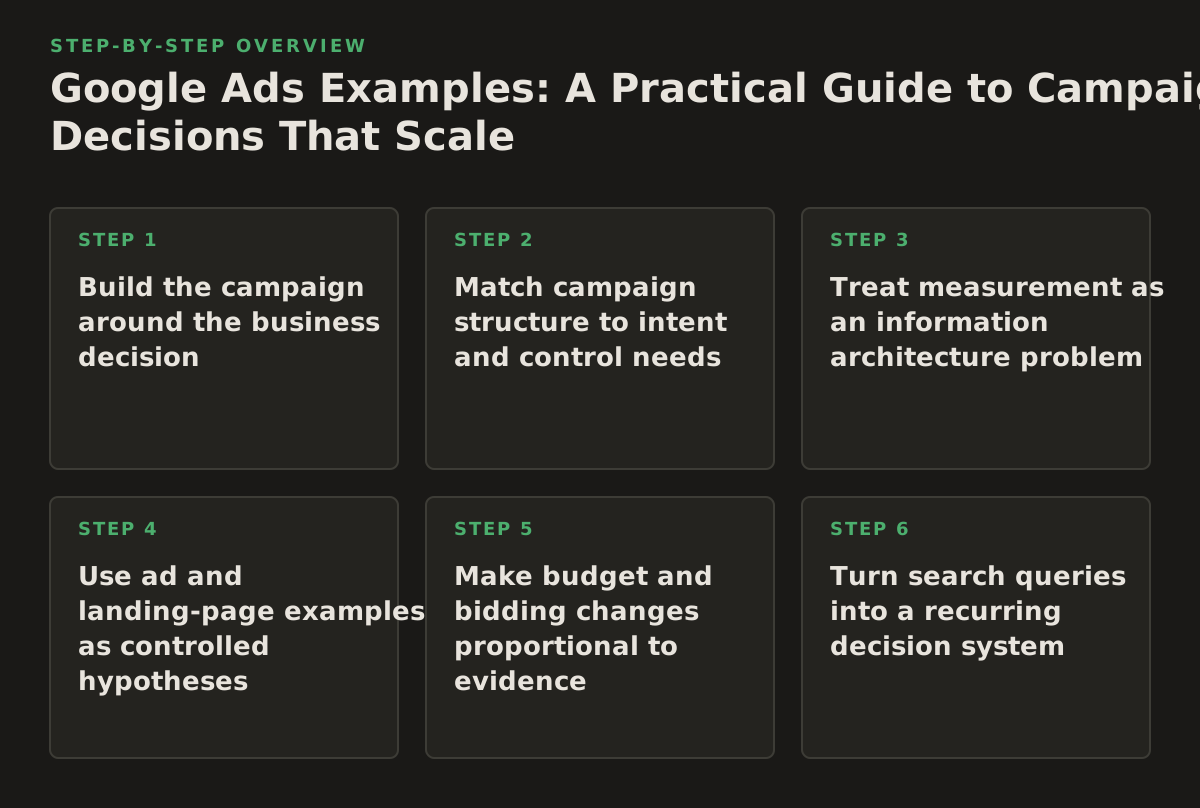
- Write the commercial decision. Name the outcome, audience constraint, economic limit, and accountable owner. If the outcome cannot be stated without a platform metric, stop and resolve the brief.
- Map the measurement path. Document observed events, primary optimization events, CRM stages, value fields, exclusions, timestamps, and reconciliation checks. Fix broken tracking before interpreting campaign performance.
- Choose the smallest useful structure. Split only where budget, economics, geography, fulfillment, or reporting require separate control. Keep a written reason for every major campaign boundary.
- Create hypothesis-led examples. For each important intent, connect query, promise, proof, landing page, and next step. Review qualification quality alongside click and conversion metrics.
- Install the operating controls. Maintain a change ledger, search-term classification log, approval thresholds, rollback rules, and post-change verification owner. Label starting policies as illustrative and revise them with evidence.
- Automate the read path first. Let the AI workflow collect evidence, identify anomalies, and draft recommendations. Add approval-gated execution only after the team can explain, verify, and reverse the proposed changes.
For a first 2026 rollout, start with one business outcome and one bounded workflow—for example, diagnosing lead-quality deterioration and proposing a narrowly scoped search-term action. Expand to cross-channel analysis only after the identifiers, dates, definitions, and ownership rules are stable.
NotFair can help teams connect approval-gated AI workflows to advertising and analytics systems through hosted MCP servers; explore the platform at NotFair when you are ready to move from account inspection to controlled execution.
Authored with NotFair SEO