

A google ads credit is a promotional balance that Google may apply to an eligible advertising account after the advertiser satisfies stated offer conditions. It is not free cash, a refund for previous spend, or a permanent reduction in cost per click. Usually, the advertiser must enter or accept an offer, spend qualifying money within a defined period, and then wait for Google to apply the promotional amount under the offer’s terms. The exact eligibility rules, deadlines, qualifying spend, and credit amount vary by offer and account.
That distinction matters to agencies, in-house growth teams, and small businesses because a credit changes the timing of cash outflow, not the underlying economics of a campaign. You still need valid conversion tracking, a defensible budget, and a plan for what happens when the credit runs out. Treating the offer as a reason to launch an unmeasured campaign is one of the quickest ways to turn a promotion into wasted spend.
What Google Ads Credit actually is
The phrase covers several things that practitioners should keep separate: a promotional credit offered to new or reactivated advertisers, an account balance adjustment made by Google, and ordinary billing corrections or refunds. Only the first is normally what a marketer means when searching for a Google Ads promotional offer. Google’s official explanation says promotional offers have their own eligibility requirements and terms, so the offer attached to a particular account is the controlling document—not a screenshot, blog post, or sales email from another advertiser. See Google’s current guidance on Google Ads promotional offers before planning spend around one.
Credit versus budget
Illustrative example: A budget is your spending instruction. A credit is a billing offset applied under conditions. If a campaign spends $1,000 and an eligible credit covers part of that amount, the campaign still generated $1,000 of media activity; it did not become a campaign with a $1,000 performance budget at no cost. The advertiser may still owe money for spend outside the offer, taxes, invalid or non-qualifying activity, and spend after the credit is exhausted.
For reporting, maintain two views:
- Media performance: impressions, clicks, conversions, conversion value, cost, and auction-level outcomes.
- Cash economics: the amount charged to the payment method, the promotional balance used, and the remaining amount the business must fund.
- Post-credit economics: the expected cost and return once ordinary billing resumes.
Blending those views creates misleading conclusions. A campaign can appear highly efficient when the cash ledger is considered but unprofitable when evaluated at its normal media cost. Conversely, a credit can provide a useful acquisition test even when it does not make an otherwise weak campaign strategically sound.
What it is not
A promotional credit does not guarantee impressions, clicks, leads, sales, a particular ad position, or approval of every creative and landing page. It also does not override Google Ads policies. The account must continue to meet policy and payment requirements, and the advertiser remains responsible for deciding whether the traffic is commercially useful.
For a business preparing its first serious launch, the operational question is therefore not “How do we spend the free money?” It is “What evidence do we need before committing ordinary cash?” That change in framing leads to better campaign structure, cleaner measurement, and a more realistic handoff from promotion to recurring budget.
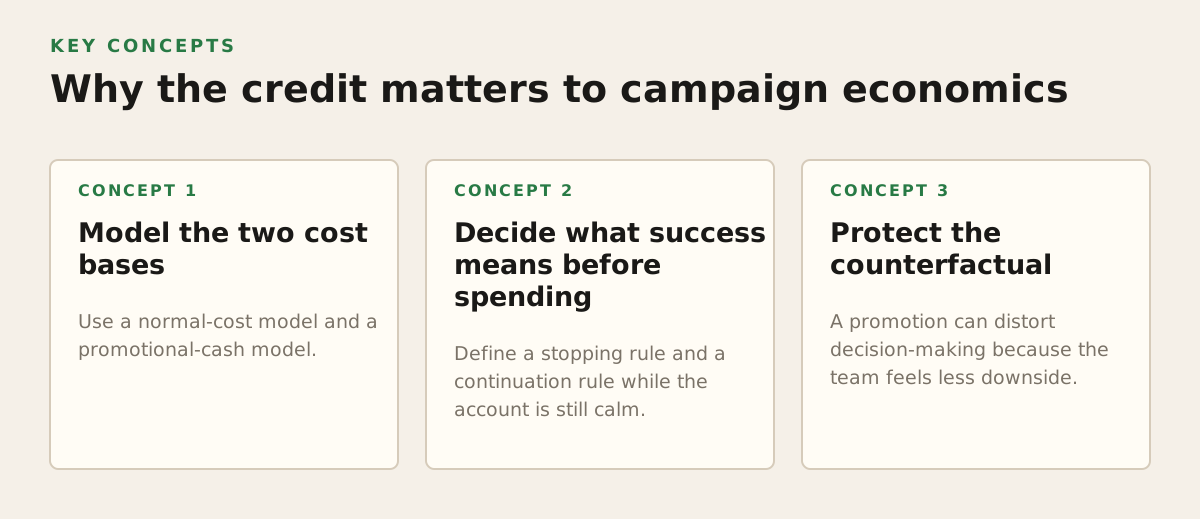
Why the credit matters to campaign economics
The most useful effect of a credit is risk reduction during controlled learning. It can let a business collect search-term, conversion, and landing-page evidence before the full financial exposure sits on its own payment method. That benefit exists only if the test is designed in advance. A credit should buy information, not disguise the absence of a business case.
Model the two cost bases
Use a normal-cost model and a promotional-cash model. Suppose the following figures are an illustrative planning example, not a universal benchmark:
- A search campaign spends $1,200 in qualifying media during the offer period.
- It produces 30 tracked leads, giving an illustrative media cost per lead of $40.
- The business estimates that 20% of leads become qualified opportunities and 25% of those opportunities become customers.
- The resulting expected customer count is 1.5, so the illustrative media cost per customer at full cost is $800.
- If an eligible $400 credit is applied, the cash outlay appears to be $800, but the media-based acquisition cost remains $800 per expected customer.
Illustrative example: The credit may improve cash flow and lower the cost of learning, but it does not change the campaign’s underlying $40 cost per lead or the estimated $800 cost per customer. If the business can profitably acquire a customer at $800, the campaign may merit more funding. If it cannot, the credit has helped prove a problem rather than solved it.
Decide what success means before spending
Define a stopping rule and a continuation rule while the account is still calm. A useful starting policy, explicitly illustrative rather than a universal benchmark, might say:
- Pause a search theme if it receives material traffic but produces no qualified action after the team’s pre-agreed observation window.
- Keep a theme active when it generates qualified leads at or below the business’s allowable acquisition cost, even if the promotional balance is nearly depleted.
- Do not scale solely because the remaining credit is available; scale only when conversion quality and capacity support the additional demand.
- Reserve part of the planned test for the transition period, so the team observes performance under ordinary billing rather than ending exactly when the credit ends.
Those rules force a distinction between cheap traffic and valuable demand. For lead generation, import downstream stages such as qualified lead, opportunity, and closed revenue where possible. For ecommerce, use transaction revenue and margin rather than purchases alone. For a local service business, record booked appointments and completed jobs, not just form submissions.
Protect the counterfactual
A promotion can distort decision-making because the team feels less downside. Keep a counterfactual record: what would this campaign cost at the normal billing rate, and would the expected results justify that cost? Record the answer in the campaign brief, not only in a dashboard. This prevents a common failure mode in which a manager celebrates low cash spend, then discovers that the campaign cannot survive the first ordinary invoice.
Attribution also deserves caution. A credit does not make branded searches incremental. If most conversions would have happened without the ads, the campaign may be harvesting existing demand rather than creating new demand. Compare brand and non-brand activity, inspect search terms, and use business-quality outcomes before concluding that the offer produced incremental growth.
How eligibility, billing, and measurement work
The mechanics have three separate stages: offer eligibility, qualifying spend, and credit application. Confusing their order causes most avoidable disputes. An account may be eligible to receive an offer but not yet have earned the credit. It may have earned a credit but not have it visible immediately. It may show a balance while still charging the payment method for non-qualifying spend.
Read the offer as an operating contract
Before accepting an offer, capture these fields in the account record:
- The account, customer ID, billing country, and currency to which the offer applies.
- The date by which the promotional code must be entered or the offer must be accepted.
- The date range in which qualifying spend must occur.
- Whether the condition is based on spend, first-time advertising activity, account status, or another requirement.
- When the credit is expected to appear and how long it can be used.
- Any exclusions for taxes, adjustments, prior spend, refunded activity, or other charges.
Google’s billing documentation explains that advertisers can be charged according to the account’s payment setting and billing threshold or scheduled arrangement; the presence of a promotion does not eliminate the need for a valid billing setup. Review the official Google Ads billing options documentation alongside the offer, because the timing of charges affects cash forecasting and account continuity.
Understand the sequence
A typical sequence looks like this:
- The advertiser creates or qualifies an account and accepts the applicable offer.
- The advertiser launches eligible campaigns and incurs qualifying spend within the stated period.
- Google determines whether the qualifying conditions were met.
- The promotional balance is applied according to the offer’s timing and billing rules.
- The account continues spending against ordinary funding once the promotional balance is used or expires.
That sequence is a pattern, not a promise about every promotion. The offer’s own terms control. Never increase spend merely because a dashboard displays an expected credit. First confirm that the spend is eligible and that the resulting campaign activity is commercially acceptable.
Instrument conversions before launch
Measurement must be ready before the first click. Google’s documentation describes conversion tracking as the mechanism for measuring actions that matter after interaction with an ad; its official conversion tracking overview covers the setup choices and implementation considerations. In practical terms, verify the tag or imported event, attribution setting, primary versus secondary action status, value rules, and lead deduplication before spending promotional funds.
A minimum launch checklist includes:
- One primary conversion that represents a meaningful business outcome, not every low-intent interaction.
- A test submission or transaction that appears in the expected platform and analytics reports.
- Consent, call tracking, CRM, or offline-import behavior documented for the relevant market and funnel.
- UTM naming and campaign-source conventions that survive the handoff into analytics and the CRM.
- A named owner who checks spend, disapprovals, conversion volume, and lead quality on a defined schedule.
Google Analytics can provide another view of acquisition and engagement, but it is not a substitute for validating the ad platform’s conversion action. Differences between Google Ads and Analytics can arise from attribution, processing, identity, consent, time zones, and counting rules. Use each system for the decision it is designed to support rather than forcing identical totals.
For teams building an automated operating layer, Google Ads MCP is relevant when the job is to connect an AI client to Google Ads data and workflows. The useful design question is not whether an agent can read a credit balance; it is whether the agent can distinguish billing state from campaign performance and require approval before changing spend.
Where promotional credits break down
Credits fail as growth tools when the operational constraints are ignored. The most dangerous issues are not usually dramatic technical errors; they are small assumptions about timing, eligibility, or measurement that compound into an expensive decision.
Eligibility and timing failures
Offers may be account-specific, country-specific, or limited to particular campaign or billing conditions. An offer that worked for one customer ID may not apply to a related account, a manager account, or an account with prior advertising history. In 2026, teams should treat every promotion as a dated commercial term and retain the original terms with the account’s financial records.
Common timing failures include:
- Entering a code after its redemption deadline.
- Spending after the qualifying window closes and assuming that later activity counts.
- Launching too late to generate the required activity before the deadline.
- Pausing campaigns while waiting for a credit and losing the learning or delivery window.
- Assuming the credit will appear immediately after qualifying spend.
Set a calendar reminder for the redemption deadline, qualification deadline, expected application date, and expected depletion date. Assign each reminder to a person who can actually inspect billing and campaign status. A reminder without an owner is not a control.
Billing and cash-flow failures
Even when a credit is valid, the account may incur charges before the credit is applied, or may continue charging after the balance is depleted. Payment failures can interrupt delivery, reset a launch plan, or create an avoidable scramble for an agency managing several client accounts. Finance should receive the offer terms and the worst-case cash requirement, not just the promotional headline.
Use a simple ledger with these columns:
| Field | Why it matters | Owner |
|---|---|---|
| Qualifying spend | Tracks progress toward the offer condition | Paid media manager |
| Applied credit | Confirms the balance actually posted | Account or finance owner |
| Unfunded exposure | Shows what ordinary billing may require | Finance |
| Expiry or depletion date | Prevents an unplanned billing transition | Campaign owner |
| Post-credit budget | Tests whether the campaign can continue | Growth lead |
Optimization failures
A credit can encourage premature automation. Automated bidding needs enough reliable conversion signal and an objective that reflects business value. Google describes Smart Bidding as automated bid strategies that use auction-time signals to optimize for conversions or conversion value; see the official Smart Bidding documentation for the strategy definitions and setup considerations. That does not mean an advertiser should immediately hand a thin-data promotional test unlimited control over budget.
Use guardrails proportionate to the evidence:
- Keep initial targeting and match-type choices narrow enough to make search-term review possible.
- Separate brand, non-brand, remarketing, and experimental themes when their economics differ.
- Set account and campaign spending limits that reflect the business’s real cash tolerance.
- Require human review for budget increases, broad targeting changes, and conversion-goal changes.
- Log every material change with the reason, expected effect, approver, and rollback condition.
An AI system can accelerate diagnosis, but it can also scale a bad assumption. It may interpret a billing credit as permission to raise budgets, mistake a tracking spike for demand, or recommend changes based on incomplete attribution. Approval gates and reversible changes are therefore more valuable than a promise of fully autonomous optimization.
How practitioners should apply a credit
The best use case is a bounded experiment tied to a real offer, landing page, sales process, and post-credit budget. Agencies should document the rules in the client’s media plan; in-house teams should put them in the launch brief; consultants should leave a billing and measurement handoff that another operator can audit.
Build a credit-aware launch plan
Start with the business constraint, not the available balance. Decide the acceptable acquisition cost, the service capacity, the geographic scope, and the minimum quality threshold. Then design a campaign that can produce a decision within the offer period without expanding into every possible keyword or audience.
A practical launch sequence is:
- Verify the offer: save the terms, account identity, deadlines, and qualification rules.
- Verify measurement: test primary conversions, values, CRM handoffs, and reporting time zones.
- Choose a narrow hypothesis: for example, one service category in one region with a defined high-intent query set.
- Set a funded continuation plan: decide the ordinary budget and stop condition before launch.
- Review query and lead quality: remove irrelevant demand before adding reach.
- Reconcile billing: compare spend, credit earned, credit applied, and remaining exposure.
- Make the post-credit decision: continue, restructure, pause, or move the budget to a better-proven channel.
For a local service business, the hypothesis might be that searches for a specific emergency service produce calls that meet a minimum job value. For a B2B company, it might be that a narrow solution category produces demo requests that sales accepts as qualified. For ecommerce, it might be that a particular product group can acquire first orders within the permitted margin. The credit is useful only when the hypothesis can be evaluated.
Use reporting that exposes the transition
Report promotional and ordinary periods side by side. Do not reset the baseline when the credit is applied. A useful weekly report contains:
- Spend at media rate, promotional amount applied, and cash charged.
- Impressions, clicks, conversion rate, cost per conversion, and conversion value.
- Brand versus non-brand contribution and the main search-term exclusions.
- Lead acceptance, opportunity rate, revenue, or margin where the funnel supports it.
- Remaining credit, expected depletion date, and the decision required before depletion.
Mark changes in conversion tracking, landing pages, targeting, budgets, and bidding on the same timeline as performance. Otherwise, a team may attribute an apparent improvement to the credit when the real cause was a new page, a seasonal demand shift, or a change in conversion counting.
Coordinate channels without hiding the economics
A Google promotion should not be evaluated in isolation when the business is also buying Meta, LinkedIn, or other paid traffic. The channels may serve different roles, but they compete for the same sales capacity and budget. Keep each channel’s spend and conversion definitions visible, then compare qualified outcomes rather than platform-reported conversions alone.
For teams operating across Google and Meta, Meta Ads MCP can help frame the corresponding connection for Meta Ads. The practical benefit of a shared operating process is consistent naming, approvals, anomaly review, and budget governance—not pretending that the two auction systems or attribution models are interchangeable.
If a business needs human support to launch and optimize a campaign after receiving promotional credit, Google Ads management can help with launching, optimizing, digital marketing, and online lead generation. The useful handoff is a campaign plan that protects the promotional deadline while also preparing the account for ordinary billing.

Recommendation: treat the credit as a test budget with an exit plan
Use a Google Ads credit only when the account has a measurable business objective, a verified billing record, and enough operational capacity to follow up on the demand. Before launch, write down the qualification condition, the maximum cash exposure, the primary conversion, the decision thresholds, and the post-credit budget. During the offer, optimize for qualified outcomes and information gained—not for consuming the balance.
For agencies and growth teams, the strongest control is a two-stage approval: one approval for launching the experiment and another for continuing after the credit is depleted. That second approval should use full-cost economics, lead or revenue quality, and the business’s ability to serve additional demand. If those conditions are not met, pausing is a successful decision, not a failure to use the promotion.
NotFair’s hosted MCP connections can help teams inspect advertising data and route proposed changes through approval workflows; NotFair is a sensible next step when you want AI-assisted campaign operations without surrendering human control over billing and budget decisions.
Authored with NotFair SEO