

The best google ads course for a manager, agency, or in-house growth team is not the one with the most videos. Choose a program that combines official platform fundamentals, hands-on campaign decisions, conversion measurement, optimization practice, and supervised automation. Use the framework below to compare courses, identify gaps in your current skills, and build a study plan that produces work you can safely apply to a real account.
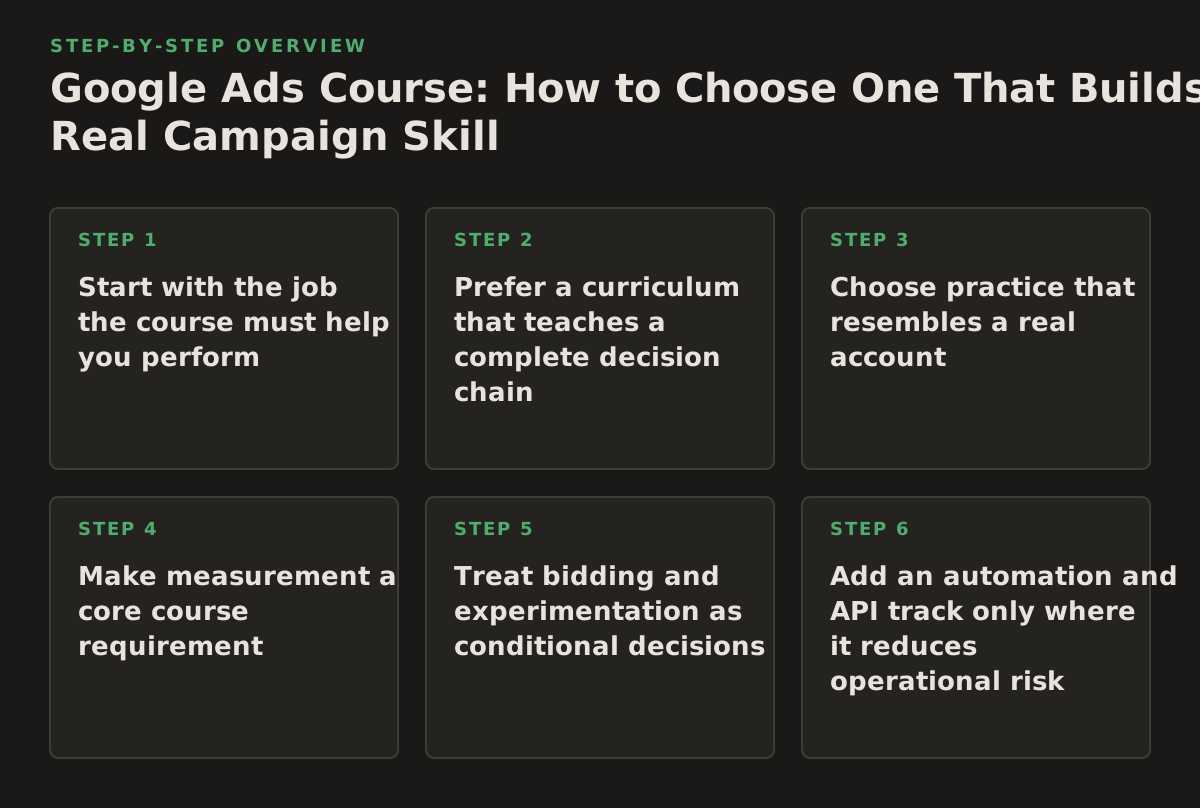
1. Start with the job the course must help you perform
“Learn Google Ads” is too broad to guide a purchase. A paid search manager may need to diagnose declining lead quality. An agency strategist may need a repeatable account-audit process. A small business owner may need to stop wasting budget on poorly tracked conversions. An AI or MCP developer may need to understand campaign objects, reporting fields, permissions, and approval boundaries.
Define the job before comparing syllabuses. A course is useful when its exercises resemble the decisions you make at work, not merely the screens you can navigate. Google’s own Skillshop provides Google Ads learning and certification resources, but official training should be treated as a foundation to adapt to your account context rather than proof that someone can manage every commercial situation. See the current learning catalog at Google Skillshop.
Match the course to your operating level
- New operator: learn account structure, campaign objectives, keyword intent, ad assets, budgets, and basic reporting.
- Working manager: learn conversion diagnosis, search-term analysis, bid strategy selection, budget allocation, and experiment design.
- Agency strategist: learn audit frameworks, client communication, change logs, forecasting assumptions, and repeatable QA.
- Automation builder: learn APIs, data permissions, object relationships, validation, rollback, and human approval.
Failure mode: choosing a beginner course when your real problem is measurement or decision quality. You may finish every lesson and still not know why a campaign’s reported conversions changed. For example, a demand-generation team should prioritize a module on primary versus secondary conversions and lead-quality feedback over another introductory lesson on where to create an ad.
2. Prefer a curriculum that teaches a complete decision chain
A strong Google Ads curriculum follows the path from business objective to post-click evidence. It should show how a decision changes the account, what signal justifies that change, and how the manager will evaluate the result. Look for mechanism, evidence, and consequence in every major topic.
A practical sequence usually includes:
- Business translation: connect revenue, qualified pipeline, margin, or local demand to an advertising objective.
- Account architecture: separate campaigns and ad groups according to intent, geography, product, audience, or budget control needs.
- Message and query alignment: connect search intent to ad copy and landing-page relevance.
- Measurement: define conversion actions, values, attribution assumptions, and data-quality checks.
- Optimization: use search terms, auction information, creative results, budget constraints, and downstream outcomes.
- Experimentation: document the hypothesis, isolate the change where possible, and set a review condition.
Google describes conversion tracking as a way to understand actions people take after interacting with ads; the exact setup depends on the conversion source and implementation. The official setup guidance is available in Google Ads conversion tracking documentation. A course that teaches campaign settings without showing how conversion data enters the system leaves out the part that determines whether optimization is trustworthy.
Use a syllabus stress test
For each module, ask three questions:
- What decision will I be able to make after completing it?
- What evidence will I inspect before making that decision?
- What could make the recommendation wrong?
Failure mode: treating platform terminology as strategic competence. Memorizing the difference between campaign types does not tell an agency whether to consolidate structure, split budgets, or reject a low-quality lead source. A useful exercise would give you a fictional account with rising cost per qualified opportunity and require you to distinguish tracking drift from auction pressure, landing-page weakness, or a change in query mix.
3. Choose practice that resembles a real account
Video lessons are efficient for concepts, but campaign judgment develops through incomplete information. A course should require you to inspect a data set, make a change, state the expected effect, and decide what would cause you to reverse it. The practice does not need to use a live client account; a carefully designed sandbox or case study is safer and often more structured.
Hands-on practice should include imperfect conditions. Real accounts have limited conversion volume, delayed lead-quality feedback, branded and non-branded demand mixed together, budget ceilings, seasonal changes, and tracking discrepancies. A polished example in which every recommendation works teaches the wrong mental model.
A useful practice brief
Give the learner:
- Thirty to ninety days of campaign, search-term, conversion, and cost data.
- A stated business goal, such as qualified demos rather than raw form fills.
- Known constraints, such as a fixed monthly budget or restricted geography.
- At least one misleading signal, such as cheap conversions with poor sales acceptance.
- A required deliverable: diagnosis, prioritized actions, risk notes, and review date.
Failure mode: making irreversible changes while learning. Do not use a client account as a practice lab unless the owner has approved the scope, access, and rollback method. An illustrative exercise might ask a learner to reduce spend on a broad-match campaign, add negatives, and reallocate budget only after documenting the query evidence and preserving the original settings.
For an agency, score the exercise on diagnosis before action, not on how many recommendations the learner produces. Five well-ranked changes are more valuable than twenty low-confidence edits.
4. Make measurement a core course requirement
Many advertising courses discuss conversion tracking as a setup task and then move on. That is a serious gap. Measurement affects bidding, budget allocation, creative evaluation, client reporting, and any automated recommendation built on the data.
A course should teach the difference between:
- an event that occurred, such as a form submission;
- a conversion action configured for reporting or optimization;
- a business-qualified outcome, such as an accepted opportunity;
- a value assigned for decision-making rather than literal revenue;
- a reported result that may be delayed, modeled, duplicated, or incomplete.
Measurement is an operating system, not a dashboard decoration. If a lead-generation account optimizes toward every form fill, the platform may pursue volume even when sales rejects those leads. The course should therefore include a feedback loop from CRM status to advertising decisions, or at least teach the limits of optimizing on early-funnel events.
Google’s documentation for importing offline conversions explains the role of downstream business actions in measurement; review the current requirements and supported workflows in the official offline conversion documentation. For analytics teams, Google’s guidance on key events and conversions also helps clarify how reporting concepts differ across products; see Google Analytics documentation on key events.
Example: diagnose before changing bids
Suppose a B2B account reports 40 percent more conversions in March but the sales team sees fewer qualified opportunities. A measurement-focused learner would check:
- whether the conversion action changed;
- whether duplicate events or spam submissions increased;
- whether the campaign mix shifted toward low-intent queries;
- whether the CRM import was delayed or incomplete;
- whether March traffic included a different region, device, or product category.
Failure mode: accepting platform-reported CPA as the business truth. A course that teaches bid adjustments before data validation can make a tracking problem more expensive. Require every optimization exercise to name the measurement assumption it relies on.
5. Treat bidding and experimentation as conditional decisions
There is no universally correct bidding strategy. The appropriate approach depends on conversion volume, data quality, value variation, budget control, sales-cycle length, and the level of uncertainty in the account. A course should teach when a strategy is appropriate, what signal it needs, and what to do when that signal is weak.
Google’s official explanation of automated bidding describes strategies that use signals and goals to set bids, but the documentation does not remove the need for accurate conversion measurement or suitable objectives. Review the current guidance at Google Ads automated bidding documentation.
| Situation | Course skill to prioritize | Starting action | Review question |
|---|---|---|---|
| Conversions are numerous but low quality | Conversion taxonomy and CRM feedback | Separate qualified outcomes from raw leads | Did lead quality improve without hiding valid demand? |
| Conversions are sparse or recently changed | Data sufficiency and controlled testing | Stabilize tracking before major bid changes | Is the observed movement larger than normal noise? |
| Budget is consistently constrained | Marginal return and prioritization | Protect the highest-value intent before expanding | Which spend has the strongest business case at the margin? |
| Performance varies by product or region | Value segmentation and structure | Compare segments before consolidating them | Would one target or bid signal conceal meaningful differences? |
| Creative fatigue is suspected | Message testing and landing-page diagnosis | Change one message hypothesis at a time | Did engagement improve while qualified conversion held? |
Failure mode: turning every fluctuation into an experiment. If a course encourages frequent edits without a hypothesis or observation window, learners may reset the very data they need to evaluate performance. An illustrative starting policy is to require a written reason, expected direction, owner, and review date for every material change; the exact interval should reflect the account’s conversion lag and volume, not a universal rule.
6. Add an automation and API track only where it reduces operational risk
Automation is valuable when it removes repetitive inspection, enforces a check, or accelerates a reversible action. It is dangerous when it silently changes targeting, budgets, bids, or conversion settings without context. A course for advanced marketers or MCP developers should teach read, recommend, approve, execute as separate stages.
Google’s developer documentation describes the Google Ads API’s access model, resources, services, and reporting concepts. The current starting point is the Google Ads API documentation. Use official API documentation for implementation details rather than relying on a course recording that may describe an older version.
A safe automation exercise
Build a workflow that:
- reads campaign and search-term data;
- flags a defined condition, such as spend on a term with no desired conversion;
- shows the evidence and the proposed change;
- requests approval from an authorized person;
- executes only the approved, narrowly scoped edit;
- records the before-and-after state and supports rollback.
For AI clients and MCP developers, the course should also cover least-privilege access, ambiguous instructions, rate limits, stale data, conflicting recommendations, and human-readable change logs. A useful capstone might allow an agent to recommend negative keywords but prohibit automatic addition until a manager approves the exact terms and campaign scope.
Failure mode: confusing natural-language convenience with operational safety. “Improve performance” is not a valid execution specification. A safer instruction identifies the account, date range, metric, threshold, permitted action, exclusions, approver, and rollback condition.
NotFair’s Google Ads MCP is relevant for teams exploring this operating model because it connects AI clients with Google Ads workflows while keeping approval-gated changes central to execution. It should complement, not replace, platform knowledge and account-level review.
7. Compare course providers with evidence, not branding
Once the learning objective is clear, compare each course on the same criteria. A recognizable instructor or a long video library is not enough. Ask for a sample lesson, exercise instructions, update policy, assessment method, and explanation of what learners can safely do after completion.
| Selection criterion | Strong evidence | Warning sign |
|---|---|---|
| Platform accuracy | Uses current official terminology and links to changing documentation | Promises permanent mastery of a changing interface |
| Practical depth | Requires diagnosis, prioritization, and written reasoning | Quiz completion is the main assessment |
| Measurement | Covers tracking validation and business-quality feedback | Reports are treated as automatically correct |
| Optimization judgment | Explains conditions, trade-offs, and failure cases | Uses fixed rules for every account |
| Automation safety | Separates recommendations from approved execution | Encourages unrestricted automated edits |
| Transferability | Applies to different goals, budgets, and business models | Relies on one polished account example |
Meta’s official certification learning resources are useful when your role spans paid social as well as search; compare them using the same criteria rather than assuming a platform credential demonstrates cross-channel strategy. The current certification entry point is Meta Certification. For teams managing multiple channels, the transferable skills are measurement design, audience reasoning, experimentation, and change governance—not memorizing one interface.
Failure mode: choosing on certificate value alone. A certificate may help document study, but it does not prove that a learner can protect a budget, explain uncertainty to a client, or diagnose a conversion discrepancy. Ask for a practical assessment or create one internally if the course does not provide it.
For agencies, also check whether the course can be used as a shared operating standard. A short internal rubric—diagnosis, evidence, recommendation, risk, owner, and review date—often creates more consistency than asking every strategist to follow personal habits.
Implementation plan: turn the course into account capability
Use the following sequence in 2026 rather than enrolling and hoping the lessons translate automatically.
- Write the role brief. State the account type, business outcome, platform scope, current skill level, and the decisions the learner must make independently.
- Audit the syllabus. Mark where it covers structure, measurement, optimization, experimentation, reporting, and automation. Identify topics supported by current official documentation.
- Complete a baseline exercise. Give the learner a small account export or case study and record the quality of the diagnosis before training begins.
- Study in decision-sized blocks. After each module, produce one artifact: a measurement map, account diagram, query review, budget recommendation, or experiment brief.
- Review measurement before optimization. Validate conversion definitions, data ownership, lead-quality feedback, and known reporting limitations before changing bids or budgets.
- Run a controlled capstone. Require a prioritized plan with evidence, expected impact, downside risk, approval status, and rollback instructions.
- Add automation last. Start with read-only reporting and recommendations. Introduce execution only for narrow, reversible changes with explicit approval and logging.
- Reassess after real work. Thirty days after applying the training, review which decisions improved, which assumptions failed, and which course gaps require documentation or coaching.
If your team needs to connect AI clients to advertising data and approved workflows across channels, NotFair can be a practical next layer after the operating rules are defined. Explore NotFair for approval-gated marketing automation rather than treating an agent as a substitute for trained campaign judgment.
Authored with NotFair SEO