

Google ads certification is useful when it helps you make better decisions inside real accounts—not when it merely adds a badge to a profile. For a paid search manager, agency strategist, consultant, or in-house growth team, the practical decision is whether certification should be treated as a hiring signal, a structured learning path, a client-trust asset, or a foundation for safer automation.
This guide focuses on that decision. It shows how to select the right learning scope, convert exam knowledge into repeatable account diagnostics, prove competence with evidence, and introduce AI or MCP-assisted workflows without giving an automated system unchecked control over spend. The examples use illustrative policies and budgets rather than universal benchmarks.
1. Start with the job the certification must perform
Certification has different value depending on the work you need it to support. A junior search manager may need a structured introduction to campaign settings and measurement. An experienced agency strategist may need a credible way to explain account decisions to a procurement team. A developer connecting an AI client to advertising data may need enough platform knowledge to recognize dangerous recommendations.
The certificate itself does not establish all of those capabilities. Google describes its Ads certifications as professional accreditation available through Skillshop, where learners can study Google Ads products and demonstrate knowledge through assessments. The current program and assessment requirements can change, so use Google Skillshop as the source of record when planning a 2026 learning path.
Define the operational outcome first. Then choose the credential as one component of that outcome.
Match the learning goal to the working context
- Account execution: prioritize campaign construction, search terms, bidding, budgets, assets, and conversion settings.
- Strategy and planning: prioritize business objectives, measurement design, audience logic, incrementality questions, and channel allocation.
- Agency credibility: pair the credential with a short case walkthrough showing assumptions, decisions, and outcomes without exposing confidential client data.
- AI or MCP development: learn enough Ads structure and policy logic to define safe tool permissions, approval steps, and validation rules.
For example, a demand-generation manager hiring a search specialist should not use certification as a pass-or-fail substitute for an account exercise. Ask the candidate to explain why conversions dropped after a tracking change, what evidence they would inspect, and which change they would delay. That exercise tests judgment the exam cannot fully capture.
The failure mode is credential substitution: treating a completed assessment as proof that someone can manage spend responsibly. The correction is simple: use certification to establish a baseline vocabulary, then evaluate applied work with a controlled account review, forecast exercise, or change-log critique.
2. Select a certification path around account responsibility
A certification plan should reflect the decisions a person will actually own. Someone responsible for lead generation on Search has a different learning sequence from someone managing ecommerce Performance Max, YouTube activity, or a multi-channel measurement stack.
Begin with the account’s commercial model rather than choosing every available course. Write down the conversion event, sales cycle, margin constraint, geography, and primary campaign types. This prevents a common training mistake: collecting broad product knowledge while remaining weak on the one mechanism that controls business value.
Use a role-to-skill map
| Role or responsibility | Skills to prioritize | Proof of applied competence | First automation boundary |
|---|---|---|---|
| Search campaign manager | Query intent, match behavior, bidding, budgets, ad assets, conversion quality | Annotated account audit and proposed change log | Read-only diagnostics and draft recommendations |
| Agency strategist | Business goals, forecasting, experiment design, client communication | 90-day plan with assumptions and decision criteria | Approval-gated budget and targeting proposals |
| In-house growth lead | Pipeline quality, CRM feedback, attribution limitations, incrementality | Measurement brief tied to revenue stages | Automated anomaly alerts, not automatic budget edits |
| Marketing automation developer | API objects, permissions, validation, audit trails, rollback design | Tool specification and test scenarios | Sandbox or read-only client with explicit write scopes |
Choose one primary operating lane for the first study cycle. A lead-generation specialist might start with Search and measurement, then add broader campaign types only after they can reconcile platform conversions with qualified pipeline. An ecommerce team might prioritize product data, value-based bidding inputs, and margin-aware reporting before adding more automation.
Official Google Ads documentation explains that conversion tracking is used to understand actions after an interaction with an ad, including purchases, sign-ups, and other valuable actions. The implementation details and supported methods should be checked against the current Google Ads conversion tracking documentation, especially when a certification study plan is being converted into a live measurement design.
The failure mode is syllabus shopping: studying whichever module feels easiest and calling the result a complete operating model. Prevent it with a capability map that names the decisions, data inputs, and review artifacts required for the role.
3. Turn exam concepts into an account-diagnosis routine
Memorized definitions have limited value during a performance incident. A practical certification program should force every concept into a diagnostic question: what changed, where did it change, what evidence would confirm the cause, and what is the least risky response?
Use a fixed inspection order so an urgent account review does not become a tour of disconnected reports. The order below is a starting policy, not a universal benchmark.
- Confirm the business signal: identify whether the problem is spend, leads, qualified opportunities, revenue, margin, or delivery.
- Check measurement integrity: compare conversion volume, timestamps, attribution settings, duplicate events, and CRM or analytics records.
- Segment the change: isolate campaign, device, geography, query theme, network, landing page, and time period.
- Inspect recent interventions: review edits to budgets, bidding, assets, targeting, feeds, tracking, and exclusions.
- Form competing hypotheses: write at least two plausible causes instead of accepting the first visible correlation.
- Recommend a reversible action: define owner, expected signal, observation window, and rollback condition.
Suppose an agency sees a 25% decline in reported leads in an illustrative weekly review. A weak response is to raise bids. A stronger response checks whether the decline exists in CRM-created opportunities, whether the conversion tag stopped firing on one form, whether a campaign was limited by budget, and whether the mix shifted toward lower-intent queries. Only after those checks should a bidding or budget intervention be considered.
Separate delivery symptoms from measurement symptoms. A platform-reported conversion decline and a business-reported pipeline decline can have different causes. Certification material may explain how a feature works; the operating routine determines whether you apply it in the right order.
Require a written diagnostic record
- Observed symptom and exact date range.
- Business metric affected and source system.
- Segments where the change is concentrated.
- Evidence supporting and contradicting each hypothesis.
- Proposed action, risk, owner, and rollback condition.
The failure mode is action-first optimization: changing bids or budgets before establishing whether the data is trustworthy. The practical remedy is a minimum evidence checklist that blocks recommendations when conversion tracking or data freshness is uncertain.
4. Treat measurement as a prerequisite, not an advanced extra
Many teams study campaign controls before they study what the account is actually optimizing toward. That reverses the dependency. A bidding strategy can only pursue the signals it receives; a dashboard can only support decisions if its definitions and windows are understood.
Build a measurement brief before making a major campaign recommendation. It should state:
- Primary conversion: the action the campaign is explicitly trying to generate.
- Quality signal: the downstream event that distinguishes a useful lead from a cheap lead.
- Value rule: whether values are fixed, modeled, imported, or unavailable.
- Attribution boundary: what the platform can observe versus what the CRM or finance system owns.
- Diagnostic cadence: how often tracking, spend, conversion volume, and lead quality are reviewed.
For a B2B advertiser, “form submission” may be an early signal while “sales-accepted opportunity” is the commercial signal. The implementation example could be a weekly reconciliation: export platform conversions, join them to CRM records using a permitted identifier, classify accepted opportunities, and annotate campaign decisions with the lag between click and qualification.
Google’s documentation on enhanced conversions describes methods for improving the accuracy of conversion measurement by using consented first-party customer data in supported implementations. Any such setup must follow the current technical and policy requirements in the official enhanced conversions guidance; do not infer compliance or availability from a training note alone.
Use certification to ask better measurement questions, not to imply that the platform report is the business truth. If two systems disagree, the disagreement is an investigation queue, not permission to select the more favorable number.
The failure mode is optimizing a proxy indefinitely. A lead-generation account can look efficient while producing weak sales outcomes. Set a review rule such as “no major bid strategy change until lead quality has been checked,” labeling that rule as an internal starting policy and adjusting it to the sales cycle.
5. Convert learning into a portfolio of evidence
A certificate is easy to list and hard to interpret. A small portfolio makes the underlying judgment inspectable for employers, clients, and internal stakeholders. It also exposes gaps that multiple-choice study can conceal.
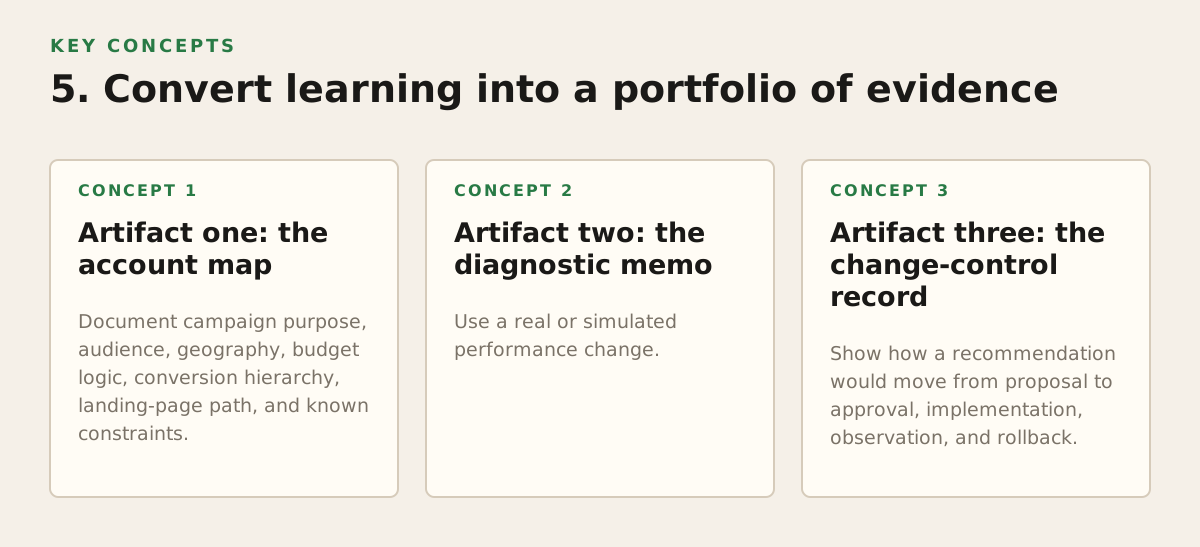
Create three artifacts from the same fictional, anonymized, or permissioned account:
Artifact one: the account map
Document campaign purpose, audience, geography, budget logic, conversion hierarchy, landing-page path, and known constraints. The point is not to reproduce every setting. It is to show that you understand how the pieces interact.
Artifact two: the diagnostic memo
Use a real or simulated performance change. Include the baseline period, comparison period, segmentation, hypotheses, evidence, recommendation, and unresolved uncertainty. Do not claim a lift unless the experiment actually produced one and the evidence can be shared.
Artifact three: the change-control record
Show how a recommendation would move from proposal to approval, implementation, observation, and rollback. Include the person authorized to approve a change and the condition that would stop it.
Show judgment under uncertainty. A strong portfolio includes a decision not to act: for example, holding a budget change because tracking diverged from CRM data, or postponing a targeting expansion until search-term quality is understood.
An agency can turn this into a client-safe review template:
- One-page account objective and constraint summary.
- Three prioritized findings ranked by business impact and confidence.
- One proposed test with a falsifiable outcome.
- One risk register covering measurement, policy, delivery, and commercial risk.
- One implementation log with approval and rollback fields.
The failure mode is portfolio theater: polished screenshots with no assumptions, causal reasoning, or limitations. Remove sensitive data and retain the reasoning. A plain spreadsheet with an explicit decision trail is more useful than an impressive dashboard that cannot explain what changed.
6. Add AI and MCP only after the human workflow is clear
AI can reduce the time required to inspect accounts, summarize anomalies, and draft recommendations. It cannot remove the need to define authorization, context, and reversibility. The safest sequence is to automate observation first, recommendation second, and execution last.
A useful capability progression is:
- Read-only retrieval: collect campaign status, spend, conversions, search terms, change history, and diagnostics.
- Structured analysis: compare periods, identify outliers, and attach evidence to each finding.
- Draft recommendations: propose a change with expected effect, risk, and missing information.
- Human approval: require a named reviewer to accept, edit, or reject the proposal.
- Constrained execution: apply only pre-approved reversible changes within explicit limits.
- Post-change monitoring: record the action and check the defined rollback condition.
For example, an AI client connected through a Google Ads MCP workflow could retrieve campaigns whose spend rose while qualified conversions did not, group the issue by device and query theme, and draft a recommendation to review search-term exclusions. The system should not automatically alter budgets merely because a statistical pattern looks unusual.
The same principle applies across channels. A team using Google Ads MCP can treat the connection as an operational interface for account investigation, while a separate Meta Ads MCP workflow can support Meta Ads analysis. The certifications and platform concepts remain useful because the AI needs a human-defined interpretation of metrics, not just access to fields.
Design permissions around reversibility. A tool that can read reporting data does not necessarily need permission to change budgets, targeting, ads, or billing-related settings. When write access is justified, constrain it by account, object type, approval state, and maximum change size according to an internal policy.
Minimum approval record for an AI-assisted change
- Account, campaign, and object affected.
- Current value and proposed value.
- Reason supported by specific data.
- Expected outcome and observation window.
- Approver identity and timestamp.
- Rollback action and responsible owner.
The failure mode is fluent automation: accepting a confident explanation that lacks causal evidence. Require the agent to expose source rows, date ranges, assumptions, and uncertainty. If it cannot show those items, it can remain a research assistant but should not become an execution agent.
7. Make cross-channel knowledge comparative, not interchangeable
Google Ads, Meta Ads, analytics platforms, CRM systems, and search console data can be used together, but their metrics do not automatically mean the same thing. A certification in one advertising ecosystem should improve platform fluency without encouraging false equivalence.
Build a channel translation sheet with four columns:
- Business question: what decision is the team trying to make?
- Platform signal: which metric or report provides partial evidence?
- Known limitation: what the signal cannot establish?
- Decision owner: who combines it with CRM, finance, or research data?
For instance, the question “where should the next dollar go?” cannot be answered by comparing reported platform ROAS without checking conversion windows, attribution settings, marginal performance, gross margin, and the role of each channel in the buying journey. Search Console can add organic query and visibility context, but it does not turn paid and organic clicks into a single causal dataset.
Google’s Search Console documentation describes the Performance report as a way to inspect Search results data such as queries, clicks, impressions, and position. Consult the official Performance report documentation when deciding which fields can support a cross-channel analysis.
For a practical example, an in-house team might notice that paid search conversions fell after a landing-page change while organic impressions remained stable. The correct next action is not to move budget automatically. Compare page speed and form behavior, inspect paid query intent, check tracking events, and ask whether the organic report is being used as context or incorrectly treated as a control group.
Preserve the meaning of each data source. A shared dashboard can standardize labels and dates, but it should not erase differences in attribution, identity, latency, or optimization objective.
The failure mode is blended-score simplification: combining incompatible metrics into one “channel health” number. Keep the composite score only if its inputs, weighting, and decision use are documented. Otherwise, present a small set of decision-specific views.
8. Maintain the credential as a living operating system
Advertising interfaces, automation options, policies, measurement methods, and reporting fields change. A certification completed once should therefore trigger a maintenance process rather than end one.
Set a quarterly review for the team’s playbooks. The review should compare current platform documentation with internal procedures and identify changes that could affect account safety or reported performance.
Review these items in sequence
- Campaign types and settings currently used by active accounts.
- Conversion actions, values, attribution, consent, and CRM imports.
- Automated rules, scripts, API jobs, and AI tool permissions.
- Approval thresholds and rollback procedures.
- Client reporting definitions and explanatory notes.
- Training gaps caused by newly adopted features or changed workflows.
Use official documentation for product behavior, not a cached slide deck. Google maintains developer documentation for the Google Ads API, including resources and release information; consult the Google Ads API documentation before treating an API field, service, or workflow as stable.
An agency’s maintenance example could be a quarterly “credential-to-practice” audit. Each strategist selects one recent account change, traces it to the relevant platform concept, confirms the current documentation, and updates the internal checklist if the implementation has changed.
Track knowledge decay by workflow risk. A changed label in a report may need a note; a changed conversion method or API permission model may require testing and approval review. Allocate attention according to the consequences of being wrong.
The failure mode is renewal without operational review: completing another assessment while leaving obsolete scripts, dashboards, and approval rules in place. Tie continuing education to actual account changes and documented control updates.
Implement the plan in six controlled stages
Use the following sequence if you are building a certification program for yourself, an agency team, or an AI-enabled marketing operation during 2026.
- Write the role brief. Name the account types, campaign decisions, business outcomes, and access level the learner will own. Do not begin with a generic list of certificates.
- Select the primary learning lane. Choose the product and measurement topics that govern the role’s current work. Record secondary topics as later modules rather than mixing everything into one study cycle.
- Create a controlled practice account or case. Build an account map, measurement brief, diagnostic memo, and proposed change log using anonymized or illustrative data.
- Run a review exercise. Ask the learner or AI workflow to diagnose a deliberately ambiguous problem. Score evidence quality, hypothesis discipline, commercial reasoning, and willingness to defer action.
- Introduce automation in read-only mode. Connect approved data sources, require cited evidence in recommendations, and log every retrieval and analysis step before considering write access.
- Approve only reversible execution. Define permitted objects, reviewers, limits, observation windows, and rollback actions. Review the first changes manually and update the policy when a new risk appears.
At the end of the sequence, decide which role the certification is serving. If it is a hiring signal, attach it to a practical assessment. If it is a client-trust asset, attach it to a transparent decision record. If it supports AI automation, attach it to permission design and human approval—not to a claim that an agent can manage campaigns independently.
For teams that want hosted connections between AI clients and advertising or analytics systems, NotFair provides approval-gated MCP workflows intended to keep diagnosis, recommendations, and reversible execution distinct. Explore NotFair if that controlled operating model fits your account-management process.
Authored with NotFair SEO