

Google Ads campaign types are not simply different labels in the campaign-creation menu. Each type determines which Google inventory you can reach, which signals the system can use, how much control you retain over targeting and bidding, and what evidence you need before judging performance. For a search manager, agency strategist, or in-house growth team, choosing the type is therefore a resource-allocation decision, not an administrative one.
The practical question is not “Which campaign type is best?” It is “Which campaign type can create the next business outcome with an acceptable level of control and measurement?” Search may be the right mechanism for capturing existing demand. Performance Max may be useful when you can supply strong conversion data and creative assets across several Google surfaces. Display, Video, Demand Gen, Shopping, and App campaigns solve different problems—and each can fail when used to compensate for a weak offer, poor tracking, or insufficient demand.
What campaign type means in Google Ads
A campaign type is a distribution and optimization framework. It governs the environments where ads can appear, the formats available, the targeting inputs you provide, and the optimization choices Google can make. Google’s own campaign documentation separates campaign types by the places and formats in which ads can run, including Search, Display, Shopping, Video, App, Demand Gen, and Performance Max. The exact options and settings can change as Google updates the product, so treat the official campaign-selection documentation as the current reference for 2026 rather than relying on an old account checklist: Google’s campaign type overview.
This distinction matters because two campaigns can promote the same product while operating on very different evidence. A Search campaign can respond to a query that expresses immediate intent. A Display campaign may interrupt someone while they browse content. A Shopping campaign can put product data, price, and imagery into the decision context. A Performance Max campaign can use multiple Google channels, but it asks the advertiser to accept more automation in exchange for broader reach.
The useful mental model: intent, inventory, and control
Classify every campaign type across three dimensions:
- Intent: Is the person actively asking for a solution, researching a category, consuming content, or being reminded of a brand?
- Inventory: Which placements can receive the ad—search results, product surfaces, video environments, display placements, Discover-style feeds, Maps-related surfaces, or app inventory?
- Control: Are you choosing queries, audiences, placements, products, creative combinations, or mainly business goals and conversion signals?
This model prevents a common strategic mistake: choosing a campaign type because it promises reach when the actual need is diagnostic clarity. If a lead-generation team cannot tell which search themes, audiences, or creative concepts generated qualified opportunities, adding automation may make the account harder to improve. Conversely, if a mature ecommerce account has reliable purchase values and enough approved product data, restricting activity to manually managed search may leave useful inventory unused.
Campaign type is not the same as objective
An objective describes the business result—sales, qualified leads, app installs, or awareness. A campaign type describes the mechanism used to pursue it. “Leads” can be pursued through Search, Display, Video, Demand Gen, or Performance Max, but those campaigns do not have the same relationship to demand or the same measurement burden.
That distinction is especially important when reporting to executives. “We ran a lead campaign” is not an adequate explanation of how demand was generated. A more useful report says: “We used Search to capture non-brand queries from people actively comparing providers, with qualified-opportunity imports as the optimization signal.” The second description exposes the mechanism and makes the result easier to evaluate.
How the main Google campaign types differ
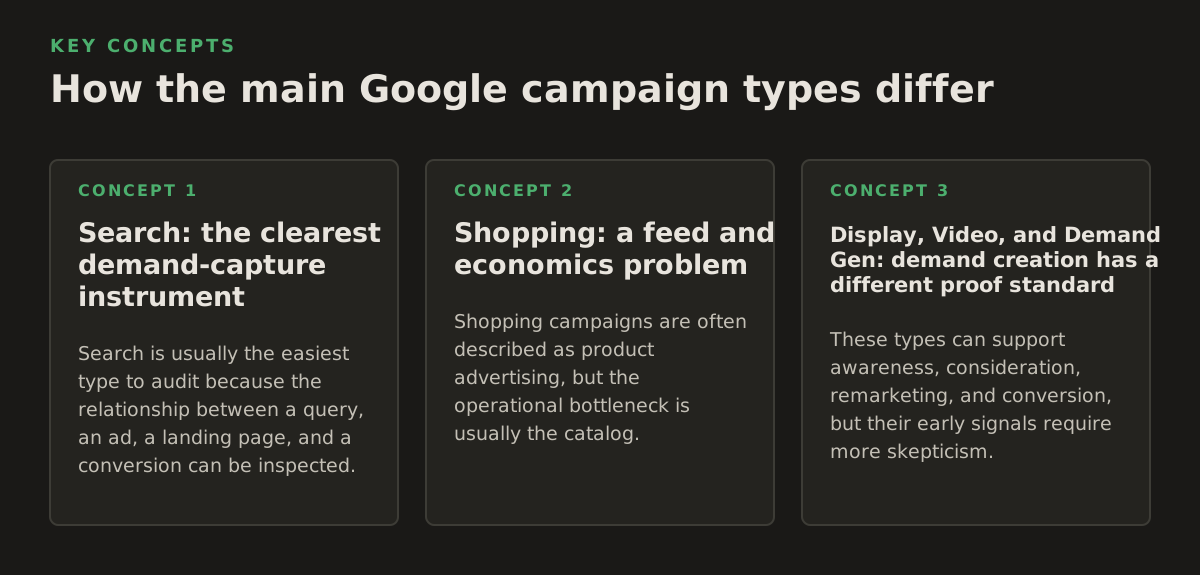
The following table is a planning aid, not a promise that every account will receive the same inventory or settings. Google can restrict eligibility based on policy, assets, feeds, geography, account history, and product changes. The key is to connect each type to the job it is capable of doing.
| Campaign type | Primary job | Useful inputs | Main trade-off |
|---|---|---|---|
| Search | Capture expressed demand through search queries | Query themes, ad copy, landing pages, conversion actions, negatives | High intent can be expensive and limited by existing demand |
| Performance Max | Optimize across eligible Google inventory toward a business goal | Conversion data, asset groups, audience signals, product feed, exclusions | Broader automation reduces placement and query-level control |
| Shopping | Promote products using structured catalog information | Merchant Center feed, product titles, attributes, prices, images, availability | Feed quality and margin visibility become central constraints |
| Display | Build consideration, remarket, or reach people across visual placements | Creative variants, audiences, exclusions, frequency and conversion controls | Clicks can be weak evidence of purchase intent |
| Video | Use video to create demand, explain a product, or support conversion | Video assets, audience strategy, measurement, brand and direct-response goals | Attention and view metrics do not automatically equal business value |
| Demand Gen | Reach people in more discovery-oriented, visual environments | Images, video, audience inputs, conversion goals, creative testing | Requires stronger creative and incrementality discipline than query capture |
| App | Drive app installs or in-app actions | App events, deep links, creative assets, post-install value signals | Install volume can obscure retention and revenue quality |
Google describes Performance Max as a goal-based campaign type that can access Google inventory from a single campaign, while also noting that it is designed to complement keyword-based Search campaigns rather than automatically replace every Search use case. The official explanation is useful because it frames Performance Max as an inventory and automation choice, not as a universal upgrade: Google’s Performance Max documentation.
Search: the clearest demand-capture instrument
Search is usually the easiest type to audit because the relationship between a query, an ad, a landing page, and a conversion can be inspected. That does not make it inherently profitable. A high-intent query can still produce poor economics when the offer is weak, competitors bid aggressively, or the account counts low-quality actions as conversions.
Search is often appropriate when you need:
- Query-level diagnosis of what prospects are asking for.
- Separate treatment for brand, non-brand, competitor, and high-value service themes.
- Ad and landing-page tests tied to a specific message or objection.
- A controlled route for converting existing demand before expanding reach.
Google’s Search campaign documentation explains the relationship between keywords, ads, and search queries, but practitioners should still distinguish keyword intent from actual query intent. Broad category terms can contain research, employment, support, free, DIY, or irrelevant meanings. The account needs a process for reviewing search terms, adding exclusions, and checking whether the conversion action reflects business value: Google’s Search campaign guidance.
Shopping: a feed and economics problem
Shopping campaigns are often described as product advertising, but the operational bottleneck is usually the catalog. Product titles, identifiers, images, availability, price, shipping information, and categorization affect whether a product is eligible and how clearly it matches a shopper’s need. A campaign cannot compensate for a feed that omits the attributes customers use to distinguish products.
For ecommerce teams, Shopping decisions should connect media performance to gross margin and stock position, not only return on ad spend. A product with a strong conversion rate may still deserve less spend if its contribution margin is thin, returns are high, or inventory is nearly exhausted. Conversely, a high-margin product may justify a more aggressive test even when its volume is smaller.
Display, Video, and Demand Gen: demand creation has a different proof standard
These types can support awareness, consideration, remarketing, and conversion, but their early signals require more skepticism. A view, impression, or click can show that an ad was delivered or interacted with; it does not by itself prove incremental revenue. Use audience exclusions, post-view analysis where appropriate, conversion windows, geo tests, holdouts, or other defensible measurement methods when the claim is that advertising created new demand.
Creative is also more consequential here. Search can sometimes succeed with concise copy because the query supplies context. Visual campaigns have to create or restore context quickly. A useful asset should communicate the category, audience, problem, and next step without relying on a user already knowing the brand.
How campaign mechanics affect optimization
Campaign type determines the available levers, but performance emerges from the interaction of conversion signals, budget, bidding, creative, and eligibility. Changing one lever can alter the environment in which the others operate. That is why campaign-type changes should be treated as controlled interventions rather than routine housekeeping.
Conversion actions are the steering signal
Automated bidding learns from the conversion actions you make primary for optimization. If a lead account counts form starts, brochure downloads, phone clicks, and qualified opportunities as equivalent primary conversions, the system receives an ambiguous instruction. It may pursue the easiest action rather than the most valuable one.
A practical hierarchy is:
- Define the business event that represents value, such as a qualified opportunity, completed purchase, or retained subscriber.
- Separate diagnostic micro-conversions from the primary optimization event.
- Import offline outcomes when the sales cycle continues beyond the website.
- Check that values, currencies, timestamps, and identifiers reconcile across the ad platform and CRM.
- Only then decide whether broader automation has enough signal to justify its reduced control.
Google Ads supports conversion tracking and data-driven attribution options, but the existence of an attribution setting does not repair missing or inconsistent event data. Google’s official conversion documentation should be used to verify the current setup, event definitions, and import requirements in 2026: Google Ads conversion tracking documentation.
Budget is a constraint on learning and delivery
Budget does not just determine how many clicks you can buy. It determines whether a campaign can enter enough auctions, collect enough conversion observations, and support a meaningful comparison between segments. Splitting a modest budget across brand, non-brand, remarketing, prospecting, several geographies, and multiple campaign types can produce a dashboard full of thin data.
Use an explicit allocation policy. The following is an illustrative starting policy, not a universal benchmark:
- Reserve the first share for proven demand capture where the business can explain the query-to-conversion path.
- Reserve a smaller test share for a new campaign type with one defined hypothesis.
- Protect enough budget for high-margin products, priority services, or strategic geographies rather than allowing volume alone to decide.
- Set a review date and a stop condition before launch, such as unacceptable lead quality, broken tracking, or spend without the intended event.
Do not use a short period of weak delivery as proof that a campaign type cannot work. First inspect eligibility, asset approval, conversion latency, budget constraints, auction competitiveness, and landing-page friction. At the same time, do not let the phrase “learning” excuse indefinite spend without a falsifiable hypothesis.
Automation expands the search space
Manual targeting narrows the set of decisions the platform can make. Automated campaign types widen that search space across audiences, placements, bids, creative combinations, and inventory. This can be valuable when your data and assets are strong, but it increases the importance of clean inputs and exclusion rules.
For teams building reporting or automation through APIs, this means the campaign object alone is not enough. You need to preserve relationships among campaign, ad group or asset group, product, audience, conversion action, search term, and change history. Google’s Ads API documentation describes campaign resources and campaign-type concepts for developers building operational tooling: Google Ads API campaign type documentation.
An AI assistant that recommends “increase budget” without checking conversion integrity, query quality, margin, and recent edits is not performing campaign strategy. It is reacting to a surface metric. A useful system should explain the evidence, identify uncertainty, propose a reversible change, and wait for approval when the consequence is material.
Where campaign-type decisions break
Most failures are not caused by choosing an objectively wrong type. They come from using a type to solve a problem it cannot solve, or from judging it with evidence that does not match its role.
Failure: using automation to hide weak measurement
If purchases are duplicated, leads are unqualified, or consent-related gaps create inconsistent reporting, broader automation can optimize toward noise at greater scale. The correct response is not automatically to reduce automation; it is to repair the event design and establish a trusted primary outcome first.
Warning signs include:
- Conversion totals in Google Ads do not reconcile with the CRM or order system.
- Performance improves only when low-value micro-conversions are included.
- Lead volume rises while sales acceptance or revenue falls.
- Managers cannot explain which event the bid strategy is pursuing.
Failure: confusing branded demand with incremental growth
Brand Search can be efficient because people already know the company. That makes it useful for capturing and defending demand, but its performance should not be presented as proof that prospecting created the demand. Separate brand from non-brand reporting, monitor impression share where relevant, and evaluate whether the campaign is reaching new customers or merely intercepting existing intent.
Failure: treating every placement as equally valuable
Reach and impressions are not interchangeable with qualified attention. Display and video campaigns can accumulate inexpensive delivery that looks efficient until you inspect assisted conversions, engaged sessions, sales quality, or geographic and placement patterns. Exclusions and frequency controls are not signs that you distrust the platform; they are ways to keep the experiment interpretable.
Failure: changing too many variables at once
Moving a campaign from Search to Performance Max, replacing the landing page, changing the primary conversion, raising the budget, and introducing new creative in the same week destroys causal clarity. If performance changes, you will not know which intervention mattered.
Use a change log with:
- The hypothesis behind the change.
- The exact campaign, asset, audience, or conversion setting affected.
- The expected direction of impact.
- The minimum observation period or evidence requirement, labeled as a policy rather than a platform guarantee.
- The rollback condition and owner.
This discipline is especially important for agencies managing many accounts. A repeatable change record turns account history into operational knowledge instead of a sequence of unexplained edits.
How practitioners should choose and manage campaign types
Start with the customer journey and the evidence available—not with the newest campaign feature. A small business with a narrow service area and a few high-value services may need a tightly structured Search foundation before testing broader reach. An ecommerce team with a complete product catalog may prioritize Shopping and then test Performance Max with product-level economics. A mobile product company may need to optimize for retained users or revenue rather than installs alone.
A practical selection sequence
- State the job in one sentence. For example: “Capture searches from organizations actively comparing outsourced payroll providers.”
- Name the observable value event. A submitted form is not necessarily a qualified sales opportunity; define the distinction before launch.
- Map the available inventory. Decide whether the job requires query capture, product presentation, visual education, remarketing, or broader discovery.
- Choose the narrowest campaign type that can perform the job. Expand only when the narrow option is constrained by demand, scale, or a clear strategic reason.
- Set the measurement and rollback rules. Decide what would count as useful evidence and what would trigger a pause or repair.
For a B2B consultancy, that sequence might lead to separate Search campaigns for brand, high-intent category terms, and tightly defined services. For a retailer, it might lead to a feed audit before any bid adjustment. For a SaaS company with a long sales cycle, it might lead to CRM imports and lead-quality reporting before testing automated prospecting.
Use an account architecture that preserves decisions
Campaign names, labels, and asset-group structures should make the strategic distinction visible. Include meaningful dimensions such as geography, business line, brand status, funnel role, or product margin tier where those dimensions change the decision. Avoid encoding every reporting attribute into campaign structure if it creates unnecessary fragmentation; some dimensions belong in labels, audiences, feeds, or a warehouse.
A useful architecture answers these questions without a manual investigation:
- Which campaigns capture existing demand?
- Which campaigns are intended to create or recover demand?
- Which campaigns optimize to revenue, qualified pipeline, or a proxy?
- Which products, services, or geographies are receiving spend?
- Which campaigns are experimental and which are operationally protected?
For teams managing both Google and Meta, keep the strategic taxonomy consistent even though the platforms expose different campaign structures. The campaign names should let a marketer compare “prospecting,” “remarketing,” “brand capture,” and “high-value product” without pretending that the underlying auctions or optimization systems are identical. The Meta Ads MCP can be useful when the same approval and diagnosis workflow needs to span Meta activity as well as Google activity.
Automate diagnosis before automating execution
AI is most useful when it reduces the time required to assemble evidence and surface anomalies. It should not turn every anomaly into an automatic budget change. A sensible operating model has three stages:
- Observe: retrieve spend, conversions, values, search terms, product status, asset status, and recent changes.
- Diagnose: identify plausible causes, distinguish data problems from auction problems, and state what is unknown.
- Act with approval: propose a bounded, reversible edit with a reason, expected effect, and rollback path.
For example, an agent could flag that non-brand Search spend rose while qualified-opportunity rate fell, then ask whether the change followed a new broad-match theme, a landing-page release, or a CRM import failure. It should not immediately pause every campaign. Similarly, it could identify that a Performance Max asset group lacks usable creative for a priority product category, but the remedy may be asset production rather than a bid change.
NotFair’s hosted Google Ads MCP is designed for this kind of connection between AI clients and Google Ads workflows. The strategic advantage is not giving an agent unlimited authority; it is giving marketers a structured way to inspect account evidence and approve carefully scoped, reversible actions.
Make the recommendation specific to the evidence
A strong recommendation should sound conditional, because campaign-type choices depend on constraints:
“Keep non-brand Search as the primary demand-capture layer because query intent and lead quality are currently inspectable. Test Performance Max only with the qualified-opportunity event, approved creative for the priority service, and a separate budget policy. Pause the test if spend reaches the pre-agreed illustrative limit without the intended event or if lead acceptance falls below the account’s historical policy threshold.”
That is more useful than “Performance Max is the future” or “Search is always safest.” It identifies the current job, the reason for the chosen mechanism, the required inputs, and the conditions under which the decision should be revisited.
For 2026 planning, use campaign types as controlled instruments in a broader measurement system: begin with the demand you can explain, add inventory when the business can supply reliable signals and suitable creative, and keep automation behind clear approval gates. If you want that workflow connected to AI tools without surrendering review over live account changes, explore what NotFair offers through NotFair.
Authored with NotFair SEO