

Facebook ads vs google ads is not a simple choice between two interchangeable traffic sources. Google Ads usually captures a declared query or a measurable commercial need, while Meta Ads uses audience signals, creative, and delivery systems to create or influence demand. The right decision depends on how people discover the offer, how much conversion data you have, how quickly you need results, and whether your team can produce enough creative to keep prospecting audiences engaged.
What the comparison actually means
“Facebook Ads” is commonly used as shorthand for advertising through Meta’s advertising system, which can include Facebook, Instagram, and other placements selected through campaign settings. “Google Ads” covers several campaign types, including search, shopping, display, video, and app campaigns. Comparing the two responsibly therefore means comparing specific campaign types, not treating each platform as one uniform channel.
The most useful comparison for many performance teams is non-brand Google Search against Meta prospecting and retargeting. Search responds to an existing expression of intent. Meta can reach a person before they search, based on the information available to its delivery system and the signals produced by campaign objectives, audience inputs, creative, and conversion events. Google describes Search campaigns as a way to show ads when people search for products or services, while Meta describes its ad delivery system as an auction that considers factors including bid, estimated action rate, and ad quality. Those are different mechanisms, not merely different interfaces: Google’s Search campaign documentation and Meta’s ad auction documentation explain the respective systems.
Intent and interruption are different jobs
A person searching “emergency plumber near me” has supplied a strong problem and often a strong time signal. A person watching a cooking video who sees an ad for a meal-kit subscription has not necessarily requested the product, even if the product is relevant. The second impression may still be valuable, but the ad must earn attention and create motivation rather than simply satisfy an existing request.
This creates a practical division:
- Google Search is often strongest when demand already exists, the query maps cleanly to a commercial offer, and the business can respond to that demand with a relevant landing page.
- Meta prospecting is often useful when the offer is visual, differentiated, socially legible, or capable of creating demand among a defined market.
- Google Shopping can be appropriate when product feeds, prices, availability, and product-level intent matter.
- Meta retargeting can help re-engage visitors or known audiences, but should not be credited as if it created all of the original demand.
These are starting hypotheses, not platform laws. A niche B2B service may generate better economics from LinkedIn or outbound sales than either channel. A consumer product with weak search volume may need Meta creative before Google Search has enough demand to harvest. A local service with urgent demand may begin with Search even if its brand has no social presence.
The unit of comparison must be the business outcome
Comparing click-through rate or cost per click across platforms can produce a misleading winner. A cheaper Meta click may represent earlier-stage attention, while an expensive Google click may represent a prospect actively comparing suppliers. Compare channels using the same outcome and a defined attribution rule:
- For lead generation: qualified leads, booked appointments, sales-qualified opportunities, and closed revenue—not raw form fills alone.
- For ecommerce: contribution margin, new-customer revenue, profit after fulfilment, and blended acquisition cost.
- For subscription products: activated accounts, retained accounts, and payback period—not trial starts alone.
- For local businesses: completed calls, attended appointments, and revenue by service line—not location-page visits.
Why the difference matters to budget and measurement
The biggest operational mistake is treating platform-reported conversions as directly comparable financial truth. Google Ads and Meta Ads each observe interactions through their own tags, modeled systems, attribution settings, and conversion definitions. A conversion can appear in both platforms, appear in neither, or be counted at different times depending on the implementation and reporting windows.
Google’s documentation distinguishes conversion actions and explains how advertisers can configure which actions are included in optimization and reporting. Its guidance on conversion tracking is a useful implementation reference. Meta likewise provides documentation for the Meta Pixel and Conversions API, including the role of browser and server-side event signals. The consequence for a manager is straightforward: reconcile the event architecture before arguing about which dashboard has the “real” number.
Use a measurement hierarchy
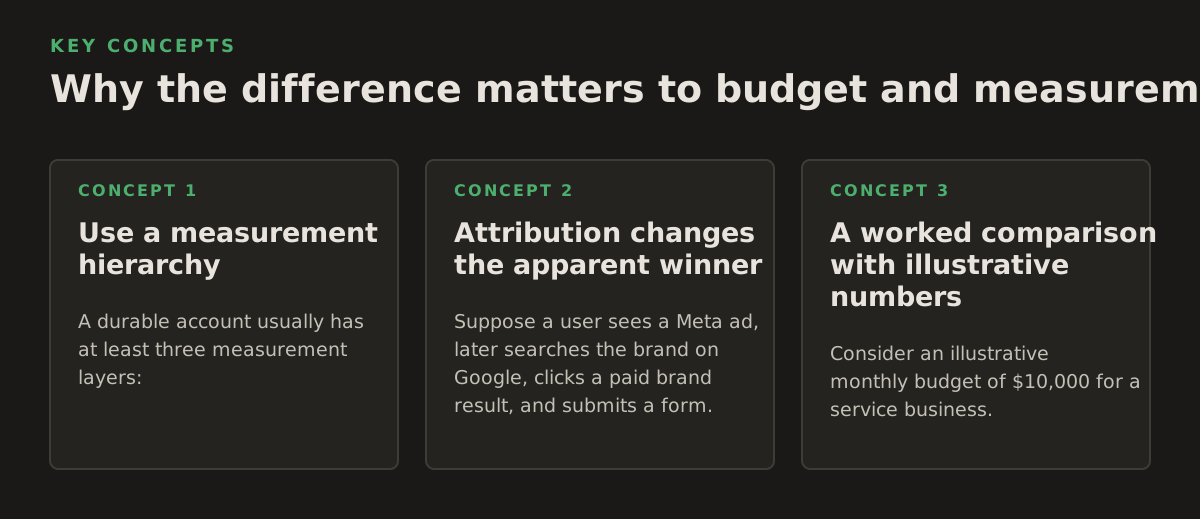
A durable account usually has at least three measurement layers:
- Platform diagnostics: impressions, clicks, spend, delivery, quality indicators, audience or query signals, and platform-attributed conversions.
- Site and analytics measurement: sessions, landing-page behavior, event completion, source and medium, consent state, and cross-channel paths.
- Business records: qualified lead status, revenue, margin, refunds, appointment attendance, and customer retention.
The first layer helps you operate campaigns. The second helps you identify instrumentation problems and compare paths. The third decides whether acquisition is economically useful. Do not force one layer to answer all three questions.
Attribution changes the apparent winner
Suppose a user sees a Meta ad, later searches the brand on Google, clicks a paid brand result, and submits a form. A last-click report may assign the conversion to Google. A platform report may assign it to Meta depending on the interaction and attribution settings. Neither view alone proves that the other channel was unnecessary.
For a small or mid-sized team, use a documented operating policy rather than endlessly changing models. An illustrative starting policy might be:
- Use platform reporting to diagnose delivery and optimization.
- Use analytics or a warehouse to deduplicate primary conversions.
- Use CRM stages to judge lead quality and revenue.
- Review assisted paths and branded-search growth before cutting prospecting.
- Keep attribution settings stable long enough to identify directional changes.
This is a policy example, not a universal benchmark. The correct window depends on the sales cycle, consent coverage, conversion volume, and the lag between first touch and revenue.
A worked comparison with illustrative numbers
Consider an illustrative monthly budget of $10,000 for a service business. The numbers below are deliberately hypothetical; they show why cost per lead is not enough.
| Metric | Google non-brand Search | Meta prospecting |
|---|---|---|
| Spend | $6,000 | $4,000 |
| Reported leads | 120 | 200 |
| Cost per reported lead | $50 | $20 |
| Qualified leads | 72 | 40 |
| Closed customers | 18 | 8 |
| Illustrative revenue per customer | $900 | $900 |
| Illustrative revenue attributed | $16,200 | $7,200 |
On the first metric, Meta wins decisively. On qualified-lead rate and illustrative revenue, Search wins. That does not mean Meta should be stopped: it may be introducing future demand, improving branded search, or reaching people who convert later. It does mean the team should not scale Meta from low-cost form fills without checking downstream quality.
How each platform works in practice
Google Ads: query, eligibility, auction, and landing page
For Search, the manager’s job begins with the query universe. Keywords are controls and signals, not a guarantee that every matching search will trigger an ad. The system evaluates eligibility, relevance, bids, assets, location and other settings, then enters an auction when appropriate. Google explains that Ad Rank influences whether and where an ad can show, incorporating factors such as bid, ad quality, thresholds, and the context of the search; see its Ad Rank documentation.
That mechanism makes several levers especially important:
- Query control: search terms, match types, exclusions, and campaign structure determine which demand enters the account.
- Message alignment: the ad should make a credible promise that the landing page fulfills.
- Commercial qualification: copy can discourage poor-fit clicks by naming service area, customer type, price structure, or constraints.
- Conversion quality: bidding systems need useful conversion signals, not a mixture of valuable actions and trivial engagement events.
Search can fail even when click volume is healthy. Common causes include broad query coverage without exclusions, weak service-area controls, an offer that is not competitive, slow follow-up, or conversion tracking that counts every button click as a lead. The platform can optimize efficiently toward the wrong event.
Meta Ads: creative, audience inputs, delivery, and feedback
Meta prospecting generally starts with a creative proposition and a conversion objective. The advertiser supplies assets, copy, destination, budget, audience inputs, and an event for optimization. The delivery system then seeks people it predicts are more likely to produce the selected result, subject to auction conditions and available signals. Meta’s campaign objective documentation describes the relationship between objectives and the business results an advertiser wants to encourage.
In practical terms, Meta often gives the creative team more responsibility than Search does:
- Attention: the first frame, opening line, or image must interrupt a feed experience.
- Recognition: the prospect needs to understand who the offer is for quickly.
- Proof: demonstrations, testimonials, comparisons, or concrete outcomes reduce uncertainty.
- Action: the landing page and conversion event must match the promise made in the ad.
Audience labels are not a substitute for a strong proposition. A narrowly described audience can still ignore an unclear ad, while a broader audience can sometimes produce better delivery when the creative clearly identifies the problem and the offer. The correct test is not “which interest targeting is cleverest?” but “which combination of message, event, and audience input produces qualified business outcomes?”
Retargeting is not the same as prospecting
Retargeting benefits from prior awareness, so its conversion rate and cost can look attractive. That performance should be reported separately from prospecting. Combining them hides whether the account is generating new demand or merely closing people who were already close to a decision.
Separate reporting at minimum by:
- New prospecting audiences.
- Website or product viewers.
- Engaged social audiences.
- Existing leads and customers.
- Suppression audiences such as recent purchasers or disqualified leads.
Google has analogous distinctions between non-brand discovery, brand demand, remarketing, and Shopping activity. A channel mix becomes more intelligible when each campaign has a stated role rather than when every campaign is judged by one blended return metric.
Where the comparison breaks down
Platform comparisons become unreliable when teams overlook the conditions underneath the campaign. The following failure modes are more important than small differences in interface or targeting features.
Low conversion volume creates unstable automation
Automated bidding and delivery need feedback. If the account has few reliable conversions, an aggressive optimization strategy may react to noise, delay learning, or favor cheap but low-quality actions. This does not mean automation is inherently unsuitable for smaller advertisers. It means the conversion event must be valuable, sufficiently observable, and defined with care.
Use a staged approach:
- Verify the event fires once, on the correct success state, with useful values where applicable.
- Remove duplicate events and exclude micro-actions from the primary optimization goal.
- Check lead quality manually or in the CRM before promoting an event to a primary signal.
- Change one major variable at a time when volume is limited.
- Use guardrails on budget, location, product category, and destination rather than assuming the algorithm knows business constraints.
Creative fatigue and query waste are different problems
Meta prospecting can weaken when the same concepts are repeatedly shown to a finite audience or when the promise no longer feels fresh. The response is usually a creative diagnosis: inspect frequency, comments, thumb-stop behavior, landing-page engagement, and conversion quality, then produce genuinely different angles.
Google Search can weaken through query drift: ads receive searches that are adjacent to the offer but commercially poor. The response is usually a search-term and structure diagnosis: add exclusions, refine ad groups or themes, adjust geography, and rewrite qualification language. Reusing the same “creative fatigue” playbook for both problems wastes time.
Tracking loss is not always a channel failure
Consent choices, browser restrictions, blocked scripts, cross-domain transitions, phone calls, offline sales, and CRM import errors can all create gaps between platform reports and business records. Google Analytics documentation explains that event collection and attribution depend on implementation and settings; its key events guidance is a useful reference for distinguishing important user actions from general activity.
Before cutting spend because reported conversions fell, inspect:
- Whether the landing page still loads and the form still submits.
- Whether the thank-you state or server event fires exactly once.
- Whether consent mode or privacy settings changed observability.
- Whether CRM imports are delayed, rejected, or mapped to the wrong campaign.
- Whether call tracking, offline purchases, or appointment outcomes are missing from the feedback loop.
Incrementality is not visible in ordinary reports
A platform can report a conversion after an ad interaction without proving that the ad caused an incremental outcome. Brand Search is a classic example: some people would have searched for the business and converted anyway. Retargeting can have the same issue when the audience already contains high-intent users.
When spend is material, use controlled methods where practical: geographic holdouts, audience exclusions, campaign experiments, or carefully designed before-and-after analyses. These methods still have limitations, but they ask a better question than “which platform claimed more conversions?”
How practitioners should allocate and operate the mix
Start with the demand map
Write down how a qualified customer becomes aware, evaluates, and buys. Then map each stage to a channel role:
- Existing demand: capture high-intent queries with Search or Shopping where the offer and inventory are clear.
- Problem awareness: use Meta creative, video, partnerships, content, or other channels to explain the problem and establish relevance.
- Consideration: use proof, comparisons, case evidence, email, remarketing, and sales follow-up.
- Conversion: remove friction from the form, checkout, booking flow, or call process.
- Retention: exclude existing customers from acquisition where appropriate and measure repeat value separately.
This map prevents a common budgeting error: asking Meta to behave like a search engine or asking Google Search to manufacture demand for an offer nobody recognizes.
Choose the first channel using constraints
Use the following decision rules as a starting framework:
- Choose Google Search first when queries clearly express need, the service area is constrained, and sales can follow up quickly.
- Choose Meta first when the product is visually demonstrable, the market is larger than existing search demand, and the team can sustain varied creative.
- Use both when Search can harvest demand while Meta creates or nurtures demand, and measurement can distinguish new prospects from returning users.
- Delay scaling either channel when the landing page, offer economics, qualification process, or tracking is not ready.
- Use Shopping when product data, availability, price, and fulfilment are operationally reliable—not simply because the business sells products.
Set a test that can produce a decision
A useful test has a hypothesis, a budget boundary, a conversion definition, and a stopping rule. For example: “For new customers in two service regions, a problem-specific Meta creative set will produce qualified consultations at an acceptable cost over the next measurement cycle.” The test should specify which event counts, how lead quality will be checked, and what happens if volume is too low to judge.
Illustrative starting policies may include a fixed spend cap, a minimum number of qualified outcomes before a major structural decision, and a review after the longest normal sales lag. These are not universal benchmarks. A high-value enterprise sale may require a longer observation period than a direct ecommerce purchase, and a small local campaign may never generate enough volume for a statistically strong platform experiment.
Operate with separate control planes
Campaign managers need to distinguish diagnosis from execution. A practical weekly review can follow this sequence:
- Confirm spend, delivery, disapprovals, budget limits, and tracking health.
- Review search terms on Google and creative-level signals on Meta.
- Compare platform conversions with analytics events and CRM outcomes.
- Identify one bottleneck: demand quality, message, landing page, sales follow-up, or measurement.
- Make the smallest reversible change that tests the diagnosis.
- Record the change, expected effect, owner, and review date.
Automation should support this process, not conceal it. An AI agent that changes budgets without an approval boundary can turn a measurement anomaly into a financial loss. A safer workflow retrieves account and analytics data, explains the suspected issue, proposes a change, waits for approval, applies a bounded update, and records what changed. Reversible actions and explicit scopes matter more than a flashy recommendation.
For teams connecting AI tools to advertising data, a Google Ads MCP server can provide a structured way to inspect campaign performance and account signals. A corresponding Meta Ads MCP connection can help bring Meta campaign and ad-set information into the same diagnostic workflow. The operational requirement remains the same: define permissions, approval gates, validation checks, and rollback procedures before allowing execution.
Build one cross-channel scorecard
Keep platform-native metrics for troubleshooting, but use a shared scorecard for investment decisions. A useful scorecard may contain:
- Spend and pacing by channel and campaign role.
- Unique qualified leads or customers after deduplication.
- Revenue or contribution margin tied to the agreed attribution view.
- New-customer share versus existing-customer activity.
- Time from first touch to qualification and sale.
- Tracking coverage, CRM match rate, and unresolved data-quality issues.
Do not hide uncertainty. If Meta’s prospecting contribution is difficult to observe because of consent or long sales cycles, label the result as uncertain and use an experiment or holdout to improve the estimate. If Google’s brand campaign captures demand that other channels created, report that role rather than calling it pure incremental acquisition.
Recommendation: choose roles before choosing a winner
For most teams, the best answer to the Facebook ads versus Google Ads question is a role-based mix rather than a permanent winner. Start with the channel that matches the strongest existing constraint: Google Search for explicit, serviceable demand; Meta for creative-led demand creation and audience development. Then judge both on qualified business outcomes, not on cheap clicks or platform-attributed volume.
Keep the systems separate enough to diagnose them, but connected enough to compare spend, conversion quality, and revenue in one operating process. If you want approval-gated AI workflows for inspecting and making reversible advertising changes across these platforms, NotFair offers hosted connections for that work through NotFair.
Authored with NotFair SEO