

Your placement report is full of cheap clicks from surfaces nobody on the team recognizes. Facebook Feed looks acceptable, Instagram Reels is volatile, and Audience Network appears to deliver volume, yet qualified leads haven't followed. The problem usually isn't a missing button in Ads Manager. It's the absence of a clear mental model for how the Facebook Ads Network connects inventory, auctions, delivery, measurement, and automation.
Table of Contents
- Introduction to the Facebook Ads Network
- Placements Across the Meta Ecosystem
- How the Ad Auction Really Works
- Campaign Structure and Budget Control
- Measuring Incremental Impact
- Managing Meta Accounts Safely with AI Agents
- Best Practices and Key Takeaways
Introduction to the Facebook Ads Network
The Facebook Ads Network isn't one ad slot called Facebook. It's a connected delivery system that can distribute campaigns across Facebook, Instagram, Messenger, and third-party apps and sites through Audience Network. Meta decides where an eligible impression can be bought, then ranks competing ads for that opportunity in real time.
That distinction matters because a campaign can look profitable at the campaign level while hiding a placement problem underneath. A low-cost click from a third-party app may help an awareness campaign, but the same click can be expensive if your real business outcome is a qualified sales conversation. You need to evaluate the network as a set of different environments, not as one blended traffic source.
Facebook officially unveiled its self-serve advertising system on November 6, 2007, at its Social Advertising Event. The launch included business Pages, targeted ads connected to the social graph, and 12 landmark partners that had committed to using the product, according to Facebook's announcement of the original Facebook Ads launch. That architecture joined user connections, profile information, and advertiser targeting in one system, creating the foundation for later Meta advertising products.
The scale is now global. A January 2025 industry snapshot reported Facebook advertising audience reach of 2.28 billion people, representing 27.9% of the global population and 41.1% of internet users, with year-over-year growth of 93.3 million users, or 4.3% (Pace Ads Meta advertising statistics). Those figures describe potential reach, not guaranteed impressions or conversions, but they explain why placement and delivery decisions deserve management attention.
Working definition: The Facebook Ads Network is Meta's auction-based system for matching advertiser campaigns with people across owned and partner inventory.
A practical map follows a simple sequence:
- Inventory: Feeds, Stories, Reels, Marketplace, Messenger, Instagram surfaces, and Audience Network provide different contexts.
- Auction: Meta compares eligible ads using more than the advertiser's bid.
- Delivery: The system seeks people likely to complete the selected objective.
- Measurement: Platform attribution records reported actions, while incrementality methods test whether advertising caused additional outcomes.
- Operations: Human teams, rules, and AI agents can inspect or change campaigns, but write access needs controls.
For a concise platform reference before you open Ads Manager, Meta Ads documentation provides a useful overview of the account connection and operating context.
Placements Across the Meta Ecosystem
Meta's placement list is easier to understand when you group surfaces by the user's intent and the amount of control you retain.
Facebook Feed and Instagram Feed are scroll-based environments where the creative competes with organic content. They often suit prospecting, retargeting, product discovery, and lead generation because the user can pause, read, watch, click, or continue scrolling in the same session.
Stories and Reels are vertical, full-screen environments. They demand creative built for mobile viewing, with the message visible quickly and important text kept away from interface controls. A square feed image can technically appear in a vertical placement, but technical eligibility isn't the same as persuasive fit.
Marketplace reaches users in a shopping-oriented context. Messenger can support conversations and follow-up, while Instagram surfaces such as Explore and profile-related inventory can help discovery when the creative matches the visual expectations of that platform. For a format-by-format reference, every Meta ad format explained is useful when deciding whether an asset is suited to its intended placement.
Audience Network extends delivery beyond Meta's owned properties into participating third-party apps and sites. That extra inventory can make reach cheaper, and it may be sensible for broad awareness or some app-install objectives. It deserves more caution for lead generation, where a click has value only if the resulting person has real commercial intent.
Independent commentary has flagged low-intent and potentially fraudulent traffic risks on Audience Network. One analysis estimated invalid traffic as high as about 67% in some contexts, particularly when Advantage+ placements remain broad by default (Aurelius Media analysis of Meta Ads lead quality). This isn't a universal rate for every account or placement. It is a reason to inspect downstream quality rather than treating low cost per click as proof of efficiency.
Advantage+ automatic placements can distribute an ad across eligible surfaces to find delivery opportunities. That default can help the system work with more inventory, but it also shifts the burden to measurement. If Audience Network produces many inexpensive clicks and few qualified leads, separate the placement, review lead quality, and decide whether the marginal reach is worth the tradeoff.
Placement rule: Don't ask whether a placement is cheap. Ask whether it produces the business action your campaign objective promises.
The right decision depends on the job:
- Awareness: Broader inventory may be acceptable when the goal is exposure or video consumption.
- App installs: Third-party inventory may contribute useful scale, but validate activated users rather than installs alone.
- Lead generation: Treat unexplained placement-level lead volume as a quality investigation, not an automatic win.
- High-consideration sales: Favor environments where the message, click path, and qualification process remain easy to understand.
How the Ad Auction Really Works
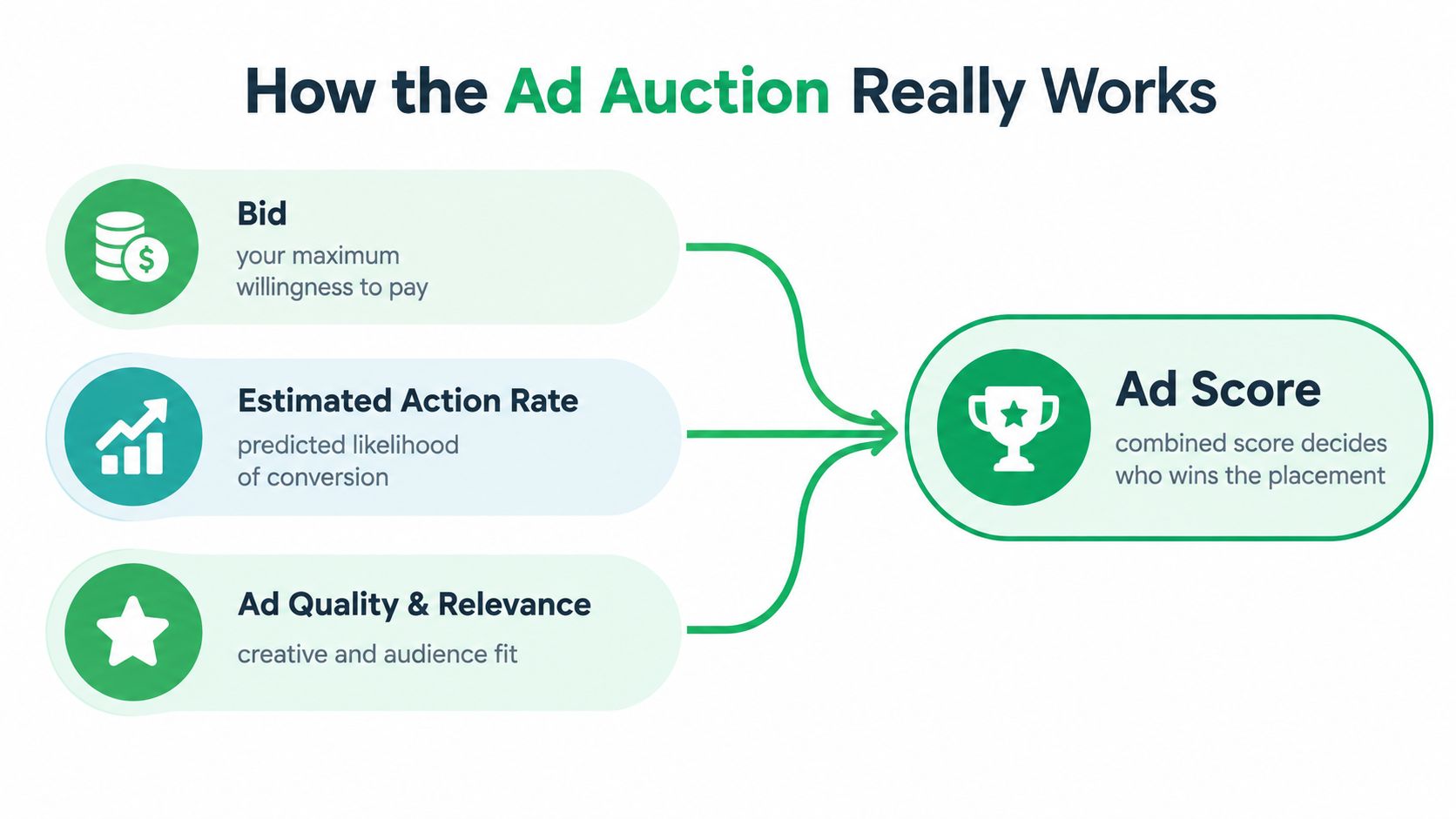
A common mistake is to treat Meta's auction as a contest where the highest bidder always wins. Meta describes a real-time auction that combines bid, estimated action rate, and ad quality and relevance. A higher bid can lose when another ad is more likely to produce the desired action and offers a better experience (Meta's explanation of ad auction delivery).
Think of the auction as a restaurant choosing which reservation to accept during a busy service. The customer's willingness to pay matters, but so does the likelihood that the reservation is real and the quality of the experience the restaurant expects to provide. An advertiser's bid is only one part of the decision.
The three signals that shape delivery
Bid represents the advertiser's maximum willingness to pay under the selected bidding setup. It creates an economic boundary, but it doesn't rescue an ad that users consistently ignore.
Estimated action rate is Meta's prediction that a person will complete the action tied to the campaign objective. A conversion campaign needs people likely to convert, not merely people likely to click. If early delivery produces weak signals, the system has less evidence that the ad deserves future opportunities.
Ad quality and relevance reflect how well the creative fits the audience and placement, alongside signals associated with a poor user experience. Clear creative, credible claims, and an aligned landing page support the quality side of the decision. Irrelevant or misleading creative can make additional budget inefficient.
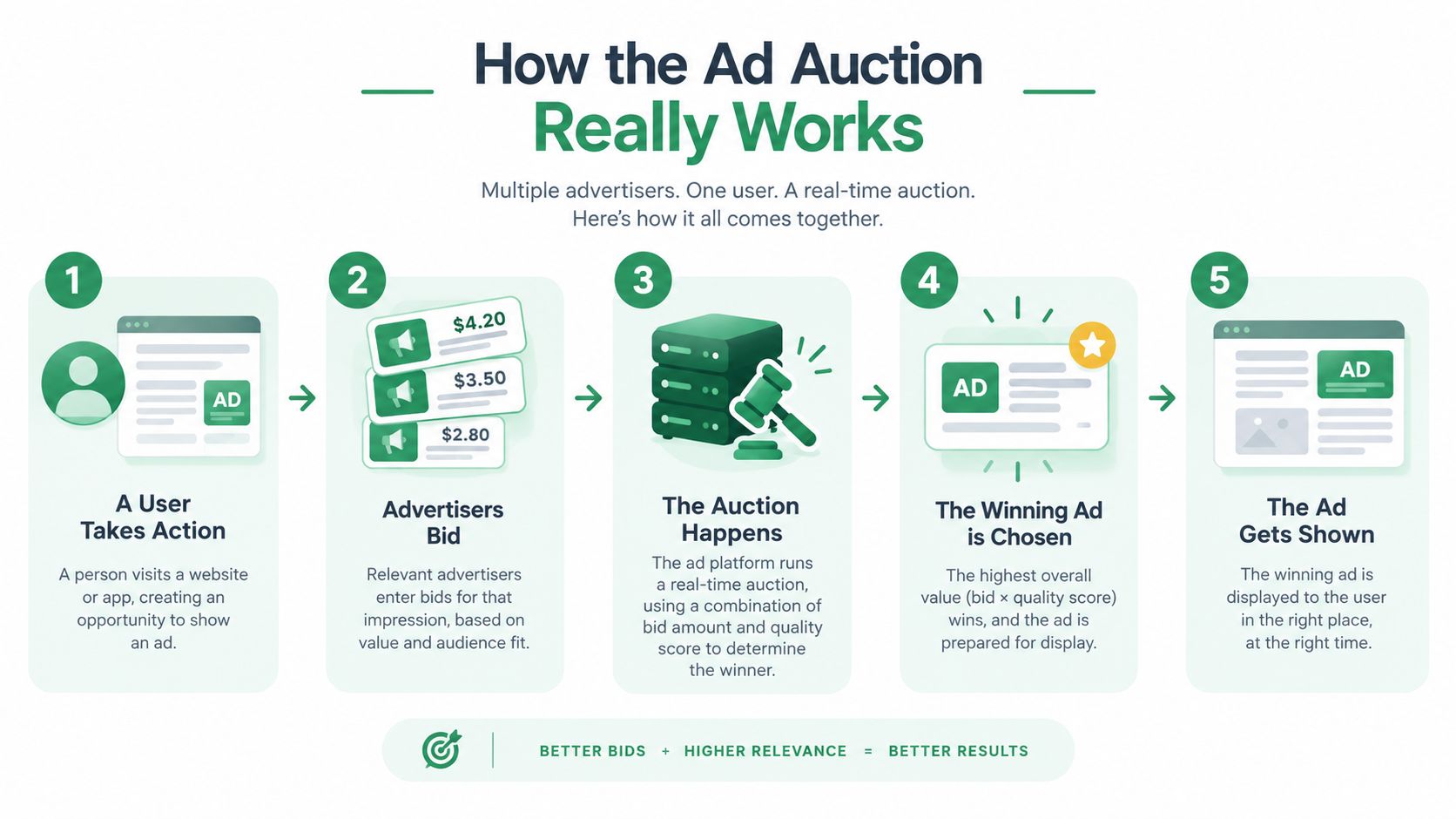
Meta also identifies objective, targeting, sufficient budget, campaign duration, and compelling creative as factors that affect auction performance. These conditions interact. A narrowly defined audience with too little budget may not provide enough opportunities for learning, while a broad audience with weak creative may provide volume without useful action signals.
What to fix before raising the bid
If delivery is weak, first check whether the campaign is optimizing for the right event. Then inspect audience fit, creative clarity, placement-specific assets, and the amount of conversion evidence available to the system. Raising the bid can buy more opportunities, but it can't make an unsuitable audience interested.
This is why a relevant ad can sometimes achieve a lower cost per result than a competing ad with a larger bid. The relevant ad gives Meta stronger evidence that the impression can create the selected outcome. Your optimization task is therefore broader than controlling price. You are improving the evidence that your campaign deserves delivery.
Campaign Structure and Budget Control
Meta's account hierarchy has three operational levels. Campaigns define the marketing objective, ad sets define audience and delivery conditions, and ads contain the creative that people see.
| Account Level | What You Control | Main Lever |
|---|---|---|
| Campaign | Objective and high-level organization | Choose the outcome Meta should optimize toward |
| Ad set | Audience, placements, schedule, and budget approach | Decide where and for whom delivery can occur |
| Ad | Format, copy, media, destination, and call to action | Improve relevance and response |
The hierarchy matters because a budget decision made at the wrong level can hide the cause of performance changes. With campaign budget optimization, Meta can distribute campaign budget between eligible ad sets as opportunities change. With ad set budgets, you retain more direct control over how much each audience or placement strategy can spend.
Neither method is automatically correct. Campaign-level allocation can help the system move money toward stronger opportunities, while ad-set-level budgets can protect a test design or keep separate audiences from competing invisibly. Choose based on the decision you need to make, not on a preference for a particular interface setting.
A practical debugging sequence
Start at the campaign and confirm that the objective matches the business outcome. A traffic objective can produce visitors, but it isn't the same instruction as finding qualified leads or completed purchases.
Move to the ad set and inspect audience, delivery status, schedule, budget, and placements. If one ad set contains both owned Meta inventory and Audience Network, placement-level results may be difficult to interpret. If a placement is strategically important, give it enough structure to evaluate rather than allowing it to disappear inside blended reporting.
Finish at the ad level. Compare the message, format, destination, and user expectation. A placement problem may in fact be a creative problem, such as a feed asset being used in a vertical video environment or a lead promise that the form doesn't support.
Budget principle: Give the system enough room to learn, but don't use additional spend to conceal a broken objective, weak creative, or poor lead qualification.
For teams that want to inspect or operate Meta data from an AI-assisted workflow, NotFair's Meta Ads integration for Codex can sit alongside the normal Ads Manager process. Keep the account hierarchy visible in every diagnosis so an automated recommendation doesn't move money without explaining which campaign, ad set, or ad it affects.
Measuring Incremental Impact
Meta-reported conversions show the tracked actions the platform attributed to a campaign under its selected settings. Incrementality measures the added outcomes caused by advertising, separating advertising impact from actions that would have happened without exposure.
Meta's conversion lift framework uses randomized test and control groups. The test group receives the advertising treatment, while the control group does not. The difference in outcomes estimates incremental impact, creating a counterfactual for what might have happened without the ads (Meta's conversion lift framework).
When lift testing is realistic
Meta specifies that an eligible campaign must have started within the past year, spent at least $5,000 USD, and generated at least 500 conversions under supported attribution settings. Those requirements make lift testing practical for accounts with meaningful conversion volume, rather than every advertiser running a small test.
If an account cannot support a randomized lift study, a reported conversion total remains an optimization signal, not proof of causation. Combine platform reporting with business outcomes, CRM quality, and revenue validation.
A measurement choice by account reality
Larger advertisers can consider conversion lift when a campaign has sufficient volume and the business can accept a test design. Smaller advertisers may use aggregated methods such as marketing mix modeling or geo experiments, which Meta also recommends as privacy-conscious approaches that rely less on user-level tracking.
A sensible measurement stack answers three separate questions:
- Delivery: Did Meta spend and deliver according to plan?
- Response: Did people complete the selected event?
- Incrementality: Did advertising create outcomes beyond what would have happened otherwise?
Placement quality belongs in the final interpretation. A low-cost Audience Network placement may generate many events while producing weak leads or little revenue. Auction efficiency determines where delivery goes, while lift and business validation determine whether that delivery created value. Assess both before treating cheap inventory as a successful part of the Facebook ads network.
Managing Meta Accounts Safely with AI Agents
A performance manager asks an AI agent a straightforward question: “Why did this ad set's costs rise, and what should we change?” The agent needs current spend, delivery, placement, creative, and conversion context. A stale export can describe last week's account, while a live read can show what is happening when the question is asked.
A safer workflow begins with read access only. The agent inspects campaigns, ad sets, ads, insights, budgets, and delivery states, then explains the suspected cause. It might find that Audience Network is taking delivery without producing qualified leads, or that an ad set's audience and creative no longer match the selected objective.
From diagnosis to an approved change
The agent should not jump directly from diagnosis to execution. It should propose a specific operation, such as pausing an ad set or moving budget between two ad sets, and display an explicit diff:
- Object: The exact campaign or ad set affected.
- Current state: Existing status, budget, and relevant delivery context.
- Proposed state: The new status or budget.
- Reason: The evidence supporting the recommendation.
- Reversal: The action needed to undo the change.
The manager reviews that proposal in chat and approves it deliberately. The system then writes the change, records who approved it, and preserves the previous state for reversal. This approval-gated design is especially important when an agent can act across multiple accounts or when a recommendation depends on placement quality that platform-attributed numbers don't fully capture.
NotFair's Meta Ads MCP is one example of a hosted workflow built around live account reads, approval-gated Meta pauses and budget moves, explicit diffs, change logging, and one-call undo. It connects Meta Ads context to AI clients rather than replacing Ads Manager or removing human review. For broader context on using AI in social workflows, Taja AI's 2026 AI social media guide offers a wider operational perspective.
A realistic operating loop
- Ask: “Find ad sets spending on Audience Network with weak qualified-lead outcomes.”
- Inspect: The agent reads live delivery and account context.
- Explain: It identifies the placement and shows the evidence behind the diagnosis.
- Propose: It drafts a pause, placement adjustment, or budget move with a diff.
- Approve: The manager confirms the exact change.
- Monitor: The team checks downstream lead quality and reverses the change if the hypothesis fails.
The important safeguard isn't the agent's confidence. It's the fact that every write remains visible, attributable, and reversible.
Best Practices and Key Takeaways
The strongest Facebook Ads Network decisions follow the path from business outcome to placement, not from cheap click to larger budget.
Use this order of operations
Start with placement quality. Break out Facebook, Instagram, Messenger, and Audience Network results where the reporting allows it. For lead generation, compare qualified outcomes and sales progression, not just click volume or form submissions. Audience Network can be useful, but broad delivery deserves scrutiny when cheap traffic doesn't become useful demand.
Fix relevance before price. Return to the auction signals. Check whether the objective, audience, creative, and landing experience tell the same story. A higher bid may create more opportunities, but it won't repair weak estimated action rates or poor quality signals.
Protect the learning environment. Keep campaign and ad-set structure aligned with the decision you need to make. Don't fragment audiences without a reason, and don't starve strategically important ad sets of budget while expecting delivery to produce reliable evidence.
Match measurement to scale. Use platform reporting for operational decisions, then choose conversion lift, geo experiments, or marketing mix modeling according to the volume and resources your account can support. Treat attributed conversions as a measurement signal, not a complete statement of incrementality.
Put gates around AI writes. An agent can diagnose faster than a person moving between dashboards, but speed isn't permission. Require live reads, proposed diffs, explicit approval, logs, and a one-call undo before an agent pauses campaigns or changes budgets.
What the Ads Library can and cannot tell you
The Facebook Ads Library helps with competitive creative research. For normal commercial ads, it shows information such as creative, page name, start date, and placement context, but it doesn't provide the spend, budget, or results needed for a full performance benchmark (Meta Ads Library transparency overview). The library has expanded transparency for some ad types, including advertiser profile pages with cumulative spend over a 12-month period and impression ranges shown for ads since January 2026, but those additions still don't reveal normal commercial campaign performance in full.
Use the library to study positioning, offers, formats, and recurring creative themes. Don't copy a competitor's visible ad and assume its placement mix or results justify your own budget.
Final check: If you can't connect a placement to a qualified business outcome, you haven't finished the audit.
The network is large enough to matter across markets, but scale increases the cost of vague decisions. Define the outcome, inspect where delivery happens, understand why the auction favors an ad, and automate only the changes a manager can review and reverse.
NotFair connects AI clients such as Claude, Codex, and Cursor to live Meta Ads account data, with approval-gated pauses and budget moves, explicit diffs, logged changes, and one-call undo. Visit NotFair to review a safer workflow for diagnosing placement quality and operating Meta campaigns with human approval.