


Psychological pricing is setting the numerical presentation of a price so buyers perceive more or less value, not only stating an economically precise amount. You're probably looking at a pricing page right now and wondering whether $49, $49.99, or $50 will sell best. The amount barely changes, but the message does.
That's the part many people overlook. A price isn't only a cost to recover, it's a headline that shoppers read in a split second. Treat each tactic below as a hypothesis to test in your funnel, not as a guaranteed lever.
Table of Contents
- What Psychological Pricing Actually Means
- Core Tactics Compared at a Glance
- How Charm Pricing Exploits the Left Digit
- How Anchoring Sets the Reference Price
- How Decoy Options Steer the Choice
- Where Psychological Pricing Backfires
- Choose and Test the Right Tactic for Your Offers
What Psychological Pricing Actually Means
Psychological pricing is a retail and marketing strategy in which the numerical presentation of a price is designed to influence how consumers perceive value, rather than merely stating an economically precise amount. The most familiar form is charm or odd pricing, such as $19.99 instead of $20.00 and $2.99 instead of $3.00.
A discount changes what you collect in a meaningful way. Psychological pricing can change the price by one cent and still try to alter perception, because the effect comes from how the number is read, not from the saving itself.
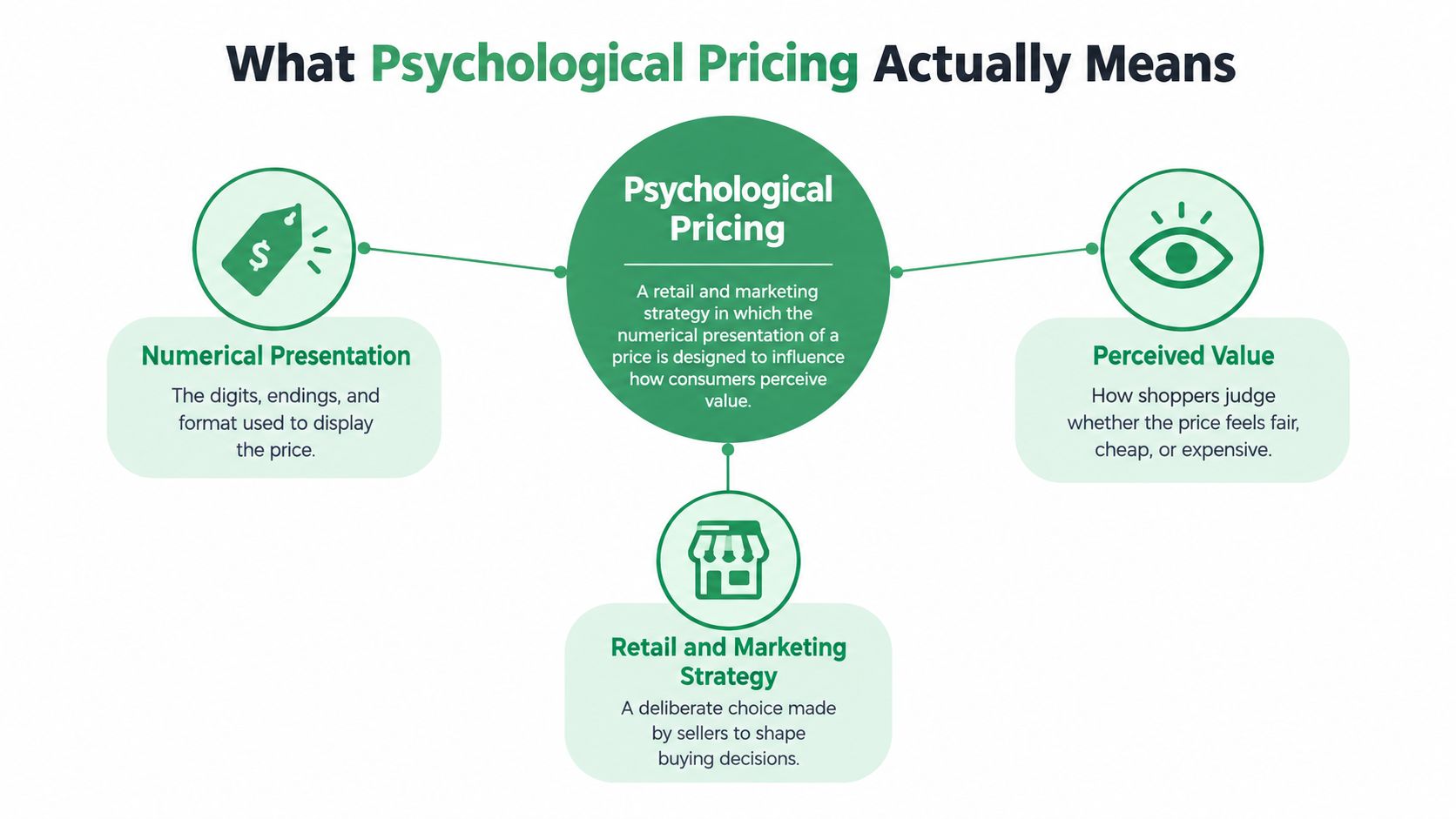
Think of a price tag as a shop window sign. The number is the headline, and everything under it gets judged through that frame. A 9-ending often reads as a bargain, a round price reads as simple or higher quality, and a deliberately high price can read as status.
The Working Definition
A useful definition of psychological pricing is a method that deliberately sets a monetary amount to influence perceived magnitude, affordability, value, or deal quality, rather than relying only on production cost or conventional demand elasticity, as described in the PLOS ONE discussion of left-digit and perceptual effects. Its best-studied mechanism is the left-digit effect. Shoppers process the first digit before they fully process the cents.
That gives you three messages to choose from.
- Bargain message: a 9-ending signals low cost and good value.
- Simple or premium message: a round figure signals confidence and quality.
- Status message: a higher price signals exclusivity, if your product can support it.
Those messages show up in five tactics you'll see next, charm pricing, anchoring, decoy options, prestige pricing, and bundling. None works by magic. Each one frames value in a different way, and each one can fail if the frame doesn't fit the buyer, the category, or the price level.
Core Tactics Compared at a Glance
Use this table as your quick reference, one row per tactic, before you pick a lever for a single offer.
| Tactic | Mechanism | Typical example | Best fit |
|---|---|---|---|
| Charm (odd) pricing | Left-digit effect, buyers read the leading digit first | $19.99 instead of $20.00 | Mass-market, value-led products and everyday ecommerce |
| Anchoring | The first price seen becomes the reference point | Original $299 struck through beside $199 | Subscriptions, sales events and renewals |
| Decoy effect | A third, inferior option makes a target option look better | Three plan tiers where the middle tier is the target | Multi-tier SaaS and service packages |
| Prestige (round) pricing | Round numbers signal quality and simplicity | $500 instead of $499 | Premium, luxury and professional services |
| Bundling | Combined value is judged against the total of the parts | Buy two for $30 instead of $32 bought separately | Ecommerce cross-sell and software suites |
Read a row left to right. The mechanism tells you why it might work, the example shows what the buyer sees, and the best fit tells you where to try it first. If the mechanism doesn't match how your buyer decides, the example won't help.
How to Use the Table Without Stacking Tactics
Tactics often overlap on one page. A SaaS pricing page can anchor with a struck-through price, charm the monthly figure, and add a decoy tier at the same time. When everything changes at once, you can't tell which lever moved behavior.
Pick one primary lever per offer, then let the buyer's reference point decide which one it should be.
If shoppers arrive from a comparison search, the rival price is the reference, so charm or anchoring makes sense. If they arrive for a premium service, quality is the reference, and a round figure is cleaner. For store-specific examples of these trade-offs, pricing insights for Shopify merchants from Quikly walk through how merchants apply the same choices at checkout.
Start simple. Choose the row that matches the decision your buyer is making, run it against a control, and only add a second tactic after you've measured the first.
How Charm Pricing Exploits the Left Digit
Charm pricing works, when it works, because shoppers often encode and compare the leftmost digit before they process the cents. They don't read a price like an accountant. They scan it, categorize it, and move on.
Compare two one-cent steps. Moving from $2.98 to $2.99 keeps you in the $2 range. Moving from $2.99 to $3.00 crosses into the $3 range. The math is identical, so the perceived jump isn't.
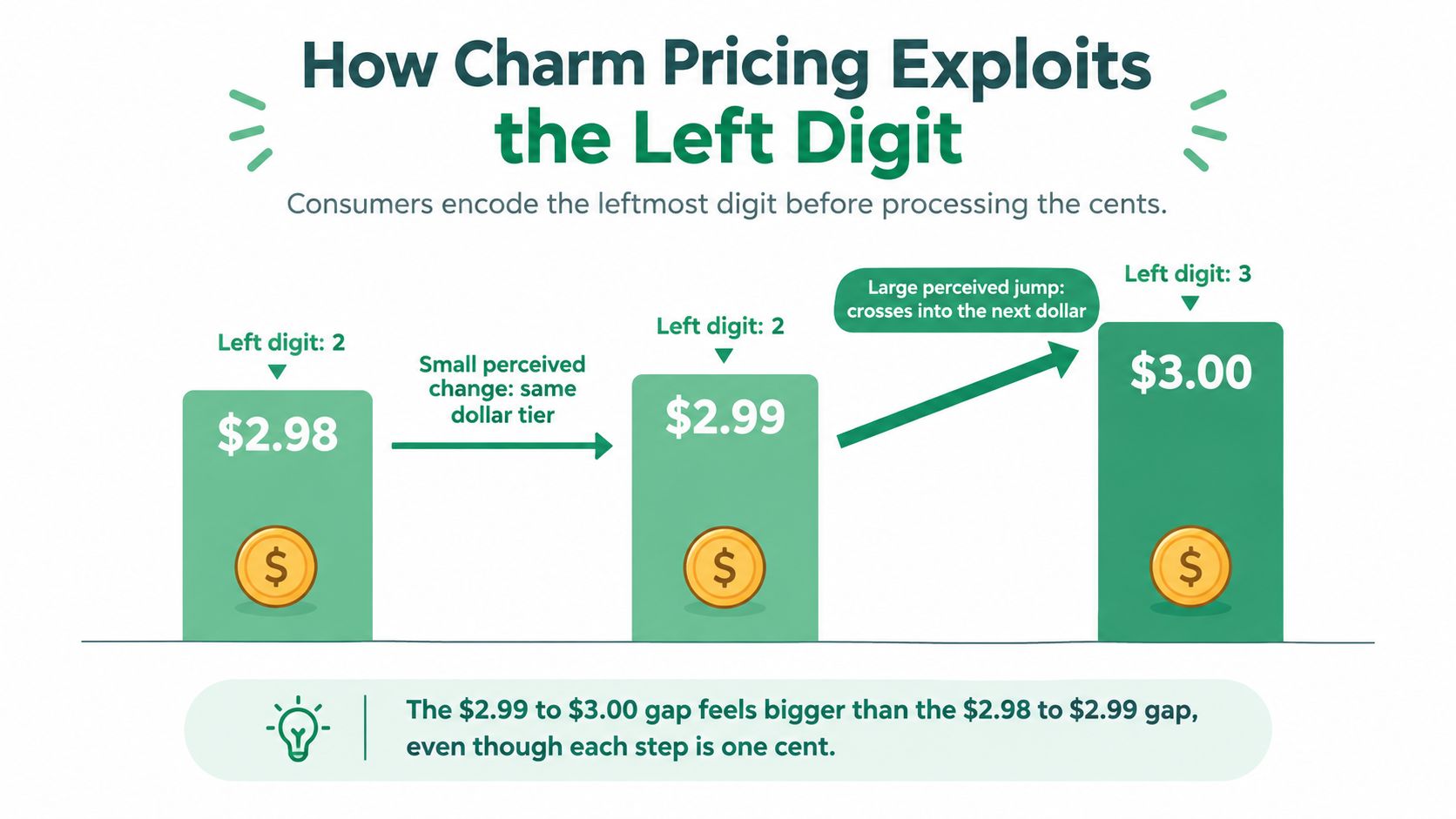
That boundary is the whole idea. $2.99 versus $3.00 is more consequential than $2.98 versus $2.99, because only the first pair changes the leading integer. Shoppers may mentally file $2.99 under $2 even though it's one cent below $3.00.
Evidence That It Became a Convention
This isn't just a lab trick. In the 1997 analysis summarized in the Wikipedia overview of odd pricing, approximately 60% of observed advertised prices ended in 9, 30% ended in 5, and 7% ended in 0, while the remaining seven digits together represented slightly more than 3%.
| Final digit of advertised price | Share of observed prices |
|---|---|
| 9 | About 60% |
| 5 | 30% |
| 0 | 7% |
| Other seven digits combined | Slightly more than 3% |
That distribution tells you sellers adopted charm endings as a standard pattern across consumer markets. It doesn't prove every 9-ending lifts sales today. Convention and effectiveness are two different claims, and confusing them leads to lazy testing.
This short video walks through the scanning habit behind the effect.
The Practical Rule for Testing
The effect is strongest when two conditions hold. Your price straddles a threshold, and it sits close to a competing price. Say you run a paid search landing page at $49.99 against a $50 rival. That one cent crosses the $49 to $50 boundary right where comparison is sharpest.
Segment your tests accordingly. Don't lump a $19.99 price, a $29.99 price, and a $99.99 price into one bucket called 9-endings. Separate results by threshold crossing and by product category, so you can see where crossing the left digit changed behavior.
How Anchoring Sets the Reference Price
Say a subscription costs $200 a year. You drop it to $199. You've given up one dollar, yet the offer now reads as under $200, and that small reclassification can matter more than the saving.
Now show the buyer something first. Put $299 struck through beside $199, and the first number becomes the frame. The buyer isn't asking whether $199 is cheap in isolation anymore. She's asking whether $199 looks good next to $299.
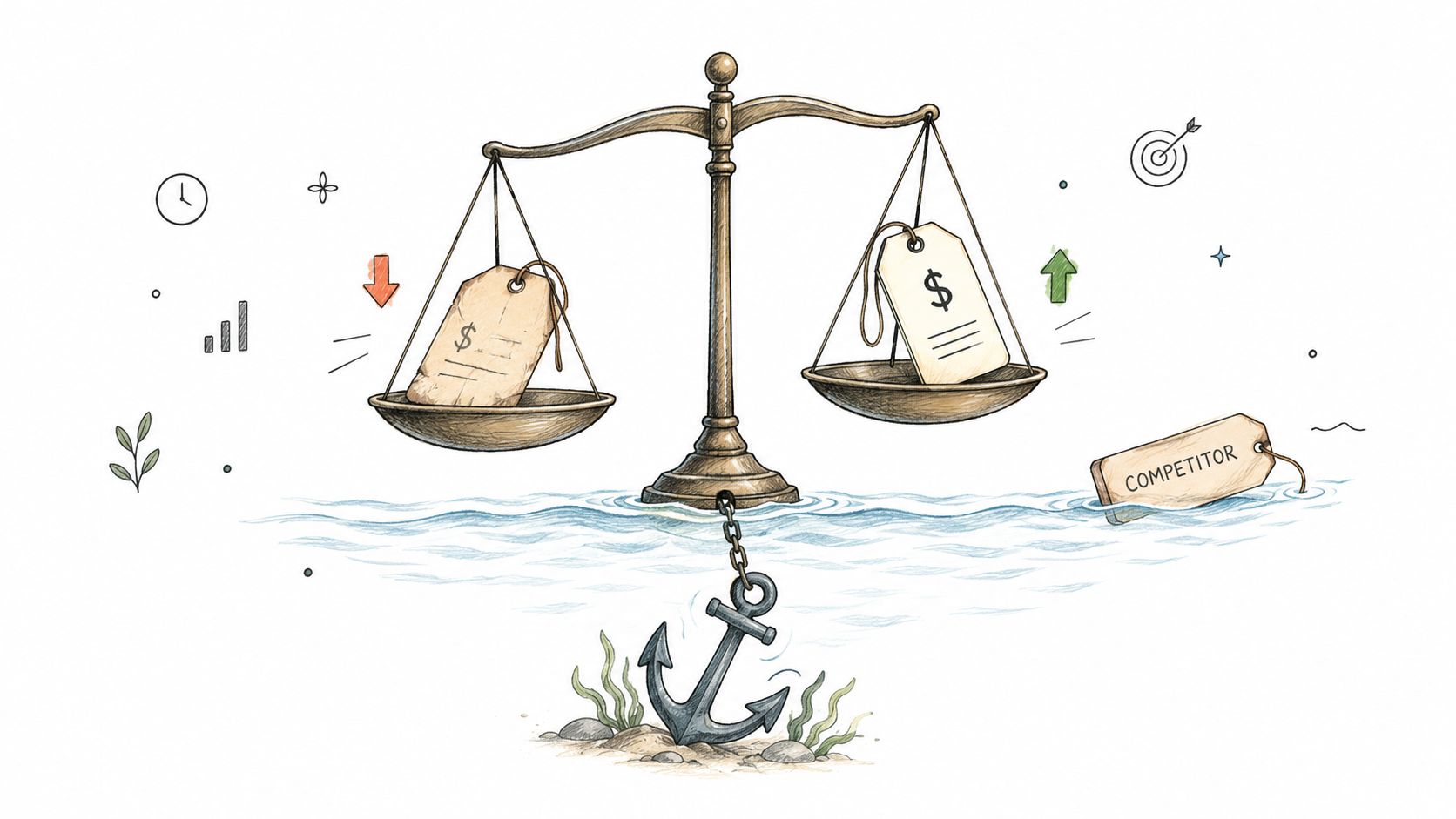
That's anchoring. Buyers evaluate a presented price relative to an internal benchmark, such as a remembered typical price, a competitor's price, or a previously displayed anchor, as formalized in the Journal of Consumer Research model of reference-price effects. Against that benchmark, a price can feel like a gain, a loss, or hardly different at all.
Why Order and Placement Matter
Whichever figure a buyer reads first tends to become the benchmark for everything after it. Put the anchor where eyes land first, usually left or above the current price, and keep it visually connected to the offer. Bury it in small print and you've removed the comparison you're counting on.
Check the anchor first: if buyers don't believe the reference price was real, they won't use it to judge your current price.
Don't confuse two effects that often appear together. Left-digit underestimation is about misreading size. The image effect is about what a 9-ending communicates, a low-price or promotional feel, even when the threshold hasn't changed. Moving from $190 to $189 doesn't cross a hundred-dollar boundary, but it can still look like a deal cue.
Before you use an anchor, run three checks.
- Credibility check: the reference price matches what buyers expect for this category.
- History check: the original price was genuinely charged, for a real period.
- Match check: the claim matches this offer, not a larger bundle or a different term.
If any check fails, drop the anchor. A fake reference doesn't just fail to persuade, it teaches buyers to ignore your next price too.
How Decoy Options Steer the Choice
A decoy is a third option you add, not because you expect many people to buy it, but because it makes your target option look like the better deal. You're steering the comparison, not changing the target itself.
Say you sell software with three tiers, and treat these figures as illustrative. Basic costs $19 per month with limited features. Pro, your target, costs $49 per month. Team costs $59 per month, with the same core features as Pro plus more seats.
Watch what the buyer does. She compares Pro with Team, sees most of the value for $10 less, and feels Pro is well priced. She has stopped judging $49 on its own.
Why the Comparison Replaces Absolute Judgment
People struggle to judge a price in a vacuum. They're much better at spotting which of two similar options gives more for the money. The decoy hands them that easy comparison, and the question shifts without notice from whether $49 is affordable to which option is the best value.
Two conditions decide whether buyers use the decoy or ignore it.
- Same attribute: the decoy must be comparable to the target on the feature buyers care about, such as seats, storage, or support level.
- Credible distance: the decoy must be priced close enough to count as a real alternative, not so far away that buyers dismiss it instantly.
If Team cost $199 in the example, nobody would weigh it against Pro, and the comparison would collapse. If Team offered unrelated features, buyers couldn't line the two options up at all.
How to Check Whether It Worked
Track the share of buyers choosing the target tier before and after you add the decoy. That's your primary signal. Total sales can rise for seasonal reasons while the decoy does nothing, so don't credit it for a busy month.
Then confirm the movement happened for the reason you expect. If Pro's share rises while Basic and Team shares fall slightly, the decoy is steering choices inside your range. If everything rises together, something outside the pricing page probably changed, such as traffic quality or a promotion elsewhere.
Keep the test clean. Change only the tier lineup, hold the features and prices of Basic and Pro steady, and read the result over a full buying cycle.
Where Psychological Pricing Backfires
The honest starting point is that these effects are conditional, not guaranteed. A well-controlled direct-mail experiment found 99-endings increased purchasing, yet a field study published in 2013 using actual sales data found that removing the .99 ending initially appeared to increase sales, and after accounting for sales of substitute products through a differences-in-differences model, the treated product no longer showed a statistically significant advantage from removing the .99 price, a pattern summarized alongside the Rutgers record of the 99-ending sales research.
Read that carefully. The early result looked exciting until substitutes were counted. Buyers may have shifted between similar products rather than buying more overall, which is exactly why a single product's sales line can mislead you.
When the Cheap Signal hurts the Goal
Research reported by Ohio State University in 2021 found that $39.99 may make a lower-priced option feel cheaper, but it can reduce willingness to choose a more expensive version. That's a direct problem if your goal is upselling. The charm ending makes the entry option feel like a bargain and the upgrade feel like a bigger jump.
Premium positioning creates the same conflict from the other side. A charm ending can make a luxury product feel cheaper, and a discount frame can reduce perceived quality. Service businesses weighing that trade-off can compare approaches in the UK service pricing frameworks, where price presentation is tied to positioning rather than treated as a formatting choice.
Correct three misconceptions before you test anything.
- 9-endings always raise sales: they don't, results vary by category, price level, and whether you want entry conversion or an upgrade.
- Charm pricing means only .99 endings: the umbrella also covers anchoring, decoys, prestige pricing, and bundling.
- The decoy effect works the same everywhere: a decoy only works when buyers compare options on a shared attribute.
Treat psychological pricing as a context-dependent behavioral hypothesis, not a conversion lever you pull and forget.
Choose and Test the Right Tactic for Your Offers
Start from the buyer's situation, not from your favorite tactic. The umbrella includes reference pricing, anchoring, bundling, urgency, prestige pricing, mental accounting, payment pain, and the zero-price effect, as set out in the Wikipedia overview of psychological pricing, so choosing well is a matching exercise.
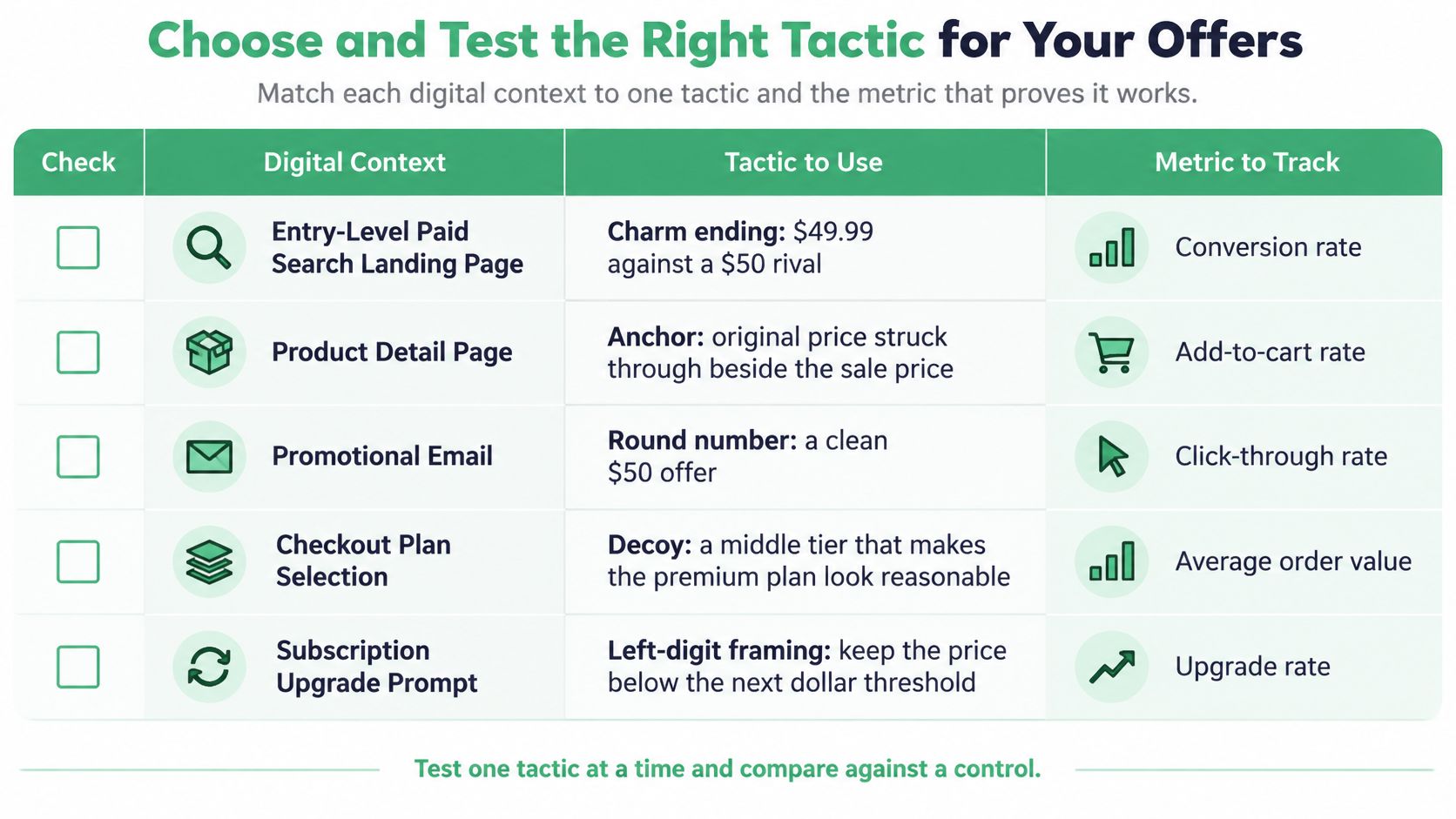
| Digital context | Tactic to test | Metric to track |
|---|---|---|
| Entry-level paid search landing page | Charm ending, $49.99 against a $50 rival | Conversion rate and refund rate by threshold crossing |
| Premium product page | Round price with no 9-ending | Average order value and conversion rate |
| Multi-tier SaaS pricing page | Decoy middle tier priced close to the target | Share of buyers choosing the target tier |
| Renewal or subscription offer | Reference price shown with a struck-through original | Renewal rate |
| Upsell to a higher tier | Avoid 9-endings on the lower tier | Upgrade rate from lower to higher tier |
This visual maps those same contexts to the metric that proves each tactic worked.
Notice that a low-ending price signals affordability while a high price can signal quality or status. Those signals conflict, so a premium brand testing a discount frame should watch perceived quality, not only clicks. You can see current plan presentation as a worked reference on the published pricing page.
The Test Rules
Run your test with discipline. If you're new to split testing mechanics, the guide on how to split test landing pages covers the setup steps before you touch a price.
- Compare otherwise identical offers: change only the price presentation.
- Hold format constant: keep displayed format and promotional framing the same in both versions.
- Segment results: split by threshold crossing and product category.
- Use a randomized split: don't run versions on different days or traffic sources.
- Report confidence intervals: a point estimate alone hides how shaky the result is.
- Measure beyond conversion: track contribution margin, refund rate, and customer quality alongside conversion rate.
Then check repeat purchase before you scale. An apparent conversion lift may reflect a short-term response to framing rather than genuine willingness to pay, and buyers won through framing alone may not come back at full price.
Choose one primary tactic per page and run the test through a full buying cycle. That's how the definition of psychological pricing becomes useful in practice, one measured claim at a time.
If you're testing price presentation on landing pages that paid ads send traffic to, you need to read campaign performance and page results together, not in separate dashboards. NotFair connects AI agents such as Claude or ChatGPT to Google Ads, Meta Ads, GA4, and Search Console through hosted MCP servers, with read access for diagnosis and approval-gated writes that show an explicit diff before any budget or campaign change. Visit today, start on the free plan, and use live account data to decide which price test deserves more spend.