

Claude skills for meta ads are reusable instructions that teach Claude how to handle recurring Meta Ads work—such as checking tracking, comparing performance, or drafting change recommendations. They do not fetch account data or edit campaigns by themselves: for that, Claude needs an authorized connection such as an MCP server or another tool. The practical setup is to pair clear operating rules with read access first, then add carefully limited write access only when a human can review and approve changes.
What a Claude skill for Meta Ads actually is
A Claude skill is a packaged set of instructions and supporting resources for a repeatable task. It can give Claude a workflow, explain how to interpret a particular account’s conventions, and specify what a good output should contain. Anthropic describes skills as directories organized around a SKILL.md file, with instructions and optional supporting files; Claude can draw on a skill when it is relevant to the request. See Anthropic’s Agent Skills documentation for the format and behavior.
For a paid social team, a skill might say: compare results against the account’s named objective, check attribution settings before interpreting conversions, and never recommend a budget change without stating the evidence and risk. That makes it more useful than a one-off prompt because the procedure can be reused and revised. It is not a model fine-tune, an ad account, or a magical Meta Ads integration.
The distinction matters because marketers often group three different pieces together:
- Skill: the playbook—task instructions, definitions, guardrails, and output format.
- MCP server or other tool: the connection that exposes account data or actions to Claude. Anthropic’s MCP documentation describes MCP as a way to connect Claude to external tools and data sources.
- Claude: the model that applies the instructions to the user’s request and information returned by available tools.
Keep those responsibilities separate in your design. If an audit produces the wrong result, you need to know whether the cause was a poor rule, stale or incomplete data, or the model’s interpretation—not just “the AI got it wrong.”
Why skills matter in day-to-day Meta Ads work
Most account work is not a single clever analysis. It is a sequence of checks that should happen consistently across campaigns, clients, and handoffs. One strategist may remember to distinguish link clicks from landing-page views; another may compare a short conversion window with a longer one and draw a different conclusion. A skill lets the team write down its preferred method and ask Claude to follow it each time.
That consistency is especially useful when multiple people manage accounts with different naming conventions, objectives, or approval rules. A useful skill does not pretend every advertiser should use the same benchmarks. Instead, it tells Claude which account-specific source of truth to consult, which comparisons are valid, and when to stop and ask for clarification.
For example, a skill for weekly creative review could require Claude to:
- Group ads by the team’s creative concept labels rather than treating every variation as unrelated.
- Separate delivery and spend observations from outcome observations.
- Flag missing or inconsistent labels before comparing creative groups.
- Recommend a next test with a stated hypothesis, not just name the ad with the lowest cost per result.
The gain is repeatability, not guaranteed performance lift. A well-written skill can reduce missed checks and make recommendations easier to review. It cannot repair weak measurement, turn noisy data into certainty, or make a bad offer convert. If an account has too little reliable data to support a conclusion, the skill should say so rather than manufacture confidence.
How the skill, Claude, and Meta Ads data work together
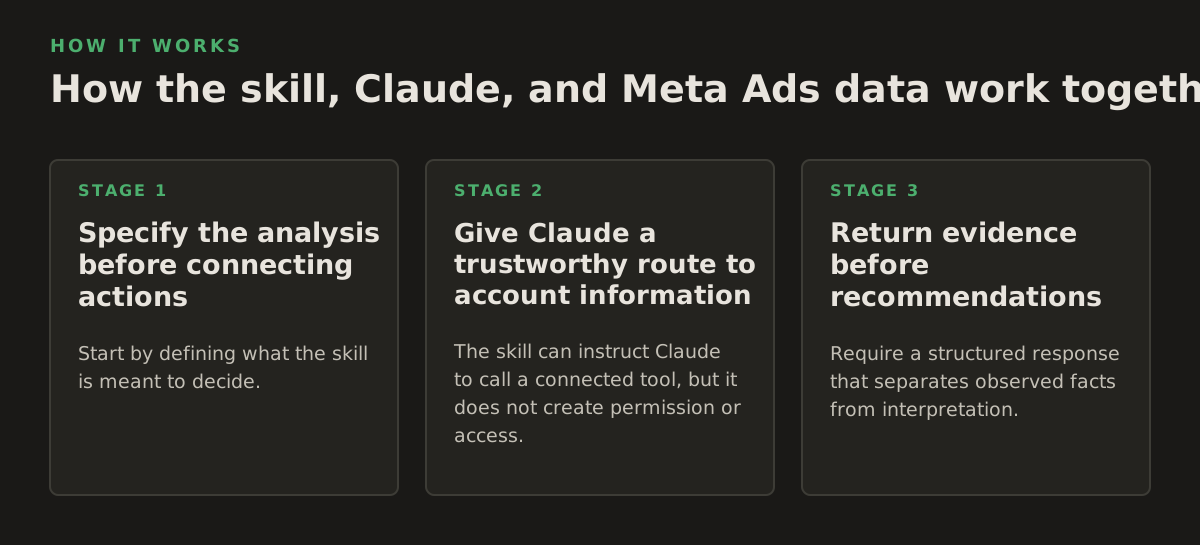
A practical workflow has three stages: Claude receives a request, applies relevant instructions, and uses available tools to retrieve information or propose an action. If the tool connection only exposes reporting data, Claude can analyze and draft recommendations but cannot change campaign settings. If write tools are available, the skill should add explicit conditions for when an action may be proposed, what must be checked first, and who approves it.
1. Specify the analysis before connecting actions
Start by defining what the skill is meant to decide. “Optimize my account” is too broad to audit. “Review the last seven complete days against the previous seven, identify ad sets with delivery changes, and list likely causes without changing anything” is testable. In the skill, define the comparison period, the account’s reporting conventions, and the minimum evidence needed for a recommendation.
Meta’s Marketing API Insights documentation describes the reporting interface used to retrieve performance insights. The fields and breakdowns available to a workflow affect what it can conclude, so specify the required measures and dimensions rather than assuming the connection returns every useful view. For instance, a creative review may need ad-level results and a reliable creative identifier; a campaign summary alone may not be enough to diagnose which ads drove the change.
2. Give Claude a trustworthy route to account information
The skill can instruct Claude to call a connected tool, but it does not create permission or access. A server or integration must authenticate to the relevant account and expose the permitted operations. Meta’s Marketing APIs documentation is the official starting point for the platform’s API capabilities and concepts. In practice, confirm that the chosen connection exposes the specific account objects and reporting fields the workflow requires.
For teams choosing a connection, scope access to the job. A reporting assistant may need read-only access; it does not need permission to publish ads. A controlled execution workflow might need more, but should still limit which actions are available and preserve a clear approval step. NotFair’s Meta Ads MCP is relevant when the goal is to connect an AI client to Meta Ads through an MCP server; evaluate any connection against the same needs: supported operations, permission scope, review process, and how changes can be reversed.
3. Return evidence before recommendations
Require a structured response that separates observed facts from interpretation. A useful report might include the account and date range, the metrics retrieved, the comparison used, the finding, the likely explanation, and the next check that would confirm it. When values are missing or attribution settings are unclear, Claude should identify that limitation instead of filling the gap with an assumption.
For an action workflow, add a proposal stage between diagnosis and execution. Claude should show the exact object, current value, proposed value, reason, and expected risk. A human can then approve, reject, or ask for a narrower change. Anthropic’s MCP overview explains the connection pattern, but the precise available tools and safeguards depend on the MCP server and client configuration; do not assume that an MCP connection is automatically read-only or approval-gated.
Where Meta Ads skills break down
Instructions cannot compensate for bad inputs. If the connected account is wrong, a report omits relevant fields, or conversion events are misconfigured, Claude may give a polished explanation based on incomplete evidence. Tell the skill to verify account identity and reporting scope before analysis, and to list missing inputs explicitly. For consequential decisions, compare the returned data with the team’s trusted reporting source.
Attribution and timing are common sources of false certainty. A short period may show spend before conversions have fully registered; a campaign’s reported outcome can also depend on the selected attribution setting. Avoid turning a single day’s movement into a confident diagnosis. When the data does not distinguish between competing explanations, the useful output is a follow-up check—not a definitive claim about why performance changed.
Skills can also become stale. An instruction written around an old naming convention, account structure, or approval policy may still be followed even after the team changes its process. Assign an owner, date the skill’s operating assumptions, and review it when tracking, reporting, or permissions change. Keep platform-specific rules grounded in current documentation and account settings rather than copied into a skill and forgotten.
Finally, write access raises the cost of ambiguous instructions. “Reduce waste” is not a sufficiently precise authorization to pause an ad or cut a budget. Before enabling changes, decide which actions are allowed, which require approval, and which are prohibited. Keep logs and a rollback path; reversibility helps limit damage, but it does not remove the need for human accountability.
Practical examples and a safe rollout
The examples below use illustrative values and policies, not universal Meta Ads benchmarks. Adjust the periods and thresholds to the account’s conversion volume, buying cycle, and internal risk tolerance.
- Weekly delivery audit: compare the latest seven complete days with the prior seven; flag an ad set if spend changed by more than 25%, then report delivery and outcome measures before suggesting a cause.
- Tracking check: inspect the last three days for a gap between recorded landing-page views and the team’s expected event flow; label it a possible tracking issue and request verification rather than editing events.
- Creative review: group ads using the team’s concept labels, compare a 14-day window, and identify candidates for a new test only when the required outcome data is present.
- Budget proposal: if a campaign exceeds an illustrative cost-per-result guardrail for two consecutive weekly reviews, draft a proposed 10% budget reduction for approval; do not execute automatically.
To make one of these workflows operational, write the skill around a specific task and test it against realistic cases—including an account with missing data and one where the apparent winner is based on a small sample. A good test checks whether Claude asks for the missing information, follows the intended comparison, and distinguishes a proposal from an approved action.
- Start read-only. Validate the account, date range, metrics, and output format before allowing any changes.
- Make the output reviewable. Require evidence, uncertainty, and the exact next step—not an unexplained “optimization score.”
- Add one narrowly scoped action at a time. Define allowed object types, limits, approval requirements, and rollback instructions.
- Keep a change record. Capture what was proposed, who approved it, what changed, and how to restore the prior setting.
Use a skill when your team has a repeatable procedure worth documenting. Use a connected tool when Claude needs live account data or actions. If the job spans paid search and paid social, the same separation applies: a Google Ads workflow needs its own platform access and platform-specific checks, such as through Google Ads MCP, rather than reusing Meta assumptions.
What to choose for your team
For an individual marketer, a concise audit skill paired with read-only reporting access is a sensible starting point. Agencies should create shared task skills but keep client-specific account details, thresholds, and approval rules explicit; a single generic skill should not silently impose one client’s policy on another. In-house growth teams can add action proposals after the reporting workflow is reliable and the owner of each approval is clear.
Before rollout, answer four questions: What exact task does the skill perform? Which data does it need? What evidence must appear in its answer? What actions, if any, may it take without approval? If those answers are vague, keep the workflow advisory. If they are precise and testable, a skill can turn a team’s Meta Ads procedure into a repeatable Claude workflow without confusing instructions with data access or authority.
NotFair provides hosted MCP servers for connecting AI clients to advertising platforms, with approval-gated agents designed to diagnose issues, recommend fixes, and execute reversible changes. If you need that connection and review layer alongside your own operating rules, explore NotFair.
Authored with NotFair SEO