

You're staring at a Google Ads account whose cost per lead has crept up since you expanded broad match and added new search themes. Google Ads and GA4 disagree, the CRM shows fewer qualified opportunities, and nobody wants another spreadsheet export. You want an agent to investigate, but you don't want it spending your budget while it works out what went wrong.
Table of Contents
- When Claude Code Marketing Actually Helps
- Why Claude Code's Commercial Growth Matters to Marketing Operations
- Run Diagnosis Drafting and Approval
- Check the Evidence Before Any Write
- How to Choose a Hosted Ads Connector
- Measure the Rollout and Start Small
When Claude Code Marketing Actually Helps
Claude Code marketing is useful when you give the agent an investigation, not a mandate to optimize. In that rising-CPL account, the job is to identify what changed, reconcile the evidence, and prepare a recommendation you can inspect. An unattended campaign edit is a different job, and it shouldn't be bundled into the investigation.
Start with questions a paid-media lead would ask in practice. Which search terms consumed budget without producing relevant inquiries? Did the campaign attract the wrong audience, or did the business stop recording conversions correctly? Are apparently cheap leads turning into qualified opportunities?
Give the agent a bounded job
A useful session should produce concrete working material:
- Campaign diagnostics: Explain the observed change using account facts, with unresolved questions kept visible.
- A prioritized waste list: Identify questionable queries, keywords, or campaign structures and explain why they deserve attention.
- Drafted fixes: Prepare negatives or structural changes without presenting them as completed improvements.
- A reviewable change set: Show exactly what a human would authorize, not a vague recommendation to improve efficiency.
For example, an agent might flag job-seeker queries in a campaign selling software to employers. That's a plausible waste hypothesis. It still needs to establish which queries appeared, where they matched, whether they generated relevant outcomes, and whether a proposed negative would also block legitimate buyers.
“Optimize my account” doesn't establish any of that. It leaves the agent to invent the objective, choose the evidence, and decide how much disruption is acceptable.
Practical rule: Delegate the investigation before you delegate the ability to change anything.
Replace dashboard switching with a checked diagnosis
The frustrating work isn't opening Google Ads. It's carrying context between search terms, GA4 conversion events, and CRM lead records without losing the meaning of each metric.
A live account read is a better starting point than last week's spreadsheet because you can check the current state while investigating. But fresh data isn't automatically comparable data. The agent still needs to identify the reporting period, conversion definition, and relevant business outcome.
Keep the session focused on a decision someone owns. If the output can't explain why a specific change is justified, you haven't finished the diagnosis. You've generated commentary.
The question worth answering is straightforward: How do you know the campaign diagnosis is sound before anything in the live account changes?
Why Claude Code's Commercial Growth Matters to Marketing Operations
A paid-media lead can get a fluent answer from an agent in seconds. The expensive mistake is letting that speed become permission to change campaigns before anyone checks the evidence.
Anthropic's commercial growth is relevant as a reason to evaluate Claude Code as an operating tool, not as proof of advertising performance. Sacra's Anthropic company analysis reports that Claude Code launched as a standalone product in February 2025, became generally available in May 2025, and reached estimated annualized revenue of $1 billion by late 2025 and $2.5 billion in February 2026. Enterprise customers generated more than half of revenue, with adopters including Netflix, Spotify, KPMG, L'Oréal, and Salesforce.
These are annualized run-rate estimates, not recognized accounting revenue or audited annual sales. For a paid-media team, they indicate commercial momentum and organizational buying. They do not show that Claude Code can improve campaign returns, correctly interpret conversion data, or make safe account changes.

Evaluate the workflow, not the adoption story
Anthropic's research on Claude Code expertise examines Claude Code use, but its software-engineering activity does not establish whether the tool is useful for paid-media operations. Don't treat broad usage figures or coding adoption as a proxy for marketing results.
Assess the specific work you would delegate. Can the agent read the relevant account and business context, show which evidence supports a recommendation, rank the spend potentially affected, and present a precise proposed change? Can a reviewer compare that change with the live account state and roll it back if needed? Those are the tests that matter to campaign operators.
The Clearcote Labs' MCP integration guide can help technical teams understand an approach to browser-based tool integration. Use it to inform integration questions, not to substantiate claims about Claude Code's marketing performance.
Adoption is not campaign validation
Keep three claims separate:
- Commercial adoption: Organizations are paying to use coding agents.
- Workflow fit: Your team must test whether Claude Code can support its actual marketing tasks.
- Marketing effectiveness: Your own results must show whether the workflow improves decisions and outcomes.
For paid media, infrastructure means a dependable process for reading account evidence, identifying spend at risk, reviewing explicit proposed changes, and retaining a rollback path. A polished recommendation based on poorly defined conversion data can still target the wrong problem. Require evidence and human approval before any write, and judge the tool by the quality and safety of that operating process, not by revenue headlines.
Run Diagnosis Drafting and Approval
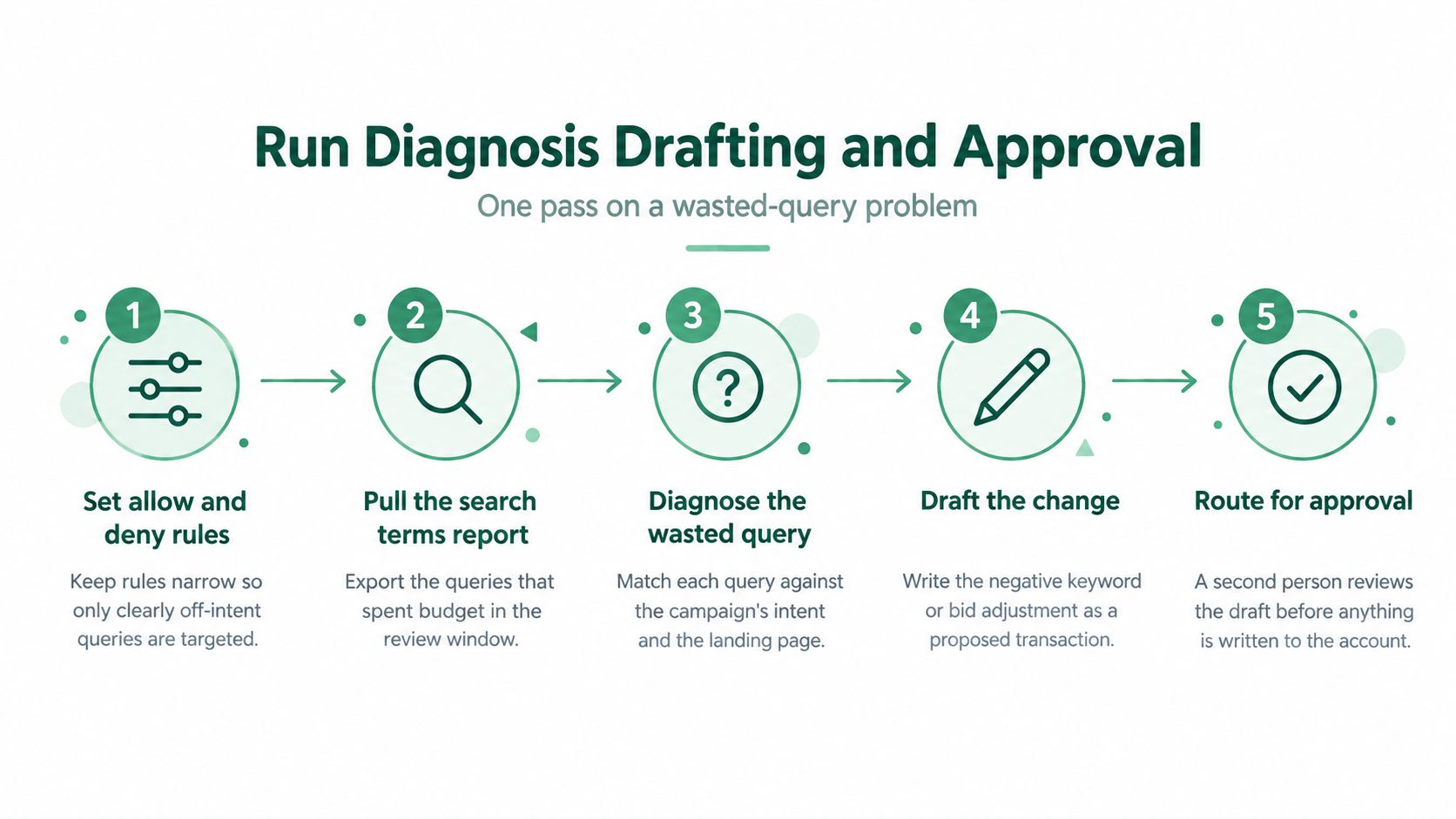
Treat a campaign change as a transaction with a reviewable beginning and end. The working sequence is diagnosis, drafting, approval, execution, and verification, with each stage producing evidence the next stage can inspect.
The query workflow should remain visible to the reviewer.
Establish the execution boundary
Configure narrow allow and deny rules, runtime permission callbacks, and hooks for trusted tools. Ordinary project instructions are advisory; hooks can enforce checks deterministically and block or modify calls before execution, as explained in Claude Code's permissions documentation.
Don't substitute a sentence asking the agent to be careful for an enforceable permission boundary. Leave global auto-approval off, and keep irreversible or high-impact actions manually gated.
Then request a read-only diagnosis containing:
- Live facts: Account identity, search terms, keywords, campaign budgets, reporting window, and retrieval time.
- Interpretation: Assumptions, confidence, alternative explanations, and missing evidence.
- Priority: Findings ranked by spend at risk, with the calculation made inspectable.
For Meta, apply the same discipline before considering pauses or budget moves. The Meta Ads MCP workflow is relevant when evaluating that platform-specific connection.
Draft changes that can be accepted separately
Consider an illustrative proposal for an employer-software campaign receiving job-seeker traffic. This is a transaction example, not a customer result.
| Proposed action | Before | After | Rollback |
|---|---|---|---|
| Add a negative | Exact query free resume template isn't excluded |
Add an exact-match negative in the reviewed campaign | Remove the newly created negative |
| Reallocate budget | Source and destination retain their live budgets | Transfer a reviewer-approved amount within existing ceilings | Restore both recorded budget values |
The executable proposal must be machine-readable, not merely this summary table. Require the actual account and object identifiers, current values, proposed values, rationale, expected impact, and rollback operation. Never let a placeholder amount or inferred identifier reach execution.
Keep expected impact qualitative unless the account evidence supports a forecast. Removing an irrelevant query doesn't justify promising a particular CPL improvement.
A reviewer should be able to approve the negative while rejecting the budget move. For teams deciding where that review belongs operationally, the SubmitMySaas marketing workflow tool roundup offers additional tooling context.
Execute the approved subset and verify it
Bind approval to the exact proposed diff. If the live state changes before execution, stop and refresh the proposal rather than applying a revised interpretation without notice.
After execution, read the affected objects again and compare their actual state with the approved diff. Record the result in a change log, including partial failures.
One-call undo is a recovery path, not permission to skip review. Restoring a setting can reverse the configuration change. It can't erase the period during which the wrong setting was active.
Check the Evidence Before Any Write
A fluent diagnosis isn't proof. If the agent says broad match caused the decline, make it establish the relationship instead of rewarding it for producing a familiar explanation.
Marketers' caution is justified: 68% of organizations surveyed by Ascend2 said AI insights were valuable but still required human judgment, while only 13% fully trusted them, according to The Evolution of AI in Marketing. Your operating response should be a stronger evidence gate, not a more elaborate prompt asking for confidence.
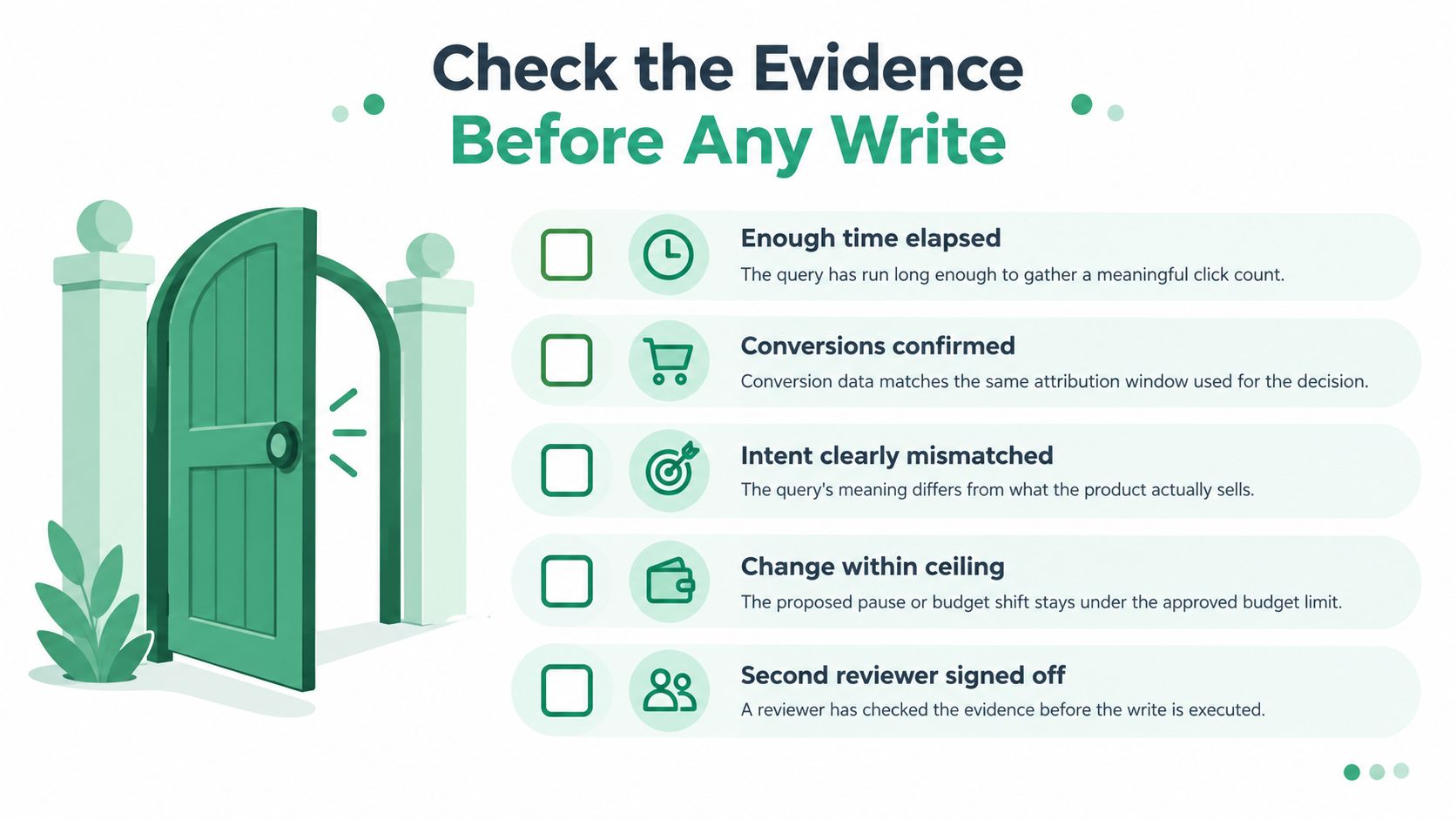
Use the checklist as a stop/go check, with the underlying account evidence attached.
Reconcile definitions before comparing outcomes
Ask the agent to reconcile Google Ads conversions with GA4 events and, when connected, CRM outcomes from a system such as GoHighLevel. Don't demand identical totals without first checking what each system counts.
A form submission, a recorded lead, and a qualified opportunity aren't interchangeable. Require the diagnosis to explain which outcome deteriorated and whether the records cover comparable periods.
Investigate these competing explanations before accepting a performance edit:
- Tracking failure: Check missing tags, interrupted conversion events, or a conversion action that stopped firing.
- Reporting mismatch: Inspect attribution windows, reporting dates, and conversion definitions.
- Recent account changes: Review learning status and configuration history before attributing the result solely to query quality.
- Lead-quality deterioration: Establish whether CRM outcomes support the apparent acquisition problem.
If measurement is broken, fix measurement first. Pausing productive traffic won't repair a missing conversion event.
Require evidence proportionate to the action
An obviously irrelevant query and an underperforming but commercially relevant keyword deserve different treatment. For the irrelevant query, inspect its meaning against the product, landing page, and proposed negative-match scope. For the relevant keyword, demand a meaningful performance baseline and enough elapsed time to interpret the outcome.
Don't cut a keyword because of a thin day. Don't move budget because the agent found a persuasive explanation in a single dashboard.
For budget reallocation, require corroboration in analytics and check downstream quality before favoring the campaign with the cheapest platform-reported leads. If the systems disagree, ask the agent to explain the disagreement or mark the recommendation unresolved.
Rank findings by spend at risk, but don't confuse that estimate with recoverable savings. Money attached to suspicious traffic is an investigation priority, not a guaranteed efficiency gain.
Finish with an explicit decision: accept, narrow, or reject. Your client explanation should identify the evidence, the competing explanation you checked, and why the action is proportionate. If you can't give that explanation, the proposal isn't ready.
How to Choose a Hosted Ads Connector
Choose the connection based on what it can read, what it can change, and who can authorize that change. A long platform list won't compensate for unclear write permissions.
Exports, a local MCP configuration, and a hosted MCP layer can all support useful work. They impose different responsibilities on the team.
Connector choices for Claude Code marketing
| Approach | Data freshness | Writes | Best fit |
|---|---|---|---|
| Export-based analysis | Reflects the exported snapshot | Separate manual work unless additional tooling is added | Bounded investigations and restricted-access environments |
| Local MCP configuration | Live where the configured tools support it | Depends on the tools and controls your team implements | Teams prepared to maintain integration and security controls |
| Hosted MCP layer | Live where supported by the connector | Assess approval gates, diff previews, logs, and undo | Teams seeking managed connectivity and shared operating controls |
Exports are a sensible starting point when you need to inspect a contained dataset without granting ongoing access. Their weakness is operational: someone must refresh the files and confirm that the account hasn't changed before implementing recommendations.
Local MCP gives technically capable teams control over their implementation. Ask who will maintain authentication, tool schemas, permission boundaries, and error handling. A local configuration isn't automatically unsafe, just as a hosted service isn't automatically governed.
For broader integration planning, connecting AI tools to revenue workflows from Prometheus Agency is relevant background. Evaluate the actual implementation separately from the integration concept.
Inspect the hosted option at transaction level
NotFair is one hosted option with OAuth sign-in, a Claude Code plugin, Claude connectors, and support for Codex, Cursor, and other MCP clients. It provides diagnostic reads and approval-gated Google Ads and Meta Ads writes with diff previews, logged history, and one-call undo.
Its coverage includes Google Ads, Meta Ads, X Ads, LinkedIn Ads, Search Console, GA4, and GoHighLevel. Ask which capabilities are available for each platform rather than assuming every connector has identical read and write tools.
For current package comparison, the Claude Google Ads connector comparison is a starting point: the published Free allowance is seven days unlimited, then 300 operations monthly, while Growth is $79 monthly or $950 annually, with unlimited Google and Meta operations and five shared ad-account spots. Confirm current terms and how operations and account spots apply before purchase.
Agencies need account boundaries, not just access
A multi-client team should require clear answers to operational questions:
- Authority: Who may authorize a pause, negative, or budget change for each client?
- Constraints: Where are client-specific ceilings, exclusions, and prohibited actions enforced?
- Isolation: Can an ambiguous instruction affect another client's account?
- Accountability: Can a reviewer reconstruct the instruction, evidence, approval, and resulting state?
Don't buy access your team can't supervise. If nobody can review campaign diffs competently, a managed strategist is the more appropriate operating choice.
Measure the Rollout and Start Small
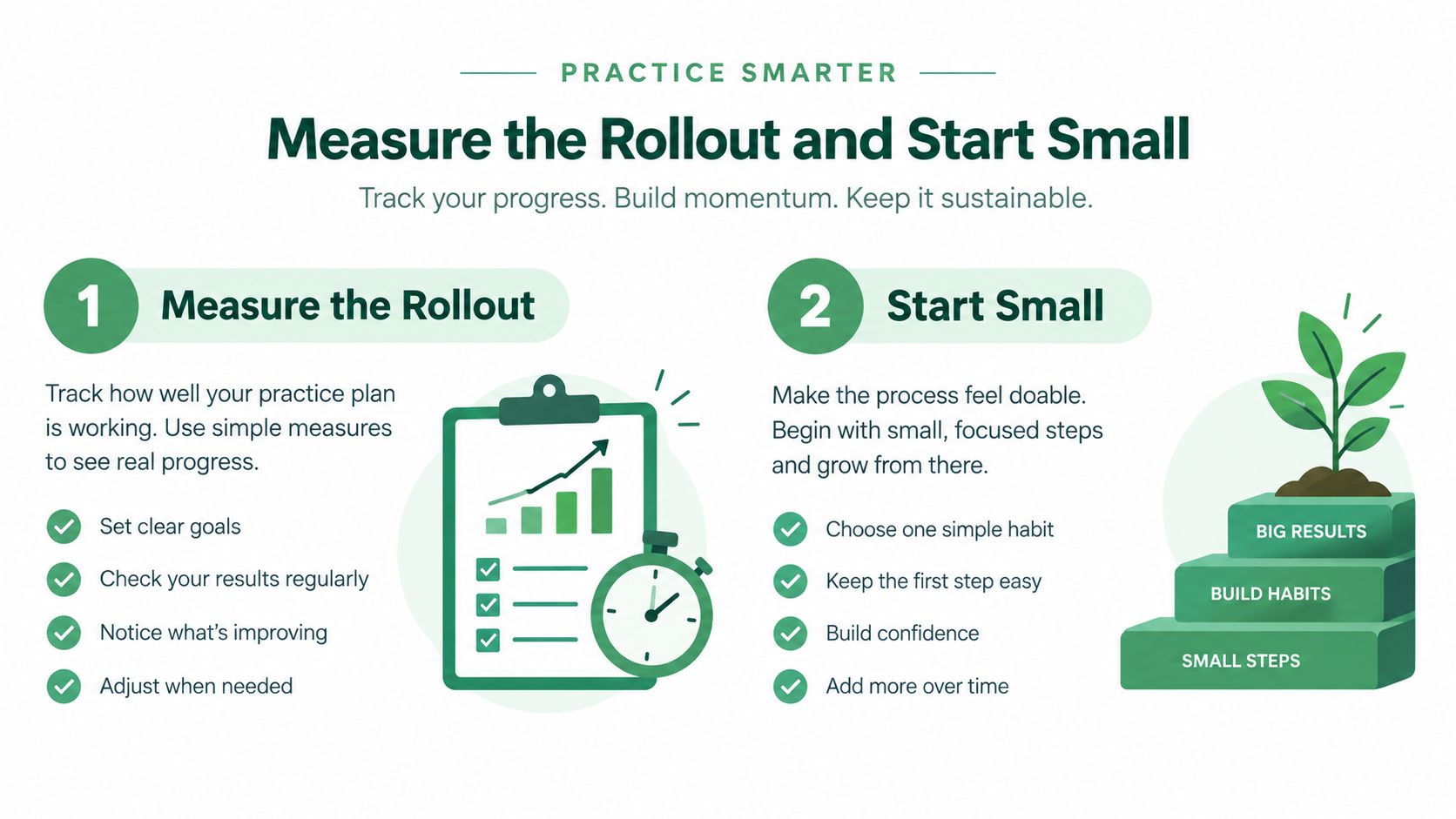
Evaluate whether the agent improves the team's work, not whether it produces recommendations quickly. A drafted fix isn't an outcome, and an executed change isn't a business win until you've observed the result.
Use a deliberately constrained rollout rather than connecting every account at once. Keep the measurement plan visible alongside the operating routine.
Establish the scorecard before claiming improvement
Use a 2–4 week baseline and proposed internal acceptance gates of at least 95% of approved writes targeting the intended object, 100% producing auditable diffs, and 100% of failed or rejected writes leaving the account unchanged; these are evaluation criteria, not industry averages, for an implementation informed by Claude Code best-practice guidance.
Keep campaign mix, budget ceilings, attribution window, and optimization objective fixed. Compare the agent-assisted cohort with a randomized control where practical, or a carefully matched historical cohort when randomization isn't feasible. Report uncertainty and confidence intervals rather than presenting an isolated lift percentage as proof.
Track operational and commercial outcomes together:
- Decision speed: Median time from anomaly detection to approved change, plus analyst minutes per diagnosis.
- Recommendation quality: Acceptance rate, rejection reasons, and the share of accepted changes successfully verified.
- Execution reliability: Rollback rate, execution errors, and discrepancies between approved and actual state.
- Business performance: A preselected measure such as CPL, CPA, ROAS, or qualified-pipeline rate.
Also log tool latency, read freshness, and approval latency. Otherwise, you won't know whether delays came from data retrieval, weak recommendations, or a review queue.
Keep the pilot interpretable
Start with a limited account scope and avoid changing several optimization levers together. Predeclare the observation window, and retain rejected proposals in the evaluation so you don't showcase only successful changes.
Keep permissions granular. Hook scripts run with user permissions, so validate inputs, quote shell arguments correctly, use absolute paths, and exclude secrets from hook inputs and logs.
For analytics setup, consult the Claude Code and Google Analytics integration workflow before deciding which conversion evidence the pilot will use.
If a video walkthrough helps with setup, use it alongside your written review requirements.
This week, connect a single Google Ads or Meta account, request a read-only spend-at-risk diagnosis, and select a reversible proposal for review. Judge the pilot on whether your team can defend the decision and verify the result, not on how quickly the agent offers to act.
NotFair offers hosted MCP connections for live campaign diagnosis and approval-gated changes with explicit diffs, change history, and undo. Visit to connect an account, inspect the evidence behind a proposed fix, and approve only the change you're prepared to defend.