

Effective ai marketing is not a chatbot writing ad copy and calling the work finished. For paid-search managers, social buyers, agencies, and growth teams, it is a system that turns campaign data into decisions, routes those decisions through controls, and measures whether the change improved the business outcome. The useful question is not “Where can we add AI?” but “Which marketing decision can be made faster or more consistently without weakening measurement, judgment, or accountability?”
What AI Marketing means in paid advertising
AI marketing is the use of machine-learning systems, generative models, and software agents to support or perform marketing work across the planning, execution, measurement, and optimization cycle. That definition includes familiar platform automation, such as automated bidding and audience modeling, but it also includes newer systems that interpret natural-language requests, query several data sources, explain anomalies, draft recommendations, and—when authorized—make changes through an advertising API.
The distinction matters because these are different jobs:
- Prediction: estimating the probability of a conversion, click, lead, purchase, or other event.
- Generation: producing ad variations, briefs, keyword groupings, summaries, or test hypotheses.
- Diagnosis: explaining a change in spend, conversion volume, CPA, ROAS, reach, or lead quality.
- Decision support: ranking possible actions by expected impact, confidence, risk, and reversibility.
- Execution: applying a budget, bid, targeting, creative, or tracking change through an approved workflow.
Automation is not the same as autonomy. A platform may automatically adjust bids inside a defined campaign objective. An AI assistant may recommend moving budget between campaigns. An agent connected to an ads API may be able to execute that move. Those three systems can all be described as AI-enabled, but they have different permissions, failure modes, and review requirements.
AI, rules, and agents are different layers
A rule says: “If cost per lead exceeds a threshold, send an alert.” A model says: “Given the available signals, this lead or auction has a predicted probability.” A generative model says: “Here are plausible explanations and next steps.” An agent adds the ability to select tools, retrieve current information, maintain task state, and take an action.
That last layer is where marketing teams need operational discipline. An agent should not be treated as an omniscient strategist. It is better understood as a software operator with a language interface. It can be helpful when it has the right context, narrow permissions, reliable tools, and a human approval path. It can be dangerous when a vague request grants access to production campaigns without scope limits.
For example, “improve performance” is not an executable marketing instruction. A better request specifies:
- the account, campaign group, and date range;
- the primary outcome, such as qualified leads rather than raw form fills;
- the constraints, such as no changes to brand campaigns or daily budgets;
- the evidence required before acting;
- the maximum permitted change and the rollback condition.
Google describes its Google Ads API as a programmatic interface for managing accounts and campaigns, including retrieving data and making changes; the official Google Ads API overview is the right reference for what the platform exposes rather than assuming an AI tool can access every setting. Meta’s official Marketing API documentation serves the same purpose for Meta campaign objects and operations. The practical implication is simple: an AI workflow can only be as capable as the data and actions its connected APIs expose.
Why AI Marketing matters to performance teams
Most paid-media teams do not lack dashboards. They lack enough time to inspect the right evidence before a decision becomes urgent. A strategist may need to reconcile spend, conversion tracking, search terms, auction behavior, creative fatigue, CRM outcomes, and landing-page changes before deciding whether a campaign is actually deteriorating.
AI can reduce the cost of that investigation, but only if it works from structured evidence. The advantage is not that a model “understands marketing” in the abstract. The advantage is that it can compress repetitive interpretation: retrieve the relevant dimensions, compare periods, identify outliers, explain likely causes, and present the unresolved questions to a human.
The real value is decision latency
Consider a lead-generation account in which reported conversions remain stable while qualified opportunities fall. A basic dashboard may show acceptable CPA. A useful diagnostic workflow would compare:
- platform conversions with CRM-qualified leads;
- campaign, ad group, audience, geography, and device performance;
- lead response time and sales-stage progression;
- recent budget, bid, creative, and landing-page changes;
- tracking events, attribution settings, and missing-value patterns.
That workflow does not prove causation. It narrows the investigation. The human still needs to verify whether the CRM field changed, sales capacity fell, or the traffic mix shifted. But the team starts with a ranked set of hypotheses rather than a blank spreadsheet.
Faster diagnosis is valuable only when it preserves the decision’s denominator. If an agent reports that CPA improved without checking conversion lag, attribution changes, spend volume, or lead quality, it has made the team faster at reaching an unreliable conclusion. The quality of the comparison matters more than the fluency of the explanation.
Where the economics can improve
AI-assisted workflows can create value in several ways:
- less analyst time spent exporting and normalizing recurring reports;
- faster detection of broken tracking, delivery interruptions, or unusual spend;
- more consistent application of account-management checklists;
- quicker production of campaign and creative hypotheses;
- more frequent review of smaller accounts that cannot justify constant manual monitoring.
These are operating benefits, not guaranteed performance lifts. A generated headline does not automatically improve conversion rate. A budget recommendation does not automatically improve ROAS. Teams should evaluate an AI workflow against a defined baseline: time to produce a reliable diagnosis, error rate, proportion of recommendations accepted, and business outcome after an appropriate measurement period.
As of 2026, Google’s documentation describes conversion measurement and conversion goals as inputs to optimization and reporting; its conversion tracking help documentation explains the need to configure and verify conversion actions. That is why an agent should treat tracking health as a prerequisite, not a footnote. If the conversion event is wrong, more sophisticated optimization can make the wrong objective easier to pursue.
How an AI Marketing system works
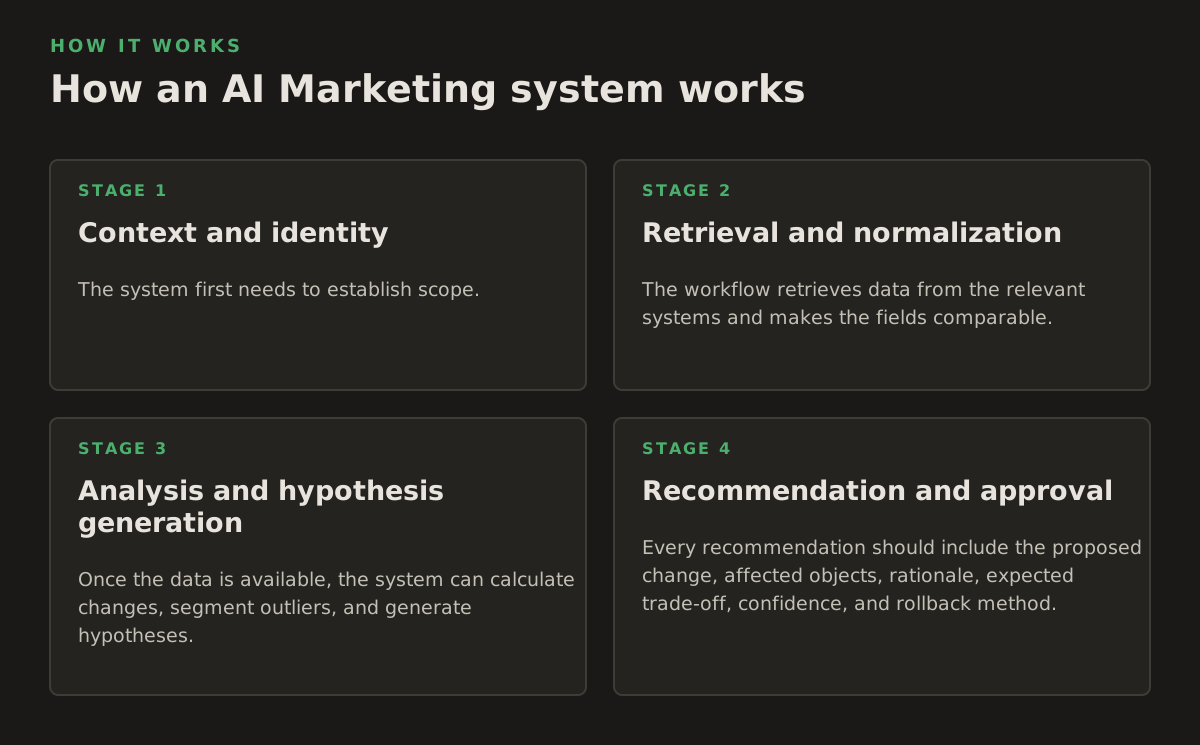
A practical system has more parts than a model. The model interprets intent and produces a plan, but the surrounding architecture determines what it can see, what it can change, and how the team can audit its work.
1. Context and identity
The system first needs to establish scope. “Check performance” should resolve to a particular organization, advertising account, campaign set, date range, currency, timezone, attribution view, and business outcome. It should also know whether the user is asking for analysis, a draft, or execution.
Context should include operational definitions. “Lead” might mean a submitted form in the ad platform, a validated contact in the CRM, or an opportunity accepted by sales. “Budget” might mean daily campaign budget, monthly account allocation, or total planned spend. Without those definitions, the model can give a coherent answer to the wrong question.
2. Retrieval and normalization
The workflow retrieves data from the relevant systems and makes the fields comparable. That may include ad-platform performance, analytics sessions, search-console queries, CRM stages, product revenue, and change history. It should preserve the source, timestamp, timezone, and level of aggregation for every important value.
Data provenance is a control, not a documentation exercise. A recommendation should be able to say which account, report, date range, and fields produced it. If the source is absent, stale, sampled, delayed, or incompatible with the requested comparison, the system should state that limitation instead of filling the gap with confident prose.
Google Analytics documentation explains that reports and explorations can use different dimensions, metrics, and attribution perspectives; the official GA4 attribution documentation is useful when deciding what a reported conversion actually represents. An AI layer should not silently combine platform-reported conversions and analytics conversions as if they were interchangeable.
3. Analysis and hypothesis generation
Once the data is available, the system can calculate changes, segment outliers, and generate hypotheses. A sound diagnostic distinguishes observation from inference:
- Observation: spend increased 28% in the selected period.
- Observation: conversion rate declined from 4.1% to 3.2%.
- Hypothesis: the additional spend came from lower-converting queries or placements.
- Verification: inspect search terms, placements, device mix, geography, and conversion lag.
- Action: apply a narrowly scoped change only if the evidence supports it.
The model is useful for proposing the next query or comparison. It should not be allowed to turn a correlation into a causal claim automatically. Performance changes can result from seasonality, auction pressure, tracking defects, sales capacity, inventory, website speed, or an external promotion.
4. Recommendation and approval
Every recommendation should include the proposed change, affected objects, rationale, expected trade-off, confidence, and rollback method. “Increase Campaign A budget” is incomplete. A usable recommendation says which budget, by how much, why now, what could worsen, and when to reassess.
Approval gates are especially important for actions that alter spend, targeting, exclusions, conversion settings, or public-facing creative. A low-risk read-only report can be automated. A budget change may require a manager. A conversion-action change may require an analytics owner and a tracking validation plan.
5. Execution and verification
Execution should be idempotent where possible: repeating the same approved instruction should not accidentally double a budget increase or create duplicate assets. The system should record the actor, request, before-state, after-state, timestamp, and API response.
After execution, verification checks whether the intended state exists and whether delivery remains healthy. It does not pretend that a performance outcome is immediately knowable. A budget update can be verified quickly; its effect on conversions may require enough data and conversion lag to evaluate.
For teams building tool-connected workflows, the Model Context Protocol documentation describes a standard way for AI applications to connect with external tools and data sources; see the official MCP introduction. An MCP server can make a marketing system easier for an AI client to use, but it does not remove the need for authorization, validation, logging, and platform-specific rules.
Where AI Marketing breaks
The most serious failures usually occur outside the model itself. They occur when the system receives ambiguous objectives, incomplete data, excessive permissions, or no meaningful review process.
Bad measurement produces polished nonsense
An AI system can summarize a broken conversion setup perfectly. Common problems include duplicate events, imported offline conversions arriving late, changed attribution windows, consent-related data loss, inconsistent naming, and CRM stages that no longer map to the platform event. The output may still look analytical because the arithmetic is correct.
Before trusting an optimization workflow, define which metrics are diagnostic and which are decision metrics. For example, clicks may help explain traffic changes, but qualified opportunities may determine budget allocation. If the business outcome is delayed, use leading indicators carefully and label them as provisional.
Attribution is not truth at the individual level
Platform reporting answers questions within a platform’s measurement rules. Analytics reporting may use a different attribution model, identity resolution approach, lookback window, or reporting scope. CRM reporting answers a further question: what happened after the lead entered the business process.
Never reconcile unlike metrics by averaging them. Instead, document why the numbers differ and decide which source governs each decision. An agent can help identify the discrepancy, but a prompt cannot resolve an instrumentation disagreement.
Generative output can be plausible and wrong
Language models are good at producing concise explanations, which is precisely why unsupported explanations are risky. The model may infer seasonality where there is a tracking break, claim creative fatigue where the audience changed, or recommend pausing a low-volume campaign because a short date range looks weak.
Reduce this risk by forcing the workflow to show:
- the exact date range and comparison period;
- the minimum volume behind the claim;
- the source fields used;
- alternative explanations considered;
- the evidence that would disconfirm the recommendation.
Execution creates asymmetric risk
A poor summary wastes time. An unauthorized budget change can spend money. A mistaken exclusion can remove valuable traffic. A changed conversion action can corrupt future optimization. The more consequential the action, the more the workflow should require explicit scope and approval.
Useful controls include:
- read-only access for analysis agents;
- separate credentials or tools for execution;
- allowlists for accounts, campaigns, and change types;
- maximum percentage or absolute change limits;
- automatic expiry for temporary changes;
- before-and-after snapshots;
- human approval for budget, targeting, tracking, and public creative changes.
Privacy and access boundaries still apply
Connecting an AI client to advertising and CRM data does not make every field appropriate for every task. Minimize the data passed to the model, avoid unnecessary personal information, and define who can retrieve customer-level or revenue-level details. Treat API keys, OAuth tokens, service accounts, and exported reports as production credentials and data assets.
The right response to these risks is not to ban AI. It is to narrow the task, improve observability, and make the failure expensive to ignore but difficult to trigger.
How practitioners should apply AI Marketing
Start with a repetitive decision that has a clear input, a bounded action, and a measurable review point. Do not begin with a general-purpose agent that can edit everything in an account. The first workflow should earn broader access by demonstrating reliable behavior.
Good starting workflows
- Daily anomaly triage: flag unusual spend, delivery, conversion, or tracking changes and attach the relevant segments.
- Weekly account review: summarize movement by campaign, identify likely causes, and create a prioritized investigation list.
- Search-term classification: group queries for review while leaving final exclusions to an accountable specialist.
- Creative inventory: identify missing variants, repeated messages, and assets needing human review.
- Measurement QA: check whether expected events, naming conventions, and destination URLs remain present.
- Change-log explanation: connect recent account edits with subsequent delivery or efficiency changes without claiming proof of causality.
These use cases are valuable because they reduce inspection work without requiring the system to make irreversible decisions. A strategist can accept, reject, or refine the output, creating a feedback loop about what constitutes a useful recommendation.
Worked example: a bounded budget recommendation
Suppose the following is an illustrative example, not a universal benchmark: three non-brand search campaigns have a combined daily budget of $600. Over the selected 28-day period, Campaign A has spent 92% of its budget and produced 48 qualified opportunities; Campaign B has spent 61% and produced 19; Campaign C has spent 98% and produced 7. The figures alone do not justify moving money.
- Verify that qualified opportunity is defined consistently across all three campaigns.
- Check conversion lag and whether the most recent days are incomplete.
- Compare impression share, lost budget, search-term mix, geography, device, and landing-page behavior.
- Check whether Campaign C is constrained by budget or simply failing to convert.
- Draft a transfer with a stated cap—for example, moving $50 per day for seven days—not as a universal rule but as a reversible starting policy.
- Require approval, record the before-state, and define the review date and rollback condition.
The agent’s job is to assemble and explain that decision. It should not infer that Campaign A can absorb unlimited spend, or that Campaign C should be paused, without checking marginal opportunity and business constraints.
Choose the right connection pattern
Teams using an AI client with advertising data generally face three patterns:
- Reports only: the system reads data and produces analysis. This is the safest starting point.
- Draft actions: the system prepares changes for approval but cannot apply them.
- Approval-gated execution: the system can execute a defined class of reversible changes after a person approves the exact plan.
For teams that need a connected workflow, NotFair’s Google Ads MCP and Meta Ads MCP are relevant examples of using hosted MCP servers to connect AI clients with advertising platforms. The important evaluation criteria are not simply whether a connector exists, but whether the workflow provides appropriate account scope, transparent inputs, approval boundaries, and a usable record of changes.
Measure the system, not just the campaigns
AI operations need their own scorecard. Track:
- time from alert to qualified diagnosis;
- percentage of recommendations accepted, rejected, or materially edited;
- number of unsupported or incorrect claims caught in review;
- execution failures and successful rollbacks;
- changes made outside the approved scope;
- business outcomes after accounting for lag and test design.
A high acceptance rate is not automatically good. It may indicate useful recommendations, or it may indicate weak review. Likewise, a low acceptance rate can mean the system is poor—or that it is surfacing difficult questions that the team previously ignored. Pair operational metrics with examples of decisions and their eventual outcomes.
A practical recommendation for 2026
For most Google Ads, Meta Ads, agency, and in-house teams, the best 2026 starting policy is read broadly, recommend narrowly, execute reversibly. Give the system enough historical and current context to investigate performance, but constrain the actions it can take. Begin with anomaly detection, reporting, measurement QA, and change explanations. Add execution only after the team can inspect the evidence and recover from mistakes.
Use a written policy for each workflow:
- what data the system may access;
- which accounts and campaigns are in scope;
- which actions are read-only, draft-only, or executable;
- what approval is required;
- what evidence must appear in the recommendation;
- how changes are logged and reversed;
- when a human must stop the automation and investigate.
Do not buy or build an AI layer merely because it can speak fluent marketing language. Choose it when it shortens a recurring decision, makes the evidence easier to inspect, and respects the economic risk of changing live campaigns. For teams that want to connect AI clients to ad platforms while keeping execution behind approval gates, NotFair offers hosted MCP connections and agent workflows designed for that operating model: NotFair
Authored with NotFair SEO