

An AI ad account audit uses an AI assistant to inspect advertising data, settings and change history, then produce evidence-backed findings for a person to verify. It is useful when a manager needs to spot tracking gaps, wasted spend, structural risks or creative fatigue faster—but it is not a substitute for checking the source data or approving consequential changes.
Define the audit’s job before connecting an AI assistant
An audit should answer a specific operating question, not merely generate a long list of observations. For an agency strategist, that might be “Which account issues could explain the decline in qualified leads?” For an in-house team, it might be “Are conversion signals reliable enough to guide next month’s budget decisions?” The question determines which data to gather and what a useful finding looks like.
In practice, an AI-supported audit combines three things: account evidence such as settings and reports, business context such as lead quality or promotion dates, and review rules that distinguish a confirmed problem from a hypothesis. AI can help connect patterns across that material, summarize exceptions and draft next steps. It cannot make an incomplete data set complete just by analyzing it.
Separate observations from interpretations
A useful audit labels each statement according to what is actually known. “The campaign recorded fewer conversions in the selected period” is an observation if supported by the report. “The landing page is broken” is an interpretation unless someone has checked the page and its tracking. This distinction keeps a plausible-sounding explanation from being treated as a verified diagnosis.
Ask the assistant to provide, for every finding:
- Evidence: the account, campaign, date range, metric or setting behind the observation.
- Interpretation: what the evidence may indicate, including alternative explanations.
- Verification: the report, setting or business owner who can confirm it.
- Proposed action: what to change, what outcome to monitor and whether approval is required.
For example, an assistant might flag that a campaign’s reported lead volume fell while spend remained similar. That is a useful prompt to inspect conversion tracking, traffic quality, offer changes and lead handling. It is not, by itself, proof that the bidding strategy or creative caused the decline.
Gather evidence that can support a real diagnosis
Before reviewing performance, align the date range, attribution context and conversion definition. A comparison is misleading if one report counts form submissions while another uses qualified leads, or if the periods include different promotions or tracking changes. Record the account time zone, reporting window, relevant conversion actions and any known changes to the site or campaign.
For Google Ads, the Google Ads API reporting documentation describes how reports are built from selectable resources, fields and segments. That makes it important to record what the audit queried rather than presenting a metric without its reporting context; see Google’s reporting overview. For Meta campaigns, the Marketing API Insights documentation is the relevant official reference for retrieving advertising insights. In either platform, an AI summary should preserve the underlying period and dimensions so a manager can reproduce the finding.
Check measurement before judging media performance
First establish whether the conversion signal represents the outcome the team cares about. In Google Ads, review the conversion actions being used and their relationship to the reported results; Google’s conversion tracking overview explains the platform’s conversion-tracking concept. In a lead-generation account, also check whether downstream CRM stages distinguish a submitted form from a qualified opportunity. An account-level audit cannot infer lead quality from a conversion count alone.
On Meta, keep the distinction between events received by the platform and business outcomes confirmed elsewhere. Meta documents the Conversions API as a way to send web events from a server to Meta. That description does not establish that a particular advertiser’s event setup is correct, deduplicated or aligned with its business definition. Those points still need verification against the account configuration and source system.
Build an evidence pack that is small enough to review and broad enough to prevent obvious blind spots:
- Account configuration: objectives, campaign structure, budgets, bidding settings and conversion selections.
- Performance reports: spend, impressions, clicks, conversion outcomes and relevant breakdowns for comparable periods.
- Change records: material edits, launches, budget shifts, tracking changes and known pauses.
- Business context: lead-quality feedback, inventory or offer constraints, sales-cycle timing and landing-page changes.
Share the least sensitive information that will answer the question. A marketing audit rarely needs customer names, raw personal data or unrestricted access to unrelated systems. If the assistant cannot cite a finding to a report, setting or supplied note, treat it as an idea to investigate—not an account fact.
Run the audit in passes, not as one giant prompt
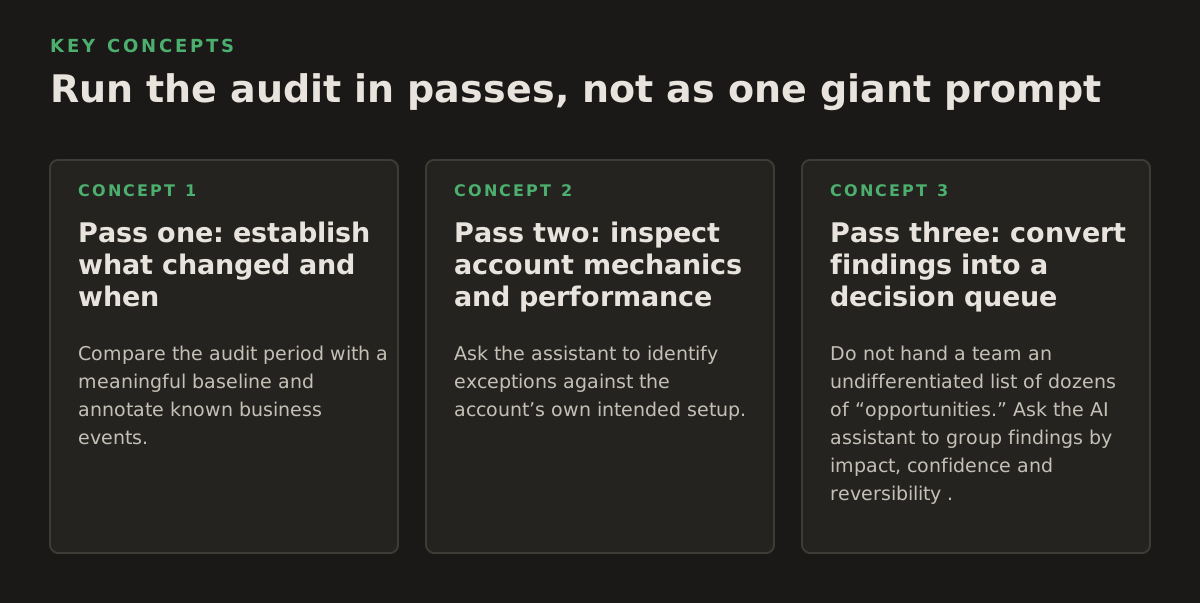
A staged review makes it easier to catch bad assumptions before they spread. Start with data quality, then look at delivery and structure, and only then ask for explanations or recommendations. If the first pass finds that conversion actions are missing or inconsistently defined, pause performance diagnosis until the measurement question is resolved.
Pass one: establish what changed and when
Compare the audit period with a meaningful baseline and annotate known business events. If results changed after a site migration, promotion end or tracking update, those events belong in the analysis. Google Ads provides a ChangeEvent resource for examining account changes through its API. Use change records to establish chronology, not causation: an edit preceding a performance shift is a lead for investigation, not proof that the edit caused it.
Pass two: inspect account mechanics and performance
Ask the assistant to identify exceptions against the account’s own intended setup. That is more actionable than asking it to declare whether a campaign is “good.” A campaign may have low volume because it is deliberately constrained, while a large conversion count may be unhelpful if the conversions are low quality. For each concern, require the assistant to name the relevant evidence and the alternative explanation that should be checked.
For example, a team might see a drop in tracked leads and ask for a cross-check of conversion reporting, account changes, campaign delivery and CRM outcomes. The analysis should separate a confirmed tracking issue from a possible traffic-mix shift. The account team can then verify the event in the platform and compare with the CRM before deciding whether to change media settings.
Pass three: convert findings into a decision queue
Do not hand a team an undifferentiated list of dozens of “opportunities.” Ask the AI assistant to group findings by impact, confidence and reversibility. Confidence should reflect evidence quality, not how certain the model sounds. A confirmed misconfiguration might merit immediate review; a speculative creative explanation may need a test plan before any edit.
A practical finding record can use these fields:
- Finding: a short, falsifiable description.
- Evidence and scope: source, date range, account area and comparison.
- Confidence: confirmed, likely or unverified—with the reason.
- Next step: investigate, test, change or leave as-is.
- Owner and guardrail: who approves it and how to reverse or monitor it.
Prioritize recommendations by consequence and reversibility
Audit findings do not all deserve the same response. A possible measurement defect can invalidate decisions across several campaigns, while a weak ad variation may affect only one part of the account. Prioritize according to the decision risk—what could go wrong if the team ignores the finding—and the amount of evidence needed to act.
One useful review order is:
- Measurement integrity: confirm the conversion action and reporting basis before interpreting efficiency.
- Material account risk: investigate settings or changes that could affect delivery, spend control or policy compliance.
- Performance diagnosis: identify patterns worth explaining with business context, not just platform metrics.
- Optimization ideas: propose controlled tests only where the evidence supports a clear hypothesis.
For instance, suppose an illustrative audit flags both an unverified conversion setup and a campaign with lower reported efficiency. Treat the conversion question as a prerequisite: changing bids based on a potentially unreliable signal could make the account harder to interpret. This is a sequencing example, not a benchmark or a claim about the likely impact of any particular change.
Also classify proposed edits by reversibility. A narrowly scoped budget adjustment or a paused test can often be reviewed and undone more easily than a broad restructure or a change to shared measurement settings. Before approving any edit, record the intended outcome, the scope, who authorized it and what observation would trigger a rollback. When a finding is uncertain, the right recommendation may be “verify” rather than “change.”
Know where AI audits break down
An AI assistant can be fluent and still be wrong about an account. It may confuse correlation with cause, misread a reporting window, overlook a promotion or treat a platform metric as a business result. It can also produce generic advice that sounds plausible but does not match the account’s objective or constraints. The defense is not a more confident prompt; it is a traceable chain from evidence to decision.
- Incomplete access: if the assistant cannot see a setting or report, it should mark the gap instead of inferring a value.
- Mixed definitions: conversion totals from different systems may not count the same event or use the same attribution basis.
- Unstated context: seasonality, lead quality, sales follow-up and offer changes may be outside the ad account.
- Overbroad actions: a recommendation that changes several variables at once makes later diagnosis harder.
- Untrusted input: text in campaign names, landing pages or imported documents should be treated as data to inspect, not instructions to the assistant.
For AI governance, the NIST AI Risk Management Framework offers a voluntary structure for thinking about risks across AI design and use. For an advertising audit, the practical application is modest but important: define what the assistant may inspect, what it may recommend, what requires human approval and how decisions are documented. The framework does not certify a marketing workflow or establish that a particular tool is safe.
Keep diagnosis separate from execution. An assistant may draft a proposed change, but a named account owner should verify its target, expected effect and rollback path before it is applied. This matters especially for shared budgets, conversion settings and changes that affect multiple campaigns. If an organization cannot identify who owns approval, keep the workflow read-only until that responsibility is clear.
Make the audit repeatable without turning it into autopilot
A repeatable audit has a stable question, a known evidence set and a consistent way to close findings. Keep a record of the reporting period, the queries or exports used, account changes considered, unresolved data gaps and decisions made. That makes the next review more useful: the team can distinguish a recurring issue from a one-off anomaly and see whether a previous recommendation was actually verified.
For agencies, use the same finding format across clients but keep each client’s goals, definitions and permissions distinct. For in-house growth teams, agree on which conversion outcome is the decision metric and who confirms it with sales or CRM data. For MCP developers, design the workflow so outputs retain source context and proposed writes require explicit approval; avoid asking the model to silently fill in missing account evidence.
A practical cadence depends on the account’s decision cycle and risk, so there is no universal schedule to promise. Run an audit when a meaningful performance change, tracking change, account handoff or planned restructuring makes the evidence worth reviewing. Between those moments, a smaller exception review may be more useful than repeatedly generating a broad account report.
NotFair provides hosted MCP servers connecting AI clients with advertising and analytics platforms, plus approval-gated agents intended to diagnose issues, recommend fixes and execute reversible campaign changes. If that approach fits your workflow, explore Google Ads MCP and Meta Ads MCP; otherwise, use the same evidence-and-approval discipline with the tools your team already trusts. Learn more about NotFair.
Authored with NotFair SEO