

The surprising part of agentic AI marketing isn't that adoption is accelerating. It's that most marketing organizations still aren't ready to let agents act without supervision. A 2026 BCG survey found that 42% of CMOs still use generative AI as an assistant for discrete tasks, while only 8% run campaigns where multiple agents operate autonomously (BCG's research on agentic marketing transformation). The constraint isn't imagination or access to models. It's whether your team owns the data, controls approvals, records every action, and can undo a bad decision quickly.
That distinction matters in paid media. An agent that drafts headlines is useful. An agent that reads live search terms, diagnoses wasted spend, proposes negative keywords, waits for approval, makes the change, and logs the result is operating at a different level. Agentic AI marketing is an operating model, not just another content tool.
Table of Contents
- Why Agentic AI Marketing Is Different from Everything Before It
- What Makes an AI Agent Actually Agentic
- High-Value Use Cases in Paid Media and Growth
- The Real Risks of Deploying Agents in Live Ad Accounts
- Governance and Approval Patterns That Work
- How MCP Connectors Enable Safe Agentic Workflows
- Ownership, Accountability, and Measuring Agentic Marketing Performance
Why Agentic AI Marketing Is Different from Everything Before It
Agentic AI changes who performs the marketing workflow, not just how quickly a task is completed. Task-assist tools generate ad copy, suggest keywords, create image variations, or summarize reports. A marketer still interprets the output, switches between platforms, makes the edit, checks the result, and records what happened.
An agent starts with an objective. It can divide that objective into steps, retrieve evidence from connected systems, recommend an action, execute an approved change, inspect the result, and continue. In a paid account, that makes it closer to an operational teammate than an autocomplete tool. It also creates a governance problem, because the team must define what the agent may change, who approves exceptions, and how every action can be reversed.
McKinsey estimates that agentic AI could power as much as two-thirds of current marketing activities and accelerate campaign creation and execution by 10 to 15 times (McKinsey's analysis of agentic marketing workflows). The practical shift is from isolated task assistance to systems that can plan, generate, test, and optimize campaigns at scale. Speed matters, but control determines whether that speed produces value or spreads an error across live campaigns.
The workflow changes, not just the task
Consider a rising cost per lead in Google Ads. A task-assist tool might summarize the campaign or draft a recommendation. An agentic workflow can:
- Inspect live data: Read spend, search terms, conversion activity, keyword status, and campaign settings.
- Form a diagnosis: Distinguish query waste from tracking failures, audience changes, landing-page friction, or budget pacing.
- Prepare an action: Draft negative keywords, suggest a bid adjustment, or identify campaigns for review.
- Route the decision: Present the proposed changes to the accountable marketer before writing anything.
- Execute and record: Apply the approved edit, preserve the before-and-after state, and expose the result for later review or rollback.
The team's role therefore changes. People perform fewer repetitive platform operations, while taking greater responsibility for defining boundaries and judging exceptions. Data ownership, approval routing, action logs, and rollback procedures become part of campaign performance, not administrative overhead.
Practical rule: If an agent cannot show what it read, what it plans to change, and how to reverse that change, do not give it unrestricted write access.
Adoption is moving faster than operational maturity. A 2026 survey of B2B go-to-market leaders found that 76% of organizations were deploying or actively implementing agentic AI, while 47% identified lead and data quality as a primary barrier (RevSure and Ascend2 findings summarized by Supermetrics). Teams preparing for this shift need media buying, measurement, systems integration, and control-design skills alongside prompt expertise. Specialist resources on AI marketing leadership hiring can help define that operating role.
What Makes an AI Agent Actually Agentic
A calculator performs an operation and waits. A capable new hire receives a business objective, determines the steps, uses the systems available, checks the result, and reports back. The difference between those two examples is a practical way to distinguish ordinary AI assistance from an agent.
A marketing agent needs four characteristics:
1. Goal-directed behavior
The instruction isn't “write five ad descriptions.” It's closer to “reduce wasted search spend while protecting conversion volume.” That objective gives the system a reason to inspect several signals and select a sequence of actions.
2. Tool use
The agent must be able to access the systems that contain the relevant evidence. In a paid media workflow, that may include Google Ads, Meta Ads, Google Search Console, GA4, and a CRM. Without tool access, the system can only speculate from pasted or stale data.
3. Multi-step reasoning
The agent needs to connect observations. It might find a search term with high spend and no recorded conversions, check whether conversion tracking is functioning, compare the query with the intended keyword, and then rank a proposed negative keyword by potential spend exposure.
4. Self-correction
A reliable workflow validates its assumptions before acting. If the account has just entered a learning phase, if a conversion event changed, or if the data window is incomplete, the agent should flag that condition instead of treating an apparent anomaly as a settled diagnosis.
Single-agent and multi-agent setups
A single-agent system can handle a defined loop, such as diagnosing Google Ads search-term waste and preparing a change request. A multi-agent system adds specialization. An orchestrator might assign one agent to data quality, another to paid search, and another to CRM lead quality, then combine their findings for human review.
The market is still early in that progression. BCG found that just under one-third of CMOs had moved to agent-led workflows, and only 8% operated campaigns with multiple autonomous agents (BCG's survey). That maturity gap is useful context. You don't need a swarm of autonomous agents to start. A narrowly scoped, read-first agent with clear escalation rules is often more valuable than an ambitious system that can change everything and explain little.
High-Value Use Cases in Paid Media and Growth
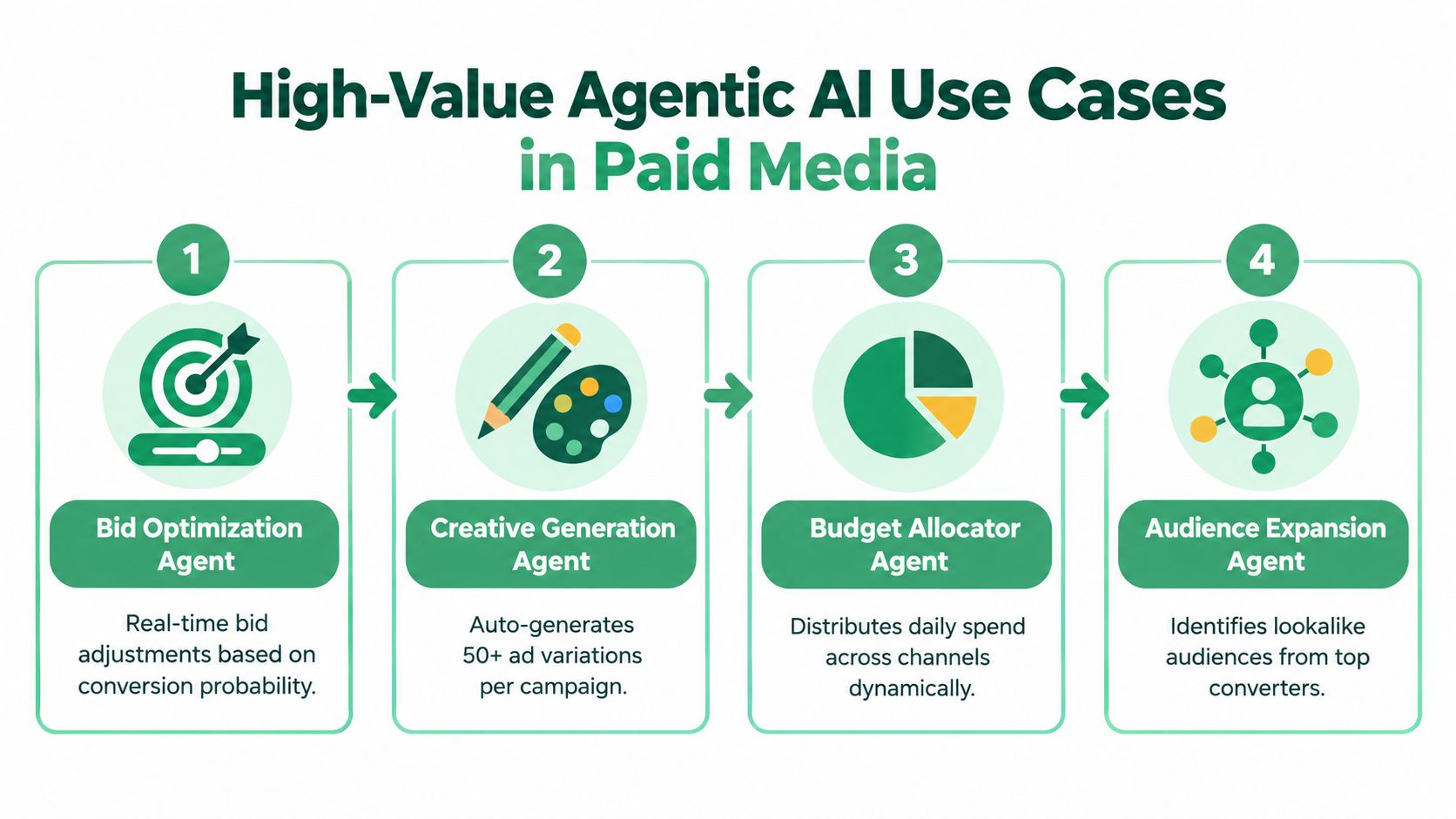
The strongest early use cases share a pattern: the agent reads live information, prepares a bounded recommendation, and leaves consequential execution behind an approval gate. They don't require the system to invent a strategy from nothing. They require it to process more evidence and maintain a faster operating rhythm than a busy team can manage manually.
Search term waste detection
An agent can pull current search term data from Google Ads, group queries by intent, compare them with keyword and landing-page coverage, and flag terms that appear irrelevant or commercially weak. It can rank the recommendations by spend at risk instead of handing a buyer an unprioritized export.
The useful output isn't “add negative keywords.” It's a proposed change set with the query, campaign, match type, reason, recent evidence, and expected scope. The marketer can approve the safe additions, reject ambiguous terms, and send uncertain cases to a separate review queue.
Budget pacing and reallocation
Budget agents should monitor pacing rather than blindly chase short-term performance. They can compare planned daily delivery with actual spend, detect campaigns that are underdelivering, and identify where a shift may be appropriate based on the account's defined objectives.
The agent shouldn't move budget just because one campaign looks efficient in a narrow window. It should check for learning status, limited volume, tracking changes, seasonality flags, and the organization's spending constraints. A good proposal says what will move, why, what remains protected, and who must approve it.
Cross-channel diagnosis
A cost-per-lead spike rarely belongs to one dashboard. An agent can correlate paid traffic with organic query data from Search Console, GA4 conversion paths, and landing-page behavior to distinguish a media problem from a measurement or demand problem.
For example, if paid clicks remain stable but qualified pipeline falls, the agent should examine CRM outcomes before recommending more bids or new creative. If both paid and organic traffic show weaker conversion paths, the likely investigation moves toward the offer, page experience, or sales handoff.
Lead quality triage
A low cost per lead can hide poor commercial value. By connecting ad performance with CRM stage and pipeline data, an agent can flag whether a campaign is producing fewer leads, less qualified leads, or leads that sales isn't progressing.
Cross-functional ownership becomes essential here. The media manager can control targeting and spend, but sales operations may own lifecycle definitions and data hygiene. The agent should surface the discrepancy and route it to the right owner rather than optimizing toward a misleading volume metric.
For teams that need a concrete paid social control, an approval-gated Meta Ads pause workflow illustrates the right pattern: the agent can identify a candidate action, but the platform change remains reviewable before execution.
The Real Risks of Deploying Agents in Live Ad Accounts
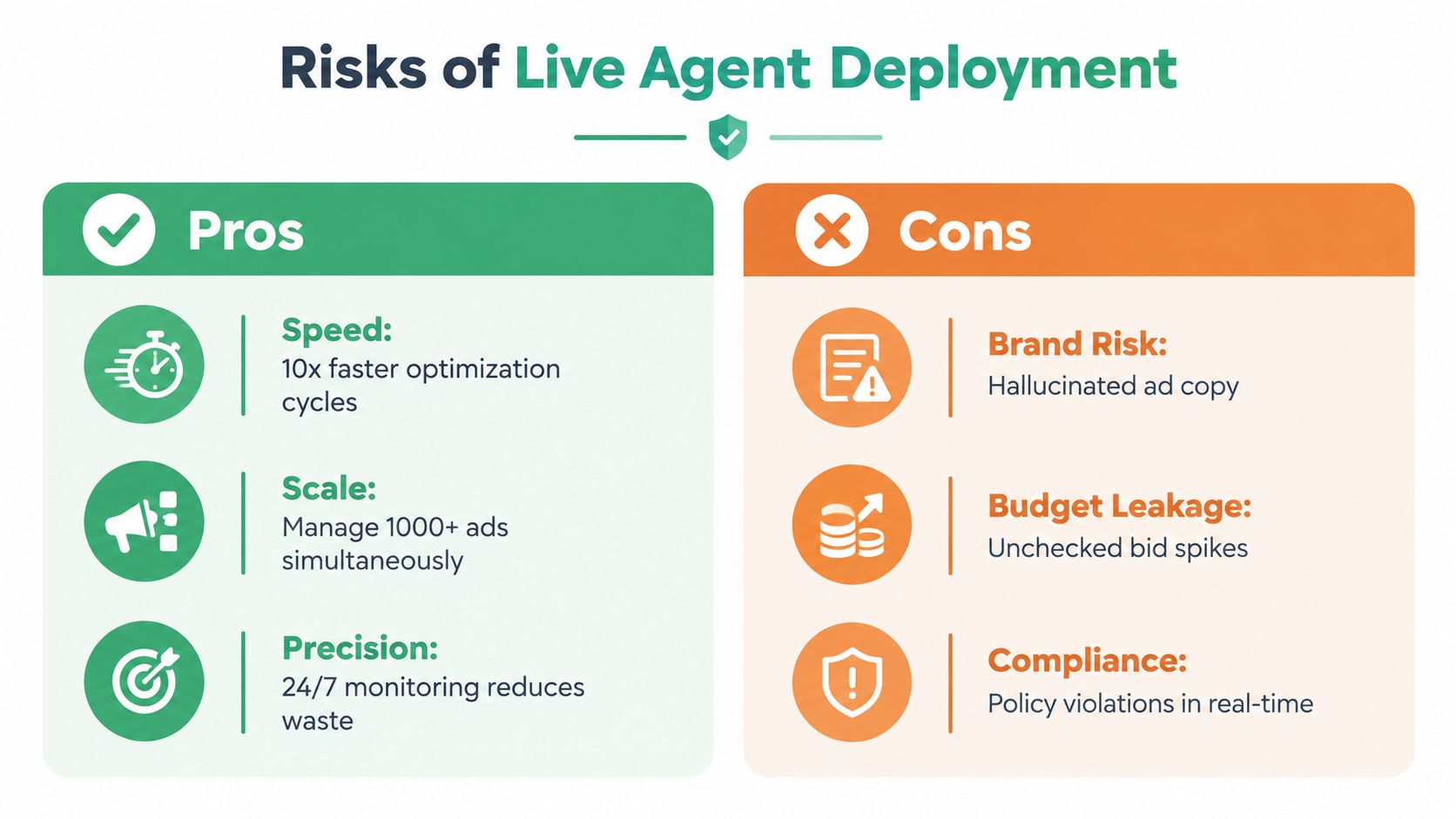
Write access turns an AI experiment into an operational risk. A recommendation can be wrong and remain harmless in a document. A wrong budget change, campaign pause, or keyword edit can affect delivery before anyone notices.
The failure modes are familiar to anyone who has managed accounts through volatile periods:
- Stale context: The agent acts on an export that no longer reflects the account's learning phase, tracking configuration, or active promotions.
- Overreaction: A short-lived anomaly causes the system to pause a valuable ad group or suppress a query that needs more context.
- Broad permissions: One connector allows changes across accounts, campaigns, budgets, audiences, and creative when the initial use case only required diagnostic reads.
- Missing history: Performance drops, but nobody can reconstruct which agent changed what, using which data, and under whose approval.
- Unclear recovery: The team can identify the bad action but has no reliable one-step method to restore the previous state.
Independent benchmarking supports caution. Zapier's AutomationBench reports a top marketing automation score of 50.0%, with other frontier models clustered around 48% (Zapier's AutomationBench results). In a multi-tool environment, that means even leading systems complete only about half of end-to-end marketing automations correctly.
That result doesn't make agents useless. It defines the architecture they need. You can safely use a system with imperfect execution when it operates inside narrow permissions, presents explicit changes, requires approval for material actions, and preserves a reversible record.
The Google Ads MCP safety guidance is relevant here because permissions and reversibility should be designed before the first live write. Governance isn't a brake on performance. It's what lets a team run more frequent optimization cycles without asking one person to watch every platform action manually.
Governance and Approval Patterns That Work
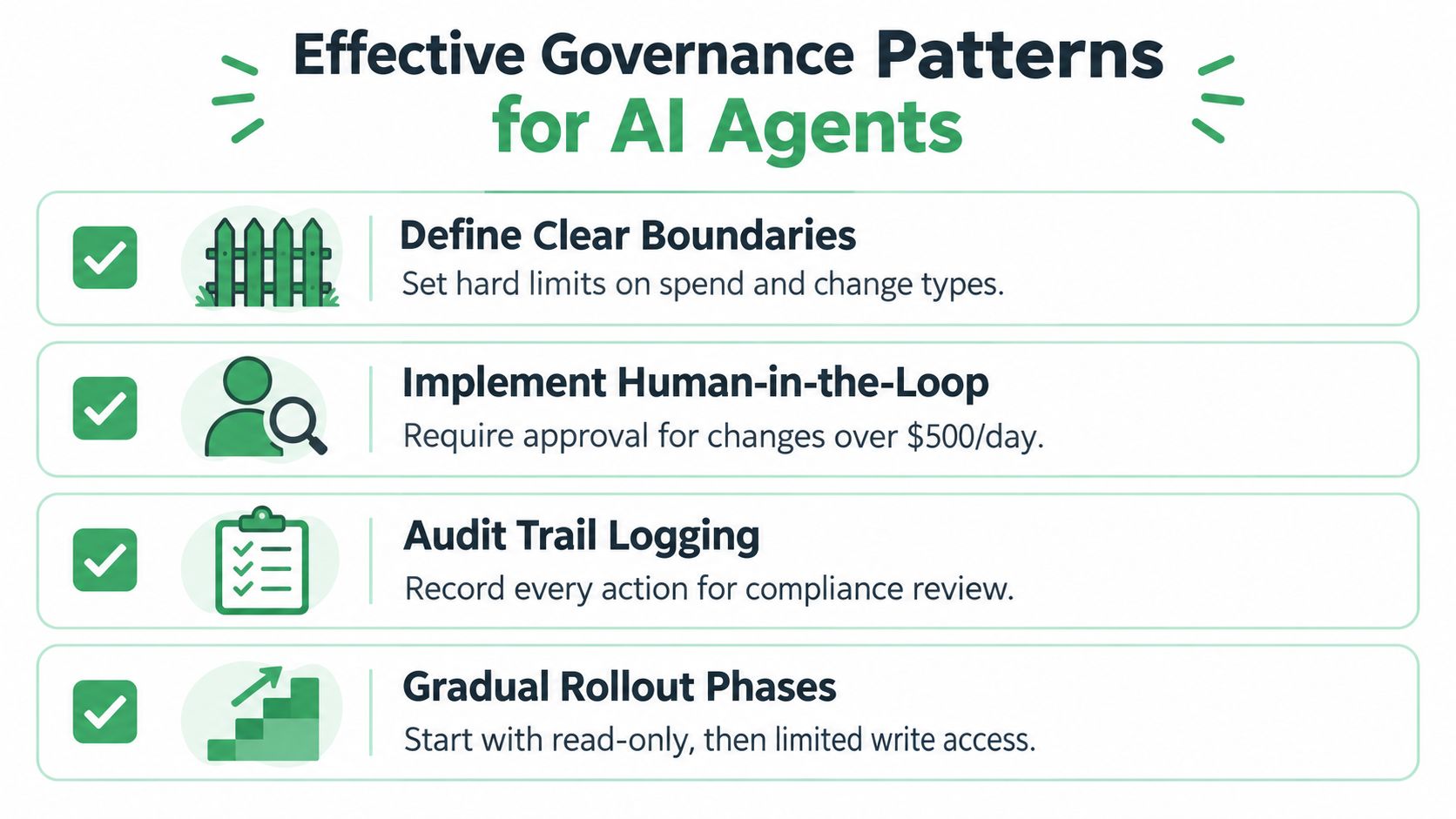
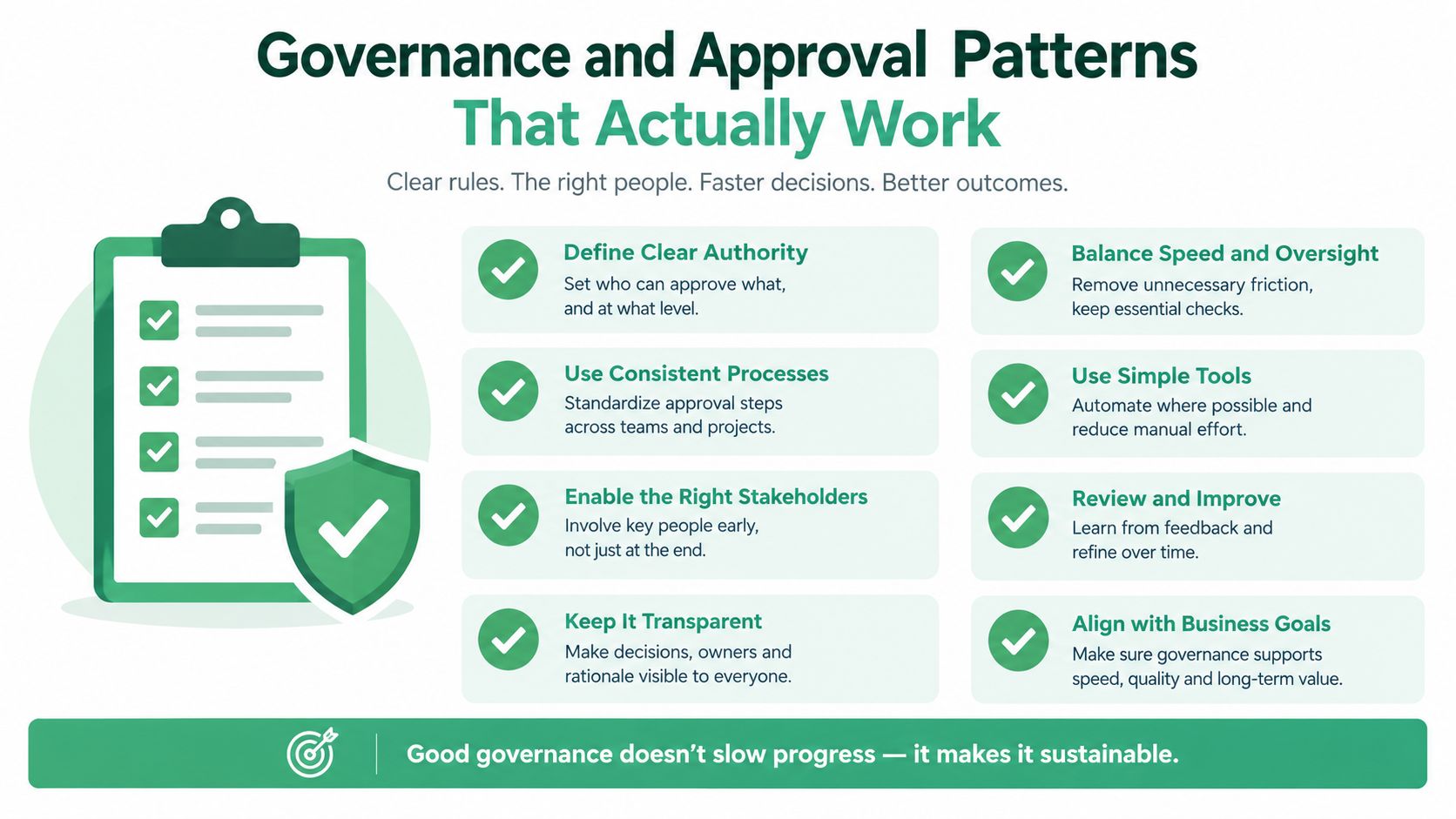
A safe agentic workflow begins with a firm control: the agent must earn write access through evidence. It reads the live account, prepares a proposed change, and makes the approval decision explicit. This governance layer, rather than the model alone, determines whether optimization can run at useful speed without losing accountability.
Read before write
An agent should never base an edit on a cached spreadsheet when the platform can provide current data. Before drafting a change, it retrieves campaign status, budget, spend, relevant conversion signals, and conditions that could invalidate the recommendation.
That check prevents a routine operational error: treating yesterday's account state as today's truth. It also defines the evidence window for the approval record, so a reviewer knows which account state supported the recommendation.
Show an explicit diff
A recommendation should be a before-and-after comparison, not persuasive prose. For a budget change, show the current amount, proposed amount, campaign, reason, evidence, and limits. For a keyword action, show the term, match type, affected campaign, and intended outcome.
The diff gives the approver a concrete object to inspect. It also exposes consequential details that a broad instruction can hide, such as an unintended campaign scope or a change larger than the account's agreed tolerance.
Put writes behind named approval gates
Diagnostic reads and reporting can often run autonomously. Changes to budgets, keyword structure, campaign status, targeting, or creative should enter a queue with a named approver.
“Human approval required” is too vague for a live account. The gate should identify the responsible person or role, define the permitted scope, and specify escalation rules for actions that exceed the agreed risk tolerance. Low-risk recommendations can move quickly, while material writes receive deliberate review.
Log the action and make undo simple
Each approved change needs a record of the requester, evidence used, proposed diff, approver, timestamp, execution result, and restoration data. One-call undo matters because investigations often happen under pressure. A recovery process that requires someone to rebuild the previous state manually will not be used consistently.
Teams extending these controls beyond advertising can build an AI governance policy covering data access, roles, retention, escalation, and incident response.
A shared connector applies these controls across platforms. For example, a Meta Ads MCP integration can support live reads and approval-gated operations without forcing the team to design a separate governance process for every platform.
How MCP Connectors Enable Safe Agentic Workflows
Model Context Protocol, or MCP, gives an AI client a standardized way to connect with external tools and data. Instead of building a separate custom integration for every combination of model, advertising platform, analytics system, and CRM, a team can expose supported capabilities through a common interface.
That matters because agentic marketing depends on context. A Google Ads agent needs current search terms and campaign state. A growth diagnostic may need Search Console queries, GA4 conversions, and CRM pipeline stages. The agent becomes useful when it can retrieve those signals in one workflow rather than asking a marketer to copy data between dashboards.
The connector is part of the control plane
An MCP connector shouldn't be treated as a pipe that gives an agent unrestricted access. It should define what the agent can read, what it can propose, what it can write, and what evidence must appear before a write is allowed.
A practical session might look like this:
- The marketer asks for search-term waste in a selected account.
- The agent reads current data from Google Ads.
- It identifies candidate negatives and ranks them by spend at risk.
- The connector returns a structured diff.
- The marketer approves selected items.
- The connector executes only those items and records the result.
- The agent can retrieve the change history if performance later shifts.
That same sequence can extend across paid media, analytics, and CRM, provided each system exposes appropriate permissions and the organization agrees on ownership.
Hosted access reduces setup friction
Teams can build and operate connectors internally, but smaller marketing operations often need a hosted layer with OAuth sign-in, managed updates, and consistent policy enforcement. The important question isn't whether the connector is technically impressive. It's whether it keeps credentials controlled, limits actions clearly, and preserves an audit trail across the AI clients the team uses.
MCP also applies beyond advertising. Teams researching a web scraping MCP server are solving a related context problem, connecting agents to external information through a defined tool interface. The marketing-specific difference is that advertising connectors must handle not only retrieval but also commercially consequential writes, which makes approval and undo central design requirements.
Ownership, Accountability, and Measuring Agentic Marketing Performance
The hardest question isn't whether an agent can change a campaign. It's who answers for the result after it does.
A 2026 study of U.S. enterprises found that 40% believe the Chief AI Officer should own agentic marketing strategy and execution, while those leaders also named data governance and data hygiene as major blockers (the enterprise ownership research reported by Business Wire). That combination exposes the problem. Organizations may assign strategic ownership to an AI leader while the data, media permissions, and commercial outcomes remain distributed across marketing operations, performance teams, sales, and finance.
Give every workflow a human owner
Each agent should have a named owner for the platform or account it touches. That owner isn't expected to approve every diagnostic read, but they should control the workflow's scope, escalation rules, and success criteria.
A practical accountability map includes:
- Platform owner: Responsible for account permissions, campaign structure, and operational safety.
- Data owner: Responsible for conversion definitions, CRM stages, data quality, and reporting integrity.
- Commercial owner: Responsible for pipeline or revenue outcomes, not just media efficiency.
- AI governance owner: Responsible for policy, logging, incident review, and cross-team standards.
Approval thresholds should point to a specific role. “Someone from marketing” is not accountability. The approver needs enough context and authority to accept the business risk.
Measure decisions, not just channel outcomes
Agentic systems act across paid, organic, analytics, and CRM environments. Last-touch reporting won't explain which agent recommendation influenced a budget shift, which human changed it, or whether the underlying conversion data was reliable.
Teams should preserve session-level records that connect:
- the objective given to the agent,
- the data and tools it accessed,
- the diagnosis it produced,
- the proposed diff,
- the human approval or rejection,
- the executed action,
- and the downstream business result.
That record lets the team compare agent-assisted decisions with human-only decisions without pretending every performance change came from one action. It also makes failure analysis possible. If an agent repeatedly recommends changes during unreliable tracking periods, the organization can correct the workflow rather than blaming the media buyer for an opaque system.
Accountability principle: The agent may perform the action, but the organization must assign a human owner for the permission, the decision boundary, and the outcome.
Agentic AI marketing will amplify strong operating teams and expose weak ones. Clean data, narrow permissions, explicit approvals, and reversible actions create the conditions for speed. Without them, autonomy makes errors travel faster.
NotFair connects AI agents to live Google Ads, Meta Ads, analytics, and CRM data with read-first diagnosis, explicit diffs, approval-gated writes, audit logs, and one-call undo. Visit NotFair to evaluate a safer operating layer for agentic campaign management and start with a workflow your team can review and reverse.